What is the Feed Testing Market Size and Growth Rate?
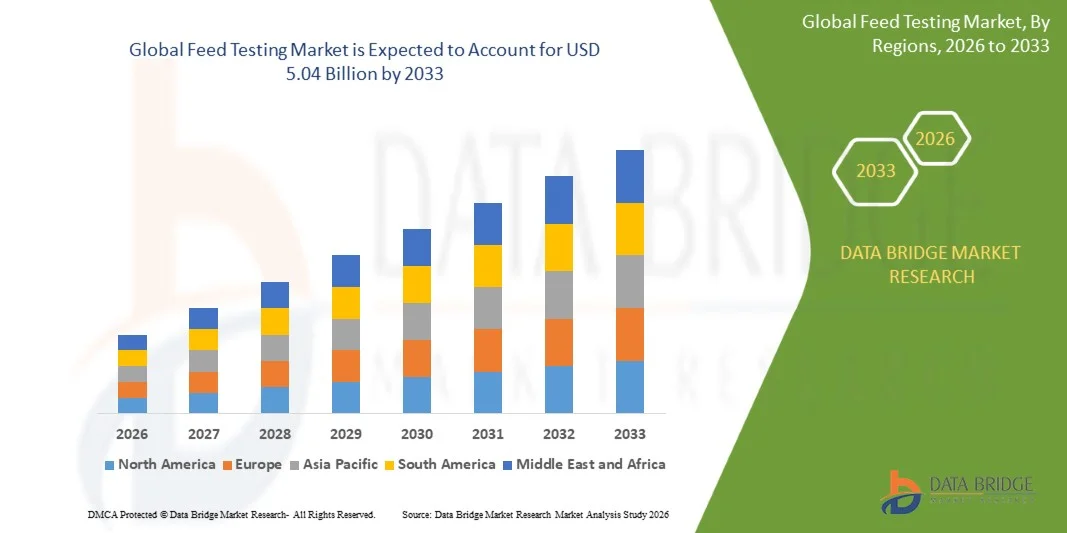
- As per Data Bridge Market Research analysis, the feed testing market was valued at USD 3.29 billion in 2025 and is projected to reach USD 5.04 billion by 2033, growing at a CAGR of 5.50% from 2026 to 2033.
- The market is experiencing steady growth driven by increasing emphasis on animal feed safety, stringent regulatory requirements for feed quality, and rising demand for contaminant-free livestock feed. Growing concerns over mycotoxins, pathogens, pesticide residues, and nutritional accuracy are encouraging feed manufacturers to adopt comprehensive testing services.
- Increasing commercial livestock production, expanding global trade of animal feed, and advancements in rapid analytical technologies are further supporting market expansion. In addition, greater awareness of food safety, traceability standards, and quality assurance across the livestock value chain is expected to accelerate demand for feed testing throughout the forecast period.
Market Size & Forecast
- Market Value (2025): USD 3.29 Billion
- Expected Market Value (2033): USD 5.04 Billion
- Forecast CAGR (2026–2033): 5.50%
- Leading Region in 2025: North America
- Fastest Growing Region: Asia-Pacific
What are the Major Takeaways of the Feed Testing Market?
- North America dominated the feed testing market with the largest revenue share in 2025, supported by stringent feed safety regulations, well-established laboratory infrastructure, and the presence of major testing service providers across the U.S. and Canada.
- The Asia-Pacific feed testing market is expected to witness the fastest growth during the forecast period from 2026 to 2033, primarily driven by expanding livestock production, increasing commercial feed manufacturing, and strengthening feed safety regulations across countries such as China, India, Japan, Australia, and Southeast Asia.
- The microbiological testing segment held the largest market revenue share in 2025, driven by increasing concerns over bacterial contamination in animal feed, stringent regulatory standards for feed safety, and the growing need to minimize livestock health risks and foodborne disease outbreaks.
- The nutritional testing segment is expected to witness the fastest growth during the forecast period from 2026 to 2033. Growth is supported by increasing demand for precision animal nutrition, rising adoption of scientifically balanced feed formulations, and stricter quality standards for nutritional composition.
- The animal feed segment held the largest market revenue share in 2025, driven by its high production volume, stringent feed safety regulations, and increasing demand for routine testing to detect pathogens, contaminants, and nutritional composition. The widespread testing of compound feed for poultry, cattle, swine, and aquaculture has further strengthened the dominance of this segment.
- The pet food segment is expected to witness the fastest growth during the forecast period from 2026 to 2033. Growth is supported by increasing pet ownership, rising demand for premium and specialized pet nutrition, and stricter quality standards for pet food safety.
Report Scope and Feed Testing Market Segmentation
|
Attributes |
Feed Testing Key Market Insights |
|
Segments Covered |
|
|
Countries Covered |
North America
Europe
Asia-Pacific
Middle East and Africa
South America
|
|
Key Market Players |
|
|
Market Opportunities |
|
|
Value Added Data Infosets |
In addition to the insights on market scenarios such as market value, growth rate, segmentation, geographical coverage, and major players, the market reports curated by the Data Bridge Market Research also include import export analysis, production capacity overview, production consumption analysis, price trend analysis, climate change scenario, supply chain analysis, value chain analysis, raw material/consumables overview, vendor selection criteria, PESTLE Analysis, Porter Analysis, and regulatory framework. |
What is the Key Trend in the Feed Testing Market?
- Livestock producers and feed advisors are increasingly moving away from sending forage samples to centralized laboratories and waiting days for results, instead seeking real-time, on-farm nutritional data that allows them to make immediate decisions about silage production and feed rations.
- The key trend shaping the market is testing service providers partnering with spectroscopy technology developers to bring portable, handheld near-infrared (NIR) analysis directly to the farm, shifting feed testing from a purely lab-based service model toward a hybrid approach that combines in-laboratory precision with instant, on-site nutritional insights. This reflects a broader shift toward decentralized, real-time diagnostics across the agricultural testing industry.
- For Instance, in July 2025, Eurofins Agro Testing and trinamiX GmbH, a subsidiary of BASF, announced the launch of their first jointly developed on-farm nutritional analysis applications for fresh maize, maize silage, corn cob mix, grass and clover silage, and haylage. The solutions run on the mobile NIR spectrometer trinamiX PAL Two, enabling farmers and feed advisors to receive real-time forage information in any location, with the companies stating the data can be used to improve forage management and optimize feed formulations, leading to healthier animals, improved productivity, and reduced environmental impact. The launch built on the companies' original collaboration announced in November 2024 at EuroTier, which combined trinamiX's handheld spectrometer with Eurofins Agro Testing's forage-analysis applications.
- As testing providers continue partnering with spectroscopy technology developers to expand mobile, real-time forage and feed analysis capabilities, on-farm nutritional testing is expected to remain a defining trend reshaping how livestock producers manage feed quality and animal health decisions.
What are the Key Drivers of the Feed Testing Market?
- Rising mycotoxin contamination rates across major feed-producing regions continue to expose livestock to compounding health and productivity risks, keeping mycotoxin testing and monitoring a persistent priority for feed manufacturers, nutritionists, and livestock producers worldwide.
- A key driver of the feed testing market is the consistently high and, in some cases, rising prevalence of mycotoxin contamination detected in global feed ingredient surveys, which reinforces the necessity of routine testing to manage livestock health risks and prevent compounding biological stress from co-occurring toxins. As global feed and nutrition companies publish annual survey data showing persistent or worsening contamination trends, feed manufacturers and producers face continued pressure to invest in regular testing and risk-management programs.
- For Instance, February 2026 report by Bovine Vet Online, 86% of North American feed ingredient samples tested above the risk threshold for mycotoxins in 2025. Ursula Hofstetter, head of mycotoxin risk management at dsm-firmenich, said in a press release that the 2025 results show a continued mycotoxin challenge, with contamination rates rising for both aflatoxins and zearalenone and average levels increasing across all major mycotoxins, indicating that livestock may face stacked biological stress from multiple co-occurring toxins.
- As global mycotoxin contamination trends continue to rise or hold at elevated levels across key feed-producing regions, sustained demand for routine mycotoxin monitoring and risk-management testing is expected to remain a key driver of growth in the global feed testing market.
Which Factors are Challenging the Feed Testing Market?
- Rising operational costs at diagnostic and feed testing laboratories are forcing testing providers to raise fees to maintain service quality and turnaround times, creating a cost burden that gets passed down to feed manufacturers, veterinarians, and livestock producers who depend on routine testing.
- The central challenge weighing on the market is that laboratory operating costs, including staffing, equipment maintenance, and consumables, continue to climb faster than testing volumes can offset, forcing accredited testing centers to periodically raise fees across their service menus. This creates affordability pressure for smaller feed manufacturers, veterinary clinics, and livestock producers who rely on frequent, routine testing but have less capacity to absorb rising costs than large, vertically integrated feed companies.
- For instance, according to the Alltech U.S. Harvest Analysis 2025 Report, 99% of U.S. corn samples contained two or more mycotoxins, highlighting the growing complexity of feed contamination and reinforcing the need for advanced multi-mycotoxin testing and routine feed safety monitoring across the livestock industry.
- Until diagnostic and feed testing laboratories can offset rising operational costs through efficiency gains rather than repeated fee increases, cost pressure is expected to remain a key challenge limiting affordable, routine access to feed testing services, particularly for smaller producers and manufacturers.
How is the Feed Testing Market Segmented?
The feed testing market is segmented on the basis of test type, sample type, technology, and livestock.
- By Test Types
On the basis of test type, the feed testing market is segmented into microbiological testing, nutritional testing, chemical testing, and contaminant testing. The microbiological testing segment held the largest market revenue share in 2025, driven by increasing concerns over bacterial contamination in animal feed, stringent regulatory standards for feed safety, and the growing need to minimize livestock health risks and foodborne disease outbreaks. The widespread testing of feed ingredients and finished feed products for pathogens such as Salmonella, E. coli, and Listeria has further strengthened the dominance of this segment.
The nutritional testing segment is expected to witness the fastest growth during the forecast period from 2026 to 2033. Growth is supported by increasing demand for precision animal nutrition, rising adoption of scientifically balanced feed formulations, and stricter quality standards for nutritional composition. The expanding livestock industry, growing focus on feed efficiency, and increasing demand for high-quality animal feed are further expected to accelerate the adoption of nutritional testing services during the forecast period.
- By Sample Type
On the basis of sample type, the feed testing market is segmented into animal feed, pet food, ingredients, and raw materials. The animal feed segment held the largest market revenue share in 2025, driven by its high production volume, stringent feed safety regulations, and increasing demand for routine testing to detect pathogens, contaminants, and nutritional composition. The widespread testing of compound feed for poultry, cattle, swine, and aquaculture has further strengthened the dominance of this segment.
The pet food segment is expected to witness the fastest growth during the forecast period from 2026 to 2033. Growth is supported by increasing pet ownership, rising demand for premium and specialized pet nutrition, and stricter quality standards for pet food safety. The growing focus on ingredient quality, contaminant detection, and nutritional accuracy is further expected to accelerate the adoption of feed testing services in the pet food segment during the forecast period.
- By Technology
On the basis of technology, the feed testing market is segmented into PCR technology, mass spectrometry, chromatography, and immunoassays. The PCR technology segment held the largest market revenue share in 2025, driven by its high accuracy, rapid turnaround time, and widespread adoption for detecting pathogens such as Salmonella and E. coli. The increasing emphasis on feed safety, regulatory compliance, and early detection of microbial contamination has further strengthened the dominance of this segment.
The mass spectrometry segment is expected to witness the fastest growth during the forecast period from 2026 to 2033. Growth is supported by increasing demand for highly sensitive and precise detection of mycotoxins, pesticide residues, veterinary drug residues, and other contaminants. The growing adoption of advanced analytical technologies, expanding food safety regulations, and increasing need for comprehensive multi-residue analysis are further expected to accelerate the adoption of mass spectrometry in feed testing during the forecast period.
- By Livestock
On the basis of livestock, the feed testing market is segmented into poultry, swine, pets, equine, cattle, and aquatic animals. The poultry segment held the largest market revenue share in 2025, driven by the large-scale commercial production of broilers and layers, increasing demand for high-quality animal protein, and stringent feed safety regulations. Feed testing is widely utilized in the poultry industry to ensure nutritional consistency, detect contaminants, monitor mycotoxin levels, and improve feed conversion efficiency, supporting segment dominance across major poultry-producing regions.
The aquatic animals segment is projected to register the fastest growth at a CAGR from 2026 to 2033, driven by the rapid expansion of aquaculture production, growing global seafood consumption, and increasing focus on feed quality and sustainability. Rising adoption of specialized aquafeed formulations, coupled with stricter regulatory standards for aquatic animal health and food safety, is accelerating demand for comprehensive feed testing services across the aquaculture industry.
Which Region Holds the Largest Share of the Feed Testing Market?
- North America dominated the feed testing market with the largest revenue share of 40.5% in 2025, supported by stringent feed safety regulations, well-established laboratory infrastructure, and the presence of major testing service providers across the U.S. and Canada. The region's large commercial livestock industry and growing demand for high-quality, contaminant-free animal feed continue to drive routine testing for mycotoxins, pathogens, pesticide residues, and nutritional composition.
- The region also benefits from increasing adoption of advanced analytical technologies, strong regulatory oversight by food safety authorities, and rising investments in quality assurance programs. Growing exports of animal feed products and increasing focus on traceability and livestock health further strengthen North America's leading position in the global feed testing market.
U.S. Feed Testing Market Insight
The U.S. dominated the feed testing market with the largest revenue share in 2025 due to stringent feed safety regulations, increasing commercial livestock production, and rising demand for high-quality animal feed. Feed manufacturers are increasingly adopting testing services to detect mycotoxins, pathogens, pesticide residues, and nutritional composition, ensuring compliance with regulatory standards and improving livestock health. In addition, advancements in analytical testing technologies, growing emphasis on food safety and traceability, and increasing exports of animal feed products are further driving market expansion.
Asia-Pacific Feed Testing Market Insight
The Asia-Pacific feed testing market is expected to witness the fastest growth during the forecast period from 2026 to 2033, primarily driven by expanding livestock production, increasing commercial feed manufacturing, and strengthening feed safety regulations across countries such as China, India, Japan, Australia, and Southeast Asia. Rising awareness of animal health, food safety, and export quality standards is encouraging feed manufacturers to adopt comprehensive testing services. In addition, increasing investments in modern livestock farming, rapid growth in aquaculture and poultry industries, and expanding adoption of advanced analytical testing technologies are supporting market growth. Government initiatives to improve feed quality and the rising demand for safe, contaminant-free animal feed are expected to further strengthen Asia-Pacific's position as the fastest-growing regional market during the forecast period.
Japan Feed Testing Market Insight
The Japan feed testing market is expected to witness the fastest growth during the forecast period from 2026 to 2033 due to stringent feed safety regulations, increasing demand for high-quality animal feed, and growing focus on livestock health and food safety. Feed manufacturers are increasingly adopting advanced testing solutions to detect mycotoxins, pathogens, chemical residues, and nutritional composition, ensuring compliance with regulatory standards. Furthermore, technological advancements in analytical testing and the country's emphasis on quality assurance and traceability are supporting continued market expansion.
China Feed Testing Market Insight
The China feed testing market is expected to witness the fastest growth during the forecast period from 2026 to 2033, driven by its large livestock and aquaculture industries, expanding commercial feed production, and strengthening feed safety regulations. Rising demand for safe and contaminant-free animal feed, increasing investments in modern testing laboratories, and growing exports of livestock products are accelerating the adoption of feed testing services across the country. In addition, government initiatives promoting food safety, quality assurance, and advanced analytical technologies are positioning China as one of the fastest-growing feed testing markets globally.
Europe Feed Testing Market Insight
The Europe feed testing market is expected to witness the fastest growth during the forecast period from 2026 to 2033, driven by stringent feed safety regulations, increasing emphasis on animal health, and strong quality standards across the livestock industry. Rising demand for contaminant-free feed, growing adoption of advanced analytical testing technologies, and expanding commercial feed production are supporting market growth. Furthermore, increasing focus on traceability, food safety, and compliance with European regulatory frameworks continues to strengthen the demand for feed testing services across the region.
Germany Feed Testing Market Insight
The Germany feed testing market is expected to witness the fastest growth during the forecast period from 2026 to 2033 due to the country's well-established livestock sector, advanced laboratory infrastructure, and strict feed quality regulations. Increasing demand for safe animal feed, growing investments in analytical testing technologies, and rising emphasis on detecting mycotoxins, pathogens, and chemical residues are contributing significantly to market growth. In addition, continuous research and innovation in feed quality assurance are supporting the adoption of advanced feed testing solutions.
U.K. Feed Testing Market Insight
The U.K. feed testing market is expected to witness the fastest growth during the forecast period from 2026 to 2033 owing to increasing emphasis on feed safety, livestock health, and regulatory compliance. Rising adoption of advanced laboratory testing methods, growing demand for premium animal feed, and increasing focus on contaminant detection and nutritional analysis are supporting continued market expansion. Moreover, ongoing investments in food safety infrastructure and quality assurance programs are further driving the demand for feed testing services across the country.
Which are the Top Companies in Feed Testing Market?
The feed testing industry is primarily led by well-established companies, including:
- SGS Société Générale de Surveillance SA (Switzerland)
- Eurofins Scientific (Luxembourg)
- Intertek Group plc (U.K.)
- Bureau Veritas (France)
- ALS Limited (Australia)
- Mérieux NutriSciences Corporation (U.S.)
- Neogen Corporation (U.S.)
- Romer Labs Division Holding GmbH (Austria)
- AsureQuality Limited (New Zealand)
- TÜV SÜD AG (Germany)
- TÜV Rheinland AG (Germany)
- NSF International (U.S.)
- Microbac Laboratories, Inc. (U.S.)
- RJ Hill Laboratories Limited (New Zealand)
What are Latest Developments in Feed Testing Market?
- In July 2024, Eurofins Food & Water Testing United Kingdom acquired Salamon & Seaber, a testing services company specializing in animal feed analysis. The acquisition strengthened Eurofins' feed testing capabilities in the U.K. and expanded its portfolio of analytical services for the feed industry.
- In July 2024, Eurofins Scientific SE acquired Labormar, a laboratory testing service provider in Colombia with expertise in animal feed testing. This acquisition expanded Eurofins' laboratory network in Latin America and enhanced its feed safety and quality testing capabilities across the region.
- In October 2023, SGS SA opened a new ISO/IEC 17025-accredited microbiological testing laboratory in Centurion, South Africa. The facility provides food, animal feed, water, and hygiene testing services, strengthening SGS's feed safety testing capabilities and regional laboratory network.

- Interactive Data Analysis Dashboard
- Company Analysis Dashboard for high growth potential opportunities
- Research Analyst Access for customization & queries
- Competitor Analysis with Interactive dashboard
- Latest News, Updates & Trend analysis
- Harness the Power of Benchmark Analysis for Comprehensive Competitor Tracking
Data collection and base year analysis are done using data collection modules with large sample sizes. The stage includes obtaining market information or related data through various sources and strategies. It includes examining and planning all the data acquired from the past in advance. It likewise envelops the examination of information inconsistencies seen across different information sources. The market data is analysed and estimated using market statistical and coherent models. Also, market share analysis and key trend analysis are the major success factors in the market report. To know more, please request an analyst call or drop down your inquiry.
The key research methodology used by DBMR research team is data triangulation which involves data mining, analysis of the impact of data variables on the market and primary (industry expert) validation. Data models include Vendor Positioning Grid, Market Time Line Analysis, Market Overview and Guide, Company Positioning Grid, Patent Analysis, Pricing Analysis, Company Market Share Analysis, Standards of Measurement, Global versus Regional and Vendor Share Analysis. To know more about the research methodology, drop in an inquiry to speak to our industry experts.
Data Bridge Market Research is a leader in advanced formative research. We take pride in servicing our existing and new customers with data and analysis that match and suits their goal. The report can be customized to include price trend analysis of target brands understanding the market for additional countries (ask for the list of countries), clinical trial results data, literature review, refurbished market and product base analysis. Market analysis of target competitors can be analyzed from technology-based analysis to market portfolio strategies. We can add as many competitors that you require data about in the format and data style you are looking for. Our team of analysts can also provide you data in crude raw excel files pivot tables (Fact book) or can assist you in creating presentations from the data sets available in the report.