


Fermented Feed Ingredients Market Size
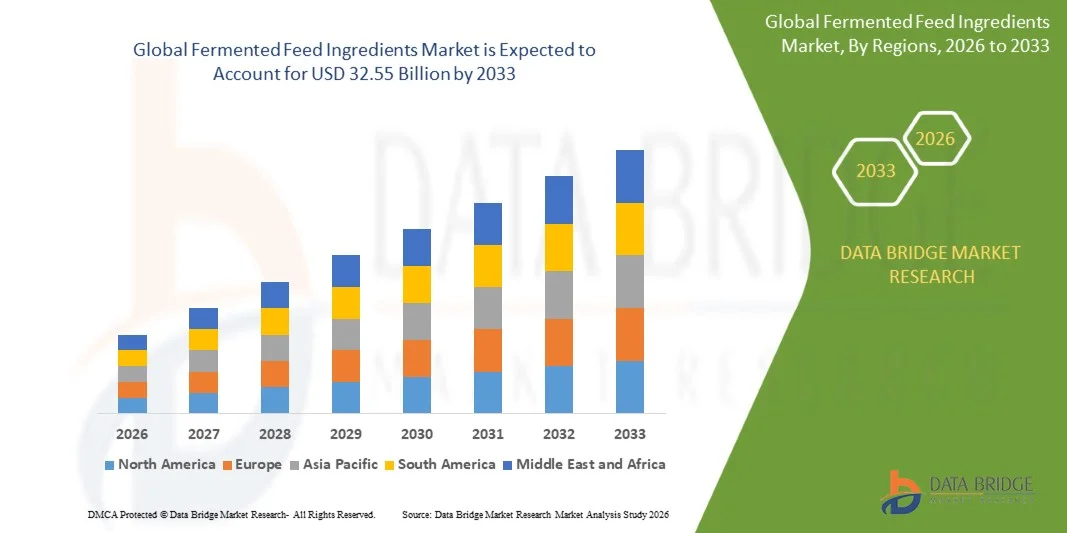
- The global fermented feed ingredients market size was valued at USD 21.17 billion in 2025 and is expected to reach USD 32.55 billion by 2033, at a CAGR of 9.20% during the forecast period
- The market growth is largely fuelled by the increasing demand for high-quality animal nutrition products that improve feed digestibility, gut health, and livestock productivity
- Rising awareness regarding sustainable livestock farming practices and the growing restriction on antibiotic growth promoters are further accelerating the adoption of fermented feed ingredients globally
Fermented Feed Ingredients Market Analysis
- The market is witnessing strong growth due to increasing focus on improving animal health, feed efficiency, and nutritional absorption across poultry, swine, ruminant, and aquaculture sectors
- Fermented feed ingredients are gaining popularity because they enhance nutrient availability, support beneficial gut microbiota, and reduce harmful pathogens in animal feed formulations
- North America dominated the fermented feed ingredients market with the largest revenue share in 2025, driven by increasing demand for high-quality animal nutrition solutions, rising adoption of antibiotic-free livestock farming practices, and growing awareness regarding animal gut health and feed efficiency
- Asia-Pacific region is expected to witness the highest growth rate in the global fermented feed ingredients market, driven by increasing meat consumption, expanding commercial livestock farming activities, growing investments in feed manufacturing infrastructure, and rising adoption of advanced animal nutrition technologies across emerging economies such as China, India, and Japan
- The probiotics and prebiotics segment held the largest market revenue share in 2025 driven by increasing demand for gut health improvement, enhanced nutrient absorption, and antibiotic-free animal nutrition solutions. Probiotics and prebiotics are widely used in livestock feed formulations to improve digestion, strengthen immunity, and support overall animal performance, making them highly preferred among commercial feed manufacturers and livestock producers
Report Scope and Fermented Feed Ingredients Market Segmentation
|
Attributes |
Fermented Feed Ingredients Key Market Insights |
|
Segments Covered |
|
|
Countries Covered |
North America
Europe
Asia-Pacific
Middle East and Africa
South America
|
|
Key Market Players |
• Balchem Inc. (U.S.) |
|
Market Opportunities |
• Increasing Adoption Of Sustainable And Antibiotic-Free Animal Feed Solutions |
|
Value Added Data Infosets |
In addition to the insights on market scenarios such as market value, growth rate, segmentation, geographical coverage, and major players, the market reports curated by the Data Bridge Market Research also include in-depth expert analysis, pricing analysis, brand share analysis, consumer survey, demography analysis, supply chain analysis, value chain analysis, raw material/consumables overview, vendor selection criteria, PESTLE Analysis, Porter Analysis, and regulatory framework. |
Fermented Feed Ingredients Market Trends
“Increasing Demand for Sustainable and Antibiotic-Free Animal Nutrition Solutions”
• The growing focus on sustainable livestock farming and improved animal health is significantly shaping the fermented feed ingredients market, as livestock producers increasingly prefer feed solutions that enhance digestion, nutrient absorption, and overall animal performance. Fermented feed ingredients are gaining traction due to their ability to improve gut health, reduce harmful pathogens, and enhance feed efficiency without relying on antibiotic growth promoters. This trend is strengthening their adoption across poultry, swine, ruminant, and aquaculture industries, encouraging manufacturers to develop innovative and functional feed formulations
• Rising awareness regarding animal nutrition, food safety, and sustainable meat production has accelerated the demand for fermented feed ingredients in commercial livestock farming. Farmers and feed manufacturers are actively seeking nutritional solutions that improve immunity, growth performance, and feed conversion ratios while reducing environmental impact. This has also encouraged collaborations between feed ingredient suppliers, biotechnology companies, and livestock producers to improve feed quality and productivity
• Sustainability and antibiotic-free livestock production trends are influencing purchasing decisions, with feed manufacturers emphasizing natural fermentation processes, traceable sourcing, and environmentally responsible production practices. These factors are helping companies differentiate products in a competitive market and build long-term trust among livestock producers. Manufacturers are also investing in advanced microbial fermentation technologies and marketing strategies to highlight the health and sustainability benefits of fermented feed ingredients
• For instance, in 2024, Cargill in the U.S. and ADM in the U.S. expanded their animal nutrition portfolios by introducing advanced fermented feed ingredient solutions for poultry and swine applications. These launches were introduced in response to increasing demand for sustainable and antibiotic-free feed products, with distribution across commercial feed manufacturers and livestock farms globally. The products were also promoted as solutions for improving gut health, feed efficiency, and livestock productivity, strengthening customer adoption and repeat purchases
• While demand for fermented feed ingredients continues to rise, sustained market expansion depends on continuous R&D, scalable fermentation technologies, and maintaining cost-effective production processes. Manufacturers are also focusing on improving microbial strain performance, supply chain reliability, and product consistency to support broader adoption across global livestock industries
Fermented Feed Ingredients Market Dynamics
Driver
“Growing Adoption of Antibiotic-Free and Nutrient-Enriched Animal Feed”
• Rising demand for antibiotic-free and high-performance animal nutrition solutions is a major driver for the fermented feed ingredients market. Feed manufacturers are increasingly incorporating fermented ingredients into livestock diets to improve nutrient digestibility, gut microbiota balance, and animal immunity while reducing dependence on synthetic additives and antibiotics. This trend is also encouraging research into advanced microbial fermentation technologies and alternative feed ingredients
• Expanding applications in poultry, swine, cattle, aquaculture, and pet food industries are influencing market growth. Fermented feed ingredients help improve feed palatability, nutrient bioavailability, and overall animal performance while supporting healthier livestock production systems. The increasing global demand for meat, dairy, and aquaculture products is further reinforcing the adoption of fermented feed solutions across commercial farming operations
• Animal nutrition companies and feed manufacturers are actively promoting fermented feed ingredient-based formulations through product innovation, strategic partnerships, and sustainable farming initiatives. These efforts are supported by growing consumer preference for safe, high-quality, and naturally produced animal-derived food products. Companies are also collaborating with research institutions and biotechnology firms to enhance product functionality and improve feed efficiency
• For instance, in 2023, DSM-Firmenich in the Netherlands and Alltech in the U.S. reported increased use of fermented feed ingredients in poultry and ruminant nutrition products. This expansion followed growing demand for antibiotic-free animal feed and improved livestock productivity solutions, driving product differentiation and stronger market penetration. Both companies also emphasized sustainability, feed efficiency, and animal welfare in promotional campaigns to strengthen customer confidence and long-term adoption
• Although rising demand for sustainable and nutrient-rich feed solutions supports market growth, wider adoption depends on production cost optimization, ingredient availability, and efficient large-scale fermentation capabilities. Investments in biotechnology, microbial research, and sustainable feed processing infrastructure will be critical for meeting increasing global demand and maintaining competitive advantage
Restraint/Challenge
“High Production Costs and Limited Awareness in Emerging Markets”
• The relatively high production and processing costs associated with fermented feed ingredients compared to conventional feed additives remain a major challenge, limiting adoption among small and medium-scale livestock producers. Advanced fermentation technologies, microbial culture maintenance, and specialized storage requirements contribute to higher operational expenses. In addition, fluctuations in raw material availability can further impact pricing and market accessibility
• Consumer and livestock producer awareness remains uneven, particularly in developing regions where traditional feed solutions continue to dominate the market. Limited understanding of the nutritional and functional benefits of fermented feed ingredients restricts adoption across certain livestock categories. This also slows the pace of innovation and commercial deployment in emerging economies where investment in advanced animal nutrition remains limited
• Supply chain and storage challenges also affect market growth, as fermented feed ingredients often require controlled processing conditions, efficient transportation, and strict quality management systems. Variability in fermentation quality and shorter shelf life of certain products can increase operational complexities and distribution costs. Companies must invest in efficient logistics networks, cold storage systems, and quality assurance technologies to maintain product effectiveness and safety
• For instance, in 2024, feed distributors in Vietnam and Indonesia supplying poultry and aquaculture producers reported slower adoption of fermented feed ingredients due to higher costs and limited awareness regarding long-term nutritional benefits compared to traditional feed additives. Storage and transportation challenges, along with inconsistent availability of advanced feed products, were additional barriers affecting wider market penetration. These factors also encouraged some livestock producers to continue relying on lower-cost conventional feed alternatives
• Overcoming these challenges will require cost-efficient production technologies, expanded distribution networks, and targeted educational initiatives for feed manufacturers and livestock producers. Collaboration with agricultural organizations, feed associations, and biotechnology companies can help unlock the long-term growth potential of the global fermented feed ingredients market. Furthermore, advancements in microbial fermentation processes, sustainable raw material sourcing, and large-scale manufacturing efficiency will be essential for improving affordability and supporting widespread adoption
Fermented Feed Ingredients Market Scope
The market is segmented on the basis of ingredients, livestock, and form.
• By Ingredients
On the basis of ingredients, the fermented feed ingredients market is segmented into amino acids, vitamins and minerals, enzymes, organic acids, probiotics and prebiotics, carotenoids, and others. The probiotics and prebiotics segment held the largest market revenue share in 2025 driven by increasing demand for gut health improvement, enhanced nutrient absorption, and antibiotic-free animal nutrition solutions. Probiotics and prebiotics are widely used in livestock feed formulations to improve digestion, strengthen immunity, and support overall animal performance, making them highly preferred among commercial feed manufacturers and livestock producers.
The enzymes segment is expected to witness the fastest growth rate from 2026 to 2033, driven by their ability to improve feed digestibility, nutrient utilization, and feed conversion efficiency across poultry, swine, and ruminant applications. Enzyme-based fermented feed ingredients are particularly gaining popularity due to increasing focus on cost-efficient feed formulations and sustainable livestock production practices.
• By Livestock
On the basis of livestock, the fermented feed ingredients market is segmented into poultry, swine, ruminant, and others. The poultry segment held the largest market revenue share in 2025 driven by rising global poultry meat consumption, increasing commercial poultry farming activities, and growing focus on improving feed efficiency and bird health. Fermented feed ingredients are extensively used in poultry nutrition to enhance gut health, improve growth performance, and reduce the use of antibiotic growth promoters.
The swine segment is expected to witness the fastest growth rate from 2026 to 2033, driven by increasing demand for high-quality pork products and rising awareness regarding animal health and feed optimization. Fermented feed ingredients are increasingly adopted in swine feed formulations to improve digestion, nutrient absorption, and immunity while supporting sustainable and efficient livestock production systems.
• By Form
On the basis of form, the fermented feed ingredients market is segmented into dry and liquid. The dry segment held the largest market revenue share in 2025 driven by its longer shelf life, ease of storage, and convenient transportation compared to liquid feed products. Dry fermented feed ingredients are widely preferred by feed manufacturers and livestock farms due to their stability, easy mixing capability, and suitability for large-scale commercial feed production.
The liquid segment is expected to witness the fastest growth rate from 2026 to 2033, driven by increasing demand for highly digestible and rapidly absorbable feed solutions in livestock and aquaculture applications. Liquid fermented feed ingredients are gaining traction due to their ability to improve feed palatability, microbial activity, and nutrient availability, making them suitable for advanced animal nutrition programs and intensive farming operations.
Fermented Feed Ingredients Market Regional Analysis
• North America dominated the fermented feed ingredients market with the largest revenue share in 2025, driven by increasing demand for high-quality animal nutrition solutions, rising adoption of antibiotic-free livestock farming practices, and growing awareness regarding animal gut health and feed efficiency
• Livestock producers in the region highly value the nutritional benefits, improved digestibility, and enhanced immunity offered by fermented feed ingredients across poultry, swine, ruminant, and aquaculture applications
• This widespread adoption is further supported by advanced commercial farming infrastructure, strong presence of animal nutrition manufacturers, and increasing investments in sustainable livestock production, establishing fermented feed ingredients as an essential component in modern animal feed formulations
U.S. Fermented Feed Ingredients Market Insight
The U.S. fermented feed ingredients market captured the largest revenue share in 2025 within North America, fueled by the increasing demand for antibiotic-free animal feed and the expanding focus on improving livestock productivity and health. Livestock producers are increasingly prioritizing feed solutions that enhance nutrient absorption, gut microbiota balance, and overall animal performance. The growing adoption of advanced feed technologies, combined with strong demand for sustainable livestock farming practices, further propels the fermented feed ingredients market. Moreover, increasing investments in biotechnology and animal nutrition research are significantly contributing to market expansion across the country.
Europe Fermented Feed Ingredients Market Insight
The Europe fermented feed ingredients market is expected to witness the fastest growth rate from 2026 to 2033, primarily driven by stringent regulations regarding antibiotic usage in animal feed and the increasing focus on sustainable livestock production. Rising consumer demand for high-quality meat and dairy products is encouraging livestock producers to adopt advanced nutritional feed solutions. European manufacturers are also emphasizing environmentally responsible feed production and animal welfare standards. In addition, increasing investments in feed biotechnology and microbial fermentation technologies are supporting market growth across the region.
U.K. Fermented Feed Ingredients Market Insight
The U.K. fermented feed ingredients market is expected to witness the fastest growth rate from 2026 to 2033, driven by increasing awareness regarding livestock health, sustainable farming practices, and feed efficiency optimization. The rising demand for premium-quality meat, dairy, and poultry products is encouraging farmers and feed manufacturers to adopt fermented nutritional ingredients. Furthermore, the country’s strong focus on reducing antibiotic usage in livestock farming and improving animal welfare standards is expected to continue stimulating market growth.
Germany Fermented Feed Ingredients Market Insight
The Germany fermented feed ingredients market is expected to witness the fastest growth rate from 2026 to 2033, fueled by increasing adoption of technologically advanced animal nutrition solutions and rising demand for sustainable feed additives. Germany’s strong livestock farming sector, combined with growing emphasis on feed quality, animal health, and environmental sustainability, is supporting the use of fermented feed ingredients across poultry and ruminant applications. The integration of advanced fermentation technologies and microbial feed solutions is also becoming increasingly prevalent, aligning with the country’s focus on innovation and sustainable agriculture.
Asia-Pacific Fermented Feed Ingredients Market Insight
The Asia-Pacific fermented feed ingredients market is expected to witness the fastest growth rate from 2026 to 2033, driven by increasing meat consumption, rapid expansion of commercial livestock farming, and growing awareness regarding animal nutrition in countries such as China, Japan, and India. The region’s expanding poultry, swine, and aquaculture industries are encouraging the adoption of advanced feed solutions to improve productivity and animal health. Furthermore, government support for sustainable farming practices and increasing investments in feed manufacturing infrastructure are accelerating market growth across Asia-Pacific.
Japan Fermented Feed Ingredients Market Insight
The Japan fermented feed ingredients market is expected to witness the fastest growth rate from 2026 to 2033 due to the country’s strong focus on food safety, livestock productivity, and advanced agricultural technologies. Japanese livestock producers are increasingly adopting fermented feed solutions to improve digestion, nutrient absorption, and animal immunity while supporting sustainable farming practices. The integration of biotechnology and precision livestock farming techniques is also fueling demand for advanced fermented feed ingredients. Moreover, Japan’s emphasis on premium-quality meat and dairy production is further supporting market expansion across the country.
China Fermented Feed Ingredients Market Insight
The China fermented feed ingredients market accounted for the largest market revenue share in Asia Pacific in 2025, attributed to the country’s expanding livestock industry, rising meat consumption, and increasing adoption of advanced feed technologies. China represents one of the largest markets for animal nutrition products, with fermented feed ingredients becoming increasingly popular in poultry, swine, and aquaculture applications. The push toward sustainable livestock farming, coupled with growing awareness regarding animal health and feed efficiency, is significantly supporting market growth. In addition, the presence of large domestic feed manufacturers and expanding commercial farming activities are further propelling the fermented feed ingredients market in China.
Fermented Feed Ingredients Market Share
The Fermented Feed Ingredients industry is primarily led by well-established companies, including:
• Balchem Inc. (U.S.)
• DSM (Netherlands)
• ADM (U.S.)
• HARVEST FUEL INC / SWEETPRO FEEDS (U.S.)
• BASF SE (Germany)
• Evonik Industries AG (Germany)
• AJINOMOTO CO., INC. (Japan)
• Chr. Hansen Holding A/S (Denmark)
• Bluestar Adisseo Co., Ltd. (China)
• Cargill, Incorporated (U.S.)
• Novozymes (Denmark)
• Nutreco (Netherlands)
• NOVUS INTERNATIONAL (U.S.)
• Lonza (Switzerland)
• Kerry Inc. (Ireland)
• Alltech (U.S.)
• AB Vista (U.K.)
• AngelYeast Co., Ltd. (China)
• Kemin Industries, Inc. (U.S.)
• CJ CheilJedang Corp. (South Korea)
• Lallemand Inc. (Canada)
• Fermented Nutrition Corporation (U.S.)

- Interactive Data Analysis Dashboard
- Company Analysis Dashboard for high growth potential opportunities
- Research Analyst Access for customization & queries
- Competitor Analysis with Interactive dashboard
- Latest News, Updates & Trend analysis
- Harness the Power of Benchmark Analysis for Comprehensive Competitor Tracking
Global Fermented Feed Ingredients Market, Supply Chain Analysis and Ecosystem Framework
To support market growth and help clients navigate the impact of geopolitical shifts, DBMR has integrated in-depth supply chain analysis into its Global Fermented Feed Ingredients Market research reports. This addition empowers clients to respond effectively to global changes affecting their industries. The supply chain analysis section includes detailed insights such as Global Fermented Feed Ingredients Market consumption and production by country, price trend analysis, the impact of tariffs and geopolitical developments, and import and export trends by country and HSN code. It also highlights major suppliers with data on production capacity and company profiles, as well as key importers and exporters. In addition to research, DBMR offers specialized supply chain consulting services backed by over a decade of experience, providing solutions like supplier discovery, supplier risk assessment, price trend analysis, impact evaluation of inflation and trade route changes, and comprehensive market trend analysis.
Data collection and base year analysis are done using data collection modules with large sample sizes. The stage includes obtaining market information or related data through various sources and strategies. It includes examining and planning all the data acquired from the past in advance. It likewise envelops the examination of information inconsistencies seen across different information sources. The market data is analysed and estimated using market statistical and coherent models. Also, market share analysis and key trend analysis are the major success factors in the market report. To know more, please request an analyst call or drop down your inquiry.
The key research methodology used by DBMR research team is data triangulation which involves data mining, analysis of the impact of data variables on the market and primary (industry expert) validation. Data models include Vendor Positioning Grid, Market Time Line Analysis, Market Overview and Guide, Company Positioning Grid, Patent Analysis, Pricing Analysis, Company Market Share Analysis, Standards of Measurement, Global versus Regional and Vendor Share Analysis. To know more about the research methodology, drop in an inquiry to speak to our industry experts.
Data Bridge Market Research is a leader in advanced formative research. We take pride in servicing our existing and new customers with data and analysis that match and suits their goal. The report can be customized to include price trend analysis of target brands understanding the market for additional countries (ask for the list of countries), clinical trial results data, literature review, refurbished market and product base analysis. Market analysis of target competitors can be analyzed from technology-based analysis to market portfolio strategies. We can add as many competitors that you require data about in the format and data style you are looking for. Our team of analysts can also provide you data in crude raw excel files pivot tables (Fact book) or can assist you in creating presentations from the data sets available in the report.













