


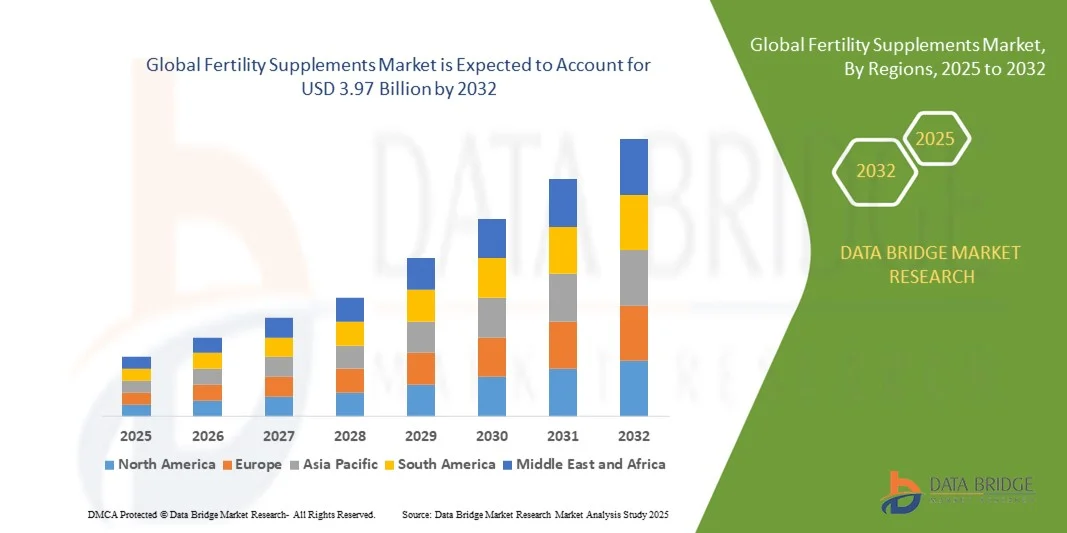
Global Fertility Supplements Market Size
- The global Fertility Supplements Market size was valued at USD 2.26 billion in 2024 and is projected to reach USD 3.97 billion by 2032, growing at a CAGR of 7.33% during the forecast period.
- The market expansion is primarily driven by increasing infertility rates, rising awareness of reproductive health, and growing preference for non-invasive, over-the-counter fertility solutions across both male and female demographics.
- Additionally, lifestyle changes, delayed pregnancies, and growing investments in supplement R&D are fueling product innovation and global availability. These factors collectively enhance market penetration and accelerate the adoption of fertility supplements worldwide.
Global Fertility Supplements Market Analysis
- Fertility supplements, designed to support reproductive health and improve fertility outcomes in both men and women, are becoming increasingly essential in modern wellness and healthcare routines due to rising infertility rates, delayed family planning, and increased health awareness.
- The growing demand for fertility supplements is primarily driven by lifestyle changes, rising incidences of hormonal imbalances, and an increasing inclination toward non-prescription, natural fertility enhancement solutions.
- Asia-Pacific dominated the Global Fertility Supplements Market with the largest revenue share of 36.6% in 2024, attributed to high awareness levels, advanced healthcare infrastructure, and greater accessibility to fertility products, with the U.S. seeing notable growth due to increasing fertility-related concerns and proactive health management.
- North America is expected to be the fastest growing region in the Global Fertility Supplements Market during the forecast period due to increasing urbanization, growing healthcare expenditure, and a rising focus on reproductive health among the younger population.
- The capsules segment dominated the market with the largest revenue share of 39.2% in 2024, driven by their ease of consumption, extended shelf life, and ability to hold complex ingredient blends.
Report Scope and Global Fertility Supplements Market Segmentation
|
Attributes |
Fertility Supplements Key Market Insights |
|
Segments Covered |
|
|
Countries Covered |
North America
Europe
Asia-Pacific
Middle East and Africa
South America
|
|
Key Market Players |
|
|
Market Opportunities |
|
|
Value Added Data Infosets |
In addition to the insights on market scenarios such as market value, growth rate, segmentation, geographical coverage, and major players, the market reports curated by the Data Bridge Market Research also include in-depth expert analysis, pricing analysis, brand share analysis, consumer survey, demography analysis, supply chain analysis, value chain analysis, raw material/consumables overview, vendor selection criteria, PESTLE Analysis, Porter Analysis, and regulatory framework. |
Global Fertility Supplements Market Trends
Personalized Fertility Solutions Through AI and Digital Health Integration
- A significant and accelerating trend in the global Fertility Supplements Market is the increasing integration of artificial intelligence (AI) and digital health platforms to deliver personalized fertility support. This technological evolution is enhancing how consumers track, manage, and optimize their reproductive health, leading to more effective and tailored supplement regimens.
- For instance, AI-powered fertility tracking apps such as Ovia and Glow integrate with wearable devices to monitor ovulation cycles, hormonal changes, and lifestyle factors. These insights can be used to recommend specific fertility supplements based on individual needs, improving outcomes and user satisfaction.
- AI is also enabling deeper analysis of user data, helping identify nutritional deficiencies or hormonal imbalances that may impact fertility. Some platforms offer supplement suggestions in real time, adjusting as new data is collected from connected health devices or user input. This responsive approach ensures that supplement use aligns with changing reproductive health needs.
- The integration of fertility supplements with digital health tools promotes greater adherence and education. Users receive reminders, dosage tracking, and progress monitoring through mobile apps, enhancing the effectiveness of supplementation and fostering long-term engagement with fertility wellness routines.
- This convergence of AI, data analytics, and fertility supplements is shifting the market toward highly personalized solutions, where consumers expect products and guidance tailored to their unique biological profiles. Companies such as Natalist and Conceive are leveraging these technologies to create subscription-based supplement plans informed by individual fertility data and reproductive goals.
- As consumer demand for personalized, tech-driven reproductive health solutions continues to rise, the market is witnessing rapid growth in AI-enabled fertility ecosystems. These platforms combine supplements, tracking tools, and professional guidance, offering a holistic approach to fertility care across global markets.
Global Fertility Supplements Market Dynamics
Driver
Growing Need Due to Rising Infertility Rates and Lifestyle-Driven Health Concerns
- The increasing global prevalence of infertility, driven by lifestyle factors such as poor diet, stress, sedentary behavior, and delayed family planning, is a major factor fueling demand for fertility supplements across both developed and emerging markets.
- For instance, the World Health Organization (WHO) estimates that 1 in 6 people worldwide will experience infertility in their lifetime, highlighting the growing urgency for accessible and non-invasive fertility support solutions.
- As more individuals and couples seek ways to naturally improve their reproductive health without resorting to expensive or invasive medical treatments, fertility supplements are becoming a preferred first-line option due to their ease of use and broad availability.
- Moreover, increasing awareness of reproductive wellness, especially among millennials and Gen Z, is driving a cultural shift toward proactive fertility care. Social media, wellness influencers, and digital health platforms are contributing to this trend, normalizing the use of fertility supplements as part of a holistic health routine.
- The rise in e-commerce and digital pharmacy platforms is also accelerating market growth by improving access to fertility products, particularly in regions with limited physical retail presence or fertility clinics. Subscription-based supplement models and AI-powered product recommendations further support consistent usage and personalization.
Restraint/Challenge
Lack of Clinical Validation and Regulatory Oversight
- One of the primary challenges facing the global fertility supplements market is the lack of comprehensive clinical validation for many products. While consumer interest is growing, skepticism remains due to inconsistent scientific evidence supporting the effectiveness of certain supplements.
- For Instance, while ingredients such as folic acid, CoQ10, and myo-inositol have documented fertility benefits, many products on the market contain proprietary blends with limited peer-reviewed research or standardized dosing, leading to concerns about efficacy and safety.
- Additionally, the fertility supplement industry often operates in a regulatory grey area, especially in regions where supplements are not classified as pharmaceuticals. This lack of stringent regulation can result in quality inconsistencies, misleading claims, and consumer mistrust.
- In emerging markets, limited awareness about proper usage, potential side effects, and interactions with medications can also restrict adoption. Furthermore, high-quality fertility supplements can be expensive, placing them out of reach for low-income populations, particularly in regions where infertility rates are also high.
- Overcoming these challenges will require increased investment in clinical research, transparent labeling, and stricter industry standards. Companies that prioritize science-backed formulations, third-party testing, and education-based marketing are more likely to build trust and drive sustainable growth in this evolving market.
Global Fertility Supplements Market Scope
The fertility supplements market is segmented on the basis of ingredient, type, procedure, service, application, end user and distribution channel.
- By Ingredient
On the basis of ingredient, the Global Fertility Supplements Market is segmented into natural, synthetic, and a blend of natural and synthetic. The blend of natural and synthetic segment dominated the market with the largest revenue share of 46.5% in 2024, driven by the efficacy and versatility offered by combining pharmaceutical-grade nutrients with herbal and botanical extracts. This formulation strategy allows manufacturers to address multiple fertility factors in both men and women while also aligning with the consumer preference for natural wellness.
The natural segment is expected to witness the fastest growth rate of 21.8% from 2025 to 2032, fueled by rising demand for clean-label supplements, increasing awareness around herbal fertility aids like ashwagandha, maca, and chasteberry, and growing regulatory support for natural health products. The global shift toward organic and plant-based solutions in the health and wellness space continues to drive innovation and demand within this segment.
- By Type
On the basis of product form, the Global Fertility Supplements Market is segmented into capsules, soft gels, powders, liquids, and others. The capsules segment dominated the market with the largest revenue share of 39.2% in 2024, driven by their ease of consumption, extended shelf life, and ability to hold complex ingredient blends. Capsules are widely accepted by both consumers and clinicians for daily fertility support routines, especially in multivitamin or antioxidant-based formulations.
The soft gels segment is expected to witness the fastest CAGR of 22.4% from 2025 to 2032 due to their enhanced bioavailability and better nutrient absorption. Soft gels are also gaining popularity for delivering oil-based ingredients such as omega-3s, vitamin E, and CoQ10, which are commonly recommended in fertility treatment. The innovation in texture, taste masking, and ease of swallowing continues to make this format more attractive across all age groups and genders.
- By Procedure
On the basis of procedure, the Global Fertility Supplements Market is segmented into IVF with ICSI, IVF without ICSI, IUI, surrogacy, and others. The IVF with ICSI segment accounted for the largest market revenue share of 38.6% in 2024, owing to its widespread adoption in advanced fertility clinics and its role in addressing male-factor infertility, where targeted supplement regimens can enhance sperm quality. Supplement usage is often integrated into IVF cycles to support egg quality, embryo development, and overall reproductive health.
The IUI segment is projected to grow at the fastest CAGR of 23.1% from 2025 to 2032, driven by its increasing popularity as a less invasive, cost-effective alternative to IVF. The rising use of fertility supplements in conjunction with ovulation induction and timed intercourse procedures is also contributing to growth in this segment. Healthcare professionals increasingly recommend supplements during early-stage fertility treatments to improve conception outcomes.
- By Service
On the basis of service, the Global Fertility Supplements Market is segmented into frozen non-donor, egg and embryo banking, fresh non-donor, fresh donor, and frozen donor cycles. The fresh non-donor segment held the largest market share of 41.7% in 2024, as fertility supplements are most commonly used during in-cycle treatments involving the patient’s own eggs and embryos. This segment benefits from strong clinical adoption of supplements aimed at improving oocyte quality, hormonal balance, and endometrial receptivity.
The egg and embryo banking segment is expected to register the fastest growth rate of 24.3% from 2025 to 2032, driven by the rising trend of fertility preservation among women delaying childbirth due to career or health reasons. Supplements that enhance ovarian reserve and support optimal outcomes during egg retrieval are increasingly marketed alongside preservation services, further contributing to this segment's growth.
- By Application
On the basis of application, the Global Fertility Supplements Market is segmented into men and women. The women segment dominated the market with the largest revenue share of 56.4% in 2024, driven by the broader variety of targeted formulations available for female fertility concerns, including hormonal imbalances, ovulation support, egg quality, and prenatal health. Female-focused supplements have long been a staple in both clinical and consumer fertility programs.
the men segment is anticipated to witness the fastest growth rate of 22.7% from 2025 to 2032, due to increasing recognition of male-factor infertility, greater awareness campaigns, and growing product innovation tailored to improving sperm health, motility, and morphology. As fertility becomes viewed more holistically, male-focused supplements are expected to contribute significantly to market expansion.
- By End User
On the basis of end user, the Global Fertility Supplements Market is segmented into fertility clinics, hospitals, surgical centres, clinical research institutes, and others. The fertility clinics segment held the largest market revenue share of 45.3% in 2024, as these facilities often recommend or dispense fertility supplements as part of pre- and post-treatment protocols. Clinical endorsement of specific products improves consumer confidence and compliance, especially in ART cycles.
The clinical research institutes segment is projected to grow at the fastest CAGR of 21.9% from 2025 to 2032, driven by increased interest in studying the efficacy of fertility supplements, ongoing trials, and broader institutional adoption. Collaboration between supplement brands and research bodies is boosting credibility and helping validate product claims through scientific studies, further encouraging clinical integration.
- By Distribution Channel
On the basis of distribution channel, the Global Fertility Supplements Market is segmented into over-the-counter (OTC) and prescribed. The OTC segment dominated the market with the largest revenue share of 61.2% in 2024, as fertility supplements are widely available through retail pharmacies, supermarkets, and online platforms without the need for a prescription. This accessibility appeals to health-conscious consumers seeking proactive fertility support and convenience.
The prescribed segment is expected to witness the fastest growth rate of 23.5% from 2025 to 2032, due to increasing clinician involvement in recommending evidence-based supplements alongside ART procedures. As medical professionals grow more confident in the efficacy of fertility nutraceuticals, prescription-based sales are expected to rise, especially for patients undergoing formal fertility treatments in clinics or hospitals.
Global Fertility Supplements Market Regional Analysis
- Asia-Pacific dominated the Global Fertility Supplements Market with the largest revenue share of 36.6% in 2024, driven by increasing infertility rates, delayed family planning, and rising health awareness among the population. The region also benefits from a strong presence of fertility clinics, established healthcare infrastructure, and high consumer spending on wellness products.
- Consumers in the region are increasingly turning to fertility supplements as part of proactive reproductive health strategies, with a growing preference for clinically backed, doctor-recommended formulations. The demand spans both male and female segments, with targeted supplements addressing hormone balance, egg and sperm quality, and prenatal support.
- This growing adoption is further fueled by the popularity of online pharmacies, personalized supplement programs, and e-commerce platforms offering easy access to trusted brands. High levels of health literacy, strong digital engagement, and widespread acceptance of nutraceuticals have positioned North America as a leading region in shaping global trends in fertility nutrition.
U.S. Fertility Supplements Market Insight
The U.S. fertility supplements market captured the largest revenue share of 78.6% in North America in 2024, driven by increasing infertility rates, delayed parenthood trends, and growing consumer awareness about reproductive health. High healthcare expenditure, advanced fertility clinics, and a strong presence of market players offering clinically backed formulations contribute to market leadership. Moreover, the rising popularity of over-the-counter fertility supplements, especially those containing folic acid, CoQ10, and myo-inositol, is fueling demand. The growth of online retail channels and personalized supplement programs is also expanding access, making fertility support more mainstream among health-conscious individuals and couples preparing for conception.
Europe Fertility Supplements Market Insight
The Europe fertility supplements market is projected to expand at a substantial CAGR during the forecast period, supported by favorable government healthcare policies, an aging population, and a shift toward preventive reproductive health strategies. Countries like Germany, France, and Italy are seeing growing consumer interest in supplements that promote hormonal balance, ovulation support, and sperm quality. Additionally, the rising awareness of male-factor infertility and increasing clinical recommendations of fertility nutraceuticals are driving adoption. Supplements are also being incorporated alongside assisted reproductive technologies (ART) in clinical settings, contributing to strong growth across both male and female segments.
U.K. Fertility Supplements Market Insight
The U.K. fertility supplements market is anticipated to grow at a noteworthy CAGR during the forecast period, propelled by delayed childbearing trends, increasing cases of subfertility, and heightened awareness of natural fertility boosters. Consumers in the U.K. are turning to fertility supplements as part of lifestyle changes aimed at improving conception chances. The market is also benefitting from a well-developed digital health infrastructure, which supports online consultations and e-commerce distribution of fertility products. The combination of accessibility, consumer education, and the normalization of fertility conversations is expected to further drive supplement use.
Germany Fertility Supplements Market Insight
The Germany fertility supplements market is expected to expand at a considerable CAGR during the forecast period, driven by high health literacy, innovation in natural supplements, and growing integration of nutraceuticals into clinical fertility care. German consumers are increasingly opting for science-backed, eco-conscious fertility products, particularly those free from synthetic additives. Furthermore, the presence of leading European fertility clinics and partnerships with supplement manufacturers are boosting demand. Supplements targeting egg quality, hormonal health, and sperm parameters are witnessing growing traction across both genders, with Germany emerging as a hub for product development and clinical validation in the fertility segment.
Asia-Pacific Fertility Supplements Market Insight
The Asia-Pacific fertility supplements market is poised to grow at the fastest CAGR of 24.2% from 2025 to 2032, driven by rising infertility rates, lifestyle changes, and growing middle-class populations in countries like China, India, and Japan. Government initiatives to improve reproductive health and increasing access to fertility treatments are promoting supplement use across the region. Additionally, cultural shifts in family planning and expanding urbanization are leading consumers to explore natural fertility boosters. The region also serves as a manufacturing hub for nutraceuticals, enabling affordable pricing and widespread availability, especially in densely populated urban centers.
Japan Fertility Supplements Market Insight
The Japan fertility supplements market is gaining momentum due to a combination of low birth rates, an aging population, and increased emphasis on fertility preservation. The demand is particularly strong for clinically researched supplements that support hormonal regulation and ovarian health. Japanese consumers are also drawn to formulations that emphasize purity, traceability, and traditional herbal ingredients like Japanese ginseng. With a highly developed healthcare system and growing awareness of ART support therapies, the adoption of fertility supplements is increasing both in clinical settings and through direct consumer channels.
China Fertility Supplements Market Insight
The China fertility supplements market accounted for the largest revenue share in Asia-Pacific in 2024, supported by a rapidly expanding middle class, delayed marriage and childbirth, and increased awareness about reproductive wellness. With the government gradually easing family planning policies and promoting fertility care, there is rising demand for both male and female fertility supplements. Domestic and international brands are rapidly expanding their footprint through e-commerce platforms, offering products that blend traditional Chinese medicine (TCM) with modern ingredients. The integration of supplements into IVF clinics and wellness centers is also helping drive growth in urban and Tier-2 cities.
Global Fertility Supplements Market Share
The Fertility Supplements industry is primarily led by well-established companies, including:
• Fairhaven Health (U.S.)
• Coast Science (U.S.)
• Lenus Pharma GesmbH (Austria)
• Active Bio Life Science GmbH (Germany)
• Orthomol (Germany)
• Exeltis USA, Inc. (U.S.)
• Bionova (India)
• Fertility Nutraceuticals LLC (U.S.)
• Vitabiotics Ltd. (U.K.)
• Extreme V, Inc. (U.S.)
• Xena Bio Herbals Pvt. Ltd. (India)
• Gonadosan Distribution GmbH (Fertilovit) (Austria)
• InnovaMed Ltd. (Amino Expert) (U.K.)
• Babystart Ltd. (U.K.)
• Crown Nutraceuticals (U.S.)
• Sal Nature LLC (U.S.)
• Yadtech (Israel)
• Prega News (India)
• PlusPlus Lifesciences LLP (India)
What are the Recent Developments in Global Fertility Supplements Market?
- In April 2023, Vitabiotics Ltd., a leading U.K.-based nutraceutical company, launched a new product line under its Wellman and Wellwoman fertility ranges, specifically formulated for couples trying to conceive. The launch includes tailored multivitamin supplements enriched with key fertility-supporting nutrients like zinc, selenium, folic acid, and CoQ10. This expansion reinforces Vitabiotics’ commitment to evidence-based formulations and consumer health, positioning the brand strongly within the growing fertility wellness segment while addressing rising concerns around reproductive health in both men and women.
- In March 2023, Fairhaven Health (U.S.) introduced its “FertilAid Advanced Support” series, an upgraded fertility supplement range for men and women, incorporating clinically studied ingredients such as myo-inositol, N-acetyl cysteine (NAC), and methylfolate. Designed to support ovulatory function, hormonal balance, and sperm quality, this launch reflects Fairhaven’s continuous innovation and its strong alignment with healthcare practitioners and fertility clinics. The product aims to bridge the gap between natural supplementation and medically informed fertility care.
- In March 2023, Bionova (India) announced the development of a new fertility supplement range formulated using ayurvedic herbs blended with modern nutraceuticals. The initiative includes products aimed at improving egg health, boosting male fertility, and supporting hormonal balance. The move highlights Bionova’s strategic focus on combining traditional Indian medicine with advanced science to address the regional rise in infertility and position itself as a leader in holistic fertility solutions.
- In February 2023, Fertility Nutraceuticals LLC (U.S.), the parent company of FH PRO, launched a new educational and product awareness campaign targeting fertility clinics and reproductive endocrinologists in North America and Europe. This strategic move aims to build stronger ties between the supplement sector and clinical ART practices. The campaign emphasizes the importance of antioxidant-based fertility support during IVF and IUI cycles, further validating the role of nutraceuticals in improving reproductive outcomes.
- In January 2023, Lenus Pharma GesmbH (Austria) expanded its international distribution network by entering new markets in Eastern Europe and Southeast Asia with its flagship product, Profertil. This expansion supports Lenus Pharma’s mission to offer clinically proven male fertility supplements globally. The company’s focus on scientifically validated formulations and doctor-recommended therapies underscores its competitive advantage, particularly in emerging markets where awareness around male infertility is growing rapidly.

- Interactive Data Analysis Dashboard
- Company Analysis Dashboard for high growth potential opportunities
- Research Analyst Access for customization & queries
- Competitor Analysis with Interactive dashboard
- Latest News, Updates & Trend analysis
- Harness the Power of Benchmark Analysis for Comprehensive Competitor Tracking
Global Fertility Supplements Market, Supply Chain Analysis and Ecosystem Framework
To support market growth and help clients navigate the impact of geopolitical shifts, DBMR has integrated in-depth supply chain analysis into its Global Fertility Supplements Market research reports. This addition empowers clients to respond effectively to global changes affecting their industries. The supply chain analysis section includes detailed insights such as Global Fertility Supplements Market consumption and production by country, price trend analysis, the impact of tariffs and geopolitical developments, and import and export trends by country and HSN code. It also highlights major suppliers with data on production capacity and company profiles, as well as key importers and exporters. In addition to research, DBMR offers specialized supply chain consulting services backed by over a decade of experience, providing solutions like supplier discovery, supplier risk assessment, price trend analysis, impact evaluation of inflation and trade route changes, and comprehensive market trend analysis.
Data collection and base year analysis are done using data collection modules with large sample sizes. The stage includes obtaining market information or related data through various sources and strategies. It includes examining and planning all the data acquired from the past in advance. It likewise envelops the examination of information inconsistencies seen across different information sources. The market data is analysed and estimated using market statistical and coherent models. Also, market share analysis and key trend analysis are the major success factors in the market report. To know more, please request an analyst call or drop down your inquiry.
The key research methodology used by DBMR research team is data triangulation which involves data mining, analysis of the impact of data variables on the market and primary (industry expert) validation. Data models include Vendor Positioning Grid, Market Time Line Analysis, Market Overview and Guide, Company Positioning Grid, Patent Analysis, Pricing Analysis, Company Market Share Analysis, Standards of Measurement, Global versus Regional and Vendor Share Analysis. To know more about the research methodology, drop in an inquiry to speak to our industry experts.
Data Bridge Market Research is a leader in advanced formative research. We take pride in servicing our existing and new customers with data and analysis that match and suits their goal. The report can be customized to include price trend analysis of target brands understanding the market for additional countries (ask for the list of countries), clinical trial results data, literature review, refurbished market and product base analysis. Market analysis of target competitors can be analyzed from technology-based analysis to market portfolio strategies. We can add as many competitors that you require data about in the format and data style you are looking for. Our team of analysts can also provide you data in crude raw excel files pivot tables (Fact book) or can assist you in creating presentations from the data sets available in the report.













