


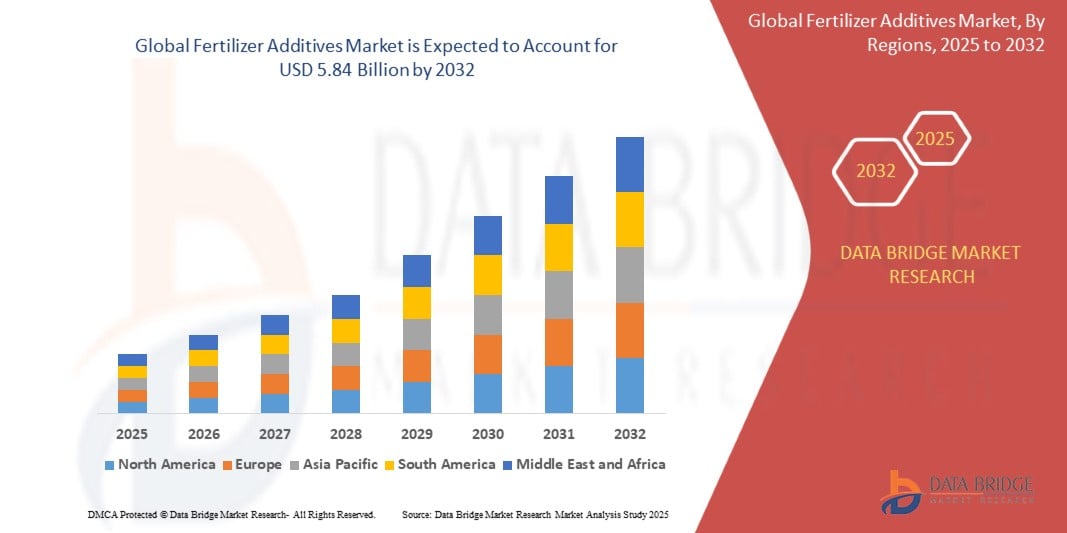
Fertilizer Additives Market Size
- The global fertilizer additives market size was valued at USD 3.56 billion in 2024 and is projected to reach USD 5.84 billion by 2032, growing at a CAGR of 6.34% during the forecast period.
- Market growth is driven by increasing global demand for high-efficiency fertilizers, rising agricultural productivity needs, and the expansion of fertilizer consumption in emerging economies.
Fertilizer Additives Market Analysis
- Fertilizer additives are essential chemical substances added to fertilizers to enhance their performance, improve nutrient stability, minimize losses, and increase crop yields. These additives serve crucial roles such as preventing caking, suppressing dust, and improving shelf life and nutrient release rates.
- The market is experiencing consistent growth, largely propelled by the rising demand for sustainable agriculture, increasing pressure on arable land, and growing awareness of minimizing fertilizer wastage. Additionally, the integration of precision farming and controlled-release fertilizers is encouraging the use of advanced additive solutions.
- Asia-Pacific dominates the global fertilizer additives market with a market share exceeding 40%, driven by large-scale agriculture in countries like China and India, government initiatives to boost yield, and increasing use of commercial fertilizers.
- Latin America and Africa are emerging as high-potential regions, attributed to growing fertilizer usage in Brazil, Nigeria, and other agrarian economies focused on boosting food security and improving soil productivity.
- The Anti-Caking Agents segment is expected to dominate the market with a market share of over 35%, owing to their critical role in maintaining fertilizer flowability during packaging, storage, and transport. These agents prevent clumping, ensuring uniform application across fields.
Report Scope and Fertilizer Additives Market Segmentation
|
Attributes |
Fertilizer Additives Market Insights |
|
Segments Covered |
|
|
Countries Covered |
North America
Europe
Asia-Pacific
Middle East and Africa
South America
|
|
Key Market Players |
|
|
Market Opportunities |
|
|
Value Added Data Infosets |
In addition to the insights on market scenarios such as market value, growth rate, segmentation, geographical coverage, and major players, the market reports curated by the Data Bridge Market Research also include in-depth expert analysis, pricing analysis, brand share analysis, consumer survey, demography analysis, supply chain analysis, value chain analysis, raw material/consumables overview, vendor selection criteria, PESTLE Analysis, Porter Analysis, and regulatory framework. |
Fertilizer Additives Market Trends
“Shift Toward Enhanced Efficiency and Environmentally Sustainable Fertilizer Solutions”
- One prominent trend in the global fertilizer additives market is the increasing shift toward enhanced efficiency and environmentally sustainable fertilizer solutions.
- This trend is driven by the growing global emphasis on sustainable agriculture, increasing regulatory pressure on nutrient runoff, and the need to optimize nutrient use efficiency to support food security without degrading soil health.
For instance, companies such as Yara International and BASF SE are investing in the development of urease and nitrification inhibitors, as well as dust suppressants and anti-caking agents that reduce nutrient loss and minimize environmental impact during handling and application.
- The focus on reducing nitrogen volatilization and phosphorus leaching is encouraging innovation in additive formulations that align with climate-smart agriculture practices.
- As farmers and fertilizer manufacturers increasingly adopt precision farming and sustainability standards, the demand for advanced fertilizer additives that improve fertilizer efficiency and environmental performance is expected to significantly shape market evolution.
Fertilizer Additives Market Dynamics
Driver
“Rising Demand for High-Efficiency Fertilizers in Precision Agriculture”
- The rising demand for high-efficiency fertilizers in precision agriculture is a key driver propelling the growth of the fertilizer additives market.
- This is fueled by the need to maximize crop yields from limited arable land while minimizing nutrient losses, especially nitrogen and phosphorus, which are prone to volatilization and runoff.
- Technologies such as GPS-guided machinery, remote sensing, and data analytics in farming are leading to targeted fertilizer application, where additives play a crucial role in ensuring stability, flowability, and nutrient longevity in the soil.
For instance, Koch Agronomic Services has launched a series of additives that enhance nitrogen use efficiency through stabilizers and inhibitors, enabling farmers to apply fewer inputs while achieving better results.
- Similarly, Clariant offers additive solutions like anti-caking agents that improve fertilizer storage and spreading characteristics, critical for modern farming equipment.
- As precision farming continues to gain traction, especially in developed economies, demand for advanced additives that complement these systems is expected to grow steadily.
Restraint/Challenge
“Volatile Raw Material Costs and Regulatory Uncertainty”
- Volatile raw material costs and regulatory uncertainty represent significant challenges for the fertilizer additives market.
- Many additives rely on specialty chemicals and petrochemical derivatives, whose prices are subject to fluctuations in global oil and gas markets, impacting the overall cost of additive production.
- Additionally, tightening regulations on agrochemicals, especially in the EU and North America, are adding compliance costs and increasing scrutiny over additive compositions.
For instance, manufacturers of urease inhibitors and dust suppressants must now comply with stricter environmental and safety regulations, which often require reformulation and re-approval, thereby raising development costs.
- Smaller manufacturers, particularly in emerging markets, may struggle to balance cost-efficiency with compliance, leading to slower adoption of advanced additives.
- The combination of cost pressure and regulatory complexity may hinder market penetration in cost-sensitive regions, especially among smallholder farmers who are less likely to afford high-end fertilizer products.
Fertilizer Additives Market Scope
The market is segmented on the basis of type, application, function, and form.
- By Application
Based on application, the Fertilizer Additives Market is segmented into Nitrogen Fertilizers, Phosphatic Fertilizers, Potassic Fertilizers, and Compound Fertilizers. Among these, the Nitrogen Fertilizers segment held the largest market share of 40.2% in 2025, primarily due to the high global consumption of nitrogen-based fertilizers like urea and ammonium nitrate. These fertilizers are especially prone to caking, nutrient loss, and emission challenges, thus driving the adoption of various additives.
Meanwhile, the Compound Fertilizers segment is projected to witness the highest CAGR of 7.05% during 2025–2032, supported by growing demand for balanced nutrition and multi-nutrient formulations. Compound fertilizers require a broader range of additives to improve flowability, nutrient retention, and storage stability, especially in emerging agricultural economies adopting intensive farming practices.
- By Function
On the basis of function, the market is categorized into Enhancing Nutrient Efficiency, Improving Handling & Storage, Reducing Losses, and Others. The Improving Handling & Storage segment leads with the largest revenue share of 38.9% in 2025, as storage stability, product consistency, and reduced material degradation remain critical for both manufacturers and end-users across the supply chain.
However, the Enhancing Nutrient Efficiency segment is anticipated to register the fastest CAGR of 7.19% during the forecast period, driven by the rising adoption of precision agriculture, climate-resilient farming practices, and the need to improve nutrient uptake while minimizing environmental impact.
- By Form
By form, the Fertilizer Additives Market is segmented into Solid, Liquid, Granular, and Powdered. The Solid form segment dominates the market, accounting for 41.7% of the revenue share in 2025, due to its widespread use in bulk fertilizer production, ease of integration, and compatibility with existing formulation techniques.
However, the Liquid segment is projected to exhibit the highest CAGR of 6.91% from 2025 to 2032, supported by the increasing use of liquid fertilizers in fertigation systems and precision farming methods. Liquid additives provide enhanced miscibility, faster action, and uniform distribution, making them ideal for modern agricultural practices.
Global Fertilizer Additives Market Regional Analysis
North America Fertilizer Additives Market Insight
North America accounted for the largest revenue share of 32.6% in the global fertilizer additives market in 2025, owing to its well-established agricultural infrastructure, high fertilizer consumption per hectare, and emphasis on precision farming. The widespread use of urea, ammonium nitrate, and complex fertilizers in the U.S. and Canada fuels demand for various additives to improve handling, storage, and nutrient efficiency.
The region also benefits from strict environmental and safety regulations, which promote the adoption of dust suppressants and anti-caking agents in fertilizer blending and distribution.
- U.S. Fertilizer Additives Market Insight
The U.S. holds the dominant position in North America’s fertilizer additives market, driven by technological advancements in agriculture, high penetration of mechanized farming, and consistent demand for nitrogen and phosphate fertilizers. Growing awareness about nutrient loss prevention and regulations around fertilizer application are boosting the demand for enhancers and stabilizers that increase fertilizer efficacy and reduce volatilization.
- Canada Fertilizer Additives Market Insight
The Canadian fertilizer additives market is projected to grow steadily through 2032, supported by the country’s focus on sustainable farming practices and soil fertility management. The increasing use of granular and compound fertilizers in cereal and oilseed farming is fueling the adoption of anti-caking agents and granulation aids. Additionally, government-supported nutrient stewardship programs are encouraging farmers to invest in high-quality, additive-enhanced fertilizers.
Asia-Pacific Fertilizer Additives Market Insight
Asia-Pacific is expected to register the highest CAGR of 7.24% during the forecast period (2025–2032), driven by rapid population growth, expanding agricultural activities, and government initiatives promoting modern farming practices across emerging economies. The region’s growing focus on improving fertilizer efficiency and minimizing losses due to environmental factors is significantly boosting demand for additives.
Increasing investment in mechanized farming and rising consumption of urea and NPK blends across countries like China and India are contributing to robust market expansion.
- China Fertilizer Additives Market Insight
China represents the largest fertilizer additives market in Asia-Pacific, owing to its massive fertilizer production base and growing need for sustainable agriculture. With stringent government policies targeting fertilizer overuse and pollution, the adoption of efficiency-enhancing additives—especially urease and nitrification inhibitors—is rising rapidly. Furthermore, China's leadership in granular and compound fertilizer manufacturing promotes the integration of multiple additive types during production.
- India Fertilizer Additives Market Insight
India’s fertilizer additives market is poised for significant growth, underpinned by the country’s push for self-sufficiency in food production and the widespread use of nitrogenous and phosphatic fertilizers. The government’s ongoing subsidy reforms and programs encouraging balanced nutrient application are creating opportunities for granulation aids, drying agents, and nutrient efficiency enhancers. Additionally, India’s transition toward liquid and water-soluble fertilizers is boosting the demand for compatible additive solutions.
Europe Fertilizer Additives Market Insight
Europe held a notable revenue share of 21.8% in 2025, driven by the region’s advanced agricultural technologies, environmental regulations, and widespread adoption of sustainable farming methods. The European Green Deal and Farm to Fork Strategy are promoting the use of eco-friendly fertilizer products with additives that reduce losses and improve soil health.
Demand for low-emission and slow-release fertilizers is boosting innovation in formulation additives, particularly in Northern and Western Europe.
- Germany Fertilizer Additives Market Insight
Germany remains a key market in Europe due to its precision agriculture adoption, emphasis on environmental protection, and strong fertilizer manufacturing sector. The use of additives in organic and compound fertilizers is gaining momentum, with particular interest in formulations that support reduced leaching and enhanced nitrogen use efficiency. German policies promoting circular agriculture and nutrient recycling are also encouraging the use of bio-based additives.
- France Fertilizer Additives Market Insight
The French fertilizer additives market is forecasted to grow steadily, supported by a growing focus on agroecology, soil regeneration, and sustainable crop production. As farmers increasingly adopt digital farming practices and integrated nutrient management systems, the role of functional additives in improving fertilizer performance and reducing environmental footprint becomes critical. France’s leadership in wine, cereal, and fruit production continues to drive targeted demand for specialty fertilizer blends enhanced with additives.
Fertilizer Additives Market Share
The Fertilizer Additives industry is primarily led by well-established companies, including:
- BASF SE (Germany)
- Clariant AG (Switzerland)
- Kao Corporation (Japan)
- Novochem Group (Netherlands)
- Solvay S.A. (Belgium)
- Chemipol S.A. (Spain)
- Michelman Inc. (U.S.)
- Hubei Forbon Technology Co., Ltd. (China)
- Tolsa Group (Spain)
- Neelam Aqua & Speciality Chem (P) Ltd. (India)
- Codiagro, S.A. (Spain)
- Haifa Group (Israel)
- Van Iperen International (Netherlands)
- Arkema S.A. (France)
- ICL Group Ltd. (Israel)
- Alltech Crop Science (U.S.)
Latest Developments in Global Fertilizer Additives Market
- In April 2025, Clariant AG (Switzerland) launched a new range of dust control additives designed for granular fertilizers under the brand name DustTect™ Plus. These additives are engineered to reduce particulate emissions during storage and transport, improving air quality and worker safety. This innovation is expected to bolster Clariant’s presence in the fertilizer additives market, especially in regulatory-driven regions like Europe and North America.
- In February 2025, BASF SE (Germany) announced the expansion of its anti-caking agent production capacity at its Ludwigshafen site. This strategic investment is aimed at addressing growing global demand from bulk fertilizer producers, especially in Asia-Pacific and Latin America, where climate-related caking is a major logistical challenge. The move reinforces BASF’s commitment to ensuring reliable and efficient fertilizer application.
- In October 2024, Kao Corporation (Japan) unveiled a new biodegradable granulation aid for use in NPK fertilizers, marketed under its GreenForm™ series. Developed in response to the rising preference for sustainable agricultural inputs, the product enhances granule strength and flowability without contributing to soil pollution. The launch strengthens Kao’s sustainability-oriented product portfolio and positions it competitively in eco-conscious markets.

- Interactive Data Analysis Dashboard
- Company Analysis Dashboard for high growth potential opportunities
- Research Analyst Access for customization & queries
- Competitor Analysis with Interactive dashboard
- Latest News, Updates & Trend analysis
- Harness the Power of Benchmark Analysis for Comprehensive Competitor Tracking
Global Fertilizer Additives Market, Supply Chain Analysis and Ecosystem Framework
To support market growth and help clients navigate the impact of geopolitical shifts, DBMR has integrated in-depth supply chain analysis into its Global Fertilizer Additives Market research reports. This addition empowers clients to respond effectively to global changes affecting their industries. The supply chain analysis section includes detailed insights such as Global Fertilizer Additives Market consumption and production by country, price trend analysis, the impact of tariffs and geopolitical developments, and import and export trends by country and HSN code. It also highlights major suppliers with data on production capacity and company profiles, as well as key importers and exporters. In addition to research, DBMR offers specialized supply chain consulting services backed by over a decade of experience, providing solutions like supplier discovery, supplier risk assessment, price trend analysis, impact evaluation of inflation and trade route changes, and comprehensive market trend analysis.
Data collection and base year analysis are done using data collection modules with large sample sizes. The stage includes obtaining market information or related data through various sources and strategies. It includes examining and planning all the data acquired from the past in advance. It likewise envelops the examination of information inconsistencies seen across different information sources. The market data is analysed and estimated using market statistical and coherent models. Also, market share analysis and key trend analysis are the major success factors in the market report. To know more, please request an analyst call or drop down your inquiry.
The key research methodology used by DBMR research team is data triangulation which involves data mining, analysis of the impact of data variables on the market and primary (industry expert) validation. Data models include Vendor Positioning Grid, Market Time Line Analysis, Market Overview and Guide, Company Positioning Grid, Patent Analysis, Pricing Analysis, Company Market Share Analysis, Standards of Measurement, Global versus Regional and Vendor Share Analysis. To know more about the research methodology, drop in an inquiry to speak to our industry experts.
Data Bridge Market Research is a leader in advanced formative research. We take pride in servicing our existing and new customers with data and analysis that match and suits their goal. The report can be customized to include price trend analysis of target brands understanding the market for additional countries (ask for the list of countries), clinical trial results data, literature review, refurbished market and product base analysis. Market analysis of target competitors can be analyzed from technology-based analysis to market portfolio strategies. We can add as many competitors that you require data about in the format and data style you are looking for. Our team of analysts can also provide you data in crude raw excel files pivot tables (Fact book) or can assist you in creating presentations from the data sets available in the report.













