


What is the Fiber Optic Preform Market Size and Growth Rate?
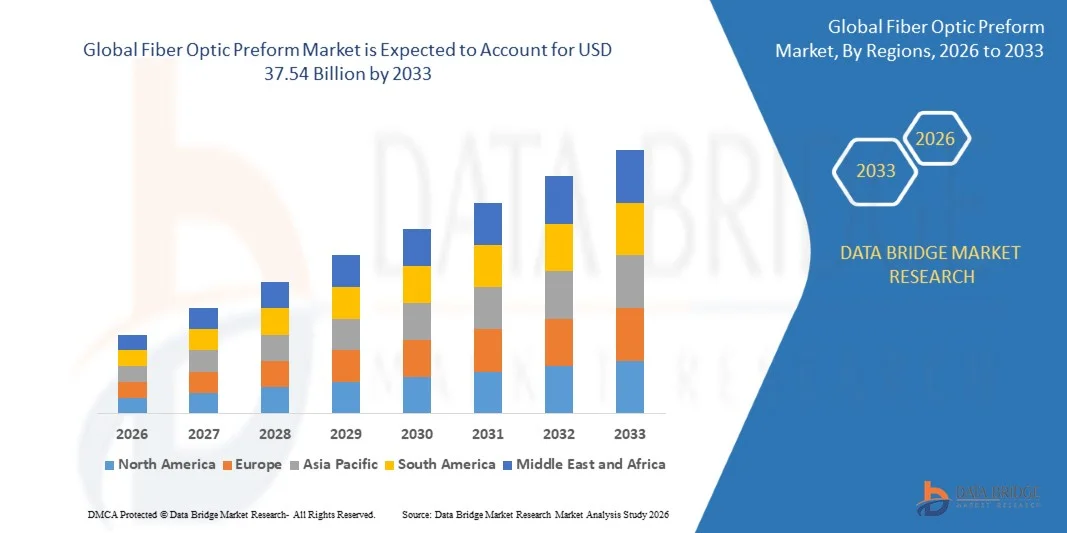
- As per Data Bridge Market Research analysis, the fiber optic preform market was valued at USD 8.85 billion in 2025 and is projected to reach USD 37.54 billion by 2033, growing at a CAGR of 19.80% from 2026 to 2033.
- The market is experiencing consistent growth driven by the rapid proliferation of 5G networks, favorable government initiatives and investments, and increasing demand for high-speed internet. Fiber optic preforms are the essential raw material used to manufacture optical fibers for high-capacity and low-latency communication networks
- The expansion of 5G networks and fiber broadband infrastructure, combined with increasing investments in hyperscale data centers and AI infrastructure, is creating sustained demand for high-quality optical fiber preforms. The extensive fiber requirements of 5G fronthaul and backhaul networks, along with the need for high-bandwidth and low-latency connectivity in AI and cloud applications, are supporting market growth. Research on optical fronthaul also highlights the importance of optical technologies in meeting the high-speed, low-latency, and reliable transmission requirements of 5G and future 6G networks
Market Size & Forecast
- Global Market Value (2025): USD 8.85 Billion
- Expected Market Value (2033): USD 37.54 Billion
- Forecast CAGR (2026–2033): 19.80%
- Leading Region in 2025: North America
- Fastest Growing Region: Asia-Pacific
What are the Major Takeaways of the Fiber Optic Preform Market?
- North America dominated the fiber optic preform market with the largest revenue share of 38.4% in 2025, supported by substantial investments in rural broadband expansion and enterprise network upgrades.
- Asia-Pacific is expected to be the fastest-growing region at a CAGR of 7.8% from 2026 to 2033, fueled by extensive government-backed infrastructure projects, domestic manufacturing capabilities, 5G base-station deployment, and expanding fiber connectivity in China and India.
- The vapor phase axial deposition (VAD) segment led the market with a 39.5% share in 2025, driven by its ability to produce high-quality preforms with low attenuation and excellent transmission characteristics
- Outside vapor deposition (OVD) are the fastest-growing process type, projected to register a CAGR of 13.8%, reflecting the surge in high scalability, uniform deposition, lower signal loss during data transmission, and flexibility in preform manufacturing.
- The multi-mode fiber optic segment dominated the product type category with a 44.38% revenue share in 2025, led by its widespread use in telecommunications and data centers and its cost-effectiveness and ease of installation
- Telecom accounted for 34.51% of the market share in 2025, preferred by broadband expansion, 5G network deployment, and increasing investment in data-communication infrastructure.
- The plastic optical fiber segment is the fastest-growing product type category, with a CAGR of 13.17%, driven by increasing adoption in short-distance communication, consumer electronics, and automotive applications
Report Scope and Fiber Optic Preform Market Segmentation
|
Attributes |
Fiber Optic Preform Key Market Insights |
|
Segments Covered |
|
|
Countries Covered |
North America
Europe
Asia-Pacific
Middle East and Africa
South America
|
|
Key Market Players |
|
|
Market Opportunities |
|
|
Value Added Data Infosets |
In addition to the market insights such as market value, growth rate, market segments, geographical coverage, market players, and market scenario, the market report curated by the Data Bridge Market Research team includes in-depth expert analysis, import/export analysis, pricing analysis, production consumption analysis, and pestle analysis. |
What is the Key Trend in the Fiber Optic Preform Market?
- The rapid expansion of AI-enabled data centers and high-bandwidth optical networks is increasing demand for advanced optical fiber, creating a strong requirement for high-quality preforms capable of supporting higher fiber density, bandwidth, and low-latency data transmission.
- For instance, in August 2024, Corning and Lumen Technologies announced an agreement reserving 10% of Corning’s global fiber capacity for each of the following two years to interconnect AI-enabled data centers. Corning stated that generative AI requires at least 10 times more fiber connections inside data centers than traditional applications.
- The increasing deployment of AI infrastructure is encouraging optical-fiber manufacturers to develop higher-density and higher-performance fiber solutions for data-center interconnects and next-generation communications networks.
- Research and development are also expanding toward specialty optical fibers, including fibers with tailored compositions and advanced performance characteristics for sensing, aerospace, defense, telecommunications, and industrial applications.
- For instance, in May 2025, Corning announced a collaboration with Broadcom to supply optical components for its Bailly co-packaged optics system, a 51.2-terabit-per-second Ethernet switch designed for large-scale AI clusters, highlighting the shift toward higher-density optical connectivity for AI infrastructure
- As AI data centers, 5G networks, cloud infrastructure, and specialty-fiber applications continue to expand, manufacturers are increasingly focusing on high-purity, low-loss, high-performance preforms, reinforcing technological innovation as a key trend in the fiber optic preform market.
What are the Key Drivers of the Fiber Optic Preform Market?
- The rapid expansion of 5G networks, fiber-to-the-home deployments, data centers, and high-speed broadband infrastructure is significantly increasing demand for optical fibers and the preforms used to manufacture them.
- For instance, in September 2024, Corning reported that its Optical Communications Enterprise sales were expected to grow by more than 40% year over year, driven by strong adoption of generative-AI optical-connectivity products used inside data centers, demonstrating the increasing requirement for high-capacity optical infrastructure.
- Telecommunications operators, cloud providers, and data-center developers are integrating higher-capacity optical connectivity to accommodate rapidly increasing data traffic, AI workloads, and low-latency communication requirements.
- For instance, in May 2025, Sumitomo Electric Industries and Japan’s National Institute of Information and Communications Technology achieved 1.02 petabits-per-second transmission over 1,808 km using a 19-core optical fiber, demonstrating the growing need for higher-capacity optical-fiber technologies for long-distance communications.
- With global telecommunications infrastructure increasingly shifting toward fiber-based high-capacity networks, rising 5G deployment, broadband expansion, cloud connectivity, and AI data-center investment will continue to stimulate demand for optical fiber preforms.
Which Factors are Challenging the Growth of the Fiber Optic Preform Market?
- Advanced fiber optic preform manufacturing requires high-purity raw materials, specialized deposition equipment, precise process control, and energy-intensive consolidation processes, increasing production complexity and capital requirements.
- For instance, in October 2024, a study published in Physics of Fluids demonstrating that optical-fiber preform extrusion involves significant heat-transfer and viscosity challenges; the study found that thermal conduction can significantly affect the size of internal holes at the extrusion exit, with direct implications for fiber geometry and manufacturing quality.
- These manufacturing requirements can create barriers for new entrants and smaller producers while increasing the cost and technical difficulty of expanding preform production capacity.
- Maintaining consistent optical and dimensional properties throughout the preform further increases manufacturing complexity, as variations in the core-to-cladding ratio can affect the transmission characteristics of the resulting fiber.
- For instance, in January 2024, a study published in Optics Express describing the Axi-Stack method for manufacturing freeform air-silica optical-fiber preforms, using precision-machined preform discs and ultrafast laser welding to overcome the geometric constraints of conventional stack-and-draw manufacturing.
- The combination of high manufacturing precision, specialized equipment, stringent purity requirements, and process complexity continues to challenge cost-effective capacity expansion, particularly as demand for high-performance preforms accelerates.
How is the Fiber Optic Preform Market Segmented?
The fiber optic preform market is segmented on the basis of process, product type, and end-user.
- By Process
On the basis of process, the fiber optic preform market is segmented into vapor phase axial deposition (VAD), modified chemical vapor deposition (MCVD), outside vapor deposition (OVD), and plasma activated chemical vapor deposition (PCVD). The vapor phase axial deposition (VAD) segment dominated the market with a 39.5% revenue share in 2025, owing to its ability to produce high-quality preforms with low attenuation and excellent transmission characteristics. VAD is particularly suitable for manufacturing large glass preforms in high quantities, supporting the mass production of optical fiber. The process enables manufacturers to achieve the quality and consistency required for telecommunications applications. Its scalability makes it particularly attractive as global fiber-optic network deployments expand. Increasing demand for high-capacity optical communication infrastructure continues to support VAD adoption. The segment is also projected to be the fastest-growing process, reflecting its importance in large-scale preform production.
The outside vapor deposition (OVD) segment is projected to register the fastest growth at a CAGR of 13.8% during forecast period, supported by high scalability, uniform deposition, lower signal loss during data transmission, and flexibility in preform manufacturing. OVD provides manufacturers with greater process flexibility for producing optical-fiber preforms with consistent characteristics. Its ability to support efficient deposition makes it suitable for increasing production requirements. The process also offers advantages in controlling the composition and structure of deposited materials. Growing demand for low-loss optical fibers is strengthening interest in OVD technology. Increasing investments in telecommunications and high-speed data-transmission infrastructure are creating additional opportunities. These advantages are expected to support the continued expansion of OVD during the forecast period.
- By Product Type
On the basis of product type, the fiber optic preform market is segmented into single-mode fiber optic, multi-mode fiber optic, and plastic optical fiber. The multi-mode fiber optic segment dominated the market with a 44.38% share in 2025, supported by its widespread use in telecommunications and data centers and its cost-effectiveness and ease of installation. Multi-mode fiber is particularly suitable for high-speed data transmission over relatively short distances. Its application across enterprise networks and data-center environments supports consistent demand for corresponding preforms. The segment benefits from the increasing deployment of high-capacity connectivity within campuses, organizations, and data centers. Its lower equipment costs compared with single-mode fiber further support adoption in appropriate short-distance applications. Growing data-center infrastructure is therefore contributing to the segment's market position.
The plastic optical fiber segment is projected to be the fastest-growing product category, registering a CAGR of 13.17%, driven by increasing adoption in short-distance communication, consumer electronics, and automotive applications. Plastic optical fiber offers advantages for applications requiring short-distance optical communication and relatively simple installation. Its growing use in automotive systems is creating additional opportunities beyond conventional telecommunications. Increasing integration of optical connectivity into consumer electronic products is also supporting demand. The technology can provide lightweight and flexible connectivity for selected applications. Expanding adoption of optical communication in connected and intelligent systems is further supporting its growth potential. These applications are expected to make plastic optical fiber an increasingly important high-growth category in the market.
- By End-User
On the basis of end-user, the fiber optic preform market is segmented into telecom, oil and gas, military and aerospace, BFSI, medical, railway, and others. The telecom segment dominated the market with a 34.51% share in 2025, driven by global broadband expansion, 5G network deployment, and increasing investment in data-communication infrastructure. Telecommunications networks remain the primary application area for optical fiber because of the technology's high bandwidth and low signal loss. Growing data consumption is encouraging operators to expand and upgrade fiber-based networks. Fiber-to-the-home and other broadband deployments are also supporting demand for optical fiber. Increasing cloud-computing and data-center connectivity requirements are further strengthening the telecommunications application. Continued investment in next-generation communication infrastructure is therefore sustaining the segment's leading position.
The oil and gas segment is projected to be the fastest-growing end-user category at a CAGR of 16.25% during forecast period, driven by increasing deployment of fiber-optic sensing and communication technologies across oil and gas operations. Fiber optics are increasingly used for downhole monitoring, pipeline monitoring, seismic sensing, and distributed temperature and acoustic sensing. Their immunity to electromagnetic interference makes them suitable for harsh and hazardous operating environments. Increasing exploration and production activities are creating opportunities for reliable real-time monitoring technologies. Fiber-optic systems can also provide continuous information about well conditions and pipeline integrity, supporting operational efficiency and safety. The growing adoption of advanced monitoring and sensing technologies across upstream, midstream, and downstream operations is expected to accelerate demand for fiber optic preforms used to manufacture specialized optical fibers.
Which Region Holds the Largest Share of the Fiber Optic Preform Market?
- North America dominated the fiber optic preform market with the largest revenue share of 38.4% in 2025, supported by substantial investments in rural broadband expansion and enterprise network upgrades.
- The region also benefits from strong investments in hyperscale data centers, artificial intelligence infrastructure, fiber broadband expansion, and 5G networks, while increasing demand for high-speed data transmission is strengthening optical-fiber deployment. Government-supported broadband initiatives and continued investments by telecommunications and technology companies are further supporting North America's leadership in the global market.
U.S. Fiber Optic Preform Market Insight
The U.S. fiber optic preform market is witnessing strong growth due to rising investments in domestic optical-fiber manufacturing, AI data-center infrastructure, and broadband network expansion. The country’s growing demand for high-capacity optical connectivity is increasing requirements for fiber used in hyperscale data centers and telecommunications networks. In addition, government-supported broadband programs and domestic-manufacturing requirements are encouraging companies to expand U.S.-based fiber and cable production. Corning reported that it had invested more than USD 500 million in U.S. fiber and cable manufacturing since 2020, nearly doubling its ability to serve the U.S. cable market. The company also reported in September 2024 that its Optical Communications Enterprise sales were expected to grow by more than 40% year over year, driven by adoption of optical-connectivity products for generative AI data centers
Asia-Pacific Fiber Optic Preform Market Insight
The Asia-Pacific fiber optic preform market is expected to witness rapid growth, driven by large-scale fiber-network deployment, expanding 5G infrastructure, data-center development, and government investment in next-generation optical networks across China, Japan, and other regional markets. China is accelerating the deployment of ultra-high-speed optical networks, while Japan continues to develop ultra-low-loss and multi-core optical-fiber technologies for high-capacity communications. In January 2025, China’s Ministry of Industry and Information Technology launched a 10G optical-network pilot program covering residential communities, factories, and industrial parks, including 50G-PON and FTTH/FTTR technologies. By the end of 2025, China had 74.99 million km of optical-cable lines and 1.21 billion FTTH/O access ports, demonstrating the scale of regional optical-fiber infrastructure
Japan Fiber Optic Preform Market Insight
The Japan fiber optic preform market is witnessing consistent growth due to increasing demand for ultra-high-capacity optical communication, AI-related cloud services, data centers, and next-generation network infrastructure. Japanese optical-fiber manufacturers are increasingly focusing on ultra-low-loss and multi-core fiber technologies to increase transmission capacity while reducing signal losses. In March 2024, Sumitomo Electric achieved a world-record transmission loss of 0.1397 dB/km at 1566 nm using ultra-low-loss silica-glass optical fiber. The company has also developed the VAD method into a mass-production technology, highlighting Japan’s established capabilities in optical-fiber preform manufacturing. Increasing demand from AI and cloud services is further supporting advanced optical-fiber development in the country.
China Fiber Optic Preform Market Insight
The China fiber optic preform market is growing rapidly, driven by extensive optical-network construction, 5G deployment, FTTH expansion, and government initiatives supporting ultra-high-speed broadband infrastructure. The country has a large installed base of optical-fiber infrastructure, creating sustained demand for optical fiber and the preforms required for fiber production. In January 2025, China’s Ministry of Industry and Information Technology initiated 10G optical-network pilot projects incorporating 50G-PON, FTTH, FTTR, high-speed optical transmission, and optical-network/AI integration. In April 2025, the ministry announced 168 projects selected for the 10G optical-network pilot program, demonstrating the scale of planned next-generation optical-network deployment. These initiatives are expected to strengthen demand for advanced optical-fiber technologies and supporting preform manufacturing capacity.
U.K. Fiber Optic Preform Market Insight
The U.K. fiber optic preform market is experiencing steady growth, supported by rapid full-fiber broadband rollout, increasing gigabit-capable connectivity, and continued investment in high-capacity telecommunications infrastructure. In January 2025, 22.5 million U.K. homes, equivalent to 74% of homes, had access to full-fibre broadband, representing an increase of 1.8 million homes over six months. Ofcom also reported that full-fibre availability could reach 28.8 million homes, or 95% of residential properties, by January 2028 if planned deployments are realised. The continued expansion of FTTH networks is increasing requirements for optical fiber and supporting demand for high-quality fiber optic preforms. Growing 5G availability and increasing data consumption are further strengthening the need for high-capacity optical connectivity
Germany Fiber Optic Preform Market Insight
The Germany fiber optic preform market is expanding steadily due to government-backed fiber-network development, increasing demand for high-speed connectivity, and the country’s objective of achieving nationwide fiber coverage by 2030. In January 2025, Germany launched its Gigabitförderung 2.0 program with a budget of EUR 1.2 billion to support fiber infrastructure and close remaining connectivity gaps. The German government aims to provide nationwide fiber coverage by 2030, with public funding supporting areas where private-sector deployment is not economically viable. Germany recorded 5.3 million active FTTH/FTTB connections at the end of 2024, approximately 1 million more than the previous year, while the number of premises passed by FTTH/FTTB increased to 21.8 million. These infrastructure investments are strengthening demand for optical fiber and the preforms used in its production.
Which are the Top Companies in Fiber Optic Preform Market?
The fiber optic preform industry is primarily led by well-established companies, including:
- Corning Incorporated (U.S.)
- Sumitomo Electric Industries, Ltd. (Japan)
- Fujikura Ltd. (Japan)
- FURUKAWA ELECTRIC CO., LTD. (Japan)
- Prysmian S.p.A (Italy)
- Yangtze Optical Fibre and Cable Joint Stock Limited Company (China)
- Hengtong Group Co., Ltd. (China)
- STL Tech (India)
- FiberHome Telecommunication Technologies Co., Ltd. (China)
- Shin-Etsu Chemical Co., Ltd. (Japan)
- Fasten Group (China)
- Futong Technology Development Holdings Limited (China)
- Tongding Group Co., Ltd. (China)
- Jiangsu Zhongli Group Co., Ltd (China)
- TIANJIN ZHONGHUAN ADVANCED MATERIAL AND TECHNOLOGY CO., LTD. (China)
- Jiangsu Tongguang Communication Co., Ltd. (China)
- Rosendahl Nextrom (Finland)
- Hexatronic Group AB (Sweden)
What are Latest Developments in Fiber Optic Preform Market?
- In July 2025, Fujikura announced the launch of its world-first 13,824-fiber SWR/WTC optical fiber cable, combining 12-fiber intermittently bonded Spider Web Ribbon with Wrapping Tube Cable technology. The product was developed for hyperscale data centers and high-density optical networks, providing twice the fiber count of the previous 6,912-fiber maximum within an outer diameter of 40 mm or less.
- In May 2025, Sumitomo Electric Industries and the National Institute of Information and Communications Technology (NICT) achieved a world-record transmission capacity of 1.02 petabits per second over 1,808 km using a 19-core optical fiber with a standard 0.125 mm cladding diameter. Sumitomo Electric designed and manufactured the coupled 19-core fiber, optimizing the core structure to reduce optical losses across the C- and L-bands. The development demonstrates continued advancement toward high-capacity optical fibers requiring sophisticated preform and fiber-manufacturing technologies.
- In March 2025, Corning launched GlassWorks AI Solutions, an end-to-end portfolio designed to help data-center operators build the dense fiber infrastructure required for generative artificial intelligence. The portfolio included the new Contour Flow Cable and network planning, design, and deployment services for high-density data-center interconnects. Corning highlighted the increasing scale and density requirements of artificial-intelligence infrastructure, reinforcing demand for advanced optical-fiber technologies.
- In March 2024, Sumitomo Electric Industries announced the development of an ultra-low-loss silica-glass optical fiber achieving a transmission loss of 0.1397 dB/km at 1566 nm. The company developed the technology to address increasing communication-capacity requirements associated with cloud services and artificial intelligence. The achievement builds on Sumitomo Electric’s VAD-based optical-fiber manufacturing expertise and its mass production of ultra-low-loss fiber since 2021.
- In March 2022, Sumitomo Electric Industries filed a patent for a method and apparatus for manufacturing optical-fiber preforms using controlled gas introduction during the deposition process. The method generates glass fine particles from a glass raw-material gas and deposits them to form a hollow porous glass preform, while introducing gases containing halogen into the interior and exterior of the preform at different partial pressures. The development focuses on improving control of the preform manufacturing process and the quality of the resulting optical fiber.

- Interactive Data Analysis Dashboard
- Company Analysis Dashboard for high growth potential opportunities
- Research Analyst Access for customization & queries
- Competitor Analysis with Interactive dashboard
- Latest News, Updates & Trend analysis
- Harness the Power of Benchmark Analysis for Comprehensive Competitor Tracking
Data collection and base year analysis are done using data collection modules with large sample sizes. The stage includes obtaining market information or related data through various sources and strategies. It includes examining and planning all the data acquired from the past in advance. It likewise envelops the examination of information inconsistencies seen across different information sources. The market data is analysed and estimated using market statistical and coherent models. Also, market share analysis and key trend analysis are the major success factors in the market report. To know more, please request an analyst call or drop down your inquiry.
The key research methodology used by DBMR research team is data triangulation which involves data mining, analysis of the impact of data variables on the market and primary (industry expert) validation. Data models include Vendor Positioning Grid, Market Time Line Analysis, Market Overview and Guide, Company Positioning Grid, Patent Analysis, Pricing Analysis, Company Market Share Analysis, Standards of Measurement, Global versus Regional and Vendor Share Analysis. To know more about the research methodology, drop in an inquiry to speak to our industry experts.
Data Bridge Market Research is a leader in advanced formative research. We take pride in servicing our existing and new customers with data and analysis that match and suits their goal. The report can be customized to include price trend analysis of target brands understanding the market for additional countries (ask for the list of countries), clinical trial results data, literature review, refurbished market and product base analysis. Market analysis of target competitors can be analyzed from technology-based analysis to market portfolio strategies. We can add as many competitors that you require data about in the format and data style you are looking for. Our team of analysts can also provide you data in crude raw excel files pivot tables (Fact book) or can assist you in creating presentations from the data sets available in the report.













