


What is the Fileless Attack Security Market Size and Growth Rate?
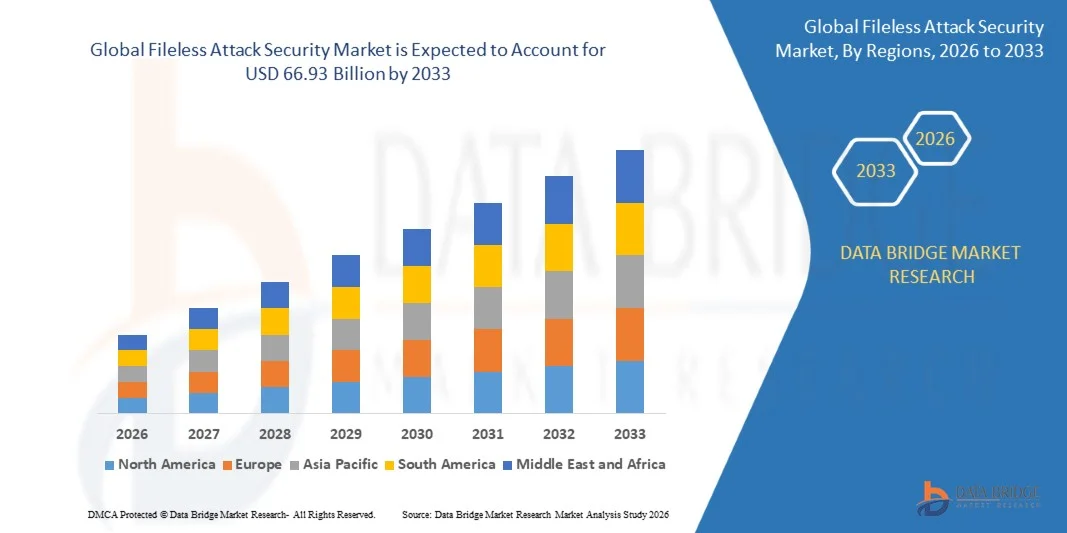
- As per Data Bridge Market Research analysis, the fileless attack security market was valued at USD 26.27 billion in 2025 and is projected to reach USD 66.93 billion by 2033, growing at a CAGR of 12.40% from 2026 to 2033.
- The market is experiencing robust growth driven by the increasing sophistication of cyber threats that exploit vulnerabilities without leaving traditional indicators. Fileless attacks, which operate in system memory and leverage legitimate system tools to infiltrate networks without leaving traceable files, are evading traditional signature-based defenses.
- As cybercriminals shift tactics toward non-traditional attack methods, organizations are prioritizing next-generation security solutions including AI-driven threat detection, behavioral analytics, and endpoint protection to counter these stealthy attacks. Zero-trust architectures and extended detection and response (XDR) platforms are becoming essential in mitigating fileless malware risks.
Market Size & Forecast
- Market Value (2025): USD 26.27 Billion
- Expected Market Value (2033): USD 66.93 Billion
- Forecast CAGR (2026–2033): 12.40%
- Leading Region in 2025: North America
- Fastest Growing Region: Asia-Pacific
What are the Major Takeaways of the Fileless Attack Security Market?
- North America dominated the fileless attack security market and accounted for the largest revenue share of 45.50% in 2025, supported by increasing cyber threats, stringent regulatory requirements, and high adoption rates of advanced security solutions.
- Asia-Pacific fileless attack security market is expected to witness the fastest growth rate from 2026 to 2033, supported by rapid digital transformation, increasing cloud adoption, and rising cybersecurity awareness across countries such as China, Japan, India, and South Korea.
- The in memory segment dominated the market with the largest revenue share in 2025, owing to the increasing prevalence of sophisticated attacks that execute directly in system memory without leaving files on storage devices. These attacks are difficult to detect using conventional antivirus solutions, driving organizations to adopt advanced endpoint protection and threat detection technologies.
- The scripts segment is projected to register the fastest growth from 2026 to 2033, driven by the increasing misuse of scripting languages such as PowerShell, JavaScript, and VBScript by cybercriminals to execute malicious code. The growing adoption of script-based automation in enterprise environments and the rising sophistication of script-based attacks are accelerating demand for script-focused security solutions.
- The cloud-based segment dominated the market with the largest revenue share in 2025, supported by the rapid adoption of cloud infrastructure, remote working environments, and cloud-native cybersecurity platforms. Cloud-based deployment offers real-time threat intelligence, centralized management, automatic updates, and scalability, making it the preferred deployment model for organizations of all sizes.
- The cloud-based segment is also anticipated to witness the fastest growth from 2026 to 2033, driven by increasing migration toward hybrid and multi-cloud environments, growing cybersecurity investments, and the rising demand for AI-powered threat detection and response capabilities.
Scope and Fileless Attack Security Market Segmentation
|
Attributes |
Fileless Attack Security Key Market Insights |
|
Segments Covered |
|
|
Countries Covered |
North America
Europe
Asia-Pacific
Middle East and Africa
South America
|
|
Key Market Players |
|
|
Market Opportunities |
|
|
Value Added Data Infosets |
In addition to the market insights such as market value, growth rate, market segments, geographical coverage, market players, and market scenario, the market report curated by the Data Bridge Market Research team includes in-depth expert analysis, import/export analysis, pricing analysis, production consumption analysis, and pestle analysis. |
What is the Key Trend in the Fileless Attack Security Market?
- Organizations are increasingly adopting AI-powered Extended Detection and Response (XDR), Endpoint Detection and Response (EDR), and behavioral analytics platforms to detect and stop fileless attacks that exploit legitimate system tools, memory, PowerShell, and script-based execution without leaving traditional malware files.
- For instance, in April 2025, CrowdStrike introduced new Falcon platform innovations at RSA Conference 2025, including AI Model Scanning, Shadow AI detection, and enhanced cloud threat detection capabilities, enabling organizations to identify sophisticated fileless and identity-based attacks across cloud, endpoint, and SaaS environments through unified behavioral analytics.
- Security vendors are integrating machine learning, real-time telemetry, identity protection, and automated threat hunting to identify abnormal process execution and "living-off-the-land" (LotL) techniques commonly used in fileless attacks, significantly improving detection accuracy.
- For instance, in June 2025, Microsoft enhanced Microsoft Defender for Endpoint with advanced AI-driven endpoint detection and response capabilities, enabling security teams to detect sophisticated multi-stage attacks through behavioral analysis, identity correlation, and automated attack disruption rather than relying solely on signature-based malware detection.
- As cybercriminals increasingly leverage fileless techniques to evade traditional antivirus solutions, enterprises are expected to accelerate investments in AI-driven XDR, EDR, and behavioral threat detection platforms, making intelligent, behavior-based security a core component of modern cybersecurity strategies.
What are the Key Drivers of the Fileless Attack Security Market?
- The growing frequency of fileless attacks, identity-based intrusions, and living-off-the-land (LotL) techniques is driving enterprises to adopt advanced endpoint detection and response (EDR), extended detection and response (XDR), and AI-powered threat detection solutions capable of identifying malicious behavior in memory and legitimate system processes.
- For instance, in April 2025, at the RSA Conference 2025, Palo Alto Networks introduced Cortex XSIAM 3.0, an AI-driven security operations platform featuring Cortex Exposure Management and Advanced Email Security to deliver proactive threat detection, automated remediation, and unified SecOps capabilities.
- Organizations across banking, healthcare, government, and critical infrastructure sectors are increasingly investing in AI-powered security analytics, zero-trust architectures, and automated incident response platforms to strengthen protection against advanced cyber threats that evade conventional antivirus solutions.
- As attackers increasingly rely on stealthy, fileless techniques to bypass traditional security defenses, enterprises are expected to accelerate investments in AI-powered behavioral analytics and autonomous cybersecurity platforms, driving sustained growth in the fileless attack security market.
Which Factors are Challenging the Growth of the Fileless Attack Security Market?
- Deploying fileless attack security solutions requires advanced behavioral analytics, AI-driven threat detection, endpoint telemetry, and continuous security monitoring, making implementation complex and resource-intensive for many organizations. Integration with existing IT infrastructure and security tools often requires significant expertise and ongoing management.
- These complexities, coupled with the global shortage of skilled cybersecurity professionals, limit the effective deployment and operation of advanced EDR, XDR, and threat hunting solutions, particularly among small and medium-sized enterprises (SMEs) and organizations in developing regions.
- For instance, in April 2025, Microsoft announced the expansion of Microsoft Security Copilot with AI agents for phishing triage, alert prioritization, identity management, and vulnerability remediation. The new autonomous agents are designed to reduce the workload on security teams, helping organizations address the shortage of skilled cybersecurity professionals while improving the speed and efficiency of detecting and responding to increasingly sophisticated cyber threats, including fileless attacks.
- The high cost of implementation, continuous monitoring, incident response, and specialized personnel continues to challenge widespread adoption, especially for organizations with limited cybersecurity budgets and expertise. As attackers continuously evolve fileless techniques, enterprises must frequently update security platforms and train personnel, further increasing operational costs.
- These technical, operational, and workforce challenges are expected to slow the adoption of advanced fileless attack security solutions, particularly among SMEs, despite the growing need for protection against sophisticated cyber threats.
How is the Fileless Attack Security Market Segmented?
The fileless attack security market is segmented on the basis of deployment type, end user, solution type, and service type.
- By Type
On the basis of type, the fileless attack security market is segmented into macros, scripts, in memory, and others. The in memory segment dominated the market with the largest revenue share in 2025, owing to the increasing prevalence of sophisticated attacks that execute directly in system memory without leaving files on storage devices. These attacks are difficult to detect using conventional antivirus solutions, driving organizations to adopt advanced endpoint protection and threat detection technologies.
The scripts segment is projected to register the fastest growth from 2026 to 2033, driven by the increasing misuse of scripting languages such as PowerShell, JavaScript, and VBScript by cybercriminals to execute malicious code. The growing adoption of script-based automation in enterprise environments and the rising sophistication of script-based attacks are accelerating demand for script-focused security solutions.
- By Deployment Type
On the basis of deployment type, the fileless attack security market is segmented into cloud-based and on-premises. The cloud-based segment dominated the market with the largest revenue share in 2025, supported by the rapid adoption of cloud infrastructure, remote working environments, and cloud-native cybersecurity platforms. Cloud-based deployment offers real-time threat intelligence, centralized management, automatic updates, and scalability, making it the preferred deployment model for organizations of all sizes.
The cloud-based segment is also anticipated to witness the fastest growth from 2026 to 2033, driven by increasing migration toward hybrid and multi-cloud environments, growing cybersecurity investments, and the rising demand for AI-powered threat detection and response capabilities.
- By Attack Technique
On the basis of attack technique, the fileless attack security market is segmented into memory-only threats, fileless persistence methods, dual-use tools, and non-portable executable (PE) file attacks. The memory-only threats segment dominated the market with the largest revenue share in 2025 due to their ability to evade traditional signature-based security tools by executing entirely within system memory. The increasing frequency of advanced persistent threats (APTs) and ransomware campaigns has further strengthened demand for solutions capable of detecting memory-resident attacks.
The dual-use tools segment is projected to register the fastest growth from 2026 to 2033, driven by the growing exploitation of legitimate administrative tools such as PowerShell, PsExec, and Windows Management Instrumentation (WMI) by attackers. Organizations are increasingly investing in behavioral analytics and EDR solutions to detect the misuse of trusted system utilities.
- By Security Technology
On the basis of security technology, the fileless attack security market is segmented into endpoint security, endpoint detection and response (EDR), email security, network security, and others. The endpoint detection and response (EDR) segment dominated the market with the largest revenue share in 2025, owing to its ability to continuously monitor endpoint activities, identify suspicious behaviors, and provide automated threat investigation and response against advanced fileless attacks.
The endpoint detection and response (EDR) segment is also expected to witness the fastest growth from 2026 to 2033, driven by increasing enterprise adoption of AI-powered threat detection, zero-trust security frameworks, and the growing sophistication of cyberattacks targeting endpoint devices.
- By Application
On the basis of application, the fileless attack security market is segmented into powershell, windows management instrumentation (WMI), and others. The powershell segment dominated the market with the largest revenue share in 2025 due to its widespread use by IT administrators and its frequent exploitation by attackers to execute malicious scripts while bypassing traditional security controls. The growing need to monitor PowerShell activities is driving demand for advanced security solutions.
The windows management instrumentation (WMI) segment is anticipated to witness the fastest growth from 2026 to 2033, driven by the increasing abuse of WMI for stealthy lateral movement, persistence, and remote execution within enterprise networks. Organizations are increasingly deploying specialized monitoring and behavioral detection tools to secure WMI environments.
- By End User
On the basis of end user, the fileless attack security market is segmented into aerospace, defence, government, banking, financial institutions, information technology (IT), telecom, healthcare, retail, e-commerce, education, and others. The banking, financial institutions segment dominated the market with the largest revenue share in 2025, owing to the increasing frequency of targeted cyberattacks against financial systems, stringent regulatory requirements, and growing investments in advanced cybersecurity infrastructure to protect sensitive financial data.
The healthcare segment is expected to witness the fastest growth from 2026 to 2033, driven by increasing digitization of healthcare records, expanding telehealth services, rising ransomware attacks, and the growing need to secure connected medical devices and patient information.
- By Service Type
On the basis of service type, the fileless attack security market is segmented into managed services and professional services. The managed services segment dominated the market with the largest revenue share in 2025, supported by growing demand for continuous security monitoring, managed detection and response (MDR), threat intelligence, and incident response services. Organizations increasingly rely on managed security providers to address evolving cyber threats while reducing operational complexity.
The managed services segment is also projected to register the fastest growth from 2026 to 2033, driven by increasing cybersecurity skill shortages, rising adoption of outsourced security operations, and growing demand for 24/7 monitoring, rapid incident response, and proactive threat hunting capabilities.
Which Region Holds the Largest Share of the Fileless Attack Security Market?
- North America dominated the fileless attack security market and accounted for the largest revenue share of 45.50% in 2025, supported by increasing cyber threats, stringent regulatory requirements, and high adoption rates of advanced security solutions.
- The region benefits from the presence of major players such as CrowdStrike, McAfee, and Palo Alto Networks, fostering a competitive landscape and continuous investments in R&D. The rise of remote work and digital transformation initiatives further fuels demand for innovative cybersecurity measures.
U.S. Fileless Attack Security Market Insight
The U.S. fileless attack security market captured the largest revenue share in 2025 within North America, fueled by the increasing sophistication of ransomware, advanced persistent threats (APTs), and nation-state cyberattacks targeting critical infrastructure and enterprises. Organizations are prioritizing AI-powered threat detection, behavioral analytics, and endpoint security solutions to protect cloud, hybrid, and on-premises environments. Moreover, rising investments in cybersecurity modernization across government agencies and private enterprises continue to accelerate market growth.
Europe Fileless Attack Security Market Insight
The Europe fileless attack security market is expected to witness the fastest growth rate from 2026 to 2033, primarily driven by stringent cybersecurity regulations, including GDPR and the NIS2 Directive, alongside increasing digitalization across industries. Organizations are strengthening their security posture through advanced endpoint protection, threat intelligence, and zero-trust architectures to address evolving cyber risks. Growing adoption of cloud services and increasing cybersecurity investments are further supporting market expansion across the region.
U.K. Fileless Attack Security Market Insight
The U.K. fileless attack security market is expected to witness the fastest growth rate from 2026 to 2033, driven by rising cyber threats targeting financial institutions, healthcare organizations, and government agencies. Increasing adoption of cloud-based security platforms, managed detection and response (MDR) services, and AI-driven threat intelligence solutions is enhancing enterprise resilience against fileless attacks. Furthermore, continuous investments in cybersecurity infrastructure and regulatory compliance are expected to support sustained market growth.
Germany Fileless Attack Security Market Insight
The Germany fileless attack security market is expected to witness the fastest growth rate from 2026 to 2033, fueled by increasing industrial digitalization and the country's strong focus on cybersecurity within manufacturing, automotive, and critical infrastructure sectors. Organizations are adopting advanced endpoint security, network monitoring, and behavioral analytics solutions to defend against sophisticated fileless threats. Germany's emphasis on data privacy, Industry 4.0, and resilient cyber infrastructure further contributes to market expansion.
Asia-Pacific Fileless Attack Security Market Insight
The Asia-Pacific fileless attack security market is expected to witness the fastest growth rate from 2026 to 2033, supported by rapid digital transformation, increasing cloud adoption, and rising cybersecurity awareness across countries such as China, Japan, India, and South Korea. Growing investments in digital infrastructure, expanding enterprise IT environments, and the increasing frequency of cyberattacks are accelerating the deployment of advanced fileless attack security solutions. Government initiatives promoting cybersecurity readiness are also contributing to regional market growth.
Japan Fileless Attack Security Market Insight
The Japan fileless attack security market is expected to witness the fastest growth rate from 2026 to 2033 due to the country's advanced digital economy, increasing adoption of cloud computing, and strong emphasis on protecting critical infrastructure. Enterprises are investing in AI-enabled security platforms, endpoint detection technologies, and real-time threat monitoring to combat sophisticated cyber threats. Moreover, the expansion of connected devices and digital services is driving demand for advanced cybersecurity solutions.
China Fileless Attack Security Market Insight
The China fileless attack security market accounted for the largest market revenue share in Asia Pacific in 2025, attributed to rapid enterprise digitalization, widespread cloud adoption, and increasing cybersecurity investments across government and private sectors. The growing number of sophisticated cyber threats targeting financial institutions, manufacturing, telecommunications, and critical infrastructure is driving demand for advanced endpoint protection and threat detection solutions. In addition, supportive national cybersecurity initiatives and the expansion of domestic cybersecurity vendors continue to propel market growth.
Which are the Top Companies in Fileless Attack Security Market?
The fileless attack security industry is primarily led by well-established companies, including:
- Microsoft Corporation (U.S.)
- Palo Alto Networks, Inc. (U.S.)
- CrowdStrike Holdings, Inc. (U.S.)
- SentinelOne, Inc. (U.S.)
- Trend Micro Incorporated (Japan)
- Cisco Systems, Inc. (U.S.)
- Broadcom Inc. (Symantec Enterprise Security) (U.S.)
- Trellix (U.S.)
- Sophos Ltd. (U.K.)
- Check Point Software Technologies Ltd. (Israel)
- Fortinet, Inc. (U.S.)
- VMware (Carbon Black) (U.S.)
- ESET, spol. s r.o. (Slovakia)
- Bitdefender (Romania)
- Elastic N.V. (Netherlands)
What are Latest Developments in Fileless Attack Security Market?
- In April 2025, CrowdStrike introduced new Falcon platform innovations at RSA Conference 2025, including AI Model Scanning, Shadow AI detection, and enhanced cloud threat detection capabilities, enabling organizations to identify sophisticated fileless and identity-based attacks across cloud, endpoint, and SaaS environments through unified behavioral analytics.
- In June 2025, Microsoft enhanced Microsoft Defender for Endpoint with advanced AI-driven endpoint detection and response capabilities, enabling security teams to detect sophisticated multi-stage attacks through behavioral analysis, identity correlation, and automated attack disruption rather than relying solely on signature-based malware detection.

- Interactive Data Analysis Dashboard
- Company Analysis Dashboard for high growth potential opportunities
- Research Analyst Access for customization & queries
- Competitor Analysis with Interactive dashboard
- Latest News, Updates & Trend analysis
- Harness the Power of Benchmark Analysis for Comprehensive Competitor Tracking
Data collection and base year analysis are done using data collection modules with large sample sizes. The stage includes obtaining market information or related data through various sources and strategies. It includes examining and planning all the data acquired from the past in advance. It likewise envelops the examination of information inconsistencies seen across different information sources. The market data is analysed and estimated using market statistical and coherent models. Also, market share analysis and key trend analysis are the major success factors in the market report. To know more, please request an analyst call or drop down your inquiry.
The key research methodology used by DBMR research team is data triangulation which involves data mining, analysis of the impact of data variables on the market and primary (industry expert) validation. Data models include Vendor Positioning Grid, Market Time Line Analysis, Market Overview and Guide, Company Positioning Grid, Patent Analysis, Pricing Analysis, Company Market Share Analysis, Standards of Measurement, Global versus Regional and Vendor Share Analysis. To know more about the research methodology, drop in an inquiry to speak to our industry experts.
Data Bridge Market Research is a leader in advanced formative research. We take pride in servicing our existing and new customers with data and analysis that match and suits their goal. The report can be customized to include price trend analysis of target brands understanding the market for additional countries (ask for the list of countries), clinical trial results data, literature review, refurbished market and product base analysis. Market analysis of target competitors can be analyzed from technology-based analysis to market portfolio strategies. We can add as many competitors that you require data about in the format and data style you are looking for. Our team of analysts can also provide you data in crude raw excel files pivot tables (Fact book) or can assist you in creating presentations from the data sets available in the report.













