


Financial Analytics Market Size
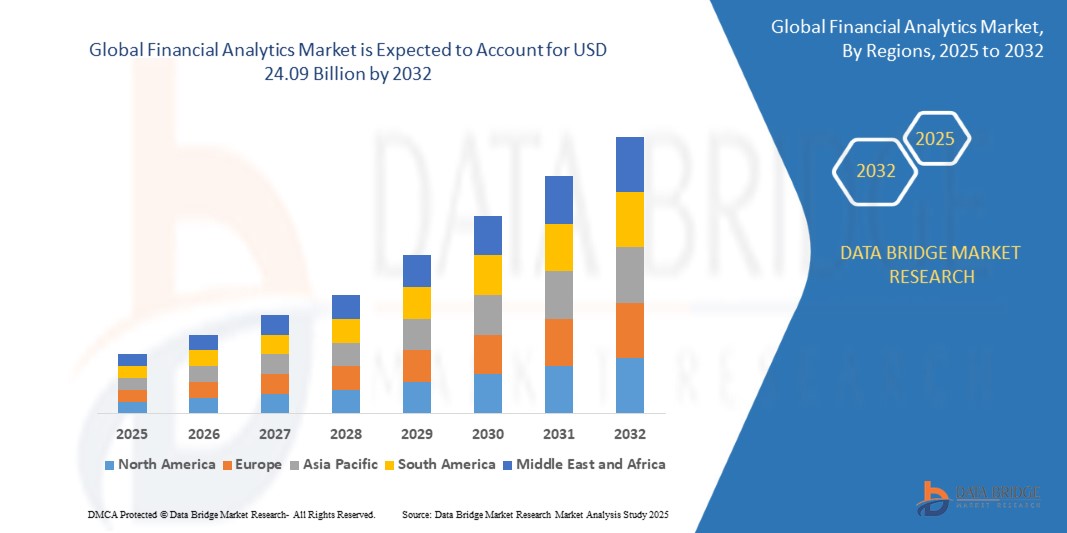
- The global financial analytics market was valued at USD 10.99 billion in 2024 and is expected to reach USD 24.09 billion by 2032
- During the forecast period of 2025 to 2032 the market is likely to grow at a CAGR of 10.30%, primarily driven by the increasing adoption of data-driven decision-making and real-time analytics
- This growth is driven by factors such as the rising demand for predictive analytics in financial operations, integration of AI and ML technologies, and the growing need for risk management and regulatory compliance across banking, insurance, and investment sectors
Financial Analytics Market Analysis
- Financial analytics involves the use of data mining, predictive modeling, machine learning, and statistical tools to analyze financial data and generate insights that support strategic decision-making. These solutions are essential for budgeting, forecasting, risk management, and profitability analysis across sectors such as banking, insurance, investment, and corporate finance
- The demand for financial analytics is significantly driven by the growing need for real-time data insights, increasing regulatory compliance requirements, and the rapid digital transformation across financial institutions. More than half of the global demand is generated by the banking and financial services sector, especially in regions with mature financial ecosystems and high digital adoption
- The North America region stands out as a dominant region for financial analytics solutions, supported by its robust financial infrastructure, large volume of financial transactions, and early adoption of advanced data analytics platforms
- For instance, financial institutions in the U.S. are investing heavily in AI-powered analytics platforms to enhance fraud detection, improve customer experience, and automate reporting processes—leading to increased operational efficiency and competitiveness
- Globally, financial analytics platforms are now regarded as one of the most critical components in modern financial technology stacks, second only to core banking systems. They play a pivotal role in enabling organizations to optimize performance, forecast trends, and make data-driven decisions with greater confidence
Report Scope and Financial Analytics Market Segmentation
Attributes |
Financial Analytics Key Market Insights |
|
Segments Covered |
|
|
Countries Covered |
North America
Europe
Asia-Pacific
Middle East and Africa
South America
|
|
Key Market Players |
|
|
Market Opportunities |
|
|
Value Added Data Infosets |
In addition to the insights on market scenarios such as market value, growth rate, segmentation, geographical coverage, and major players, the market reports curated by the Data Bridge Market Research also include import export analysis, production capacity overview, production consumption analysis, price trend analysis, climate change scenario, supply chain analysis, value chain analysis, raw material/consumables overview, vendor selection criteria, PESTLE Analysis, Porter Analysis, and regulatory framework. |
Financial Analytics Market Trends
“Increased Adoption of AI and Cloud-Based Financial Analytics Platforms”
- One prominent trend in the global financial analytics market is the accelerated adoption of artificial intelligence (AI) and cloud-based platforms to enhance financial decision-making and operational agility
- These advanced technologies empower organizations to automate complex data analysis, uncover actionable insights in real time, and improve forecasting accuracy across various financial functions such as budgeting, planning, and risk assessment
- For instance, AI-driven predictive analytics allows financial teams to identify emerging risks, spot market opportunities, and optimize investments, offering a competitive advantage in fast-paced financial environments
- Cloud integration enables scalability, cost-efficiency, and remote accessibility of financial data and analytics tools. It supports collaboration across departments and geographies, while also ensuring data security and compliance with global financial regulations
- This trend is transforming traditional financial operations into agile, data-first environments, significantly boosting efficiency, transparency, and strategic responsiveness. As a result, the demand for AI and cloud-integrated financial analytics solutions continues to rise across both large enterprises and mid-sized organizations globally
Financial Analytics Market Dynamics
Driver
“Growing Demand Due to Rising Complexity in Financial Decision-Making”
- The increasing complexity of financial decision-making in today’s dynamic business environment is a key driver contributing to the growing demand for financial analytics solutions
- Organizations across industries face challenges such as volatile market conditions, changing regulatory landscapes, inflationary pressures, and competitive disruptions, all of which require real-time, data-driven insights for effective financial planning and strategy
- Financial analytics tools provide enhanced visibility, faster reporting, and predictive capabilities, enabling decision-makers to assess risk, optimize investments, improve cash flow, and align resources with business goals. These tools are becoming essential in navigating high-stakes financial scenarios
- The rise in digital transactions and increased financial data volume further underscores the need for advanced analytics platforms that can process and interpret large datasets quickly and accurately
For instance,
- In a 2023 Deloitte survey, 82% of CFOs reported plans to increase investment in analytics capabilities to better support strategic initiatives and manage uncertainty
- According to PwC’s Global Finance Trends 2024 report, over 70% of finance leaders identified advanced analytics and AI-driven tools as critical to improving decision-making and managing risks
- As businesses increasingly rely on proactive and forward-looking financial insights to maintain a competitive edge, the demand for advanced financial analytics platforms is expected to surge, fueling market growth throughout the forecast period
Opportunity
“Transforming Financial Decision-Making with Artificial Intelligence Integration”
- The integration of artificial intelligence (AI) in financial analytics platforms presents a significant opportunity to transform how organizations handle financial planning, forecasting, risk management, and performance evaluation
- AI-powered financial analytics systems can automate complex tasks, detect patterns in vast datasets, and deliver real-time, predictive insights that help CFOs and finance teams make more strategic and informed decisions
- AI algorithms can continuously monitor key financial indicators, flag anomalies or risks (such as cash flow issues or fraud), and recommend corrective actions based on historical trends and current market conditions
- In addition, AI-driven tools support scenario modeling and stress testing, enabling organizations to prepare for economic uncertainties, regulatory changes, and evolving business environments with greater agility
For instance,
- In January 2025, a report by McKinsey & Company highlighted that companies implementing AI in financial operations experienced up to a 25% reduction in forecasting errors and significantly enhanced accuracy in budget allocations
- In October 2024, Oracle launched its AI-powered “Fusion Analytics Warehouse” for finance teams, integrating machine learning to improve cash flow forecasting and automate variance analysis, demonstrating the growing enterprise focus on intelligent finance platforms
- The integration of AI in financial analytics not only improves operational efficiency but also leads to better risk mitigation, faster decision-making, and improved shareholder value. As finance departments evolve into strategic hubs within organizations, the demand for AI-enhanced analytics platforms will continue to rise, unlocking substantial growth opportunities across global markets
Restraint/Challenge
“High Implementation Costs and Integration Complexity Hindering Adoption”
- The high cost of implementing advanced financial analytics solutions continues to pose a significant challenge, especially for small and medium-sized enterprises (SMEs) and organizations with limited IT budgets
- Comprehensive financial analytics platforms—especially those powered by AI, machine learning, and real-time data processing—often require substantial investment in software licensing, skilled personnel, infrastructure upgrades, and data integration efforts across various departments and legacy systems
- This financial barrier can deter organizations from fully embracing advanced analytics tools, leading many to rely on basic spreadsheets or outdated systems that lack the capabilities needed for modern financial management
For instance,
- According to a 2023 survey by KPMG, CFOs identified data integration from multiple systems and lack of in-house analytics expertise as key obstacles that delay digital transformation in financial functions
- As a result, these limitations can create disparities in analytics adoption across industry sectors and geographic regions, slowing down market penetration and innovation. Addressing these challenges through cost-effective, modular solutions and enhanced training programs will be crucial for unlocking the full growth potential of the financial analytics market
Financial Analytics Market Scope
The market is segmented on the basis type, organization size, deployment type, end-user, component, and application.
|
Segmentation |
Sub-Segmentation |
|
By Type |
|
|
By Organization Size |
|
|
By Deployment Type |
|
|
By End-User |
|
|
By Component |
|
|
By Application
|
|
Financial Analytics Market Regional Analysis
“North America is the Dominant Region in the Financial Analytics Market”
- North America dominates the financial analytics market, driven by a highly developed financial services sector, strong digital infrastructure, and early adoption of advanced analytics technologies across industries
- The United States holds a significant market share due to the widespread use of AI-powered analytics tools in banking, insurance, and corporate finance, as well as the increasing complexity of regulatory requirements that demand robust financial reporting and compliance solutions
- The region benefits from the presence of major technology and analytics providers such as Oracle, IBM, Microsoft, and SAS Institute, along with a strong ecosystem of fintech startups that are continuously innovating in financial data processing and automation
- In addition, favorable government policies supporting digital transformation, well-established financial governance frameworks, and large-scale investments in cloud-based analytics platforms are fueling continued growth
- The growing emphasis on real-time decision-making, automation, and data transparency makes North America a leading region for innovation and adoption in the financial analytics space, positioning it as a global hub for next-generation finance solutions
“Asia-Pacific is Projected to Register the Highest Growth Rate”
- The Asia-Pacific region is expected to witness the highest growth rate in the financial analytics market, driven by rapid digitization of financial services, increasing adoption of cloud computing, and a growing emphasis on real-time data-driven decision-making
- Countries such as China, India, and Japan are emerging as major growth engines due to their expanding financial sectors, rising fintech innovation, and increased investments in data infrastructure by both governments and enterprises
- Japan, with its mature financial ecosystem and tech-savvy business environment, continues to lead in the adoption of AI-powered analytics for portfolio optimization, regulatory compliance, and enterprise performance management
- India and China, supported by their large and digitally engaged populations, are seeing a surge in demand for advanced analytics solutions across banking, insurance, and e-commerce sectors
- Moreover, the region is benefiting from government-led financial inclusion initiatives, rapid growth in mobile payments, and increasing regulatory oversight, all of which necessitate the use of scalable and intelligent financial analytics platforms
- As businesses in Asia-Pacific continue to evolve digitally and strive for operational agility, the demand for advanced financial analytics solutions is poised to accelerate, positioning the region as a key contributor to global market expansion
Financial Analytics Market Share
The market competitive landscape provides details by competitor. Details included are company overview, company financials, revenue generated, market potential, investment in research and development, new market initiatives, global presence, production sites and facilities, production capacities, company strengths and weaknesses, product launch, product width and breadth, application dominance. The above data points provided are only related to the companies' focus related to market.
The Major Market Leaders Operating in the Market Are:
- SAP SE (Germany)
- IBM (U.S.)
- Oracle Corporation (U.S.)
- TIBCO Software Inc. (U.S.)
- MicroStrategy Inc. (U.S.)
- Deloitte (U.S.)
- Hitachi Consulting Corporation (Japan)
- Information Builders (U.S.)
- Fair Isaac Corporation (FICO) (U.S.)
- Microsoft Corporation (U.S.)
- Symphony Teleca Corp. (U.S.)
- Teradata Corp (U.S.)
- Tableau Software Inc. (U.S.)
- Rosslyn Analytics Ltd. (U.K.)
- SAS Institute Inc. (U.S.)
- Google (U.S.)
- Domo, Inc. (U.S.)
- Birst, Inc. (U.S.)
- GoodData Corporation (U.S.)
- Zoho Corporation Pvt. Ltd. (India)
Latest Developments in Global Financial Analytics Market
- In June 2023, MicroStrategy Incorporated, a leading business intelligence software provider, expanded its partnership with Microsoft Corporation, a global technology leader. Through this collaboration, MicroStrategy’s advanced analytics solutions will be integrated with Microsoft’s Azure OpenAI Service, empowering enterprises to fully leverage their data and unlock deeper insights
- In May 2023, QlikTech International AB, a provider of business intelligence solutions, acquired Talend Inc., a developer specializing in data integration and management software. This acquisition is set to enhance QlikTech’s capabilities across key areas including data quality, transformation, application connectivity, and API services
- In February 2023, Alteryx introduced new self-service and enterprise-grade features to its analytics cloud platform, aimed at helping customers make faster, data-driven business decisions. The upgraded platform delivers a modern, user-friendly interface while maintaining robust data governance standards
- In October 2022, Oracle, a prominent provider of cloud applications and platform services, unveiled new product innovations within its comprehensive data and analytics solutions portfolio to help customers drive better and faster decision-making. The enhancements include access to a prebuilt library of nearly 2,000 KPIs, dashboards, and reports, enabling organizations to accelerate insights and improve performance analysis
- In November 2022, IBM Corporation, a global leader in computer technology and IT consulting, launched a new software solution designed to help enterprises eliminate data and analytics silos. The release aims to enable organizations to accelerate data-driven decision-making by providing more unified and accessible analytics capabilities

- Interactive Data Analysis Dashboard
- Company Analysis Dashboard for high growth potential opportunities
- Research Analyst Access for customization & queries
- Competitor Analysis with Interactive dashboard
- Latest News, Updates & Trend analysis
- Harness the Power of Benchmark Analysis for Comprehensive Competitor Tracking
Table of Content
1 INTRODUCTION
1.1 OBJECTIVES OF THE STUDY
1.2 MARKET DEFINITION
1.3 OVERVIEW OF GLOBAL FINANCIAL ANALYTICS MARKET
1.4 CURRENCY AND PRICING
1.5 LIMITATIONS
1.6 MARKETS COVERED
2 MARKET SEGMENTATION
2.1 KEY TAKEAWAYS
2.2 ARRIVING AT THE GLOBAL FINANCIAL ANALYTICS MARKET
2.2.1 VENDOR POSITIONING GRID
2.2.2 TECHNOLOGY LIFE LINE CURVE
2.2.3 MARKET GUIDE
2.2.4 COMPANY POSITIONING GRID
2.2.5 MULTIVARIATE MODELLING
2.2.6 STANDARDS OF MEASUREMENT
2.2.7 TOP TO BOTTOM ANALYSIS
2.2.8 VENDOR SHARE ANALYSIS
2.2.9 DATA POINTS FROM KEY PRIMARY INTERVIEWS
2.2.10 DATA POINTS FROM KEY SECONDARY DATABASES
2.3 GLOBAL FINANCIAL ANALYTICS MARKET: RESEARCH SNAPSHOT
2.4 ASSUMPTIONS
3 MARKET OVERVIEW
3.1 DRIVERS
3.2 RESTRAINTS
3.3 OPPORTUNITIES
3.4 CHALLENGES
4 EXECUTIVE SUMMARY
5 PREMIUM INSIGHTS
5.1 INDUSTRY ANALYSIS & FUTURISTIC SCENARIO
5.2 PENETRATION AND GROWTH POSPECT MAPPING
5.3 COMPETITOR KEY PRICING STRATEGIES
5.4 TECHNOLOGY ANALYSIS
5.4.1 KEY TECHNOLOGIES
5.4.2 COMPLEMENTARY TECHNOLOGIES
5.4.3 ADJACENT TECHNOLOGIES
FIGURE 1 TECHNOLOGY MATRIX
Company Product/Service offered
5.5 COMPANY COMPETITIVE ANALYSIS
5.5.1 STRATEGIC DEVELOPMENT
5.5.2 TECHNOLOGY IMPLEMENTATION PROCESS
5.5.2.1. CHALLENGES
5.5.2.2. INHOUSE IMPLEMENTATION/OUTSOURCED (THIRD PARTY) IMPLEMENTATION
5.5.3 TECHNOLOGY SPEND OF COMPANY
5.5.4 CUSTOMER BASE
5.5.5 SERVICE POSITIONING
5.5.6 CUSTOMER FEEDBACK/RATING (B2B OR B2C)
5.5.7 APPLICATION REACH
5.5.8 SERVICE PLATFORM MATRIX
FIGURE 2 COMPANY COMPARATIVE ANALYSIS
Parameters Company A
Market Share
Growth (%)
Target Audience
Price Structure
Market Strategies
Customer Feedback
Service Positioning
Customer Feedback/Rating
Strategic Development
Acquisitions & its value (USD Million)
Application Reach
FIGURE 3 COMPANY SERVICE PLATFORM MATRIX
5.6 FUNDING DETAILS—INVESTOR DETAILS , REASON OF INVESTMENT FROM INVESTOR
5.7 USED CASES & ITS ANALYSIS
FIGURE 4 USED CASE ANALYSIS
Company Product/Service offered
6 GLOBAL FINANCIAL ANALYTICS MARKET, BY COMPONENT
6.1 OVERVIEW
6.2 SOLUTIONS
6.2.1 DATABASE MANAGEMENT AND PLANNING
6.2.2 FINANCIAL MARKET ANALYTICS
6.2.3 FINANCIAL FUNCTION ANALYTICS
6.3 SERVICES
6.3.1 MANAGED
6.3.2 PROFESSIONAL
6.3.2.1. SUPPORT AND MAINTENANCE
6.3.2.2. TRAINING AND CONSULTING
6.3.2.3. DEPLOYMENT AND INTEGRATION
7 GLOBAL FINANCIAL ANALYTICS MARKET, BY TYPE
7.1 OVERVIEW
7.2 DATABASE MANAGEMENT SYSTEM (DBMS)
7.3 DATA INTEGRATION
7.4 QUERY, REPORTING, AND ANALYSIS
7.5 OTHERS
8 GLOBAL FINANCIAL ANALYTICS MARKET, BY DEPLOYMENT
8.1 OVERVIEW
8.2 ON-PREMISES
8.3 CLOUD
9 GLOBAL FINANCIAL ANALYTICS MARKET, BY ORGANIZATION SIZE
9.1 OVERVIEW
9.2 SMES
9.3 LARGE ORGANIZATIONS
10 GLOBAL FINANCIAL ANALYTICS MARKET, BY APPLICATION
10.1 OVERVIEW
10.2 WEALTH MANAGEMENT
10.2.1 CAPITAL MANAGEMENT
10.2.2 ASSET LIABILITY MANAGEMENT
10.2.3 INVESTMENT MANAGEMENT
10.2.4 OTHERS
10.3 GOVERNANCE, RISK, AND COMPLIANCE MANAGEMENT
10.3.1 CREDIT AND MARKET RISK MANAGEMENT
10.3.2 GOVERNANCE AND COMPLIANCE MANAGEMENT
10.4 FINANCIAL FORECASTING AND BUDGETING
10.4.1 CASH FLOW ANALYTICS
10.4.2 REVENUE PREDICTION
10.5 CUSTOMER MANAGEMENT
10.5.1 CUSTOMER EXPERIENCE ANALYTICS
10.5.2 CUSTOMER PROFITABILITY ANALYTICS
10.6 TRANSACTION MONITORING
10.7 CLAIM MANAGEMENT
10.8 FRAUD DETECTION AND PREVENTION
10.9 STOCK MANAGEMENT
10.9.1 DEBT MANAGEMENT
10.9.2 EQUITY MANAGEMENT
10.1 OTHERS
11 GLOBAL FINANCIAL ANALYTICS MARKET, BY END USER
11.1 OVERVIEW
11.2 BFSI
11.2.1 ON-PREMISES
11.2.2 CLOUD
11.3 MANUFACTURING
11.3.1 ON-PREMISES
11.3.2 CLOUD
11.4 AUTOMOTIVE
11.4.1 ON-PREMISES
11.4.2 CLOUD
11.5 RETAIL AND E-COMMERCE
11.5.1 ON-PREMISES
11.5.2 CLOUD
11.6 IT AND TELECOMMUNICATIONS
11.6.1 ON-PREMISES
11.6.2 CLOUD
11.7 TRANSPORTATION AND LOGISTICS
11.7.1 ON-PREMISES
11.7.2 CLOUD
11.8 HEALTHCARE AND PHARMACEUTICALS
11.8.1 ON-PREMISES
11.8.2 CLOUD
11.9 ENERGY AND UTILITIES
11.9.1 ON-PREMISES
11.9.2 CLOUD
11.1 GOVERNMENT
11.10.1 ON-PREMISES
11.10.2 CLOUD
11.11 OTHERS
12 GLOBAL FINANCIAL ANALYTICS MARKET, BY COUNTRY
12.1 GLOBAL FINANCIAL ANALYTICS MARKET, (ALL SEGMENTATION PROVIDED ABOVE IS REPRESENTED IN THIS CHAPTER BY COUNTRY)
12.2 NORTH AMERICA
12.2.1 U.S.
12.2.2 CANADA
12.2.3 MEXICO
12.3 EUROPE
12.3.1 GERMANY
12.3.2 FRANCE
12.3.3 U.K.
12.3.4 ITALY
12.3.5 SPAIN
12.3.6 RUSSIA
12.3.7 TURKEY
12.3.8 BELGIUM
12.3.9 NETHERLANDS
12.3.10 SWITZERLAND
12.3.11 REST OF EUROPE
12.4 ASIA PACIFIC
12.4.1 JAPAN
12.4.2 CHINA
12.4.3 SOUTH KOREA
12.4.4 INDIA
12.4.5 AUSTRALIA AND NEW ZEALAND
12.4.6 SINGAPORE
12.4.7 THAILAND
12.4.8 MALAYSIA
12.4.9 INDONESIA
12.4.10 PHILIPPINES
12.4.11 REST OF ASIA PACIFIC
12.5 SOUTH AMERICA
12.5.1 BRAZIL
12.5.2 ARGENTINA
12.5.3 REST OF SOUTH AMERICA
12.6 MIDDLE EAST AND AFRICA
12.6.1 SOUTH AFRICA
12.6.2 EGYPT
12.6.3 SAUDI ARABIA
12.6.4 U.A.E
12.6.5 ISRAEL
12.6.6 REST OF MIDDLE EAST AND AFRICA
13 GLOBAL FINANCIAL ANALYTICS MARKET,COMPANY LANDSCAPE
13.1 COMPANY SHARE ANALYSIS: GLOBAL
13.2 COMPANY SHARE ANALYSIS: NORTH AMERICA
13.3 COMPANY SHARE ANALYSIS: EUROPE
13.4 COMPANY SHARE ANALYSIS: ASIA-PACIFIC
13.5 MERGERS AND ACQUISITIONS
13.6 NEW PRODUCT DEVELOPMENT AND APPROVALS
13.7 EXPANSIONS
13.8 PARTNERSHIP AND OTHER STRATEGIC DEVELOPMENTS
14 GLOBAL FINANCIAL ANALYTICS MARKET, SWOT AND DBMR ANALYSIS
15 GLOBAL FINANCIAL ANALYTICS MARKET, COMPANY PROFILE
15.1 ORACLE
15.1.1 COMPANY SNAPSHOT
15.1.2 REVENUE ANALYSIS
15.1.3 GEOGRAPHIC PRESENCE
15.1.4 PRODUCT PORTFOLIO
15.1.5 RECENT DEVELOPMENTS
15.2 IBM CORPORATION
15.2.1 COMPANY SNAPSHOT
15.2.2 REVENUE ANALYSIS
15.2.3 GEOGRAPHIC PRESENCE
15.2.4 PRODUCT PORTFOLIO
15.2.5 RECENT DEVELOPMENTS
15.3 TERADATA CORPORATION
15.3.1 COMPANY SNAPSHOT
15.3.2 REVENUE ANALYSIS
15.3.3 GEOGRAPHIC PRESENCE
15.3.4 PRODUCT PORTFOLIO
15.3.5 RECENT DEVELOPMENTS
15.4 SAP SE
15.4.1 COMPANY SNAPSHOT
15.4.2 REVENUE ANALYSIS
15.4.3 GEOGRAPHIC PRESENCE
15.4.4 PRODUCT PORTFOLIO
15.4.5 RECENT DEVELOPMENTS
15.5 SAS INSTITUTE INC.
15.5.1 COMPANY SNAPSHOT
15.5.2 REVENUE ANALYSIS
15.5.3 GEOGRAPHIC PRESENCE
15.5.4 PRODUCT PORTFOLIO
15.5.5 RECENT DEVELOPMENTS
15.6 ALTERYX
15.6.1 COMPANY SNAPSHOT
15.6.2 REVENUE ANALYSIS
15.6.3 GEOGRAPHIC PRESENCE
15.6.4 PRODUCT PORTFOLIO
15.6.5 RECENT DEVELOPMENTS
15.7 FICO
15.7.1 COMPANY SNAPSHOT
15.7.2 REVENUE ANALYSIS
15.7.3 GEOGRAPHIC PRESENCE
15.7.4 PRODUCT PORTFOLIO
15.7.5 RECENT DEVELOPMENTS
15.8 GOOGLE LLC
15.8.1 COMPANY SNAPSHOT
15.8.2 REVENUE ANALYSIS
15.8.3 GEOGRAPHIC PRESENCE
15.8.4 PRODUCT PORTFOLIO
15.8.5 RECENT DEVELOPMENTS
15.9 ZOHO CRORPORATION
15.9.1 COMPANY SNAPSHOT
15.9.2 REVENUE ANALYSIS
15.9.3 GEOGRAPHIC PRESENCE
15.9.4 PRODUCT PORTFOLIO
15.9.5 RECENT DEVELOPMENTS
15.1 QLIK INTERNATIONAL AB
15.10.1 COMPANY SNAPSHOT
15.10.2 REVENUE ANALYSIS
15.10.3 GEOGRAPHIC PRESENCE
15.10.4 PRODUCT PORTFOLIO
15.10.5 RECENT DEVELOPMENTS
15.11 DELOITTE TOUCHE TOHMATSU LIMITED
15.11.1 COMPANY SNAPSHOT
15.11.2 REVENUE ANALYSIS
15.11.3 GEOGRAPHIC PRESENCE
15.11.4 PRODUCT PORTFOLIO
15.11.5 RECENT DEVELOPMENTS
15.12 TIBCO SOFTWARE INC.
15.12.1 COMPANY SNAPSHOT
15.12.2 REVENUE ANALYSIS
15.12.3 GEOGRAPHIC PRESENCE
15.12.4 PRODUCT PORTFOLIO
15.12.5 RECENT DEVELOPMENTS
15.13 DOMO INC.
15.13.1 COMPANY SNAPSHOT
15.13.2 REVENUE ANALYSIS
15.13.3 GEOGRAPHIC PRESENCE
15.13.4 PRODUCT PORTFOLIO
15.13.5 RECENT DEVELOPMENTS
15.14 BIRST INC.
15.14.1 COMPANY SNAPSHOT
15.14.2 REVENUE ANALYSIS
15.14.3 GEOGRAPHIC PRESENCE
15.14.4 PRODUCT PORTFOLIO
15.14.5 RECENT DEVELOPMENTS
15.15 GOODDATA CORPORATION
15.15.1 COMPANY SNAPSHOT
15.15.2 REVENUE ANALYSIS
15.15.3 GEOGRAPHIC PRESENCE
15.15.4 PRODUCT PORTFOLIO
15.15.5 RECENT DEVELOPMENTS
15.16 MICROSOFT CORPORATION
15.16.1 COMPANY SNAPSHOT
15.16.2 REVENUE ANALYSIS
15.16.3 GEOGRAPHIC PRESENCE
15.16.4 PRODUCT PORTFOLIO
15.16.5 RECENT DEVELOPMENTS
15.17 INFORMATION BUILDERS
15.17.1 COMPANY SNAPSHOT
15.17.2 REVENUE ANALYSIS
15.17.3 GEOGRAPHIC PRESENCE
15.17.4 PRODUCT PORTFOLIO
15.17.5 RECENT DEVELOPMENTS
15.18 MICROSTRATEGY INCORPORATED
15.18.1 COMPANY SNAPSHOT
15.18.2 REVENUE ANALYSIS
15.18.3 GEOGRAPHIC PRESENCE
15.18.4 PRODUCT PORTFOLIO
15.18.5 RECENT DEVELOPMENTS
15.19 ROSSLYN ANALYTICS
15.19.1 COMPANY SNAPSHOT
15.19.2 REVENUE ANALYSIS
15.19.3 GEOGRAPHIC PRESENCE
15.19.4 PRODUCT PORTFOLIO
15.19.5 RECENT DEVELOPMENTS
15.2 FAIR ISSAC CORPORATION
15.20.1 COMPANY SNAPSHOT
15.20.2 REVENUE ANALYSIS
15.20.3 GEOGRAPHIC PRESENCE
15.20.4 PRODUCT PORTFOLIO
15.20.5 RECENT DEVELOPMENTS
15.21 HITACHI VANTARA CORPORATION
15.21.1 COMPANY SNAPSHOT
15.21.2 REVENUE ANALYSIS
15.21.3 GEOGRAPHIC PRESENCE
15.21.4 PRODUCT PORTFOLIO
15.21.5 RECENT DEVELOPMENTS
15.22 SALESFORCE
15.22.1 COMPANY SNAPSHOT
15.22.2 REVENUE ANALYSIS
15.22.3 GEOGRAPHIC PRESENCE
15.22.4 PRODUCT PORTFOLIO
15.22.5 RECENT DEVELOPMENTS
15.23 DATAPINE
15.23.1 COMPANY SNAPSHOT
15.23.2 REVENUE ANALYSIS
15.23.3 GEOGRAPHIC PRESENCE
15.23.4 PRODUCT PORTFOLIO
15.23.5 RECENT DEVELOPMENTS
15.24 THOUGHTSPOT
15.24.1 COMPANY SNAPSHOT
15.24.2 REVENUE ANALYSIS
15.24.3 GEOGRAPHIC PRESENCE
15.24.4 PRODUCT PORTFOLIO
15.24.5 RECENT DEVELOPMENTS
15.25 BOARD
15.25.1 COMPANY SNAPSHOT
15.25.2 REVENUE ANALYSIS
15.25.3 GEOGRAPHIC PRESENCE
15.25.4 PRODUCT PORTFOLIO
15.25.5 RECENT DEVELOPMENTS
15.26 GRAYMATTER SOFTWARE SERVICES INC.
15.26.1 COMPANY SNAPSHOT
15.26.2 REVENUE ANALYSIS
15.26.3 GEOGRAPHIC PRESENCE
15.26.4 PRODUCT PORTFOLIO
15.26.5 RECENT DEVELOPMENTS
15.27 DENOLOGIX INC.
15.27.1 COMPANY SNAPSHOT
15.27.2 REVENUE ANALYSIS
15.27.3 GEOGRAPHIC PRESENCE
15.27.4 PRODUCT PORTFOLIO
15.27.5 RECENT DEVELOPMENTS
15.28 INCORTA INC.
15.28.1 COMPANY SNAPSHOT
15.28.2 REVENUE ANALYSIS
15.28.3 GEOGRAPHIC PRESENCE
15.28.4 PRODUCT PORTFOLIO
15.28.5 RECENT DEVELOPMENTS
15.29 INFRAGISTICS
15.29.1 COMPANY SNAPSHOT
15.29.2 REVENUE ANALYSIS
15.29.3 GEOGRAPHIC PRESENCE
15.29.4 PRODUCT PORTFOLIO
15.29.5 RECENT DEVELOPMENTS
15.3 DATARAILS
15.30.1 COMPANY SNAPSHOT
15.30.2 REVENUE ANALYSIS
15.30.3 GEOGRAPHIC PRESENCE
15.30.4 PRODUCT PORTFOLIO
15.30.5 RECENT DEVELOPMENTS
NOTE: THE COMPANIES PROFILED IS NOT EXHAUSTIVE LIST AND IS AS PER OUR PREVIOUS CLIENT REQUIREMENT. WE PROFILE MORE THAN 100 COMPANIES IN OUR STUDY AND HENCE THE LIST OF COMPANIES CAN BE MODIFIED OR REPLACED ON REQUEST
16 CONCLUSION
17 QUESTIONNAIRE
18 RELATED REPORTS
19 ABOUT DATA BRIDGE MARKET RESEARCH

Data collection and base year analysis are done using data collection modules with large sample sizes. The stage includes obtaining market information or related data through various sources and strategies. It includes examining and planning all the data acquired from the past in advance. It likewise envelops the examination of information inconsistencies seen across different information sources. The market data is analysed and estimated using market statistical and coherent models. Also, market share analysis and key trend analysis are the major success factors in the market report. To know more, please request an analyst call or drop down your inquiry.
The key research methodology used by DBMR research team is data triangulation which involves data mining, analysis of the impact of data variables on the market and primary (industry expert) validation. Data models include Vendor Positioning Grid, Market Time Line Analysis, Market Overview and Guide, Company Positioning Grid, Patent Analysis, Pricing Analysis, Company Market Share Analysis, Standards of Measurement, Global versus Regional and Vendor Share Analysis. To know more about the research methodology, drop in an inquiry to speak to our industry experts.
Data Bridge Market Research is a leader in advanced formative research. We take pride in servicing our existing and new customers with data and analysis that match and suits their goal. The report can be customized to include price trend analysis of target brands understanding the market for additional countries (ask for the list of countries), clinical trial results data, literature review, refurbished market and product base analysis. Market analysis of target competitors can be analyzed from technology-based analysis to market portfolio strategies. We can add as many competitors that you require data about in the format and data style you are looking for. Our team of analysts can also provide you data in crude raw excel files pivot tables (Fact book) or can assist you in creating presentations from the data sets available in the report.













