What is the Global Finger Splint Market Size and Growth Rate?
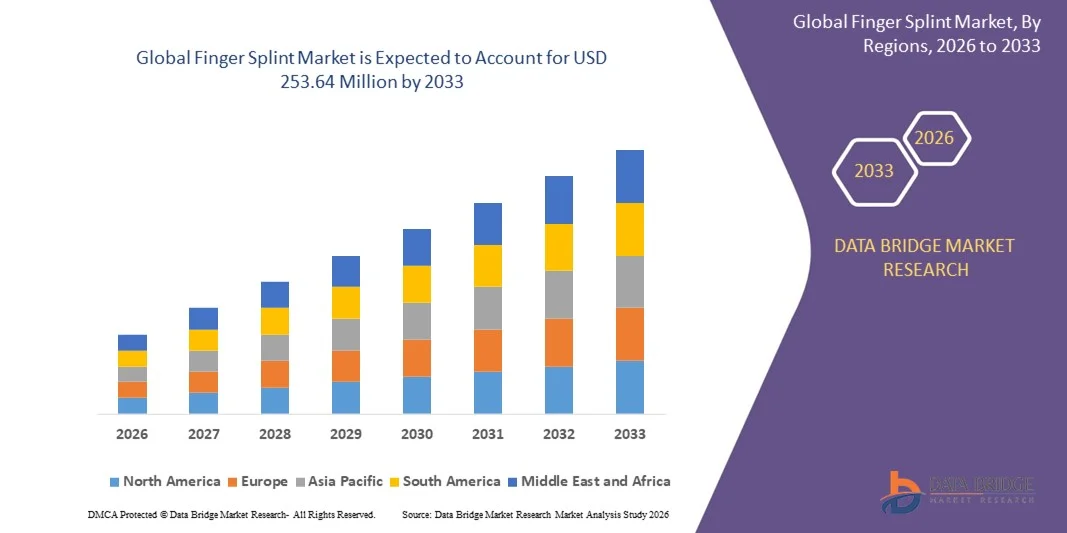
- As per Data Bridge Market Research Analysis the global finger splint market size was valued at USD 146.52 million in 2025 and is expected to reach USD 253.64 million by 2033, at a CAGR of7.10% during the forecast period
- Rising incidences of accidental and adventure related injuries and increasing personal disposable income are the major factors fostering the growth of the market
Market Size & Forecast
- Global Market Value (2025): USD 146.52 million
- Expected Market Value (2033): USD 253.64 million
- Forecast CAGR (2026–2033): 7.10%
What are the Major Takeaways of Finger Splint Market?
- Growth and expansion of healthcare and medical devices industry especially in the developing economies, surge in the participation of youngsters and different kinds of sports, growing number of surgical operations and rise in the research and development activities are some other indirect market growth determinants
- Growing penetration of e-commerce platforms, increased inclination towards purchasing new and advanced medical products, rising geriatric population and rising globalization and westernization will also create lucrative and remunerative market growth opportunities in the long run
- Asia-Pacific dominated the Finger Splint market with a 42.05% revenue share in 2025, driven by a large patient population, rising incidence of finger injuries, arthritis, and sports-related hand trauma, along with expanding access to orthopedic care across China, India, Japan, South Korea, and Southeast Asia
- North America is projected to register the fastest CAGR of 9.78% from 2026 to 2033, driven by high diagnosis rates of finger injuries, strong adoption of advanced orthopedic solutions, and growing preference for home-based rehabilitation across the U.S. and Canada
- The Trigger Finger Splint segment dominated the market with a 34.6% share in 2025, driven by the rising prevalence of trigger finger conditions among the aging population, office workers, and individuals engaged in repetitive hand movements
Report Scope and Finger Splint Market Segmentation
|
Attributes |
Finger Splint Key Market Insights |
|
Segments Covered |
|
|
Countries Covered |
North America
Europe
Asia-Pacific
Middle East and Africa
South America
|
|
Key Market Players |
|
|
Market Opportunities |
|
|
Value Added Data Infosets |
In addition to the insights on market scenarios such as market value, growth rate, segmentation, geographical coverage, and major players, the market reports curated by the Data Bridge Market Research also include in-depth expert analysis, pricing analysis, brand share analysis, consumer survey, demography analysis, supply chain analysis, value chain analysis, raw material/consumables overview, vendor selection criteria, PESTLE Analysis, Porter Analysis, and regulatory framework. |
What is the Key Trend in the Finger Splint Market?
Increasing Shift Toward Lightweight, Ergonomic, and Custom-Fit Finger Splints
- The finger splint market is witnessing growing adoption of lightweight, low-profile, and ergonomically designed splints aimed at improving patient comfort and long-term compliance
- Manufacturers are increasingly introducing custom-molded, adjustable, and anatomically contoured finger splints using advanced materials such as thermoplastics, aluminum composites, and breathable fabrics
- Rising demand for home-based rehabilitation, post-injury care, and non-invasive orthopedic solutions is driving the use of finger splints across hospitals, clinics, and homecare settings
- For instance, companies such as Zimmer Biomet, DJO, OTTOBOCK, THUASNE, and Bird & Cronin have expanded their portfolios with custom-fit, removable, and easy-to-adjust finger splints
- Increasing focus on early mobility, faster recovery, and patient-centric orthopedic care is accelerating the shift toward customizable and easy-to-wear finger splint solutions
- As musculoskeletal injuries and hand-related disorders rise, Finger Splints will remain essential for effective immobilization, rehabilitation, and injury management
What are the Key Drivers of Finger Splint Market?
- Rising prevalence of finger fractures, ligament injuries, arthritis, tendon injuries, and sports-related hand trauma is driving sustained demand for finger splints
- For instance, in 2024–2025, leading orthopedic companies such as Zimmer Biomet, DeRoyal Industries, and ORFIT INDUSTRIES NV launched enhanced splint designs focused on comfort, durability, and clinical effectiveness
- Growing adoption of non-surgical treatment approaches and outpatient orthopedic care is increasing usage across hospitals, rehabilitation centers, and homecare environments
- Advancements in material science, 3D molding, and breathable support structures have improved splint flexibility, hygiene, and patient adherence
- Rising geriatric population and increasing incidence of osteoarthritis and repetitive strain injuries are creating consistent demand for finger immobilization devices
- Supported by expanding orthopedic care infrastructure and rehabilitation awareness, the Finger Splint market is expected to witness steady long-term growth
Which Factor is Challenging the Growth of the Finger Splint Market?
- High costs associated with custom-molded, advanced material-based, and premium orthopedic splints limit adoption in price-sensitive healthcare settings
- For instance, during 2024–2025, fluctuations in raw material prices and medical-grade polymers increased manufacturing costs for several global splint manufacturers
- Improper fitting and lack of clinical guidance can lead to patient discomfort, reduced compliance, and suboptimal treatment outcomes
- Limited awareness in emerging markets regarding correct usage, benefits, and rehabilitation protocols slows market penetration
- Competition from alternative immobilization solutions such as taping, soft supports, and compression gloves creates pricing pressure
- To address these challenges, companies are focusing on cost-efficient designs, clinician training, and patient education, supporting broader adoption of Finger Splints
How is the Finger Splint Market Segmented?
The market is segmented on the basis of product type, size, material, application, price range, and distribution channel.
- By Product Type
On the basis of product type, the Finger Splint market is segmented into Finger Extension Splints, Thumb Spica Splints, Finger Cot Splints, Frog Splints, Trigger Finger Splints, and Mallet Finger Splints. The Trigger Finger Splint segment dominated the market with a 34.6% share in 2025, driven by the rising prevalence of trigger finger conditions among the aging population, office workers, and individuals engaged in repetitive hand movements. These splints are widely used for pain relief, tendon stabilization, and non-surgical treatment, supporting strong adoption across hospitals and homecare settings.
The Mallet Finger Splints segment is expected to grow at the fastest CAGR from 2026 to 2033, supported by increasing sports-related finger injuries and higher diagnosis rates of tendon injuries. Growing awareness regarding early immobilization and improved recovery outcomes is further accelerating demand for mallet finger splints.
- By Material
On the basis of material, the Finger Splint market is segmented into Aluminium, Foam, Plastic, Thermoplastic, Fabric and Rubber, and Neoprene. The Aluminium segment dominated the market with a 38.2% share in 2025, owing to its durability, lightweight nature, and ability to provide firm immobilization for fractures and ligament injuries. Aluminium splints are widely preferred in emergency care, orthopedic clinics, and sports injury management due to their cost-effectiveness and ease of molding.
The Thermoplastic segment is projected to grow at the fastest CAGR from 2026 to 2033, driven by increasing demand for custom-fit, heat-moldable splints that enhance patient comfort and compliance. Advancements in medical-grade thermoplastics and growing preference for personalized orthopedic solutions are supporting rapid growth.
- By Application
On the basis of application, the Finger Splint market is segmented into Sports, Medical, and Others. The Medical segment dominated the market with a 52.8% share in 2025, supported by widespread use of finger splints in hospitals, orthopedic clinics, rehabilitation centers, and homecare settings. Rising incidence of arthritis, fractures, tendon injuries, and post-surgical immobilization continues to drive strong demand within the medical segment.
The Sports segment is expected to grow at the fastest CAGR from 2026 to 2033, fueled by increasing participation in sports, fitness activities, and recreational athletics. Growing awareness of injury prevention, faster recovery, and protective orthopedic support is boosting adoption among athletes and sports medicine professionals.
- By Price Range
On the basis of price range, the Finger Splint market is segmented into Under USD 10, USD 10–USD 50, and Above USD 50. The USD 10–USD 50 segment dominated the market with a 46.3% share in 2025, as it offers an optimal balance between affordability, durability, and clinical effectiveness. This price range includes a wide variety of aluminum, plastic, and thermoplastic splints suitable for both medical and homecare use.
The Above USD 50 segment is anticipated to grow at the fastest CAGR from 2026 to 2033, driven by rising demand for premium, custom-molded, and clinically advanced finger splints. Increasing focus on comfort, long-term use, and specialized rehabilitation solutions is supporting growth in higher-priced products.
- By Distribution Channel
On the basis of distribution channel, the Finger Splint market is segmented into Online and Offline. The Offline segment dominated the market with a 61.7% share in 2025, driven by strong reliance on hospitals, orthopedic clinics, pharmacies, and medical supply stores for splint purchases. Clinical recommendations, proper fitting assistance, and immediate product availability support offline dominance.
The Online segment is expected to grow at the fastest CAGR from 2026 to 2033, fueled by increasing e-commerce penetration, rising homecare adoption, and availability of a wide range of affordable splints. Convenience, competitive pricing, and growing digital health awareness are accelerating online sales growth.
Which Region Holds the Largest Share of the Finger Splint Market?
- Asia-Pacific dominated the Finger Splint market with a 42.05% revenue share in 2025, driven by a large patient population, rising incidence of finger injuries, arthritis, and sports-related hand trauma, along with expanding access to orthopedic care across China, India, Japan, South Korea, and Southeast Asia. Increasing awareness of early immobilization, growing adoption of non-surgical treatments, and improving healthcare infrastructure continue to fuel demand for finger splints across hospitals, clinics, and homecare settings
- Leading manufacturers in the region are introducing cost-effective, lightweight, and mass-market finger splints, supporting widespread adoption across both urban and semi-urban areas. Strong presence of local manufacturers and expanding medical device distribution networks further strengthen regional leadership
- Rising healthcare expenditure, expanding geriatric population, and growing sports participation reinforce Asia-Pacific’s dominance in the global Finger Splint market
China Finger Splint Market Insight
China is the largest contributor to Asia-Pacific, supported by high volumes of orthopedic injuries, rapid growth in hospital infrastructure, and strong domestic manufacturing capabilities. Increasing prevalence of arthritis, workplace hand injuries, and sports trauma drives demand for affordable and durable finger splints. Government support for medical device production and competitive pricing further boost market penetration.
Japan Finger Splint Market Insight
Japan shows steady growth driven by an aging population and high prevalence of musculoskeletal disorders. Strong emphasis on preventive care, rehabilitation, and high-quality medical products supports adoption of premium and custom-fit finger splints. Advanced healthcare systems and patient compliance further sustain long-term market growth.
India Finger Splint Market Insight
India is emerging as a major growth hub due to rising road accidents, sports participation, and expanding access to orthopedic care. Growing awareness of early treatment, increasing availability of low-cost splints, and rapid expansion of online medical supply platforms accelerate market adoption across the country.
South Korea Finger Splint Market Insight
South Korea contributes significantly due to rising sports injuries, strong healthcare infrastructure, and increasing focus on rehabilitation and recovery solutions. Demand for ergonomic, comfortable, and reusable finger splints continues to grow across hospitals and sports medicine facilities.
North America Finger Splint Market
North America is projected to register the fastest CAGR of 9.78% from 2026 to 2033, driven by high diagnosis rates of finger injuries, strong adoption of advanced orthopedic solutions, and growing preference for home-based rehabilitation across the U.S. and Canada. Increasing participation in sports and fitness activities, along with rising incidence of arthritis and repetitive strain injuries, is accelerating demand for finger splints.
U.S. Finger Splint Market Insight
The U.S. leads North America, supported by advanced healthcare infrastructure, high healthcare spending, and strong presence of global orthopedic device manufacturers. Growing demand for custom-fit, premium, and clinically validated finger splints, along with expanding outpatient and homecare treatment models, continues to drive rapid market growth.
Canada Finger Splint Market Insight
Canada contributes to regional growth through rising awareness of musculoskeletal health, expanding rehabilitation services, and strong adoption of non-invasive orthopedic treatments. Supportive reimbursement policies and growing focus on patient comfort further enhance market expansion.
Which are the Top Companies in Finger Splint Market?
The finger splint industry is primarily led by well-established companies, including:
- Zimmer Biomet (U.S.)
- DJO, LLC (U.S.)
- OTTOBOCK (Germany)
- THUASNE (France)
- DeRoyal Industries, Inc. (U.S.)
- Alimed Inc. (U.S.)
- Tynorindia (India)
- Corflex (U.S.)
- Bird & Cronin, LLC (U.S.)
- ORFIT INDUSTRIES NV (Belgium)
- Silver Ring Splint (U.S.)
- Ortholife Global (India)
- Dynatronics Corporation (U.S.)
- MediBuddy (India)
What are the Recent Developments in Global Finger Splint Market?
- In September 2022, Field Orthopaedics announced a global distribution partnership with Medartis Inc, a specialist in head and extremity orthopedic solutions, to incorporate its NX Nail system into Medartis’ hand surgery portfolio, significantly expanding international market access and strengthening global growth prospects for the product
- In September 2021, health-tech company Dassiet introduced UCAST, an innovative thermoplastic splint designed to modernize hospital-based fracture treatment, offering a five-minute application time compared to up to 30 minutes for traditional casts, while providing lightweight, breathable, and patient-safe performance, thereby improving clinical efficiency and patient comfort

- Interactive Data Analysis Dashboard
- Company Analysis Dashboard for high growth potential opportunities
- Research Analyst Access for customization & queries
- Competitor Analysis with Interactive dashboard
- Latest News, Updates & Trend analysis
- Harness the Power of Benchmark Analysis for Comprehensive Competitor Tracking
Data collection and base year analysis are done using data collection modules with large sample sizes. The stage includes obtaining market information or related data through various sources and strategies. It includes examining and planning all the data acquired from the past in advance. It likewise envelops the examination of information inconsistencies seen across different information sources. The market data is analysed and estimated using market statistical and coherent models. Also, market share analysis and key trend analysis are the major success factors in the market report. To know more, please request an analyst call or drop down your inquiry.
The key research methodology used by DBMR research team is data triangulation which involves data mining, analysis of the impact of data variables on the market and primary (industry expert) validation. Data models include Vendor Positioning Grid, Market Time Line Analysis, Market Overview and Guide, Company Positioning Grid, Patent Analysis, Pricing Analysis, Company Market Share Analysis, Standards of Measurement, Global versus Regional and Vendor Share Analysis. To know more about the research methodology, drop in an inquiry to speak to our industry experts.
Data Bridge Market Research is a leader in advanced formative research. We take pride in servicing our existing and new customers with data and analysis that match and suits their goal. The report can be customized to include price trend analysis of target brands understanding the market for additional countries (ask for the list of countries), clinical trial results data, literature review, refurbished market and product base analysis. Market analysis of target competitors can be analyzed from technology-based analysis to market portfolio strategies. We can add as many competitors that you require data about in the format and data style you are looking for. Our team of analysts can also provide you data in crude raw excel files pivot tables (Fact book) or can assist you in creating presentations from the data sets available in the report.