


First-in-Class Oncology Drug Market Size
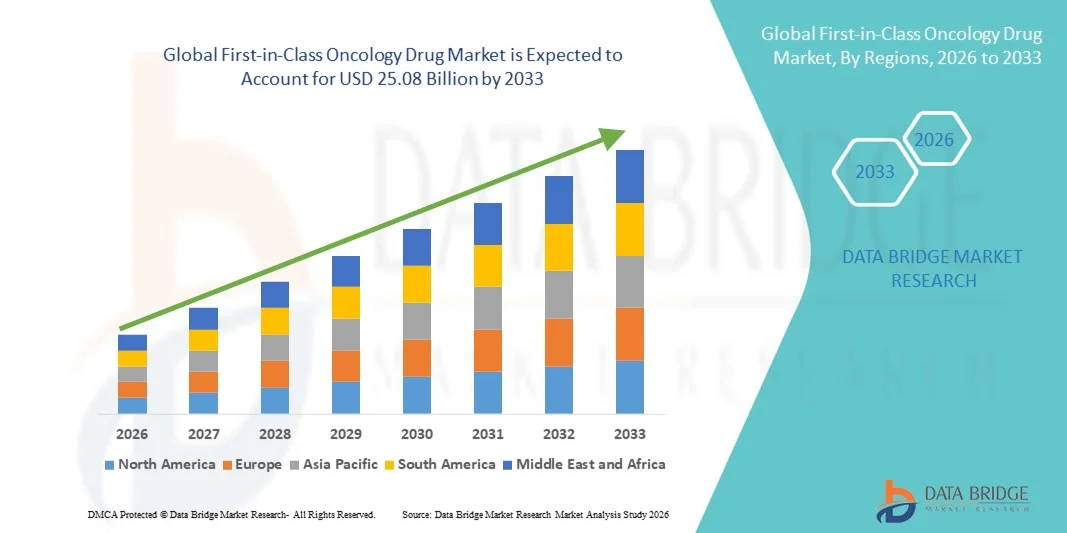
- The global first-in-class oncology drug market size was valued at USD 8.67 billion in 2025 and is expected to reach USD 25.08 billion by 2033, at a CAGR of14.20% during the forecast period
- The market growth is largely fueled by rapid advancements in drug discovery technologies, high unmet medical needs in oncology, and innovative mechanisms of action that offer therapeutic benefits over existing treatments, driving adoption across healthcare providers and research institutions
- Furthermore, rising demand for targeted therapies, personalized medicine, and first-in-class drugs for difficult-to-treat cancers is accelerating the uptake of these oncology solutions, thereby significantly boosting the overall growth of the industry
First-in-Class Oncology Drug Market Analysis
- First‑in‑Class Oncology Drugs innovative cancer therapies featuring novel mechanisms of action that represent the first approved treatments in their class — are increasingly vital in advancing targeted cancer care, improving survival rates, and offering therapeutic options where conventional treatments have limited efficacy
- The escalating demand for first‑in‑class oncology drugs is primarily driven by rising global cancer incidence, strong investment in oncology R&D, favorable regulatory support for breakthrough therapies, and growing adoption of precision medicine to address unmet clinical needs
- North America dominated the first‑in‑class oncology drug market with the largest revenue share of approximately 44% in 2025, supported by advanced healthcare infrastructure, high R&D expenditure, a strong pipeline of innovative oncology candidates, and significant regulatory approvals in the United States
- Asia‑Pacific is expected to be the fastest‑growing region in the first‑in‑Class Oncology Drug market during the forecast period due to rising healthcare investment, expanding access to cancer care, increasing clinical trial activity, and growing demand for innovative therapies in countries such as China and India
- The Solid Tumors segment dominated the largest market revenue share of approximately 63% in 2025, driven by the high prevalence of cancers such as lung, breast, colorectal, and prostate cancers
Report Scope and First-in-Class Oncology Drug Market Segmentation
|
Attributes |
First-in-Class Oncology Drug Key Market Insights |
|
Segments Covered |
|
|
Countries Covered |
North America
Europe
Asia-Pacific
Middle East and Africa
South America
|
|
Key Market Players |
|
|
Market Opportunities |
|
|
Value Added Data Infosets |
In addition to the insights on market scenarios such as market value, growth rate, segmentation, geographical coverage, and major players, the market reports curated by the Data Bridge Market Research also include in-depth expert analysis, patient epidemiology, pipeline analysis, pricing analysis, and regulatory framework. |
First-in-Class Oncology Drug Market Trends
Increasing Incidence of Cancer Worldwide
- The rising global prevalence of cancer continues to be a primary driver for the First-in-Class Oncology Drug market, as healthcare providers increasingly seek innovative treatments to improve patient survival and quality of life
- For instance, In 2025, over 19.3 million new cancer cases were reported worldwide, creating strong demand for therapies that can address both common and rare cancers effectively
- The growing burden of oncology diseases, including lung, breast, colorectal, and hematological cancers, is prompting hospitals and clinics to prioritize cutting-edge treatment options
- Demographic shifts, such as aging populations in developed regions and urbanization in emerging economies, are further contributing to the rising cancer incidence, expanding the patient pool for first-in-class drugs
- Healthcare providers are also increasingly focusing on early diagnosis and screening programs, which raise the demand for advanced therapies that can complement early detection efforts
- Patients and caregivers are becoming more aware of novel treatment options, boosting demand for first-in-class drugs with improved efficacy and tolerability profiles
- Pharmaceutical companies are expanding their oncology pipelines with breakthrough therapies, targeting unmet medical needs, which further supports market growth
- Increased funding for national cancer programs and international collaborations for research enhances accessibility to new therapies, enabling faster adoption of first-in-class oncology drugs
First-in-Class Oncology Drug Market Dynamics
Driver
Supportive Regulatory Environment and Investment in Oncology R&D
- Governments and regulatory authorities worldwide are providing incentives for oncology drug development, including accelerated approval programs, orphan drug designations, and breakthrough therapy pathway
- For instance, In 2025, the U.S. FDA granted breakthrough therapy designation to multiple innovative oncology drugs, enabling faster clinical trials and market entry
- Increased public and private investment in oncology research is supporting the development of novel first-in-class drugs, particularly in immunotherapy, cell therapy, and targeted treatments
- Collaborations between pharmaceutical companies, academic institutions, and CROs are facilitating access to specialized research expertise, advanced trial designs, and novel drug candidates
- Regulatory harmonization in regions such as North America, Europe, and Asia-Pacific is reducing time-to-market for innovative therapies and encouraging multinational clinical trials
- Incentives and grants for oncology research in emerging markets are driving investment and enabling local production and commercialization of advanced therapies
- The increasing focus on precision medicine and biomarker-driven therapies by regulators ensures that first-in-class drugs are validated with strong clinical evidence, fostering trust and adoption among healthcare providers
- Overall, these supportive policies and investments create a favorable environment for first-in-class oncology drug innovation and commercialization globally
Restraint/Challenge
High Development Costs and Clinical Trial Complexities
- The development of first-in-class oncology drugs is capital-intensive, with costs often exceeding USD 2 billion per therapy, due to extensive preclinical research, multi-phase clinical trials, and regulatory compliance requirements
- For instance, delays in patient recruitment, complex trial protocols, or adverse events can significantly increase costs and extend development timelines, impacting ROI for smaller companies
- High pricing of first-in-class therapies may limit patient access, particularly in low- and middle-income countries, affecting market penetration
- Intense competition in the oncology market, with multiple companies developing similar targeted therapies, adds pressure on pricing and adoption rates
- The complexity of clinical trial design, especially for rare cancers or biomarker-specific patient populations, often leads to slower enrollment and higher dropout rates
- Payer reimbursement challenges, including stringent insurance coverage criteria, can restrict adoption of high-cost first-in-class therapies
- Managing manufacturing complexities and ensuring consistent quality of novel biologics or cell-based therapies adds to the overall development risk
- Overcoming these challenges requires strategic partnerships, government incentives, public-private collaborations, and innovative financing models to make therapies more accessible while sustaining continued R&D investment
- Companies are also increasingly exploring adaptive trial designs and real-world evidence generation to reduce costs, accelerate approval, and mitigate clinical risks
First-in-Class Oncology Drug Market Scope
The market is segmented on the basis of drug type and cancer type.
- By Drug Type
On the basis of drug type, the Global First-in-Class Oncology Drug market is segmented into Small Molecule Drugs and Biologics. The Small Molecule Drugs segment dominated the largest market revenue share of approximately 58% in 2025, driven by their established presence in oncology treatment protocols, ease of oral administration, and broad applicability across multiple cancer types. Small molecule drugs are widely used in both solid tumors and hematologic cancers, providing targeted inhibition of specific cellular pathways and enzymes. The high adoption of small molecules is supported by well-established clinical trial data, regulatory approvals, and physician familiarity. Hospitals, oncology centers, and research institutes rely on these drugs for first-line and adjuvant therapies. Their cost-effectiveness compared with biologics and compatibility with combination therapies further enhance adoption. Strong R&D pipelines for next-generation kinase inhibitors, PARP inhibitors, and other targeted therapies continue to expand clinical use. Emerging markets, particularly in Asia-Pacific, are witnessing increasing uptake due to growing cancer incidence and improved healthcare infrastructure. Integration into national formularies and insurance coverage in developed regions supports widespread adoption. Continuous improvements in formulation, bioavailability, and reduced toxicity profiles contribute to sustained market leadership.
The Biologics segment is expected to witness the fastest CAGR of 22% from 2026 to 2033, driven by rising investment in monoclonal antibodies, immune checkpoint inhibitors, CAR-T therapies, and other innovative biologic treatments. Biologics are increasingly used for both solid tumors and hematologic cancers due to their specificity, ability to modulate immune responses, and suitability for personalized medicine approaches. Rapid advances in biotechnology, protein engineering, and cellular therapy platforms are fueling pipeline expansion. Rising demand for targeted and immuno-oncology therapies in North America, Europe, and Asia-Pacific supports adoption. Biologics are also favored in clinical trial programs and precision oncology initiatives. Increasing government and private funding, coupled with regulatory incentives for orphan and first-in-class drugs, accelerates market growth. Biologics provide opportunities for combination therapy regimens with chemotherapeutics and small molecules, enhancing clinical efficacy. Expansion of manufacturing capabilities and decreasing costs of production improve accessibility. Patient preference for therapies with fewer side effects and higher specificity contributes to adoption. Collaboration between biotech firms and academic research institutions strengthens pipeline development. Rising awareness among oncologists and patients about novel immunotherapies supports accelerated uptake globally.
- By Cancer Type
On the basis of cancer type, the Global First-in-Class Oncology Drug market is segmented into Solid Tumors and Hematologic Cancers. The Solid Tumors segment dominated the largest market revenue share of approximately 63% in 2025, driven by the high prevalence of cancers such as lung, breast, colorectal, and prostate cancers. Solid tumor treatments benefit from extensive R&D in targeted therapies, kinase inhibitors, and immune checkpoint inhibitors. Hospitals and oncology centers favor approved small molecule and biologic drugs for first-line, adjuvant, and neoadjuvant therapy regimens. Rising cancer screening programs and early detection initiatives globally support high adoption. Established clinical guidelines and strong reimbursement frameworks in North America and Europe reinforce market dominance. Integration of molecular profiling and precision medicine enhances patient-specific therapy selection. The segment also benefits from growing awareness about combination therapies and the adoption of novel treatment strategies. Collaboration between academic institutions and pharmaceutical companies accelerates clinical development. Increasing investment in outpatient oncology services expands access. Continuous innovation in drug formulation, delivery methods, and safety profiles strengthens adoption. Patient-centric treatment strategies, including oral regimens and targeted therapies, further drive usage.
The Hematologic Cancers segment is expected to witness the fastest CAGR of 21% from 2026 to 2033, fueled by rapid advancements in biologics, CAR-T therapy, monoclonal antibodies, and other targeted therapies. Hematologic cancers, including leukemia, lymphoma, and myeloma, increasingly rely on precision medicine and immuno-oncology approaches. Rising incidence rates, particularly in North America and Asia-Pacific, create significant demand. Adoption is supported by clinical trials, government and private funding, and expanded regulatory approvals for first-in-class drugs. Integration with diagnostic biomarkers, genomic profiling, and personalized therapy protocols further accelerates uptake. Hematologic cancer therapies benefit from innovative manufacturing technologies, reduced toxicity profiles, and combination regimens. The segment is expanding in emerging markets due to growing healthcare infrastructure and oncology expertise. Collaboration between biotech companies, hospitals, and research institutes supports pipeline development. Patient preference for targeted, less invasive treatments contributes to adoption. Ongoing research into cellular therapies, bispecific antibodies, and novel biologics ensures sustained market growth globally.
First-in-Class Oncology Drug Market Regional Analysis
- North America dominated the first-in-class oncology drug market with the largest revenue share of approximately 44% in 2025, supported by advanced healthcare infrastructure, high R&D expenditure, a strong pipeline of innovative oncology candidates, and significant regulatory approvals in the United States. The region benefits from well-established oncology centers, leading pharmaceutical companies, and comprehensive reimbursement frameworks
- Early adoption of precision medicine, targeted therapies, and immuno-oncology treatments further strengthens the market. Growing patient awareness, routine cancer screening programs, and integration of molecular diagnostics enhance treatment outcomes. Collaborative efforts between hospitals, research institutes, and biotech firms accelerate first-in-class drug development. The prevalence of both solid tumors and hematologic cancers, coupled with advanced clinical trial networks, encourages rapid adoption of novel therapies
- Access to skilled oncology specialists, cutting-edge laboratory infrastructure, and government support for cancer research reinforces the market’s leadership. Continuous innovations in small molecule drugs and biologics expand therapeutic options. Strong healthcare IT adoption facilitates integration with electronic medical records (EMR) and treatment monitoring. The combination of regulatory support, market maturity, and patient-centric care underpins sustained growth in the region
U.S. First-in-Class Oncology Drug Market Insight
The U.S. first-in-class oncology drug market captured the largest revenue share within North America in 2025, driven by a robust pipeline of fst-in-class oncology drugs, high regulatory approvals, and extensive clinical trial activity. Adoption of targeted therapies, immuno-oncology treatments, and combination regimens is rapidly increasing across hospitals, research centers, and specialized oncology clinics. Reimbursement policies, government funding for innovative therapies, and early detection programs accelerate uptake. Pharmaceutical companies focus on small molecule inhibitors, monoclonal antibodies, and CAR-T therapies to address both solid and hematologic cancers. High patient awareness, established healthcare infrastructure, and advanced laboratory networks further contribute to growth. Collaborative partnerships between academia, biotech, and pharma accelerate R&D, regulatory submission, and commercialization of novel therapies. Rising cancer prevalence and personalized treatment approaches continue to drive demand for first-in-class drugs.
Europe First-in-Class Oncology Drug Market Insight
The Europe first-in-class oncology drug market is projected to expand at a substantial CAGR throughout the forecast period, supported by advanced healthcare systems, increasing adoption of molecular diagnostics, and favorable reimbursement policies for innovative therapies. Growing research collaborations, precision oncology programs, and patient access initiatives are accelerating adoption. Hospitals and diagnostic centers increasingly integrate biologics and small molecule therapies for both solid and hematologic cancers.
U.K. First-in-Class Oncology Drug Market Insight
The U.K. first-in-class oncology drug market is anticipated to grow at a noteworthy CAGR during the forecast period, driven by government-supported cancer screening programs, increasing patient awareness, and adoption of innovative targeted therapies. Oncology centers and research hospitals favor precision medicine and combination treatment strategies. Collaboration between NHS hospitals and pharmaceutical firms enhances access to first-in-class drugs.
Germany First-in-Class Oncology Drug Market Insight
Germany first-in-class oncology drug market is expected to expand at a considerable CAGR during the forecast period, fueled by strong healthcare infrastructure, adoption of advanced molecular diagnostics, and integration of first-in-class drugs into standard oncology protocols. Clinical trial activity, precision medicine initiatives, and government-backed reimbursement support adoption. Hospitals, research centers, and biotech collaborations drive innovation in small molecule and biologic therapies.
Asia-Pacific First-in-Class Oncology Drug Market Insight
Asia-Pacific first-in-class oncology drug market is expected to be the fastest-growing region in the First-in-Class Oncology Drug market during the forecast period, with a notable CAGR driven by rising healthcare investment, expanding access to cancer care, increasing clinical trial activity, and growing demand for innovative therapies in countries such as China and India. Rapid urbanization, government initiatives for cancer treatment, and improving healthcare infrastructure accelerate adoption.
China First-in-Class Oncology Drug Market Insight
China first-in-class oncology drug market accounted for the largest revenue share in Asia-Pacific in 2025, supported by expanding healthcare infrastructure, growing middle-class population, increasing cancer prevalence, and rising investment in precision oncology programs. Adoption of small molecules, biologics, and immuno-oncology therapies is increasing, facilitated by local production and government incentives for innovative drugs.
Japan First-in-Class Oncology Drug Market Insight
Japan first-in-class oncology drug market is gaining momentum due to its high-tech healthcare ecosystem, aging population, and growing focus on precision medicine. Hospitals and research institutes adopt advanced molecular diagnostics and biologic therapies. Government support, early cancer screening programs, and increased clinical trial activity accelerate adoption of first-in-class oncology drugs across both solid and hematologic cancers.
First-in-Class Oncology Drug Market Share
The First-in-Class Oncology Drug industry is primarily led by well-established companies, including:
- Roche (Switzerland)
- Novartis (Switzerland)
- Bristol-Myers Squibb (U.S.)
- Merck & Co. (U.S.)
- Pfizer (U.S.)
- AstraZeneca (U.K.)
- Johnson & Johnson (U.S.)
- AbbVie (U.S.)
- Amgen (U.S.)
- Bayer (Germany)
- Takeda Pharmaceutical (Japan)
- Sanofi (France)
- Gilead Sciences (U.S.)
- GlaxoSmithKline (U.K.)
- Boehringer Ingelheim (Germany)
- Eli Lilly (U.S.)
- Regeneron Pharmaceuticals (U.S.)
- Seagen (U.S.)
- BeiGene (China)
- Incyte Corporation (U.S.)
Latest Developments in Global First-in-Class Oncology Drug Market
- In August 2021, Disitamab vedotin (Aidixi), a first‑in‑class antibody‑drug conjugate targeting HER2‑positive cancers, received its initial approval in China for HER2‑overexpressing gastric cancer, becoming one of the earliest first‑in‑class ADCs developed domestically and paving the way for expanded global oncology research
- In January 2025, the U.S. Food and Drug Administration approved Datopotamab deruxtecan‑dlnk (Datroway) — a first‑in‑class TROP‑2‑directed antibody‑drug conjugate for adults with unresectable or metastatic hormone receptor‑positive, HER2‑negative breast cancer who have received prior endocrine‑based therapy and chemotherapy. This approval marked a significant advance in targeted therapy for metastatic breast cancer and expanded options for patients with limited treatment alternatives
- In December 2024, the U.S. Food and Drug Administration granted accelerated approval to Zenocutuzumab (Bizengri) — the first FDA‑approved systemic therapy for adults with advanced, unresectable or metastatic non‑small cell lung cancer or pancreatic adenocarcinoma harboring neuregulin 1 (NRG1) gene fusions. This breakthrough represented the first targeted treatment for NRG1‑fusion cancers, addressing an unmet need in precision oncology
- In April 2025, Penpulimab (AK105) received U.S. approval for non‑keratinizing nasopharyngeal carcinoma, expanding the global availability of this PD‑1 inhibitory agent and supporting its classification as a first‑in‑class immuno‑oncology drug in certain regions
- In June 2025, BioNTech and Bristol Myers Squibb announced a major collaboration to co‑develop BNT327, an experimental antibody for solid tumors such as lung and breast cancer. The USD1.5 billion upfront commitment with potential milestone payments signals a strong strategic push to accelerate first‑in‑class oncology drug development through global partnership
- In May 2025, multiple oncology drugs including Imfinzi (durvalumab) and Pluvicto (lutetium‑177 vipivotide tetraxetan) received expanded FDA approvals for new indications in areas such as muscle‑invasive bladder cancer and PSMA‑positive prostate cancer, reflecting ongoing regulatory momentum for targeted oncology therapies that often involve first‑in‑class mechanisms or novel combinations

- Interactive Data Analysis Dashboard
- Company Analysis Dashboard for high growth potential opportunities
- Research Analyst Access for customization & queries
- Competitor Analysis with Interactive dashboard
- Latest News, Updates & Trend analysis
- Harness the Power of Benchmark Analysis for Comprehensive Competitor Tracking
Data collection and base year analysis are done using data collection modules with large sample sizes. The stage includes obtaining market information or related data through various sources and strategies. It includes examining and planning all the data acquired from the past in advance. It likewise envelops the examination of information inconsistencies seen across different information sources. The market data is analysed and estimated using market statistical and coherent models. Also, market share analysis and key trend analysis are the major success factors in the market report. To know more, please request an analyst call or drop down your inquiry.
The key research methodology used by DBMR research team is data triangulation which involves data mining, analysis of the impact of data variables on the market and primary (industry expert) validation. Data models include Vendor Positioning Grid, Market Time Line Analysis, Market Overview and Guide, Company Positioning Grid, Patent Analysis, Pricing Analysis, Company Market Share Analysis, Standards of Measurement, Global versus Regional and Vendor Share Analysis. To know more about the research methodology, drop in an inquiry to speak to our industry experts.
Data Bridge Market Research is a leader in advanced formative research. We take pride in servicing our existing and new customers with data and analysis that match and suits their goal. The report can be customized to include price trend analysis of target brands understanding the market for additional countries (ask for the list of countries), clinical trial results data, literature review, refurbished market and product base analysis. Market analysis of target competitors can be analyzed from technology-based analysis to market portfolio strategies. We can add as many competitors that you require data about in the format and data style you are looking for. Our team of analysts can also provide you data in crude raw excel files pivot tables (Fact book) or can assist you in creating presentations from the data sets available in the report.












