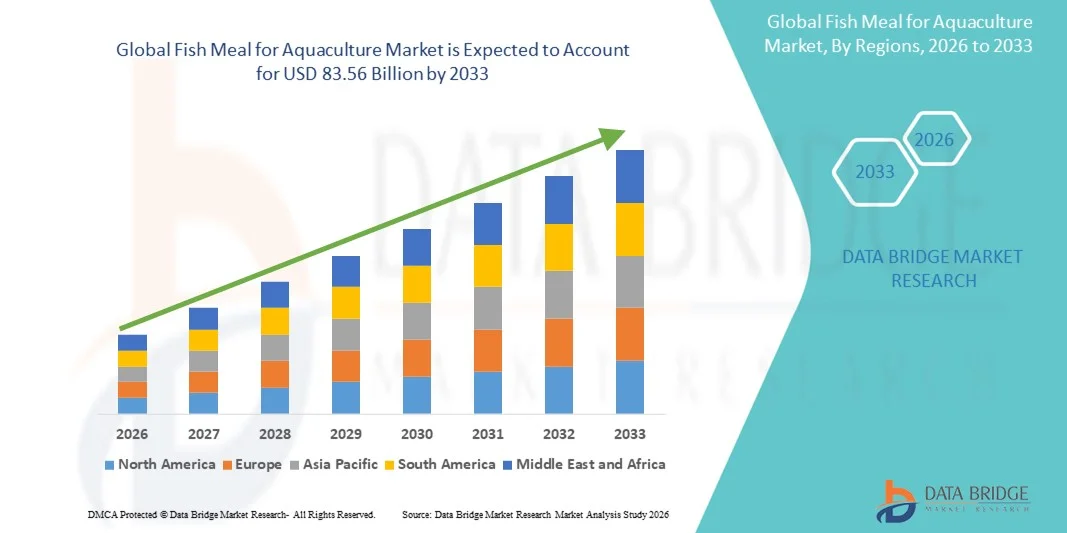
What is the Global Fish Meal for Aquaculture Market Size and Growth Rate?
- The global fish meal for aquaculture market size was valued at USD 48.27 billion in 2025 and is expected to reach USD 83.56 billion by 2033, at a CAGR of 7.10% during the forecast period
- The increasing incorporation of fishmeal in swine and poultry diets is largely flourishing the growth of the fish meal for aquaculture market over the forecast period of 2021 to 2028. The improving production and environmental performance of aquaculture will also accelerate the demand for fish meal for aquaculture market
- Likewise, increasing demand for naturally sourced protein additive in animal feed, growing awareness regarding the advantages of fish meal and increasing consumption of animal products such as fish meat are some of key determinants expected to drive the fish meal for aquaculture market growth.
What are the Major Takeaways of Fish Meal for Aquaculture Market?
- The fishmeal consists of high amounts of necessary amino acids and protein, that can be easily digested by the livestock, counting aquatic animals which will also have positive impact the fish meal for aquaculture market
- However, the EL Niño effect leading in higher prices and microbial contamination in aquafeed as well as the irregularity in regulatory structure will limit the growth of fish meal for aquaculture market in the above mentioned forecast period, whereas the increasing usage of alternative feed ingredients and rise in the number of substitutes for fishmeal have the potential to challenge the growth of the fish meal for aquaculture market
- Asia-Pacific dominated the fish meal for aquaculture market with a 41.6% revenue share in 2025, supported by large-scale aquaculture production in China, Vietnam, India, Indonesia, and Thailand
- North America is projected to register the fastest CAGR of 11.69% from 2026 to 2033, driven by rising demand for premium, nutrient-rich fish meal used in salmon farming, specialty aquaculture, and high-protein livestock feed
- The Organic segment is expected to grow at the fastest CAGR between 2026 and 2033, driven by rising demand for premium, chemical-free feed ingredients in high-value aquaculture systems such as organic shrimp, trout, and salmon farming
Report Scope and Fish Meal for Aquaculture Market Segmentation
|
Attributes |
Fish Meal for Aquaculture Key Market Insights |
|
Segments Covered |
|
|
Countries Covered |
North America
Europe
Asia-Pacific
Middle East and Africa
South America
|
|
Key Market Players |
|
|
Market Opportunities |
|
|
Value Added Data Infosets |
In addition to the insights on market scenarios such as market value, growth rate, segmentation, geographical coverage, and major players, the market reports curated by the Data Bridge Market Research also include in-depth expert analysis, pricing analysis, brand share analysis, consumer survey, demography analysis, supply chain analysis, value chain analysis, raw material/consumables overview, vendor selection criteria, PESTLE Analysis, Porter Analysis, and regulatory framework. |
What is the Key Trend in the Fish Meal for Aquaculture Market?
Rising Demand for Nutrient-Enriched and Sustainable Alternative Fish Meal for Aquaculture
- The fish meal for aquaculture market is experiencing a strong shift toward nutrient-fortified formulations, sustainable sourcing, and alternative protein inputs such as plant-based proteins, microbial proteins, and insect meals to reduce pressure on wild-caught fish stocks
- For instance, companies such as Calysta, Aker BioMarine, and Nutreco have expanded their portfolios with fermented proteins, krill-based nutrition, and low-impact feed ingredients to enhance digestibility and growth performance in shrimp, salmon, and other farmed species
- Rising industry focus on environmental sustainability, improved feed conversion ratios (FCRs), and disease resistance is supporting the adoption of specialized functional fish meals
- Manufacturers are integrating advanced processing technologies, including enzymatic hydrolysis and precision drying, to improve nutrient retention and protein bioavailability
- Increased R&D in omega-3 concentration, amino acid balancing, and anti-oxidation stabilization is accelerating innovation in aquaculture feed formulations
- As global aquaculture expands toward high-value species, nutrient-enriched and eco-friendly fish meal products are expected to remain central to feed optimization and sustainable seafood production
What are the Key Drivers of Fish Meal for Aquaculture Market?
- Growing demand for high-protein, highly digestible feed ingredients to support rapid growth, immunity, and production efficiency in aquaculture species is driving global fish meal consumption
- For instance, in 2025, companies such as Oceana Group and TASA increased production of premium fish meal grades targeting salmon farming, shrimp feed, and marine species
- Rising focus on sustainable aquaculture, clean-label feed ingredients, and high omega-3 content across Asia-Pacific, Europe, and Latin America is contributing to market growth
- Technological advancements in enzymatic processing, fermentation, lipid extraction, and nutrient stabilization are improving product quality, consistency, and shelf life
- Increasing integration of fish meal into intensive farming systems, larval feed formulas, and functional health-focused feed blends strengthens global adoption
- With continuous investment in R&D, sustainable raw material sourcing, and precision aquaculture, the Fish Meal for Aquaculture market is expected to maintain robust growth in the coming years
Which Factor is Challenging the Growth of the Fish Meal for Aquaculture Market?
- High production costs due to raw fish supply fluctuations, climate-related catch variations, and the use of premium nutrient-enhancing technologies pose affordability challenges for emerging markets
- For instance, during 2024–2025, anchoveta catch limitations in Peru and seasonal restrictions in China affected global fish meal availability and pricing
- Stringent regulatory standards related to marine resource management, sustainability certifications, and traceability compliance increase operational complexity for manufacturers
- Limited awareness in developing regions about the benefits of specialized, high-quality fish meal restricts the transition from low-cost alternatives to premium aquafeed ingredients
- Competition from soy protein concentrates, insect meal, algae meal, and other alternative proteins creates pricing and sourcing pressure for traditional fish meal producers
- To overcome these challenges, companies are adopting responsible fishing practices, automated processing systems, and diversified protein sourcing to deliver consistent, sustainable, and cost-effective fish meal for aquaculture
How is the Fish Meal for Aquaculture Market Segmented?
The market is segmented on the basis of nature, source, livestock species source, and application.
- By Nature
The Fish Meal for Aquaculture market is segmented into Organic and Conventional. The Conventional segment dominated the market with a revenue share of 72.4% in 2025, driven by large-scale industrial production, wider raw material availability, and cost-efficient processing. Conventional fish meal continues to be preferred by commercial aquafeed manufacturers due to consistent nutrient profiles, high protein digestibility, and affordability. Continuous improvements in sourcing traceability, marine sustainability certifications, and standardized processing technologies are further supporting market adoption.
The Organic segment is expected to grow at the fastest CAGR between 2026 and 2033, driven by rising demand for premium, chemical-free feed ingredients in high-value aquaculture systems such as organic shrimp, trout, and salmon farming. Increasing consumer preference for organic seafood, stricter sustainability regulations, and the growth of eco-labeled aquaculture programs are fueling the demand for organically sourced fish meal globally.
- By Source
Based on source, the market is segmented into Salmon & Trout, Marine Fish, Crustaceans, Tilapia, Carps, and Others. The Marine Fish segment dominated the market with a revenue share of 64.1% in 2025, owing to abundant availability of species such as anchovy, sardines, and menhaden, which provide high-quality protein, amino acids, and omega-3 fatty acids essential for aquaculture feed. Marine fish meal is widely used in salmon, shrimp, and marine species farming due to superior nutrient density and digestibility.
The Crustaceans segment is projected to grow at the fastest CAGR from 2026 to 2033, driven by increasing utilization of shrimp and crab by-products in circular economy-based fish meal production. Enhanced biochemical properties, improved FCR performance, and lower environmental impact are strengthening its adoption in specialized aquafeed formulations worldwide.
- By Livestock
On the basis of livestock, the market is segmented into Ruminants, Poultry, Swine, Aquatic Animals, and Others. The Aquatic Animals segment dominated the market with a revenue share of 68.7% in 2025, supported by rising aquaculture production of shrimp, salmon, tilapia, seabass, and carp. Fish meal is a critical protein source for aquatic species owing to its high digestibility, balanced amino acid profile, and growth-enhancing properties.
The Poultry segment is expected to register the fastest CAGR between 2026 and 2033, driven by increasing use of fish meal to enhance egg production, feather growth, immunity, and overall nutrient absorption. Growing interest in specialty poultry feed, fortified broiler diets, and sustainable protein alternatives is accelerating adoption across emerging markets. Diversification in feed formulations and rising protein demand in livestock production are further boosting market growth.
- By Species Source
The market is categorized into Anchovy, Blue Whiting, Sardines, Capelin, Menhaden, Norway Pout, Sandeel, Sprat, and Others. The Anchovy segment dominated the market with a revenue share of 41.9% in 2025, primarily due to Peru and Chile’s strong anchoveta fisheries, which supply high-quality fish meal with excellent digestibility and omega-3 content. Anchovy-based fish meal is widely preferred in global aquafeed due to consistent availability and superior nutritional properties.
The Sprat segment is predicted to grow at the fastest CAGR from 2026 to 2033, supported by expanding production in Europe and increasing utilization in sustainable aquafeed formulations. Rising emphasis on diversified species sourcing and reduced reliance on anchovy stocks is further boosting demand for sprat-based fish meal.
- By Application
On the basis of application, the market is segmented into Animal Feed, Dietary Supplements, Pharmaceutical, and Fertilisers. The Animal Feed segment dominated the market with a revenue share of 79.5% in 2025, driven by heavy usage of fish meal in aquaculture feed, poultry feed, and specialty livestock nutrition. Its high protein, essential amino acids, and omega-3 concentration make it indispensable for maintaining growth performance and feed efficiency.
The Pharmaceutical segment is expected to grow at the fastest CAGR between 2026 and 2033, propelled by increasing use of refined fish meal derivatives in omega-3 extraction, therapeutic formulations, and health supplements. Rising R&D in marine-based bioactives and advancements in purification technologies are further promoting adoption in nutraceutical and pharmaceutical applications.
Which Region Holds the Largest Share of the Fish Meal for Aquaculture Market?
- Asia-Pacific dominated the fish meal for aquaculture market with a 41.6% revenue share in 2025, supported by large-scale aquaculture production in China, Vietnam, India, Indonesia, and Thailand. High demand for high-protein feed ingredients, expanding fish farming operations, and increased adoption of nutrient-dense fish meal varieties strengthen regional leadership
- Leading producers in the region emphasize sustainable sourcing, advanced processing technologies, and improved fishery management to meet the growing demand from shrimp, carp, tilapia, and marine species farming
- Expanding aquafeed manufacturing capacity, government programs promoting seafood exports, and rising investments in high-performance feeds continue to support Asia-Pacific’s dominance in the global market
North America Fish Meal for Aquaculture Market Insight (Fastest Growing)
North America is projected to register the fastest CAGR of 11.69% from 2026 to 2033, driven by rising demand for premium, nutrient-rich fish meal used in salmon farming, specialty aquaculture, and high-protein livestock feed. The region benefits from strong research capabilities, sustainable fishing regulations, and expanding aquafeed production. Increasing adoption of omega-3-rich fish meal and enhanced feed formulations fuels steady growth across the U.S. and Canada.
U.S. Fish Meal for Aquaculture Market Insight
The U.S. leads the region due to high demand from salmon, trout, and hybrid striped bass farming. Strong focus on functional, high-protein aquafeed, advanced processing technologies, and sustainable sourcing drives consumption. Expanding partnerships between feed manufacturers and fisheries, along with strict quality standards, support market growth across commercial aquaculture and specialty feed applications.
Canada Fish Meal for Aquaculture Market Insight
Canada contributes significantly, supported by its growing salmon aquaculture industry, especially in British Columbia and Atlantic provinces. Increasing use of high-quality fish meal in cold-water species feed formulations, combined with strong regulatory frameworks and sustainable fishery management, strengthens the market. Rising investments in next-generation feed and omega-3-rich ingredients further boost adoption.
Europe Fish Meal for Aquaculture Market Insight
Europe holds a substantial market share, driven by high demand for premium aquafeed in Norway, Denmark, Iceland, the U.K., and Germany. Stringent sustainability standards, technological advancements in fish meal processing, and strong marine resource management support stable production. The region’s focus on high-value species such as salmon and sea bass fuels strong demand for high-protein fish meal.
Germany Fish Meal for Aquaculture Market Insight
Germany shows consistent demand, driven by its growing aquafeed processing sector and strong import requirements for high-quality fish meal. The country relies on nutrient-dense fish meal for marine species and specialty feed applications. Investments in sustainable sourcing, feed R&D, and premium livestock nutrition continue to support growth.
U.K. Fish Meal for Aquaculture Market Insight
The U.K. market remains steady, supported by expanding aquaculture operations and rising preference for protein-rich, sustainable feed formulations. Demand is driven by salmon and trout farming industries, while strong import networks ensure consistent availability of high-quality fish meal. Sustainability initiatives and modern feed technologies reinforce long-term growth.
Which are the Top Companies in Fish Meal for Aquaculture Market?
The fish meal for aquaculture industry is primarily led by well-established companies, including:
- Croda International Plc (U.K.)
- Omega Protein Corporation (U.S.)
- Calysta, Inc. (U.S.)
- TASA (Peru)
- Oceana Group Limited (South Africa)
- Austevoll Seafood ASA (Norway)
- Pioneer Fishing (South Africa)
- Lallemand Inc. (Canada)
- NOVUS INTERNATIONAL (U.S.)
- Köster Marine Proteins GmbH (Germany)
- AKER BIOMARINE ANTARCTIC AS (Norway)
- Alpha Atlantique (Morocco)
- ADM Animal Nutrition (U.S.)
- AngelYeast Co., Ltd. (China)
- Mukka Sea Food Industries Limited (India)
- Colpex International S.A.C. (Peru)
- Nutreco N.V. (Netherlands)
- Orizon Foods (Chile)
- The Scoular Company (U.S.)
- Raj Fishmeal and Oil Company (India)
What are the Recent Developments in Global Fish Meal for Aquaculture Market?
- In April 2024, SINTEF Energy initiated an EU-funded project focused on converting forestry waste into high-value products for the fish feed sector, marking a key step toward sustainable feed innovation. This development is expected to boost eco-friendly feed production in the coming years
- In March 2024, Poseidon Ocean Systems, headquartered in Campbell River, British Columbia, secured approximately USD 20.75 Million in a Series B funding round led by Ecosystem Integrity Fund to advance technologies that enhance fish welfare and minimize ecosystem disruption. This funding is anticipated to accelerate the deployment of sustainable aquaculture solutions
- In February 2024, Innovafeed inaugurated its North American Insect Innovation Center in Illinois, U.S., to expand the production and commercialization of insect-based protein for fish feed across the region. This milestone is set to strengthen the supply of alternative protein sources in the aquaculture industry
- In August 2023, Pelagin introduced ProAllo, an advanced fishmeal designed to improve fish resilience by supporting allostasis and reducing stress from environmental variations and handling. This innovation is expected to significantly enhance growth performance and feed efficiency in commercial aquaculture
- In May 2023, Scoular acquired the Northwest Farm Food Cooperative’s frozen fish processing facility in Burlington to process fish trimmings into frozen ingredients for pet food manufacturers, complementing its new joint-venture fishmeal plant in Warrenton, Oregon. This acquisition is such asly to strengthen Scoular’s year-round supply of sustainable fish ingredients

- Interactive Data Analysis Dashboard
- Company Analysis Dashboard for high growth potential opportunities
- Research Analyst Access for customization & queries
- Competitor Analysis with Interactive dashboard
- Latest News, Updates & Trend analysis
- Harness the Power of Benchmark Analysis for Comprehensive Competitor Tracking
Data collection and base year analysis are done using data collection modules with large sample sizes. The stage includes obtaining market information or related data through various sources and strategies. It includes examining and planning all the data acquired from the past in advance. It likewise envelops the examination of information inconsistencies seen across different information sources. The market data is analysed and estimated using market statistical and coherent models. Also, market share analysis and key trend analysis are the major success factors in the market report. To know more, please request an analyst call or drop down your inquiry.
The key research methodology used by DBMR research team is data triangulation which involves data mining, analysis of the impact of data variables on the market and primary (industry expert) validation. Data models include Vendor Positioning Grid, Market Time Line Analysis, Market Overview and Guide, Company Positioning Grid, Patent Analysis, Pricing Analysis, Company Market Share Analysis, Standards of Measurement, Global versus Regional and Vendor Share Analysis. To know more about the research methodology, drop in an inquiry to speak to our industry experts.
Data Bridge Market Research is a leader in advanced formative research. We take pride in servicing our existing and new customers with data and analysis that match and suits their goal. The report can be customized to include price trend analysis of target brands understanding the market for additional countries (ask for the list of countries), clinical trial results data, literature review, refurbished market and product base analysis. Market analysis of target competitors can be analyzed from technology-based analysis to market portfolio strategies. We can add as many competitors that you require data about in the format and data style you are looking for. Our team of analysts can also provide you data in crude raw excel files pivot tables (Fact book) or can assist you in creating presentations from the data sets available in the report.