


What is Fishing Boat Market Size and Growth Rate ?
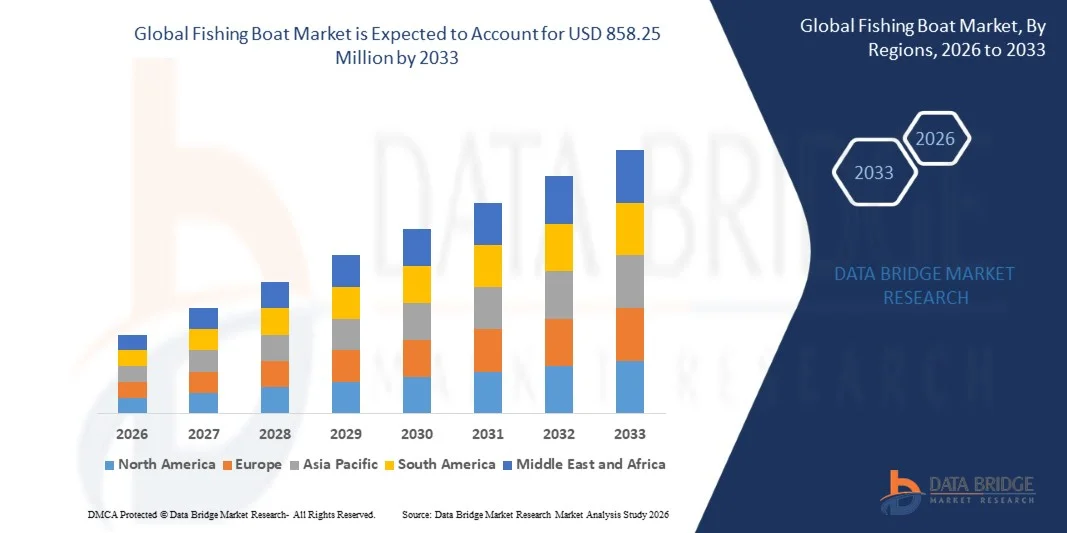
- As per Data Bridge Market Research Analysis the Global fishing boat market size was valued at USD 494.62 Million in 2025 and is expected to reach USD 858.25 Million by 2033, at a CAGR of 7.3% during the forecast period
- The Global fishing boat market comprises the design, manufacturing, distribution, and commercialization of fishing boats used for recreational, sport, and small-scale commercial fishing across freshwater and coastal environments. These boats are developed in various configurations based on boat type, hull material, propulsion systems, and power output to suit different applications such as angling, sport fishing, and leisure activities. The market includes both standardized and customized vessels equipped with features such as navigation systems, fish-finding technologies, and safety equipment to enhance operational efficiency, performance, and user experience.
- The market encompasses a broad range of offerings, including complete boats, hull systems, propulsion units, and aftermarket services such as maintenance, repair, and upgrades. It serves diverse end users, including individual boat owners, recreational anglers, fishing clubs, charter fishing operators, and rental or tourism service providers. Distribution occurs through OEM direct sales, authorized dealers, and aftermarket channels such as marine equipment retailers and online platforms. Furthermore, ongoing developments in advanced materials, electrification of marine propulsion, and smart marine technologies are expected to drive market expansion, supported by rising disposable incomes and increasing investments in marine and leisure infrastructure globally.
Market Size & Forecast
- Global Market Value (2025): USD 494.62 Billion
- Expected Market Value (2033): USD 858.25 Billion
- Forecast CAGR (2026–2033): 7.3%
What are the Major Takeaways of Fishing Boat Market ?
- The global fishing boat market is experiencing steady growth, driven by increasing participation in recreational fishing, rising marine tourism activities, and growing demand for leisure boating experiences. The expanding middle-class population and rising disposable incomes are encouraging consumers to invest in personal fishing boats, particularly in developed and coastal economies. In Australia, the market is further supported by a strong fishing culture, well-developed coastal infrastructure, and increasing interest in sport fishing and family-oriented water activities, contributing to sustained demand across various boat types and sizes.
- Technological advancements are playing a crucial role in shaping the competitive landscape of the market. The integration of advanced marine electronics such as GPS navigation systems, sonar and fish-finding technologies, and digital control interfaces is enhancing the efficiency, safety, and overall boating experience. Additionally, manufacturers are focusing on the development of lightweight and durable hull materials such as aluminum, fiberglass, and composites to improve fuel efficiency and performance. The growing adoption of high-performance and fuel-efficient outboard engines, along with emerging trends such as electric and hybrid propulsion systems, is further driving innovation in the market.
- Despite favorable growth conditions, the market faces certain challenges, including high initial costs associated with boat ownership, maintenance expenses, and regulatory compliance related to marine safety and environmental standards. Seasonal demand fluctuations and limited accessibility to certain water bodies may also impact market growth. To overcome these challenges, key players are focusing on product innovation, expanding distribution networks, and offering flexible ownership and rental models. With increasing investments in marine infrastructure, rising popularity of outdoor recreational activities, and ongoing advancements in boat design and propulsion technologies, the Global fishing boat market is expected to witness sustained growth in the coming years.
- Australia’s fishing boat market is projected to grow at a CAGR of around 6.0% during the forecast period, supported by strong commercial fishing activity and a well-established seafood export industry. Growth is driven by increasing demand for advanced, fuel-efficient vessels and modernization of aging fleets. Government regulations promoting sustainable fishing practices are also encouraging investment in newer, eco-friendly boats. Additionally, rising recreational fishing and marine tourism contribute to steady market expansion.
- In 2026, the aluminum fishing boats segment is expected to dominate the global fishing boat market with a 15.96% share due to their lightweight structure, high durability, and resistance to corrosion, making them ideal for both freshwater and saltwater use. Their lower maintenance requirements and longer lifespan compared to traditional materials further boost adoption. Additionally, aluminum boats offer better fuel efficiency and ease of handling, which appeals to both commercial and recreational users. Increasing innovation in design and manufacturing is also supporting their widespread preference.
Report Scope and Global Fishing Boat Market Segmentation
|
Attributes |
Global Fishing Boat Key Market Insights |
|
Segments Covered |
|
|
Key Market Players |
|
|
Market Opportunities |
|
|
Value Added Data Infosets |
In addition to the market insights such as market value, growth rate, market segments, geographical coverage, market players, and market scenario, the market report curated by the Data Bridge Market Research team includes in-depth expert analysis, import/export analysis, pricing analysis, production consumption analysis, and pestle analysis. |
What is the Key Trend in Fishing Boat Market ?
“Rising Global Seafood Demand and Strong Australia’s Seafood Export Industry”
- The global fishing boat market is fundamentally supported by the sustained increase in seafood consumption, driven by population growth, rising income levels, and the growing recognition of fish as a high-protein, healthy food source. According to the FAO, global seafood production is projected to continue rising, with consumption of aquatic food increasing steadily as aquaculture expands and captures a larger share of supply. This structural demand growth directly strengthens the need for modern fishing vessels capable of supporting both capture fisheries and aquaculture-linked operations. In parallel, Australia plays a significant role as a high-value seafood exporter, particularly in premium products such as rock lobster, tuna, abalone, and prawns. Although export volumes face periodic fluctuations due to pricing and trade dynamics, the sector remains export-oriented and dependent on efficient fishing fleets to maintain competitiveness in global markets. Australian fisheries and aquaculture production continues to be shaped by strong international demand, reinforcing investment in vessel modernization and operational efficiency. Together, these global and regional demand dynamics create a sustained requirement for efficient, technologically advanced fishing boats that can improve catch efficiency, reduce costs, and meet international quality and sustainability standards.
For instance,
- In November 2025, WorldPorts.org reported, citing the Food and Agriculture Organization (FAO), that global seafood production is projected to reach 197 million tonnes in 2025, driven primarily by rising seafood consumption and the continued expansion of aquaculture. The report highlighted that demand for seafood for direct human consumption continues to grow steadily, supported by population growth and shifting dietary preferences toward protein-rich food sources. This trend is directly related to the driver, as increasing global seafood consumption is boosting demand for fishing vessels and marine harvesting capacity.
- In March 2024, Australia’s Department of Agriculture, Fisheries and Forestry (DAFF) reported that fisheries and aquaculture production value reached AUD 3.56 billion, with aquaculture and wild-catch sectors contributing significantly to both domestic supply and exports. The report also noted that export performance is closely tied to global seafood demand and price trends. This is directly related to the driver as Australia’s fishing fleet capacity is strongly influenced by export-oriented seafood demand.
- In November 2025, FAO highlighted that the global fisheries and aquaculture trade value is expected to reach USD 193.3 billion, reflecting a 5% year-on-year increase driven by stronger international demand for seafood products. This supports the driver by showing how rising global trade value translates into increased demand for efficient fishing operations and vessel deployment.
- In March 2024, DAFF (Australia) highlighted that aquaculture and fisheries exports remain concentrated in premium species such as rock lobster and abalone, with Australia accounting for a major share of global supply in certain categories. This export specialization increases reliance on advanced fishing fleets capable of maintaining product quality for international markets.
- Rising global seafood demand, combined with Australia’s strong export-oriented fisheries sector, remains a core structural driver of the fishing boat market. Increasing consumption of seafood across global markets is expanding production requirements, while Australia’s dependence on high-value seafood exports reinforces the need for efficient, technologically advanced vessels. Together, these dynamics ensure sustained investment in fishing fleets, supporting both fleet expansion and modernization across global and Australian markets.
Fishing Boat Market Dynamics
Driver
Growth Of Aquaculture and Marine Industries
- The rapid growth of aquaculture and broader marine industries is reshaping the global fishing boat market by expanding the scope of vessel usage beyond traditional wild-capture fishing. Aquaculture has become the fastest-growing food production segment globally, driven by rising seafood demand, declining wild fish stocks, and increasing technological advancements in offshore farming systems. This shift has created strong demand for specialized boats used in fish farming operations, including feed transport vessels, harvesting boats, monitoring craft, and service vessels for offshore aquaculture farms. At the same time, marine industries such as offshore energy, marine research, and coastal infrastructure development are increasingly relying on multi-purpose workboats, further broadening the commercial fishing boat ecosystem.
For instance,
- In June 2024, Reuters reported that the FAO stated global aquaculture production reached 130.9 million tonnes, surpassing wild capture fisheries for the first time, marking a major shift in global seafood supply. This reflects aquaculture’s growing dominance as a primary source of fish for human consumption. The expansion of aquaculture is driving demand for specialized marine vessels, including fish farming support boats, feed transport vessels, and harvesting craft. As aquaculture operations become more widespread and intensive, the need for purpose-built service boats is rising, thereby strengthening the global fishing boat market.
- In June 2024, FAO (The State of World Fisheries and Aquaculture report) confirmed that global fisheries and aquaculture production reached 223.2 million tonnes in 2022, driven largely by aquaculture expansion. This growth reflects rising dependence on marine-based food production systems, which in turn boosts demand for aquaculture support boats, transport vessels, and monitoring crafts used across marine industries.
- In 2025, the Australian Government Department of Agriculture, Fisheries and Forestry (DAFF) reported that in 2024–25, Australia’s aquaculture production reached $2.31 billion, accounting for up to 58% of the total seafood sector value. This highlights the increasing dominance of aquaculture within Australia’s seafood industry. The sector’s strong growth is driving greater investment in specialized marine vessels, including farm support boats, feeding vessels, and offshore operational craft. These vessels are essential for maintaining and servicing expanding coastal aquaculture zones across Australia.
- In March 2024, DAFF projected continued growth in Australia’s aquaculture sector, with production value expected to increase to $2.21 billion by 2028–29. This sustained growth supports expansion of marine farming infrastructure and associated vessel fleets, particularly in Tasmania and South Australia, where aquaculture operations are concentrated.
- Overall, the expansion of aquaculture and marine industries is fundamentally reshaping the fishing boat market by shifting demand from traditional capture fishing toward specialized marine support operations. Strong global production growth, combined with Australia’s rapidly expanding aquaculture sector, is driving continuous demand for technologically advanced, multi-functional vessels. This structural transformation ensures long-term growth opportunities for fishing boat manufacturers and marine equipment suppliers worldwide.
Restraint/Challenge
High Capital and Operating Costs
- High capital investment and rising operating expenses significantly restrain the growth of the global fishing boat market. Fishing vessels require substantial upfront investment due to advanced hull construction, engine systems, navigation electronics, and safety equipment. Costs vary widely depending on vessel size and capability, with commercial fishing boats ranging from hundreds of thousands to tens of millions of dollars, creating a strong entry barrier for small and medium operators. Financing challenges further restrict fleet expansion, especially for independent fishers and small-scale operators who struggle to access affordable credit and insurance support. In addition to capital expenditure, ongoing operational costs such as fuel, labor, maintenance, insurance, and compliance costs remain persistently high and volatile. Fuel price fluctuations are particularly impactful, as fishing operations are highly fuel-intensive and often operate in remote offshore waters. Maintenance of engines, gear systems, refrigeration units, and electronic monitoring systems adds further financial pressure. In Australia, where fishing zones are vast and vessels often travel long distances, these cost pressures are even more pronounced, reducing profit margins and limiting investment in fleet modernization. As a result, rising costs continue to constrain profitability and discourage new entrants into the fishing boat market.
For instance,
- In April 2026, The Guardian reported that rising diesel prices are significantly affecting Australia’s coastal fisheries, forcing many operators to reduce fishing trips, limit operational range, or temporarily dock vessels due to unviable operating costs. This underscores how fuel price volatility directly impacts the economic viability of fishing operations. As a result, vessel utilization declines and profitability weakens, highlighting fuel costs as a critical constraint on the performance and sustainability of the Australian fishing boat sector.
- In March 2026, ABC News (Australia) reported that farmers and commercial fishers are facing doubling fuel and transport costs, with diesel price volatility forcing many operators to reduce fishing activity and warning of potential fuel shortages for trawlers. This shows how rising operating costs are directly limiting vessel deployment and profitability in Australia’s fishing sector.
- In March 2026, SGST News (Australia fishing industry report) reported that fuel prices surged by around 30%, reaching up to A$2.64 per litre, forcing fishers to cut trips and reduce time at sea. Fuel was noted as a major component of operating costs, making fishing voyages economically difficult and reducing vessel utilization.
- In April 2025, BDO Australia (industry economics report) highlighted that renewable diesel options could cost around $3–$5 per litre compared to ~ $2 per litre for fossil diesel, significantly increasing operating costs if adopted. This demonstrates how fuel dependency keeps fishing vessel operations highly cost-sensitive and limits profitability and fleet expansion.
- In March 2026, Reuters (Europe fishing industry report) showed that soaring diesel costs caused up to 80–90% of fuel-intensive fishing fleets to remain docked, as fuel costs exceeded catch value for some operations. This demonstrates how high operating costs can even force partial shutdowns of fishing fleets globally.
- Overall, high capital investment requirements combined with persistent and rising operating costs represent a major structural restraint for the global and Australian fishing boat market. The need for expensive vessel acquisition, along with ongoing expenses such as fuel, maintenance, labor, and insurance, significantly reduces profitability for operators. These financial pressures limit new market entry, slow fleet expansion, and delay modernization, thereby constraining overall market growth despite strong demand for seafood globally.
Fishing Boat Market Scope
The Global fishing boat market is segmented into nine notable segments based on boat type, boat length, hull material, outboard engine configuration, power output (outboard boats), application, water type, end user, and distribution channel.
By boat type
On the basis of boat type, the Global fishing boat market is segmented into Center Console Fishing Boats, Bass Boats, Multi-Species Fishing Boats, Aluminum Fishing Boats, Skiff Boats, Jon Boats, Walkaround Fishing Boats, Bay Boats, Flats Boats, Cuddy Cabin Boats, Ski-and-Fish Boats, and Others. In 2026, the aluminum fishing boats segment is expected to dominate with a market share 15.96% due to their lightweight structure, corrosion resistance, durability, and suitability for both freshwater and coastal fishing applications.
Walkaround fishing boats segment is the fastest-growing segment in the global fishing boat market, with a CAGR of 8.3%, driven by their versatile design that combines open-deck fishing space with enclosed cabin comfort. These boats are increasingly preferred for both recreational and offshore fishing due to enhanced safety, weather protection, and multi-purpose usability. Rising interest in extended fishing trips and family-friendly boating experiences further supports demand. Additionally, advancements in onboard amenities and navigation technologies are accelerating adoption.
By boat length
On the basis of boat length, the Global fishing boat market is segmented into 4–5 m Boats, 5–6 m Boats, 6–7 m Boats, and 7–8 m Boats. In 2026, the 5–6 m Boats segment is expected to dominate with a market share 31.92%, due to their optimal balance between maneuverability, fuel efficiency, storage convenience, and versatility across multiple fishing conditions.
5–6 m boats segment is the fastest-growing segment in the global fishing boat market, with a CAGR of 7.6%, driven by their optimal balance between size, affordability, and versatility for both recreational and small-scale commercial fishing. These boats are easy to transport, require lower maintenance, and are suitable for a wide range of water bodies including lakes, rivers, and coastal areas. Growing participation in recreational fishing and increasing demand for compact, fuel-efficient vessels are further supporting growth. Additionally, advancements in lightweight materials and engine efficiency are enhancing their overall appeal.
By hull material
On the basis of hull material, the Global fishing boat market is segmented into Aluminum Boats, Fiberglass Boats, Composite Boats, Polyethylene Boats, and Others. In 2026, the fiberglass boats segment is expected to dominate with a market share 36.76% due to their superior finish, enhanced durability, resistance to harsh marine environments, and ability to support complex boat designs.
Composite boats segment is the fastest-growing in the global fishing boat market, with a CAGR of 7.9%, driven by their superior strength-to-weight ratio, corrosion resistance, and durability in harsh marine environments. These boats offer improved fuel efficiency due to their lightweight structure, making them attractive for both recreational and commercial users. Increasing adoption of advanced composite materials enhances design flexibility and performance. Additionally, lower maintenance requirements and longer service life are further supporting their growing demand.
By outboard engine configuration
On the basis of outboard engine configuration, the Global fishing boat market is segmented into single outboard engine, twin outboard engines and high-power performance outboards. In 2026, the Single Outboard Engine segment is expected to dominate with a market share 54.43%, due to lower acquisition and maintenance costs, ease of operation, and strong suitability for small to mid-sized fishing boats.
High-power performance outboards segment is the fastest-growing in the global fishing boat market, with a CAGR of 7.6%, driven by increasing demand for faster, more powerful vessels capable of offshore and deep-sea fishing operations. These engines provide superior thrust, improved speed, and enhanced load-carrying capacity, making them suitable for professional anglers and charter operators. Growing adoption of advanced propulsion technologies and fuel-efficient high-output engines is further boosting their popularity. Additionally, rising interest in sport fishing and long-range marine excursions is accelerating market growth.
By power output (outboard boats)
On the basis of power output (outboard boats), the Global fishing boat market is segmented into Below 75 HP, 75–150 HP, 150–250 HP, and Above 250 HP. In 2026, the 75–150 HP segment is expected to dominate with a market share 38.71%, due to its ideal balance of power, fuel efficiency, and compatibility with a wide range of recreational and multi-purpose fishing boats.
Above 250 HP segment is the fastest-growing in the global fishing boat market, with a CAGR of 8.0%, driven by increasing demand for high-performance offshore fishing vessels that offer greater speed, enhanced load-carrying capacity, and superior navigation capabilities in deep-sea conditions. Rising popularity of sport fishing and long-distance marine expeditions is further supporting the adoption of high-powered outboard engines.
By application
On the basis of application, the Global fishing boat market is segmented into Recreational Angling, Sport Fishing, Coastal Fishing, Freshwater Fishing, Family Leisure Fishing, and Others. In 2026, the recreational angling segment is expected to dominate with a market share 27.12%, due to growing participation in leisure fishing activities, increasing tourism, and rising consumer interest in outdoor recreation.
Sport fishing segment is the fastest-growing in the global fishing boat market, with a CAGR of 8.4%, driven by rising participation in recreational angling activities and increasing interest in competitive fishing events. Growing demand for high-performance boats equipped with advanced navigation and fishing technologies is further supporting market growth. Expansion of coastal tourism and marine leisure activities is also contributing to higher adoption. Additionally, increasing disposable incomes and preference for premium outdoor experiences are accelerating demand for sport fishing boats.
By water type
On the basis of water type, the Global fishing boat market is segmented into freshwater (lakes, rivers, reservoirs) and coastal/nearshore waters. In 2026, the freshwater segment is expected to dominate with a market share 57.43%, due to wider accessibility, lower operational risks, and higher participation in inland fishing activities.
The coastal/nearshore waters segment is the fastest-growing segment in the global fishing boat market, with a CAGR of 7.8%, driven by rising demand for recreational and commercial fishing activities in shallow marine zones. Increasing adoption of versatile boats suitable for both leisure and small-scale fishing operations is further supporting growth. Additionally, expansion of coastal tourism and guided fishing experiences, along with improved marine infrastructure, is accelerating market demand.
By end user
On the basis of end user, the global fishing boat market is segmented into individual boat owners, recreational anglers, charter fishing operators (small boats), rental / tourism operators, fishing clubs, and others. In 2026, the individual boat owners segment is expected to dominate the market with a 34.79% share, driven by rising disposable incomes, increasing interest in recreational boating, and strong preference for personalized fishing experiences. Growing ownership of compact and mid-sized boats, along with easier financing options and improved availability of recreational marine infrastructure, is further supporting segment growth.
The charter fishing operators (small boats) segment is the fastest-growing segment in the global fishing boat market, with a CAGR of 8.0%, driven by increasing demand for guided fishing experiences and professional recreational services. Growing popularity of tourism-based fishing activities and adventure travel is encouraging more operators to expand small-boat fleets. Rising preference for cost-effective shared fishing trips compared to private ownership is further boosting demand. Additionally, improvements in marine safety, booking platforms, and boat availability are accelerating segment growth.
By distribution channel
On the basis of distribution channel, the global fishing boat market is segmented into aftermarket and direct sales (OEM). In 2026, the aftermarket segment is expected to dominate with a market share of 58.18%, due to the strong demand for replacement parts, maintenance services, upgrades, and refurbishment of existing boats. Increasing focus on extending vessel lifespan and improving performance through retrofitting and customization is further supporting growth. Additionally, the expanding network of independent marine dealers, service centers, and online marketplaces is making aftermarket solutions more accessible to boat owners.
Direct sales (OEM) segment is the fastest-growing segment in the global fishing boat market, with a CAGR of 7.8%, driven by increasing preference for customized and factory-fitted boats tailored to specific end-user requirements. Growing demand for advanced technology integration, including modern navigation systems and fuel-efficient engines, is encouraging buyers to purchase directly from manufacturers. Expansion of online OEM platforms and company-owned dealerships is further improving accessibility and customer reach. Additionally, strong manufacturer incentives, warranties, and after-sales support are boosting direct sales adoption.
Global Fishing Boat Market Regional Analysis
Australia accounting for 15.66% of the total share in 2025, due to its strong marine industry presence, extensive coastline supporting commercial and recreational fishing activities, and high demand for advanced fishing boats. The country’s well-developed seafood export sector and growing recreational boating culture further contribute to market expansion. Additionally, increasing investments in modern, fuel-efficient vessels and supportive government regulations promoting sustainable fishing practices are driving adoption.
The Major Market Leaders Operating in the Market Are:
- Smoker Craft Inc. (U.S.)
- Duckworth Boats (U.S.)
- Hewescraft Boats (U.S.)
- Thunder Jet Boats (U.S.)
- Wooldridge Boats (U.S.)
- Raider Boats (U.S.)
- KingFisher Boats (Canada)
- Osprey Boats (Canada)
- Silver Boats Ltd. (Finland)
- Linder Aluminium Boats (Sweden)
- Bar Crusher Boats (Australia)
- Makocraft (Australia)
- Formosa Marine (Australia)
- Seajay Boats (Australia)
- Horizon Boats (Australia)
- Stessco Boats (Australia)
- Cruise Craft Boats (Australia)
- Edencraft Boats (Australia)
- Fish City Boats (Australia)
- Platinum Plate Boats (Australia)
Latest Developments in Global Fishing Boat Market
- In August 2024, Smoker Craft introduced multiple new boat models during its 2025 model year dealer event, showcasing innovations across its aluminum fishing and pontoon boat lineup. The event highlighted upcoming product enhancements and reinforced the company’s focus on expanding its portfolio for recreational and fishing segments.
- In August 2025, Hewescraft announced its 2026 model lineup with refreshed design updates, new color options, and continued focus on rugged, all-welded fishing boats built for safety and performance in tough waters.
- In April 2026, KingFisher Boats officially unveiled the 38 GFX, its most advanced and largest offshore adventure boat to date. Launched on April 2, 2026, the 38-foot flagship features next-generation hull design, increased offshore capability, and upgraded luxury living spaces for extended trips at sea.
- In January 2026, Linder Aluminiumbåtar announced its 60th anniversary celebration along with the world premiere of the Arkip 570, marking a milestone in the company’s history while introducing a new model to expand its aluminium boat portfolio.

- Interactive Data Analysis Dashboard
- Company Analysis Dashboard for high growth potential opportunities
- Research Analyst Access for customization & queries
- Competitor Analysis with Interactive dashboard
- Latest News, Updates & Trend analysis
- Harness the Power of Benchmark Analysis for Comprehensive Competitor Tracking
Table of Content
1 INTRODUCTION
1.1 OBJECTIVES OF THE STUDY
1.2 MARKET DEFINITION
1.3 OVERVIEW OF GLOBAL AND AUSTRALIA FISHING BOAT MARKET
1.4 CURRENCY AND PRICING
1.5 LIMITATIONS
1.6 MARKETS COVERED
2 MARKET SEGMENTATION
2.1 MARKETS COVERED
2.2 GEOGRAPHICAL SCOPE
2.3 YEARS CONSIDERED FOR THE STUDY
2.4 DBMR TRIPOD DATA VALIDATION MODEL
2.5 PRIMARY INTERVIEWS WITH KEY OPINION LEADERS
2.6 DBMR MARKET POSITION GRID
2.7 MULTIVARIATE MODELING
2.8 BOAT TYPE TIMELINE CURVE
2.9 MARKET APPLICATION COVERAGE GRID
2.1 SECONDARY SOURCES
2.11 ASSUMPTIONS
3 EXECUTIVE SUMMARY
4 PREMIUM INSIGHTS
4.1 TECHNOLOGICAL ADVANCEMENTS
4.1.1 AI, MACHINE LEARNING & SMART FISH DETECTION SYSTEMS
4.1.2 ADVANCED SONAR, IMAGING & UNDERWATER MONITORING TECHNOLOGIES
4.1.3 IOT, BIG DATA & CONNECTED FISHING ECOSYSTEMS
4.1.4 AUTONOMOUS & UNMANNED FISHING BOATS
4.1.5 SUSTAINABLE & ELECTRIC PROPULSION TECHNOLOGIES
4.1.6 ROBOTICS & AUTOMATED FISH HANDLING SYSTEMS
4.1.7 BLOCKCHAIN & TRACEABILITY TECHNOLOGIES
4.2 ECONOMIC FACTORS
4.2.1 INTEREST RATES
4.2.2 DISPOSABLE INCOMES
4.2.3 INFLATION
4.2.4 GDP
4.2.5 EXCHANGE RATES
4.2.6 UNEMPLOYMENT RATES
4.3 TRADE ANALYSIS: IMPORT AND EXPORT SCENARIO
4.4 REGIONAL DEMAND PATTERNS
4.4.1 ASIA-PACIFIC
4.4.2 NORTH AMERICA
4.4.3 EUROPE
4.4.4 LATIN AMERICA
4.4.5 MIDDLE EAST & AFRICA
4.5 COMPANY COMPARATIVE ANALYSIS: TOP SELLING BOAT BRANDS VS PRICE RANGE
4.6 PRICING ANALYSIS
4.6.1 FUEL EFFICIENCY
4.6.2 HULL DESIGN
4.6.3 ONBOARD ELECTRONICS
4.6.4 SAFETY
4.6.5 PRICE
4.6.6 BRAND IMAGE
4.6.7 HIGH QUALITY
4.6.8 COMFORT FEATURES
4.6.9 AFTER-SALES SERVICE
4.6.10 CUSTOMIZATION OPTIONS
4.7 CONSUMER PURCHASE DECISION PROCESS
4.7.1 CONSUMER PURCHASE DECISION PROCESS – EMEA AUTOMOTIVE WIRING HARNESS MARKET
4.8 KEY STRATEGIC INITIATIVES
4.8.1 FLEET MODERNIZATION AND FUEL-EFFICIENT VESSEL DEVELOPMENT
4.8.2 INTEGRATION OF SUSTAINABLE AND LOW-IMPACT FISHING VESSEL DESIGNS
4.8.3 EXPANSION OF SMALL-SCALE AND ARTISANAL FISHING VESSEL SUPPORT PROGRAMS
4.8.4 DIGITALIZATION AND SMART FISHING VESSEL TECHNOLOGIES
4.8.5 LOCALIZED MANUFACTURING AND REGIONAL BOATBUILDING EXPANSION
4.8.6 ADOPTION OF ALTERNATIVE MATERIALS (FRP, ALUMINUM, HDPE)
4.8.7 AQUACULTURE AND MULTI-PURPOSE VESSEL DEVELOPMENT
4.8.8 REGULATORY COMPLIANCE AND SAFETY UPGRADATION INITIATIVES
4.8.9 STRATEGIC PARTNERSHIPS AND EXPORT-ORIENTED BOATBUILDING GROWTH
4.8.10 CONCLUSION
4.9 SUPPLY CHAIN ANALYSIS
4.9.1 OVERVIEW:
4.9.2 RAW MATERIALS & BOAT MANUFACTURING:
4.9.3 HARVESTING OPERATIONS (FISHING STAGE):
4.9.4 PROCESSING & VALUE ADDITION:
4.9.5 LOGISTICS & COLD CHAIN DISTRIBUTION:
4.9.6 DISTRIBUTION & TRADE NETWORKS:
4.9.7 END-USERS / CONSUMPTION:
4.9.8 CONCLUSION:
5 TARIFFS & IMPACT ON THE MARKET
5.1 OVERVIEW OF RELEVANT TARIFFS
5.2 TRADE POLICIES INFLUENCING THE MARKET
5.3 COST IMPACT ON STAKEHOLDERS
5.4 SUPPLY CHAIN DISRUPTIONS
5.5 STRATEGIC RESPONSE BY OEM
6 MARKET OVERVIEW
6.1 DRIVERS
6.1.1 RISING GLOBAL SEAFOOD DEMAND AND STRONG AUSTRALIA’S SEAFOOD EXPORT INDUSTRY
6.1.2 GROWTH OF AQUACULTURE AND MARINE INDUSTRIES
6.1.3 TECHNOLOGICAL ADVANCEMENTS IN VESSEL SYSTEMS AND DESIGN
6.1.4 GROWTH OF RECREATIONAL AND SPORT FISHING ACTIVITIES
6.2 RESTRAINTS
6.2.1 HIGH CAPITAL AND OPERATING COSTS
6.2.2 DECLINING FISH STOCKS IN SOME REGIONS
6.3 OPPORTUNITIES
6.3.1 DEVELOPMENT OF SUSTAINABLE AND ECO-FRIENDLY VESSELS
6.3.2 EXPANSION INTO EMERGING MARKETS
6.3.3 ADOPTION OF SMART FISHING TECHNOLOGIES
6.4 CHALLENGES
6.4.1 CLIMATE VARIABILITY AND WEATHER DEPENDENCY
6.4.2 SUPPLY CHAIN AND LOGISTICS INEFFICIENCIES
7 GLOBAL FISHING BOAT MARKET, BY BOAT TYPE
7.1 OVERVIEW
7.2 GLOBAL FISHING BOAT MARKET, BY BOAT TYPE, 2018-2033 (USD THOUSAND)
7.2.1 ALUMINUM FISHING BOATS
7.2.2 CENTER CONSOLE FISHING BOATS
7.2.3 BASS BOATS
7.2.4 MULTI-SPECIES FISHING BOATS
7.2.5 BAY BOATS
7.2.6 JON BOATS
7.2.7 SKIFF BOATS
7.2.8 WALKAROUND FISHING BOATS
7.2.9 FLATS BOATS
7.2.10 CUDDY CABIN BOATS
7.2.11 SKI-AND-FISH BOATS
7.2.12 OTHERS
8 GLOBAL FISHING BOAT MARKET, BY BOAT LENGTH
8.1 OVERVIEW
8.2 5–6 M BOATS
8.3 6–7 M BOATS
8.4 4–5 M BOATS
8.5 7–8 M BOATS
9 GLOBAL FISHING BOAT MARKET, BY HULL MATERIAL
9.1 OVERVIEW
9.2 FIBERGLASS BOATS
9.3 ALUMINIUM BOATS
9.4 COMPOSITE BOATS
9.5 POLYETHYLENE BOATS
9.6 OTHERS
10 GLOBAL FISHING BOAT MARKET, BY OUTBOARD ENGINE CONFIGURATION
10.1 OVERVIEW
10.2 SINGLE OUTBOARD ENGINE
10.3 TWIN OUTBOARD ENGINES
10.4 HIGH-POWER PERFORMANCE OUTBOARDS
10.5 GLOBAL SINGLE OUTBOARD ENGINE IN FISHING BOAT MARKET, BY TYPE, 2018-2033 (USD THOUSAND)
10.5.1 50–100 HP
10.5.2 100–150 HP
10.5.3 BELOW 50 HP
10.6 GLOBAL TWIN OUTBOARD ENGINES IN FISHING BOAT MARKET, BY TYPE, 2018-2033 (USD THOUSAND)
10.6.1 100–200 HP
10.6.2 200–300 HP
10.7 GLOBAL HIGH-POWER PERFORMANCE OUTBOARDS IN FISHING BOAT MARKET, BY TYPE, 2018-2033 (USD THOUSAND)
10.7.1 300–450 HP
10.7.2 ABOVE 450 HP
11 GLOBAL FISHING BOAT MARKET, BY POWER OUTPUT (OUTBOARD BOATS)
11.1 OVERVIEW
11.2 75–150 HP
11.3 BELOW 75 HP
11.4 150–250 HP
11.5 ABOVE 250 HP
12 GLOBAL FISHING BOAT MARKET, BY APPLICATION
12.1 OVERVIEW
12.2 RECREATIONAL ANGLING
12.3 FRESHWATER FISHING
12.4 COASTAL FISHING
12.5 FAMILY LEISURE FISHING
12.6 SPORT FISHING
12.7 OTHERS
13 GLOBAL FISHING BOAT MARKET, BY WATER TYPE
13.1 OVERVIEW
13.2 FRESHWATER
13.3 COASTAL / NEARSHORE WATERS
13.4 GLOBAL FRESHWATER IN FISHING BOAT MARKET, BY TYPE, 2018-2033 (USD THOUSAND)
13.4.1 LAKES
13.4.2 RIVERS
13.4.3 RESERVOIRS
14 GLOBAL FISHING BOAT MARKET, BY END USER
14.1 OVERVIEW
14.2 INDIVIDUAL BOAT OWNERS
14.3 RECREATIONAL ANGLERS
14.4 CHARTER FISHING OPERATORS (SMALL BOATS)
14.5 RENTAL / TOURISM OPERATORS
14.6 FISHING CLUBS
14.7 OTHERS
14.8 GLOBAL IN FISHING BOAT MARKET, BY BOAT TYPE, 2018-2033 (USD THOUSAND)
14.8.1 ALUMINUM FISHING BOATS
14.8.2 CENTER CONSOLE BOATS
14.8.3 BASS BOATS
14.8.4 MULTI-SPECIES BOATS
14.8.5 JON BOATS
14.8.6 SKIFF BOATS
14.8.7 BAY BOATS
14.8.8 WALKAROUND BOATS
14.8.9 FLATS BOATS
14.8.10 CUDDY CABIN BOATS
14.8.11 SKI-AND-FISH BOATS
14.8.12 OTHERS
14.9 GLOBAL RECREATIONAL ANGLERS IN FISHING BOAT MARKET, BY BOAT TYPE, 2018-2033 (USD THOUSAND)
14.9.1 CENTER CONSOLE BOATS
14.9.2 ALUMINUM BOATS
14.9.3 BASS BOATS
14.9.4 MULTI-SPECIES BOATS
14.9.5 BAY BOATS
14.9.6 SKIFF BOATS
14.9.7 JON BOATS
14.9.8 WALKAROUND BOATS
14.9.9 FLATS BOATS
14.9.10 CUDDY CABIN BOATS
14.9.11 SKI-AND-FISH BOATS
14.9.12 OTHERS
14.1 GLOBAL CHARTER FISHING OPERATORS (SMALL BOATS) IN FISHING BOAT MARKET, BY BOAT TYPE, 2018-2033 (USD THOUSAND)
14.10.1 CENTER CONSOLE BOATS
14.10.2 WALKAROUND BOATS
14.10.3 MULTI-SPECIES BOATS
14.10.4 ALUMINUM BOATS
14.10.5 BAY BOATS
14.10.6 SKIFF BOATS
14.10.7 FLATS BOATS
14.10.8 CUDDY CABIN BOATS
14.10.9 OTHERS
14.11 GLOBAL RENTAL / TOURISM OPERATORS IN FISHING BOAT MARKET, BY BOAT TYPE, 2018-2033 (USD THOUSAND)
14.11.1 ALUMINUM BOATS
14.11.2 CENTER CONSOLE BOATS
14.11.3 MULTI-SPECIES BOATS
14.11.4 SKIFF BOATS
14.11.5 JON BOATS
14.11.6 WALKAROUND BOATS
14.11.7 BAY BOATS
14.11.8 FLATS BOATS
14.11.9 CUDDY CABIN BOATS
14.11.10 SKI-AND-FISH BOATS
14.11.11 OTHERS
14.12 GLOBAL FISHING CLUBS IN FISHING BOAT MARKET, BY BOAT TYPE, 2018-2033 (USD THOUSAND)
14.12.1 BASS BOATS
14.12.2 CENTER CONSOLE BOATS
14.12.3 ALUMINUM BOATS
14.12.4 MULTI-SPECIES BOATS
14.12.5 BAY BOATS
14.12.6 JON BOATS
14.12.7 SKIFF BOATS
14.12.8 FLATS BOATS
14.12.9 SKI-AND-FISH BOATS
14.12.10 OTHERS
14.13 GLOBAL OTHERS IN FISHING BOAT MARKET, BY BOAT TYPE, 2018-2033 (USD THOUSAND)
14.13.1 ALUMINUM FISHING BOATS
14.13.2 CENTER CONSOLE BOATS
14.13.3 MULTI-SPECIES BOATS
14.13.4 WALKAROUND BOATS
14.13.5 SKIFF BOATS
14.13.6 BAY BOATS
14.13.7 JON BOATS
14.13.8 FLATS BOATS
14.13.9 CUDDY CABIN BOATS
14.13.10 SKI-AND-FISH BOATS
14.13.11 OTHERS
15 GLOBAL FISHING BOAT MARKET, BY DISTRIBUTION CHANNEL
15.1 OVERVIEW
15.2 AFTERMARKET
15.3 DIRECT SALES (OEM)
15.4 GLOBAL AFTERMARKET IN FISHING BOAT MARKET, BY TYPE, 2018-2033 (USD THOUSAND)
15.4.1 BOAT BROKERAGE & RESALE DEALERS
15.4.2 INDEPENDENT MARINE DEALERS
15.4.3 MARINE PARTS & ACCESSORIES RETAILERS
15.4.4 ONLINE BOAT MARKETPLACES
15.4.5 SERVICE & REPAIR PROVIDERS
15.4.6 OTHERS
15.5 GLOBAL DIRECT SALES (OEM) IN FISHING BOAT MARKET, BY TYPE, 2018-2033 (USD THOUSAND)
15.5.1 AUTHORIZED BOAT DEALERS
15.5.2 MARINE EQUIPMENT DEALERS
15.5.3 BOAT SHOW SALES
15.5.4 COMPANY-OWNED WEBSITES
15.5.5 OTHERS
16 GLOBAL AND AUSTRALIA FISHING BOAT MARKET, BY REGION
16.1 GLOBAL
16.2 AUSTRALIA
17 GLOBAL FISHING BOAT MARKET: COMPANY LANDSCAPE
17.1 COMPANY SHARE ANALYSIS: GLOBAL
17.2 COMPANY SHARE ANALYSIS: AUSTRALIA
18 COMPANY PROFILE GLOBAL
18.1 SMOKERCRAFT BOATS.
18.1.1 COMPANY SNAPSHOT
18.1.2 PRODUCT PORTFOLIO
18.1.3 RECENT DEVELOPMENT
18.2 HEWES MARINE COMPANY
18.2.1 COMPANY SNAPSHOT
18.2.2 PRODUCT PORTFOLIO
18.2.3 RECENT DEVELOPMENT
18.3 KINGFISHER BOATS
18.3.1 COMPANY SNAPSHOT
18.3.2 PRODUCT PORTFOLIO
18.3.3 RECENT DEVELOPMENT
18.4 RENAISSANCE MARINE GROUP, INC.
18.4.1 COMPANY SNAPSHOT
18.4.2 PRODUCT PORTFOLIO
18.4.3 RECENT DEVELOPMENT
18.5 WOOLDRIDGE BOATS.
18.5.1 COMPANY SNAPSHOT
18.5.2 PRODUCT PORTFOLIO
18.5.3 RECENT DEVELOPMENT
18.6 ALUMACRAFT
18.6.1 COMPANY SNAPSHOT
18.6.2 PRODUCT PORTFOLIO
18.6.3 RECENT DEVELOPMENT
18.7 LINDER
18.7.1 COMPANY SNAPSHOT
18.7.2 PRODUCT PORTFOLIO
18.7.3 RECENT DEVELOPMENT
18.8 OSPREY BOATS NZ.
18.8.1 COMPANY SNAPSHOT
18.8.2 PRODUCT PORTFOLIO
18.8.3 RECENT DEVELOPMENT
18.9 RAIDER BOATS.
18.9.1 COMPANY SNAPSHOT
18.9.2 PRODUCT PORTFOLIO
18.9.3 RECENT DEVELOPMENT
18.1 SILVER BOATS
18.10.1 COMPANY SNAPSHOT
18.10.2 PRODUCT PORTFOLIO
18.10.3 RECENT DEVELOPMENT
19 COMPANY PROFILE AUSTRALIA
19.1 CRUISE CRAFT BOATS QUEENSLAND AUSTRALIA (THE NICHOLS GROUP)
19.1.1 COMPANY SNAPSHOT
19.1.2 PRODUCT PORTFOLIO
19.1.3 RECENT DEVELOPMENT
19.2 HORIZON BOATS
19.2.1 COMPANY SNAPSHOT
19.2.2 PRODUCT PORTFOLIO
19.2.3 RECENT DEVELOPMENT
19.3 BAR CRUSHER
19.3.1 COMPANY SNAPSHOT
19.3.2 PRODUCT PORTFOLIO
19.3.3 RECENT DEVELOPMENT
19.4 MAKOCRAFT
19.4.1 COMPANY SNAPSHOT
19.4.2 PRODUCT PORTFOLIO
19.4.3 RECENT DEVELOPMENT
19.5 EDENCRAFT INTERNATIONAL PTY LTD
19.5.1 COMPANY SNAPSHOT
19.5.2 PRODUCT PORTFOLIO
19.5.3 RECENT DEVELOPMENT
19.6 BLUEFIN BOATS
19.6.1 COMPANY SNAPSHOT
19.6.2 PRODUCT PORTFOLIO
19.6.3 RECENT DEVELOPMENT
19.7 FORMOSA MARINE
19.7.1 COMPANY SNAPSHOT
19.7.2 PRODUCT PORTFOLIO
19.7.3 RECENT DEVELOPMENT
19.8 PLATINUM PLATE BOATS
19.8.1 COMPANY SNAPSHOT
19.8.2 PRODUCT PORTFOLIO
19.8.3 RECENT DEVELOPMENT
19.9 SEA JAY
19.9.1 COMPANY SNAPSHOT
19.9.2 PRODUCT PORTFOLIO
19.9.3 RECENT DEVELOPMENT
19.1 STESSL BOATS
19.10.1 COMPANY SNAPSHOT
19.10.2 PRODUCT PORTFOLIO
19.10.3 RECENT DEVELOPMENT
20 QUESTIONNAIRE
21 RELATED REPORTS
List of Table
TABLE 1 KEY TECHNOLOGICAL ADOPTION IN FISHING BOAT MARKET
TABLE 2 COMPANY COMPARATIVE ANALYSIS
TABLE 3 COST STRUCTURE BREAKDOWN
TABLE 4 GLOBAL FISHING BOAT MARKET, 2018-2033 (USD THOUSAND)
TABLE 5 GLOBAL FISHING BOAT MARKET, BY BOAT TYPE, 2018-2033 (USD THOUSAND)
TABLE 6 GLOBAL FISHING BOAT MARKET, BY BOAT LENGTH, 2018-2033 (USD THOUSAND)
TABLE 7 GLOBAL FISHING BOAT MARKET, BY HULL MATERIAL, 2018-2033 (USD THOUSAND)
TABLE 8 GLOBAL FISHING BOAT MARKET, BY OUTBOARD ENGINE CONFIGURATION, 2018-2033 (USD THOUSAND)
TABLE 9 GLOBAL SINGLE OUTBOARD ENGINE IN FISHING BOAT MARKET, BY TYPE, 2018-2033 (USD THOUSAND)
TABLE 10 GLOBAL TWIN OUTBOARD ENGINES IN FISHING BOAT MARKET, BY TYPE, 2018-2033 (USD THOUSAND)
TABLE 11 GLOBAL HIGH-POWER PERFORMANCE OUTBOARDS IN FISHING BOAT MARKET, BY TYPE, 2018-2033 (USD THOUSAND)
TABLE 12 GLOBAL FISHING BOAT MARKET, BY POWER OUTPUT(OUTBOARD BOATS), 2018-2033 (USD THOUSAND)
TABLE 13 GLOBAL FISHING BOAT MARKET, BY APPLICATION, 2018-2033 (USD THOUSAND)
TABLE 14 GLOBAL FISHING BOAT MARKET, BY WATER TYPE, 2018-2033 (USD THOUSAND)
TABLE 15 GLOBAL FRESHWATER IN FISHING BOAT MARKET, BY TYPE, 2018-2033 (USD THOUSAND)
TABLE 16 GLOBAL FISHING BOAT MARKET, BY END USER, 2018-2033 (USD THOUSAND)
TABLE 17 GLOBAL IN FISHING BOAT MARKET, BY BOAT TYPE, 2018-2033 (USD THOUSAND)
TABLE 18 GLOBAL RECREATIONAL ANGLERS IN FISHING BOAT MARKET, BY BOAT TYPE, 2018-2033 (USD THOUSAND)
TABLE 19 GLOBAL CHARTER FISHING OPERATORS (SMALL BOATS) IN FISHING BOAT MARKET, BY BOAT TYPE, 2018-2033 (USD THOUSAND)
TABLE 20 GLOBAL RENTAL / TOURISM OPERATORS IN FISHING BOAT MARKET, BY BOAT TYPE, 2018-2033 (USD THOUSAND)
TABLE 21 GLOBAL FISHING CLUBS IN FISHING BOAT MARKET, BY BOAT TYPE, 2018-2033 (USD THOUSAND)
TABLE 22 GLOBAL OTHERS IN FISHING BOAT MARKET, BY BOAT TYPE, 2018-2033 (USD THOUSAND)
TABLE 23 GLOBAL FISHING BOAT MARKET, BY DISTRIBUTION CHANNEL, 2018-2033 (USD THOUSAND)
TABLE 24 GLOBAL AFTERMARKET IN FISHING BOAT MARKET, BY TYPE, 2018-2033 (USD THOUSAND)
TABLE 25 GLOBAL DIRECT SALES (OEM) IN FISHING BOAT MARKET, BY TYPE, 2018-2033 (USD THOUSAND)
TABLE 26 AUSTRALIA FISHING BOAT MARKET, 2018-2033 (USD THOUSAND)
TABLE 27 USD THOUSAND
TABLE 28 AUSTRALIA FISHING BOAT MARKET, BY BOAT TYPE, 2018-2033 (USD THOUSAND)
TABLE 29 AUSTRALIA FISHING BOAT MARKET, BY BOAT LENGTH, 2018-2033 (USD THOUSAND)
TABLE 30 AUSTRALIA FISHING BOAT MARKET, BY HULL MATERIAL, 2018-2033 (USD THOUSAND)
TABLE 31 AUSTRALIA FISHING BOAT MARKET, BY OUTBOARD ENGINE CONFIGURATION, 2018-2033 (USD THOUSAND)
TABLE 32 AUSTRALIA SINGLE OUTBOARD ENGINE IN FISHING BOAT MARKET, BY TYPE, 2018-2033 (USD THOUSAND)
TABLE 33 AUSTRALIA TWIN OUTBOARD ENGINES IN FISHING BOAT MARKET, BY TYPE, 2018-2033 (USD THOUSAND)
TABLE 34 AUSTRALIA HIGH-POWER PERFORMANCE OUTBOARDS IN FISHING BOAT MARKET, BY TYPE, 2018-2033 (USD THOUSAND)
TABLE 35 AUSTRALIA FISHING BOAT MARKET, BY POWER OUTPUT(OUTBOEARD BOATS), 2018-2033 (USD THOUSAND)
TABLE 36 AUSTRALIA FISHING BOAT MARKET, BY APPLICATION, 2018-2033 (USD THOUSAND)
TABLE 37 AUSTRALIA FISHING BOAT MARKET, BY WATER TYPE, 2018-2033 (USD THOUSAND)
TABLE 38 AUSTRALIA FRESHWATER IN FISHING BOAT MARKET, BY TYPE, 2018-2033 (USD THOUSAND)
TABLE 39 AUSTRALIA FISHING BOAT MARKET, BY END USER, 2018-2033 (USD THOUSAND)
TABLE 40 AUSTRALIA IN FISHING BOAT MARKET, BY BOAT TYPE, 2018-2033 (USD THOUSAND)
TABLE 41 AUSTRALIA RECREATIONAL ANGLERS IN FISHING BOAT MARKET, BY BOAT TYPE, 2018-2033 (USD THOUSAND)
TABLE 42 AUSTRALIA CHARTER FISHING OPERATORS (SMALL BOATS) IN FISHING BOAT MARKET, BY BOAT TYPE, 2018-2033 (USD THOUSAND)
TABLE 43 AUSTRALIA RENTAL / TOURISM OPERATORS IN FISHING BOAT MARKET, BY BOAT TYPE, 2018-2033 (USD THOUSAND)
TABLE 44 AUSTRALIA FISHING CLUBS IN FISHING BOAT MARKET, BY BOAT TYPE, 2018-2033 (USD THOUSAND)
TABLE 45 AUSTRALIA OTHERS IN FISHING BOAT MARKET, BY BOAT TYPE, 2018-2033 (USD THOUSAND)
TABLE 46 AUSTRALIA FISHING BOAT MARKET, BY DISTRIBUTION CHANNEL, 2018-2033 (USD THOUSAND)
TABLE 47 AUSTRALIA AFTERMARKET IN FISHING BOAT MARKET, BY TYPE, 2018-2033 (USD THOUSAND)
TABLE 48 AUSTRALIA DIRECT SALES (OEM) IN FISHING BOAT MARKET, BY TYPE, 2018-2033 (USD THOUSAND)
List of Figure
FIGURE 1 GLOBAL AND AUSTRALIA FISHING BOAT MARKET: SEGMENTATION
FIGURE 2 GLOBAL AND AUSTRALIA FISHING BOAT MARKET: DATA TRIANGULATION
FIGURE 3 GLOBAL AND AUSTRALIA FISHING BOAT MARKET: DROC ANALYSIS
FIGURE 4 GLOBAL AND AUSTRALIA FISHING BOAT MARKET: GLOBAL VS REGIONAL MARKET ANALYSIS
FIGURE 5 GLOBAL AND AUSTRALIA FISHING BOAT MARKET: COMPANY RESEARCH ANALYSIS
FIGURE 6 GLOBAL AND AUSTRALIA FISHING BOAT MARKET: INTERVIEW DEMOGRAPHICS
FIGURE 7 GLOBAL AND AUSTRALIA FISHING BOAT MARKET: DBMR MARKET POSITION GRID
FIGURE 8 GLOBAL AND AUSTRALIA FISHING BOAT MARKET: MULTIVARIVATE MODELING
FIGURE 9 GLOBAL AND AUSTRALIA FISHING BOAT MARKET: BOAT TYPE TIMELINE CURVE
FIGURE 10 GLOBAL AND AUSTRALIA FISHING BOAT MARKET: APPLICATION COVERAGE GRID
FIGURE 11 GLOBAL AND AUSTRALIA FISHING BOAT MARKET: SEGMENTATION
FIGURE 12 NINE SEGMENTS COMPRISE THE GLOBAL AND AUSTRALIA FISHING BOAT MARKET, BY BOAT TYPE (2025)
FIGURE 13 GLOBAL AND AUSTRALIA FISHING BOAT MARKET: EXECUTIVE SUMMARY
FIGURE 14 STRATEGIC DECISIONS
FIGURE 15 RISING GLOBAL SEAFOOD DEMAND AND STRONG AUSTRALIA’S SEAFOOD EXPORT INDUSTRY IS EXPECTED TO DRIVE THE GLOBAL AND AUSTRALIA FISHING BOAT MARKET DURING THE FORECAST PERIOD OF 2026 TO 2033.
FIGURE 16 PRODUCT TYPE SEGMENT IS EXPECTED TO ACCOUNT FOR THE LARGEST SHARE OF THE GLOBAL AND AUSTRALIA FISHING BOAT MARKET IN 2026 & 2033
FIGURE 17 PRICES IN USD PER UNIT
FIGURE 18 GLOBAL FISHING BOAT MARKET, BY BOAT TYPE, 2025
FIGURE 19 GLOBAL FISHING BOAT MARKET, BY BOAT LENGTH, 2025
FIGURE 20 GLOBAL FISHING BOAT MARKET, BY HULL MATERIAL, 2025
FIGURE 21 GLOBAL FISHING BOAT MARKET, BY OUTBOARD ENGINE CONFIGURATION, 2025
FIGURE 22 GLOBAL FISHING BOAT MARKET, BY POWER OUTPUT (OUTBOARD BOATS), 2025
FIGURE 23 GLOBAL FISHING BOAT MARKET, BY APPLICATION, 2025
FIGURE 24 GLOBAL FISHING BOAT MARKET, BY WATER TYPE, 2025
FIGURE 25 GLOBAL FISHING BOAT MARKET, BY END USER, 2025
FIGURE 26 GLOBAL FISHING BOAT MARKET, BY DISTRIBUTION CHANNEL, 2025
FIGURE 27 GLOBAL AND AUSTRALIA FISHING BOAT MARKET: SNAPSHOT
FIGURE 28 GLOBAL FISHING BOAT MARKET: COMPANY SHARE 2025 (%)
FIGURE 29 AUSTRALIA FISHING BOAT MARKET: COMPANY SHARE 2025 (%)

Data collection and base year analysis are done using data collection modules with large sample sizes. The stage includes obtaining market information or related data through various sources and strategies. It includes examining and planning all the data acquired from the past in advance. It likewise envelops the examination of information inconsistencies seen across different information sources. The market data is analysed and estimated using market statistical and coherent models. Also, market share analysis and key trend analysis are the major success factors in the market report. To know more, please request an analyst call or drop down your inquiry.
The key research methodology used by DBMR research team is data triangulation which involves data mining, analysis of the impact of data variables on the market and primary (industry expert) validation. Data models include Vendor Positioning Grid, Market Time Line Analysis, Market Overview and Guide, Company Positioning Grid, Patent Analysis, Pricing Analysis, Company Market Share Analysis, Standards of Measurement, Global versus Regional and Vendor Share Analysis. To know more about the research methodology, drop in an inquiry to speak to our industry experts.
Data Bridge Market Research is a leader in advanced formative research. We take pride in servicing our existing and new customers with data and analysis that match and suits their goal. The report can be customized to include price trend analysis of target brands understanding the market for additional countries (ask for the list of countries), clinical trial results data, literature review, refurbished market and product base analysis. Market analysis of target competitors can be analyzed from technology-based analysis to market portfolio strategies. We can add as many competitors that you require data about in the format and data style you are looking for. Our team of analysts can also provide you data in crude raw excel files pivot tables (Fact book) or can assist you in creating presentations from the data sets available in the report.













