


What is the Fishmeal and Fish Oil Market Size and Growth Rate?
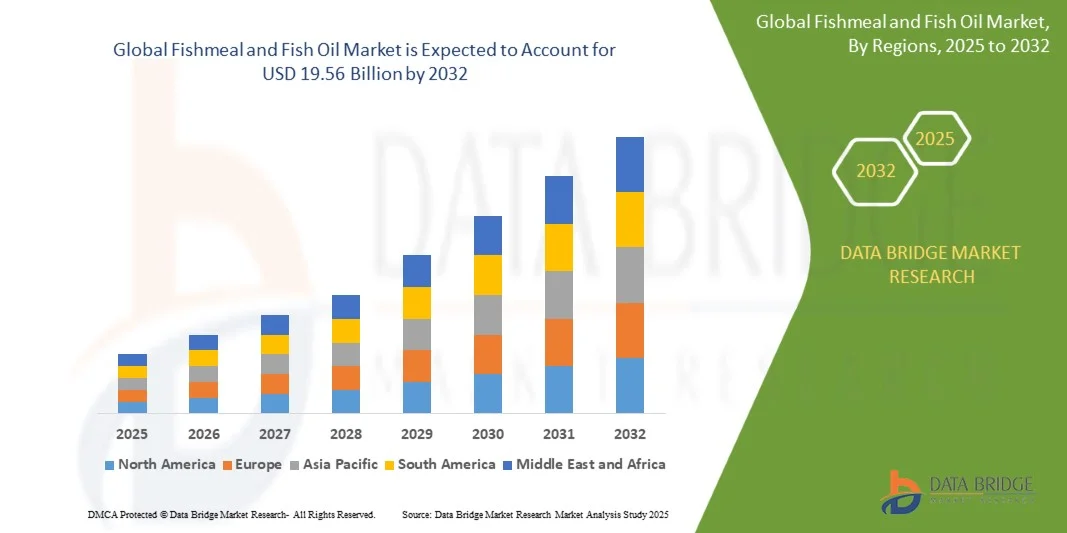
- As per Data Bridge Market Research Analysis the Fishmeal and Fish Oil Market size was valued at USD 13.34 billion in 2024 and is expected to reach USD 19.56 billion by 2032, growing at a CAGR of 4.90% during the forecast period
- Market expansion is primarily driven by the increasing demand for high-quality animal feed, especially in aquaculture and livestock sectors, where fishmeal and fish oil serve as key nutritional components
- Additionally, growing awareness of the health benefits of omega-3 fatty acids in human nutrition is fueling the use of fish oil in dietary supplements and pharmaceuticals, further propelling market growth
Market Size & Forecast
- Global Market Value (2024): USD 13.34 billion
- Expected Market Value (2032): USD 19.56 billion
- Forecast CAGR (2024–2032): 4.90%
What are the Major Takeaways of Fishmeal and Fish Oil Market?
- Fishmeal and fish oil, derived primarily from small pelagic fish, are critical ingredients in animal nutrition, widely used in aquaculture, poultry, and livestock feed for their rich protein content and essential omega-3 fatty acids, driving their growing importance across global food and health industries
- The rising demand for aquafeed, fueled by the expansion of the aquaculture sector and the need for nutrient-dense feed to enhance fish growth and immunity, is a major driver of the fishmeal and fish oil market
- Asia-Pacific dominated the fishmeal and fish oil market with the largest revenue share of 44.8% in 2024, attributed to its extensive aquaculture industry, especially in China and Southeast Asia, along with growing demand for functional foods and nutraceuticals incorporating fish oil-derived omega-3s
- Europe is expected to be the fastest growing region in the fishmeal and fish oil market during the forecast period, driven by rising consumer awareness of omega-3 health benefits and increasing sustainability efforts in marine sourcing
- The aquatic animals segment held the largest market revenue share 48.6% in 2024, driven by the dominance of aquaculture in global fishmeal and fish oil consumption.
Report Scope and Fishmeal and Fish Oil Market Segmentation
|
Attributes |
Fishmeal and Fish Oil Key Market Insights |
|
Segments Covered |
|
|
Countries Covered |
North America
Europe
Asia-Pacific
Middle East and Africa
South America
|
|
Key Market Players |
|
|
Market Opportunities |
|
|
Value Added Data Infosets |
|
What is the Key Trend in the Fishmeal and Fish Oil Market?
“Technological Advancements in Processing and Sustainability”
- A significant and accelerating trend in the Fishmeal and Fish Oil Market is the adoption of advanced processing technologies and sustainable production methods, aimed at maximizing yield, enhancing nutritional value, and reducing environmental impact across the value chain. These innovations are fundamentally reshaping production standards and operational efficiency in the industry.
- For instance, leading producers like The TASA Group and TripleNine Group A/S have invested in state-of-the-art rendering and centrifugation systems that improve protein retention and omega-3 concentration, enabling the production of premium-grade fishmeal and refined fish oils tailored for high-end aquafeed and nutraceutical markets.
- Technological innovation is also driving the development of byproduct utilization systems, allowing manufacturers to extract valuable oils and proteins from fish processing waste, thereby minimizing raw material waste and boosting sustainability. Companies such as Austevoll Seafood and FF Skagen A/S are leveraging these methods to meet stricter environmental regulations and achieve greater efficiency.
- Furthermore, automation and real-time monitoring technologies are being integrated into production lines, enabling more consistent quality control and traceability. This is particularly critical as end-users in aquaculture and human nutrition sectors demand higher standards of safety, purity, and functional quality in fish-derived products.
- The integration of blockchain and digital traceability platforms is emerging as another key trend, allowing stakeholders to track fishmeal and fish oil from ocean to end product. This is helping boost consumer and regulatory confidence, especially in Europe and North America where sustainability certifications are increasingly mandatory.
- These advancements are not only improving production capabilities but are also driving brand differentiation, as companies with advanced, eco-friendly processing gain a competitive edge. As a result, there is growing investment in R&D to further optimize output, reduce emissions, and comply with evolving global standards in food and feed safety.
Fishmeal and Fish Oil Market Dynamics
Driver
“Growing Need Due to Expansion of Aquaculture and Health Awareness”
- The increasing global demand for protein-rich food sources, particularly seafood, is driving rapid expansion in the aquaculture industry, which in turn is a major contributor to the growing need for fishmeal and fish oil
- For instance, in March 2024, Cargill expanded its aquafeed production capacity in Asia-Pacific, citing increasing demand for high-performance feeds containing fishmeal and fish oil. Such developments by key players are expected to support market growth throughout the forecast period
- As farmed fish require nutrient-dense, digestible feed, fishmeal continues to serve as a primary source of essential amino acids, while fish oil is valued for its high content of omega-3 fatty acids crucial for fish health and growth
- Additionally, rising consumer awareness of the health benefits associated with omega-3s — including cardiovascular, cognitive, and anti-inflammatory properties — is boosting demand for fish oil in human nutrition through supplements and fortified food products
- The use of fish oil in pharmaceuticals and functional foods is expanding globally, driven by scientific validation and growing interest in natural, marine-sourced health solutions. This is particularly prominent in Europe and North America, where demand for nutraceutical-grade fish oil continues to surge
- Moreover, government support for sustainable aquaculture practices, along with growing middle-class populations and dietary shifts in emerging markets such as India, China, and Brazil, are further accelerating demand for high-quality feed ingredients like fishmeal and fish oil
Restraint/Challenge
“Sustainability Concerns and Volatile Raw Material Supply”
- One of the primary challenges facing the fishmeal and fish oil market is increasing pressure on marine ecosystems and the volatility in raw material supply, due to overfishing, seasonal fluctuations, and the impact of climate events such as El Niño
- For instance, in 2024 anchovy catch restrictions in Peru the world’s largest fishmeal producer — led to reduced global output, creating price volatility and supply chain uncertainty for feed manufacturers and supplement producers alike
- Environmental concerns over wild fish harvesting have led to tightening of regulations and quotas, making it more difficult for producers to maintain consistent raw material availability. This has sparked growing scrutiny from environmental groups and regulatory bodies
- Companies such as The TASA Group and Austevoll Seafood are increasingly investing in sustainable fishing practices and alternative sourcing, including the use of fish trimmings and byproducts to reduce pressure on wild fish stocks
- Another challenge is the growing interest in plant-based or microbial alternatives to fishmeal and fish oil, particularly in regions where sustainability is a major consumer concern. While these alternatives offer environmental benefits, they could reduce demand if they become more cost-effective and nutritionally comparable
- Addressing these issues through improved fisheries management, traceability systems, and investment in alternative raw materials will be essential for ensuring long-term sustainability and maintaining market confidence in fish-derived products
How is the Fishmeal and Fish Oil Market Segmented?
The fishmeal and fish oil market is segmented on the basis of source, livestock applications, and industrial applications.
• By Source
On the basis of source, the fishmeal and fish oil market is segmented into salmon and trout, marine fish, crustaceans, tilapias, carps, and others. The marine fish segment dominated the market with the largest revenue share 47.8% in 2024, primarily due to the abundant availability of pelagic species such as anchovies, sardines, and mackerel, which are rich in essential proteins and omega-3 fatty acids. These species form the backbone of industrial fishmeal and oil production, especially in countries like Peru and Chile.
The salmon and trout segment is anticipated to witness the fastest growth rate of 21.4% from 2025 to 2032, fueled by the increasing demand for high-value farmed species in developed markets. These fish are both a source and a consumer of fishmeal and oil, as aquaculture operations invest in nutrient-dense feed solutions to enhance fish quality and production yields.
• By Livestock Applications
On the basis of livestock applications, the market is segmented into aquatic animals, swine, poultry, cattle, pets, and others. The aquatic animals segment held the largest market revenue share 48.6% in 2024, driven by the dominance of aquaculture in global fishmeal and fish oil consumption. Fishmeal serves as a high-quality protein source, while fish oil provides essential omega-3s to promote fish growth, immunity, and reproductive health.
The pets segment is expected to witness the fastest CAGR from 2025 to 2032, driven by rising consumer awareness about pet health and the growing inclusion of omega-3 fatty acids in premium pet food formulas. Pet owners are increasingly seeking functional ingredients like fish oil to support joint health, skin condition, and overall vitality in dogs and cats.
• By Industrial Applications
On the basis of industrial applications, the fishmeal and fish oil market is segmented into fertilizers, aquaculture, and pharmaceutical. The aquaculture segment accounted for the largest market revenue share 52.4% in 2024, as fishmeal and fish oil are essential inputs for feed formulations in both freshwater and marine aquaculture operations worldwide. The nutritional efficiency and digestibility of these ingredients make them indispensable for high-performance aquafeed.
The pharmaceutical segment is expected to witness the fastest growth rate from 2025 to 2032, fueled by the increasing use of refined fish oil in omega-3 supplements, capsules, and medical-grade formulations. Growing interest in marine-based health solutions and the clinical validation of omega-3 health benefits are driving investment in pharmaceutical-grade fish oil processing.
Which Region Holds the Largest Share of the Fishmeal and Fish Oil Market?
- Asia-Pacific dominated the Fishmeal and Fish Oil Market with the largest revenue share of 44.8% in 2024, driven by the rapid expansion of aquaculture operations and rising demand for high-protein animal feed across developing economies such as China, India, Vietnam, and Indonesia
- The region’s strong foothold is further supported by abundant access to raw materials, favorable climatic conditions for aquaculture, and government initiatives promoting sustainable fish farming practices
- Additionally, increasing health awareness and rising consumption of omega-3 supplements are boosting the demand for fish oil in the region, while growing middle-class populations and dietary shifts continue to drive the use of fishmeal in livestock and pet nutrition, reinforcing Asia-Pacific’s leadership in the global market
Japan Fishmeal and Fish Oil Market Insight
The Japan fishmeal and fish oil market is experiencing steady growth, driven by the country’s emphasis on health and wellness, particularly in aging populations. The high penetration of omega-3 supplements and fortified foods is contributing to increased demand for high-quality, pharmaceutical-grade fish oil. Japan also maintains a well-regulated aquaculture industry that requires premium fishmeal for efficient fish farming operations. The integration of sustainable and traceable sourcing practices is further driving consumer and regulatory confidence.
China Fishmeal and Fish Oil Market Insight
The China fishmeal and fish oil market held the largest revenue share in Asia-Pacific in 2024, owing to its massive aquaculture industry and expanding livestock feed demand. China’s rising middle class, increasing focus on food security, and awareness of omega-3 health benefits are key factors driving both feed and human consumption. Additionally, strong domestic production, government support for modernizing the aquafeed industry, and the presence of leading fishmeal manufacturers are solidifying China’s position as a dominant market player.
U.S. Fishmeal and Fish Oil Market Insight
The U.S. fishmeal and fish oil market captured the largest revenue share 78% in North America in 2024, driven by growing demand from the aquaculture sector, particularly in salmon and trout farming operations. The use of fish oil in dietary supplements is also a major growth driver, fueled by heightened consumer awareness of omega-3 health benefits. The country’s established nutraceutical and pharmaceutical industries, along with increasing investment in sustainable sourcing and refining technologies, are further propelling market expansion. Rising preference for traceable and certified products is also encouraging manufacturers to adopt eco-friendly practices.
Europe Fishmeal and Fish Oil Market Insight
The Europe fishmeal and fish oil market is projected to grow at a robust CAGR throughout the forecast period, supported by rising demand in the human nutrition segment and strict environmental regulations promoting sustainable fishing. Countries such as Norway, Denmark, and the UK lead the way in using fish oil in pharmaceuticals and omega-3 dietary supplements. Additionally, increasing demand from the region’s well-established aquaculture industry is contributing to market growth. The European consumer’s preference for eco-labeled and traceable products is influencing companies to invest in sustainable sourcing and advanced processing techniques.
U.K. Fishmeal and Fish Oil Market Insight
The U.K. fishmeal and fish oil market is anticipated to grow steadily, supported by the country’s advanced aquaculture sector and increasing consumer preference for omega-3-rich supplements. Rising interest in marine-based health products and growing awareness of the environmental impact of overfishing are pushing demand for sustainably sourced fish oil. The UK’s health-conscious population and regulatory alignment with European sustainability standards are creating favorable conditions for market growth, particularly in the dietary and pharmaceutical segments.
Germany Fishmeal and Fish Oil Market Insight
The Germany fishmeal and fish oil market is expected to expand at a significant CAGR during the forecast period, driven by increasing demand for natural health supplements and sustainable animal nutrition solutions. Germany’s strong focus on environmental responsibility is pushing manufacturers toward sustainable sourcing practices, while its large base of nutraceutical companies is encouraging the use of high-purity fish oil in dietary formulations. Growing applications in pet food and livestock feed are also contributing to the country's market expansion.
Which are the Top Companies in Fishmeal and Fish Oil Market?
The Fishmeal and Fish Oil industry is primarily led by well-established companies, including:
- FMC Corporation (U.S.)
- Austevoll Seafood (Norway)
- Croda International Plc (U.K.)
- OCEANA GROUP LIMITED (South Africa)
- Omega Protein (U.S.)
- Sürsan A.S (Turkey)
- GC Rieber Oils AS (Norway)
- The TASA Group (Peru)
- Orizon (Chile)
- Pioneer Fishing (South Africa)
- TripleNine Group A/S (Denmark)
- Pesquera Exalmar (Peru)
- Corpesca S.A. (Chile)
- FF Skagen A/S (Denmark)
- Copeinca (Peru)
- Coplex International S.A.S. (Colombia)
- Mukka Sea Food Industries (India)
- BASF SE (Germany)
- Cargill, Incorporated (U.S.)
- Pharma Marine AS (Norway)
- Omega Protein Corporation (U.S.)
What are the Recent Developments in Fishmeal and Fish Oil Market?
- In April 2023, Austevoll Seafood ASA (Norway), a leading global seafood company, announced a strategic expansion in South America aimed at boosting sustainable fishmeal and fish oil production to meet the growing demand from the aquaculture sector. This initiative highlights the company’s focus on responsible sourcing and innovative processing technologies, reinforcing its leadership position in the Fishmeal and Fish Oil Market while addressing regional supply challenges.
- In March 2023, Omega Protein Corporation (USA), a prominent player in marine-based protein and oil products, launched an advanced fish oil product specifically tailored for pharmaceutical and nutraceutical applications. The new product enhances omega-3 purity and bioavailability, demonstrating Omega Protein’s commitment to innovation and quality in health-focused fish oil solutions, thus strengthening its market position in both domestic and international markets.
- In March 2023, Croda International Plc (UK) successfully implemented a new sustainable fish oil extraction process at its European facilities, aimed at reducing environmental impact while improving product yield. This advancement supports Croda’s sustainability goals and commitment to delivering high-quality, eco-friendly ingredients for pharmaceutical, cosmetic, and food industries, reflecting broader market trends towards green technologies.
- In February 2023, FMC Corporation (USA), a key player in agricultural and specialty chemical products, entered into a strategic partnership with a leading Asian aquafeed manufacturer to develop enhanced fishmeal blends optimized for tilapia and carp farming. This collaboration aims to improve feed efficiency and growth rates, showcasing FMC’s dedication to innovation and supporting the rapidly expanding aquaculture market in Asia-Pacific.
- In January 2023, Oceana Group Limited (South Africa) launched a new line of certified sustainable fishmeal and fish oil products at the annual Global Aquaculture Summit. The launch, featuring traceability and eco-labeling, addresses growing consumer and regulatory demands for sustainability in feed ingredients. Oceana Group’s initiative underscores its leadership in responsible fishing practices and strengthens its competitive edge in the Fishmeal and Fish Oil Market.

- Interactive Data Analysis Dashboard
- Company Analysis Dashboard for high growth potential opportunities
- Research Analyst Access for customization & queries
- Competitor Analysis with Interactive dashboard
- Latest News, Updates & Trend analysis
- Harness the Power of Benchmark Analysis for Comprehensive Competitor Tracking
Global Fishmeal Fish Oil Market, Supply Chain Analysis and Ecosystem Framework
To support market growth and help clients navigate the impact of geopolitical shifts, DBMR has integrated in-depth supply chain analysis into its Global Fishmeal Fish Oil Market research reports. This addition empowers clients to respond effectively to global changes affecting their industries. The supply chain analysis section includes detailed insights such as Global Fishmeal Fish Oil Market consumption and production by country, price trend analysis, the impact of tariffs and geopolitical developments, and import and export trends by country and HSN code. It also highlights major suppliers with data on production capacity and company profiles, as well as key importers and exporters. In addition to research, DBMR offers specialized supply chain consulting services backed by over a decade of experience, providing solutions like supplier discovery, supplier risk assessment, price trend analysis, impact evaluation of inflation and trade route changes, and comprehensive market trend analysis.
Data collection and base year analysis are done using data collection modules with large sample sizes. The stage includes obtaining market information or related data through various sources and strategies. It includes examining and planning all the data acquired from the past in advance. It likewise envelops the examination of information inconsistencies seen across different information sources. The market data is analysed and estimated using market statistical and coherent models. Also, market share analysis and key trend analysis are the major success factors in the market report. To know more, please request an analyst call or drop down your inquiry.
The key research methodology used by DBMR research team is data triangulation which involves data mining, analysis of the impact of data variables on the market and primary (industry expert) validation. Data models include Vendor Positioning Grid, Market Time Line Analysis, Market Overview and Guide, Company Positioning Grid, Patent Analysis, Pricing Analysis, Company Market Share Analysis, Standards of Measurement, Global versus Regional and Vendor Share Analysis. To know more about the research methodology, drop in an inquiry to speak to our industry experts.
Data Bridge Market Research is a leader in advanced formative research. We take pride in servicing our existing and new customers with data and analysis that match and suits their goal. The report can be customized to include price trend analysis of target brands understanding the market for additional countries (ask for the list of countries), clinical trial results data, literature review, refurbished market and product base analysis. Market analysis of target competitors can be analyzed from technology-based analysis to market portfolio strategies. We can add as many competitors that you require data about in the format and data style you are looking for. Our team of analysts can also provide you data in crude raw excel files pivot tables (Fact book) or can assist you in creating presentations from the data sets available in the report.













