


What is the Fixed Satellite Services Market Size and Overview?
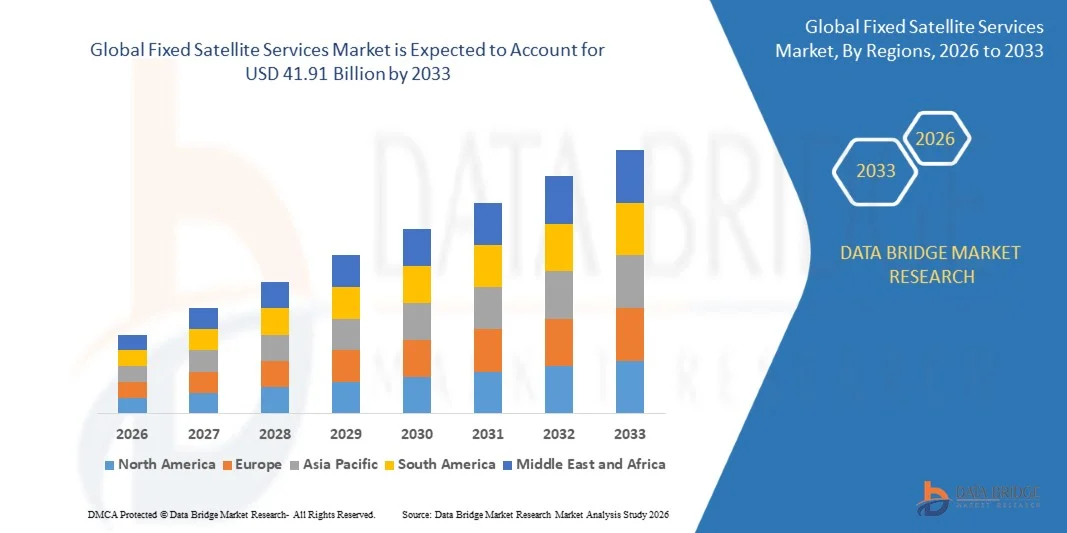
As per Data Bridge Market Research Analysis the fixed satellite service market was valued at USD 27.52 billion in 2025 and is projected to reach USD 41.91 billion by 2033, growing at a CAGR of 5.40% from 2026 to 2033. . Market expansion is supported by rising demand for secure broadband, television broadcasting, telecom backhaul, government communications, enterprise networks, and reliable connectivity in locations where terrestrial infrastructure is unavailable or difficult to maintain.
Fixed satellite services connect earth stations through satellite networks and are commonly used for voice, video, internet, data transmission, and mission-critical communications. Traditional geostationary capacity remains important for broadcasting and wide-area coverage, while high-throughput satellites, managed connectivity platforms, and multi-orbit networks are improving bandwidth, flexibility, and service quality. The market continues to balance growing data demand with high infrastructure costs, spectrum regulation, orbital-slot limitations, and competition from fiber and newer low-earth-orbit systems.
Market Size & Forecast
- Global Market Value (2025): USD 27.52 Billion
- Expected Market Value (2033): USD 41.91 Billion
- Forecast CAGR (2026–2033): 5.40%
What are the Major Takeaways of Fixed Satellite Services Market?
- North America dominated the fixed satellite services market with a 45.5% revenue share in 2025. The region has a mature satellite ecosystem, advanced ground infrastructure, major commercial operators, and strong demand from government, defense, aviation, maritime, media, telecom, and enterprise customers.
- Asia-Pacific fixed satellite services market is expected to witness the fastest growth rate from 2026 to 2033. The region includes large rural populations, island nations, mountainous areas, developing telecom networks, and rapidly growing digital economies. Satellite backhauls, direct-to-home broadcasting, government connectivity, and broadband services are helping close coverage gaps across India, China, Indonesia, the Philippines, Japan, Thailand, and other countries.
- The broadband services segment held the largest market revenue share in 2025, driven by increasing demand for high-speed internet connectivity across remote and underserved regions, as well as growing enterprise and government adoption of satellite-based broadband solutions. Expanding deployment of high-throughput satellites (HTS) and multi-orbit networks is further strengthening segment growth.
- The managed services segment is projected to register the fastest growth at a CAGR from 2026 to 2033, driven by rising demand for integrated satellite-terrestrial connectivity, network management, and customized communication services across aviation, maritime, government, and enterprise applications.
- The large enterprises segment held the largest market revenue share in 2025, driven by substantial investments in secure communication infrastructure, global network connectivity, and business continuity solutions. Large enterprises continue to be the primary users of managed satellite services across energy, telecom, and multinational operations.
- The small and medium businesses segment is projected to register the fastest growth at a CAGR from 2026 to 2033, driven by increasing adoption of satellite broadband and managed connectivity services among organizations operating in remote locations and emerging markets. The growing availability of affordable satellite solutions is accelerating segment expansion.
Report Scope and Fixed Satellite Services Market Segmentation
|
Attributes |
Fixed Satellite Services Key Market Insights |
|
Segments Covered |
|
|
Countries Covered |
North America
Europe
Asia-Pacific
Middle East and Africa
South America
|
|
Key Market Players |
|
|
Market Opportunities |
|
|
Value Added Data Infosets |
In addition to the market insights such as market value, growth rate, market segments, geographical coverage, market players, and market scenario, the market report curated by the Data Bridge Market Research team includes in-depth expert analysis, import/export analysis, pricing analysis, production consumption analysis, and pestle analysis. |
What is the Key Trend in the Fixed Satellite Services Market?
Trend: Shift Toward High-Throughput, Managed, and Multi-Orbit Satellite Networks
Growing demand for reliable, high-capacity, and low-latency communication is accelerating the adoption of high-throughput satellites (HTS), managed connectivity services, and multi-orbit satellite networks across the global Fixed Satellite Services market. Enterprises, governments, defense organizations, aviation operators, and maritime companies are increasingly relying on satellite communication to support broadband access, mission-critical operations, and seamless connectivity across geographically dispersed locations. The integration of GEO, MEO, and LEO constellations with terrestrial fiber and 5G infrastructure is further improving network resilience, expanding coverage, and enhancing service flexibility.
The continued expansion of broadband connectivity, cloud computing, IoT applications, and digital transformation initiatives is creating sustained demand for advanced satellite communication solutions capable of delivering greater bandwidth and improved operational efficiency. Continuous investments in software-defined satellites, reusable launch technologies, and satellite-enabled 5G services are enabling operators to strengthen connectivity offerings across enterprise and government markets. For instance, in March 2025, SES continued expanding its O3b mPOWER medium-earth orbit (MEO) constellation to provide high-performance broadband and managed connectivity services for enterprise, government, aviation, and maritime customers. This development reflects increasing industry investment in multi-orbit satellite infrastructure and managed network services.
The growing deployment of high-throughput and multi-orbit satellite networks is expected to reinforce long-term demand for Fixed Satellite Services, positioning operators to benefit from increasing requirements for resilient, secure, and high-speed global communication solutions.
Key Market Driver: Rising Need for Reliable Broadband, Broadcast, and Secure Communications
The global communication industry continues to experience rising demand for dependable broadband, broadcasting, and secure connectivity across remote, rural, offshore, and disaster-prone regions. Governments, enterprises, telecom operators, and defense organizations increasingly depend on satellite networks to ensure uninterrupted communication, business continuity, and mission-critical operations where terrestrial infrastructure is unavailable or economically impractical.
Major satellite operators continue investing in next-generation connectivity solutions to meet growing demand. Increasing internet penetration, expanding enterprise digitalization, rising defense communication requirements, and growing use of satellite backhaul for mobile networks are directly contributing to market expansion. For instance, in July 2025, SES completed its acquisition of Intelsat, creating a global multi-orbit connectivity provider with approximately 120 GEO and MEO satellites and access to LEO capacity. The transaction strengthened the company's capabilities across government, enterprise, aviation, maritime, and media applications, reflecting growing demand for secure and uninterrupted communication services worldwide.
As global demand for uninterrupted communication and broadband access continues to expand, Fixed Satellite Service providers are expected to benefit from sustained investments in government, enterprise, aviation, and telecom connectivity infrastructure.
Key Restraint/Challenge: High Investment Requirements and Complex Spectrum Regulations
Fixed Satellite Service operators remain heavily dependent on substantial capital investments, exposing market participants to high deployment costs associated with satellite manufacturing, launch services, gateway infrastructure, and ground equipment. Variability in regulatory requirements, spectrum allocation, orbital slot coordination, and cross-border licensing continues to affect deployment timelines and operational planning, particularly for operators managing global satellite networks.
In addition, companies must manage modernization requirements while maintaining service reliability and competitive pricing. Major operators including SES, Eutelsat, and Intelsat continue investing heavily in next-generation constellations while coordinating with international regulatory bodies to secure spectrum resources and orbital positions. These market conditions continue to create financial and operational pressures across the satellite communications industry.
Despite robust market demand, high capital expenditure and regulatory complexity are expected to remain significant restraints, increasing deployment costs, extending project timelines, and limiting market expansion throughout the forecast period.
Key Market Opportunity: Hybrid Connectivity and Managed Network Services
Governments, enterprises, and communication providers are accelerating investments in hybrid communication ecosystems that combine satellite, terrestrial, cloud, and edge computing technologies. Hybrid connectivity offers enhanced network resilience, scalability, and service continuity, creating significant long-term opportunities for Fixed Satellite Service providers delivering managed communication solutions to global customers.
Leading operators are strengthening hybrid connectivity capabilities through integrated satellite and terrestrial platforms. Growing enterprise cloud adoption, increasing deployment of private 5G networks, and expanding digital transformation initiatives are driving demand across industries including mining, energy, healthcare, maritime, aviation, and defense. For instance, in July 2026, Telesat announced an agreement in principle with Canada's Defence Investment Agency to provide Telesat Lightspeed services for secure Military Ka-band Arctic connectivity. The development highlights increasing demand for hybrid, resilient, and sovereign communication networks capable of supporting mission-critical operations in remote and strategically important regions.
As enterprises continue prioritizing scalable, secure, and uninterrupted connectivity, hybrid satellite-terrestrial communication solutions are expected to create substantial long-term growth opportunities for the global Fixed Satellite Services market.
How is the Fixed Satellite Services Market Segmented?
The fixed satellite services market is segmented by service type, organization size, and industry vertical.
- By Service Type
On the basis of service type, the fixed satellite services market is segmented into channel broadcast, telecom backhaul, broadband services, content and video distribution, military satellite communication, managed services, and other services. The broadband services segment held the largest market revenue share in 2025, driven by increasing demand for high-speed internet connectivity across remote and underserved regions, as well as growing enterprise and government adoption of satellite-based broadband solutions. Expanding deployment of high-throughput satellites (HTS) and multi-orbit networks is further strengthening segment growth.
The managed services segment is projected to register the fastest growth at a CAGR from 2026 to 2033, driven by rising demand for integrated satellite-terrestrial connectivity, network management, and customized communication services across aviation, maritime, government, and enterprise applications.
- By Organization Size
On the basis of organization size, the fixed satellite services market is segmented into small offices and home offices, small and medium businesses, and large enterprises. The large enterprises segment held the largest market revenue share in 2025, driven by substantial investments in secure communication infrastructure, global network connectivity, and business continuity solutions. Large enterprises continue to be the primary users of managed satellite services across energy, telecom, and multinational operations.
The small and medium businesses segment is projected to register the fastest growth at a CAGR from 2026 to 2033, driven by increasing adoption of satellite broadband and managed connectivity services among organizations operating in remote locations and emerging markets. The growing availability of affordable satellite solutions is accelerating segment expansion.
- By Industry Vertical
On the basis of industry vertical, the fixed satellite services market is segmented into media and entertainment, government, telecom and IT, aerospace and defense, oil and gas, retail, education, and others. The telecom and IT segment held the largest market revenue share in 2025, driven by growing demand for satellite backhaul, broadband connectivity, and hybrid communication solutions to support expanding digital infrastructure and mobile network coverage. Increasing investments in satellite-enabled 5G services are further supporting segment dominance.
The media and entertainment segment is projected to register the fastest growth at a CAGR from 2026 to 2033, driven by rising demand for high-definition broadcasting, live event transmission, video distribution, and over-the-top (OTT) content delivery services across global markets. Continued expansion of digital media consumption and satellite broadcasting capabilities is expected to accelerate segment growth.
Which Region Holds the Largest Share of the Fixed Satellite Services Market?
North America Fixed Satellite Services Market Insight
North America dominated the global fixed satellite services market with a 45.5% revenue share in 2025. The region has a mature satellite ecosystem, advanced ground infrastructure, major commercial operators, and strong demand from government, defense, aviation, maritime, media, telecom, and enterprise customers. Satellite connectivity remains especially valuable in rural communities, northern territories, offshore locations, and areas where terrestrial networks are difficult or expensive to expand. Government agencies and large businesses also use satellite links as backup communication systems during natural disasters, network outages, and other emergencies. The growing use of high-throughput satellites, managed connectivity platforms, and multi-orbit networks is helping regional providers deliver higher bandwidth and more flexible services while maintaining the wide coverage and reliability traditionally associated with fixed satellite systems.
U.S. Fixed Satellite Services Market Insight
The U.S. dominated the fixed satellite services market in 2025. Growth is supported by defense and government communications, commercial aviation, maritime connectivity, broadcast distribution, enterprise networking, and broadband services for rural and underserved areas. Satellite networks are also used for emergency response, public-safety operations, weather-related recovery, and communication continuity when terrestrial infrastructure is disrupted. The country has a strong base of satellite operators, launch providers, equipment manufacturers, ground-station developers, and managed-network companies. Increasing demand for secure data transmission, in-flight connectivity, cloud access, and hybrid satellite-terrestrial networks is encouraging operators to modernize their fleets and offer more customized services for commercial and government customers.
Asia-Pacific Fixed Satellite Services Market Insight
Asia-Pacific fixed satellite services market is expected to witness the fastest growth rate from 2026 to 2033. The region includes large rural populations, island nations, mountainous areas, developing telecom networks, and rapidly growing digital economies. Satellite backhauls, direct-to-home broadcasting, government connectivity, and broadband services are helping close coverage gaps across India, China, Indonesia, the Philippines, Japan, Thailand, and other countries. Telecom operators are increasingly using satellite capacity to extend mobile and internet services into locations where terrestrial towers or fiber networks are not commercially practical. Demand is also supported by maritime trade, aviation, disaster management, education, healthcare, and enterprise connectivity. Continued investment in high-throughput satellites and multi-orbit networks is expected to improve service quality and make satellite broadband more accessible across the region.
China Fixed Satellite Services Market Insight
China dominated the fixed satellite services market in 2025, expanding its satellite communication capacity to support national infrastructure, broadcasting, enterprise networks, transportation, and strategically important government applications. The country's large geography includes remote western regions, mountainous areas, industrial zones, and coastal locations where satellite communication can supplement terrestrial networks. Rising demand for digital services, cloud connectivity, television distribution, and secure data transmission supports the use of fixed satellite services alongside 5G and fiber infrastructure. Satellite links can also provide backup communication for critical facilities and support emergency response when conventional networks are damaged or overloaded. Continued investment in domestic satellite platforms, gateways, and ground equipment is expected to strengthen service coverage and create further opportunities for government and commercial users.
Japan Fixed Satellite Services Market Insight
Japan fixed satellite services market is expected to witness the fastest growth rate from 2026 to 2033. Driven by a technologically advanced satellite market with demand from broadcasting, maritime services, disaster management, government communications, aviation, and enterprise networks. Its island geography and exposure to earthquakes, storms, and other natural hazards increase the importance of communication systems that can continue operating when terrestrial networks are disrupted. Satellite services support television distribution, shipping routes, remote islands, emergency coordination, and secure government connectivity. Local operators are investing in flexible capacity, high-throughput platforms, and multi-orbit connectivity to improve bandwidth and service reliability. Japan's strong electronics, telecommunications, and aerospace industries also support the development of advanced terminals and network-management technologies for domestic and regional customers.
Europe Fixed Satellite Services Market Insight
Europe fixed satellite services market is expected to witness the fastest growth rate from 2026 to 2033. supported by leading operators, strong broadcasting infrastructure, government connectivity requirements, aviation and maritime demand, and growing interest in sovereign satellite communications. Satellite networks are used for television distribution, secure public-sector communication, rural broadband, enterprise backup, transport connectivity, and emergency services. The region is gradually moving toward integrated GEO-LEO service models, software-defined capacity, and hybrid systems that combine satellite links with terrestrial telecom infrastructure. Growing focus on network security, strategic autonomy, and resilient cross-border communications is encouraging governments and businesses to maintain satellite capacity as part of their wider digital infrastructure. Demand is also increasing for managed solutions that simplify network operation for customers with sites across several countries.
Germany Fixed Satellite Services Market Insight
Germany's fixed satellite services market is expected to witness the fastest growth rate from 2026 to 2033, driven by advanced telecom, industrial, automotive, logistics, energy, and defense sectors support demand for secure and resilient satellite connectivity. Large manufacturers and logistics companies may use satellite links to connect remote sites, support mobile operations, and maintain communication when terrestrial networks are unavailable. Satellite services also provide backup capacity for critical infrastructure, public agencies, and businesses that require continuous access to data and cloud platforms. Germany's strong focus on industrial automation and connected operations creates opportunities for managed networks that combine satellite, fiber, and mobile technologies. Demand is expected to remain stable as companies place greater importance on cybersecurity, network resilience, and reliable communication across international supply chains.
U.K. Fixed Satellite Services Market Insight
The U.K. fixed satellite services market is expected to witness the fastest growth rate from 2026 to 2033, benefits from strong aerospace, defense, broadcasting, maritime, aviation, financial-services, and international business sectors. Demand is supported by global connectivity requirements, government security needs, media distribution, offshore operations, and communication links for aircraft and vessels. Satellite networks also help provide resilient backup services for critical organizations and support broadband access in remote and coastal areas. The country's established space and telecom ecosystem is encouraging commercial interest in multi-orbit networks and managed connectivity platforms. As businesses depend more heavily on cloud applications and real-time communication, fixed satellite services are increasingly evaluated as part of wider hybrid networks rather than as standalone links.
Which are the Top Companies in Fixed Satellite Services Market?
The fixed satellite services industry is primarily led by well-established companies, including:
- SES S.A. (Luxembourg)
- Eutelsat Group (France)
- Telesat Corporation (Canada)
- SKY Perfect JSAT Corporation (Japan)
- Thaicom Public Company Limited (Thailand)
- Arabsat (Saudi Arabia)
- Hispasat (Spain)
- Singapore Telecommunications Limited / Singtel (Singapore)
- Telenor Satellite AS (Norway)
- Embratel Star One (Brazil)
- Nigerian Communications Satellite Limited (Nigeria)
What are Latest Developments in Fixed Satellite Services Market?
- In July 2026, Telesat announced an agreement in principle with Canada's Defence Investment Agency for Telesat Lightspeed services to provide secure Military Ka-band Arctic connectivity. The development highlights growing government demand for resilient, low-latency, and sovereign satellite communication capacity in remote regions.
- In July 2025, SES completed its acquisition of Intelsat, creating a larger multi-orbit operator with approximately 120 GEO and MEO satellites and access to LEO capacity. The combination strengthened SES's position in government, aviation, maritime, enterprise, and media connectivity while showing the wider consolidation trend in the FSS industry.

- Interactive Data Analysis Dashboard
- Company Analysis Dashboard for high growth potential opportunities
- Research Analyst Access for customization & queries
- Competitor Analysis with Interactive dashboard
- Latest News, Updates & Trend analysis
- Harness the Power of Benchmark Analysis for Comprehensive Competitor Tracking
Data collection and base year analysis are done using data collection modules with large sample sizes. The stage includes obtaining market information or related data through various sources and strategies. It includes examining and planning all the data acquired from the past in advance. It likewise envelops the examination of information inconsistencies seen across different information sources. The market data is analysed and estimated using market statistical and coherent models. Also, market share analysis and key trend analysis are the major success factors in the market report. To know more, please request an analyst call or drop down your inquiry.
The key research methodology used by DBMR research team is data triangulation which involves data mining, analysis of the impact of data variables on the market and primary (industry expert) validation. Data models include Vendor Positioning Grid, Market Time Line Analysis, Market Overview and Guide, Company Positioning Grid, Patent Analysis, Pricing Analysis, Company Market Share Analysis, Standards of Measurement, Global versus Regional and Vendor Share Analysis. To know more about the research methodology, drop in an inquiry to speak to our industry experts.
Data Bridge Market Research is a leader in advanced formative research. We take pride in servicing our existing and new customers with data and analysis that match and suits their goal. The report can be customized to include price trend analysis of target brands understanding the market for additional countries (ask for the list of countries), clinical trial results data, literature review, refurbished market and product base analysis. Market analysis of target competitors can be analyzed from technology-based analysis to market portfolio strategies. We can add as many competitors that you require data about in the format and data style you are looking for. Our team of analysts can also provide you data in crude raw excel files pivot tables (Fact book) or can assist you in creating presentations from the data sets available in the report.













