


Flame Retardant Acrylic Market Size
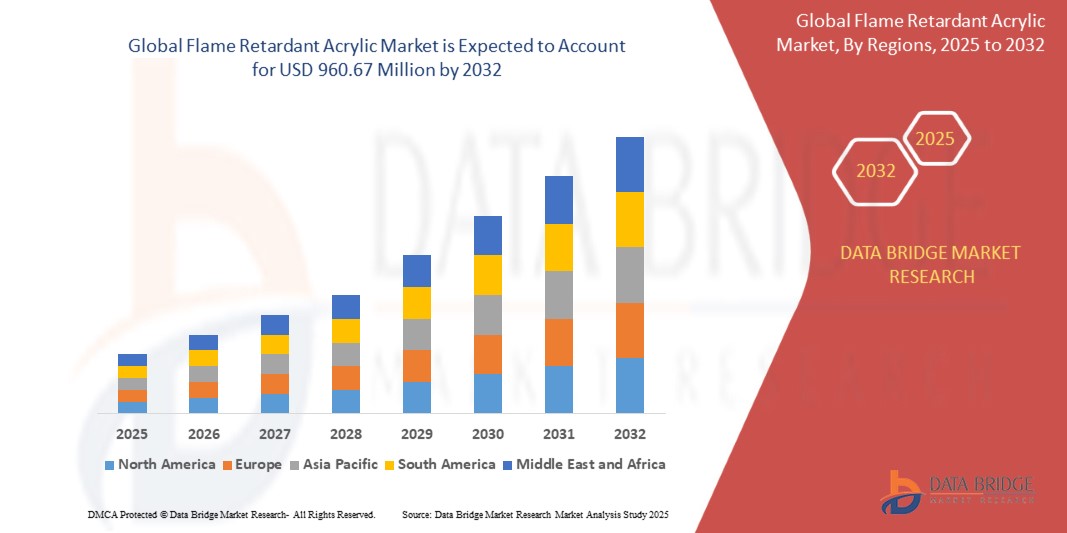
- The global flame retardant acrylic market size was valued at USD 613.78 million in 2024 and is expected to reach USD 960.67 million by 2032, at a CAGR of 5.1% during the forecast period
- Increasing regulations related to fire safety in key end-use industries such as automotive, construction, electronics, and textile are driving demand for flame retardant acrylics.
- Rising urbanization, infrastructure development, and consumer awareness about fire hazards across emerging economies are boosting market growth, especially in Asia-Pacific.
- Technological advancements in acrylic formulations improving fire resistance, durability, and eco-friendliness are supporting product adoption.
- Growing use of flame retardant acrylic fibers in protective clothing, home furnishings, and industrial applications further expands market potential.
Flame Retardant Acrylic Market Analysis
- Flame retardant acrylics are engineered materials designed to inhibit or slow the ignition and spread of fire, ensuring improved safety across diverse applications.
- The market is segmented by flame retardant types including alumina trihydrate, brominated flame retardants, antimony trioxide, phosphorous-based retardants, and other specialty retardants, each offering specific performance characteristics.
- Key end-use industries include automotive (for interior and exterior components), construction (insulation, furnishings), textiles (protective clothing, upholstery), electronics (circuit boards, casings), aerospace, paints & coatings, and packaging.
- Regulatory frameworks mandating stricter fire safety standards globally encourage adoption of flame retardant materials in product designs.
- Sustainability trends promote development of halogen-free and bio-based flame retardant acrylics to reduce environmental and health impacts.
Report Scope and Flame Retardant Acrylic Market Segmentation
|
Attributes |
Flame Retardant Acrylic Key Market Insights |
|
Segments Covered |
|
|
Countries Covered |
North America
Europe
Asia-Pacific
Middle East and Africa
South America
|
|
Key Market Players |
|
|
Market Opportunities |
|
|
Value Added Data Infosets |
In addition to the insights on market scenarios such as market value, growth rate, segmentation, geographical coverage, and major players, the market reports curated by the Data Bridge Market Research also include in-depth expert analysis, pricing analysis, brand share analysis, consumer survey, demography analysis, supply chain analysis, value chain analysis, raw material/consumables overview, vendor selection criteria, PESTLE Analysis, Porter Analysis, and regulatory framework. |
Flame Retardant Acrylic Market Trends
Shift Towards Eco-Friendly and High-Performance Flame Retardants
- Growing regulatory bans on halogenated flame retardants lead to increasing use of phosphorous-based, antimony trioxide, and bio-based flame retardants that are less harmful to health and environment.
- Advances in acrylic fiber technology enhance fire resistance, durability, and aesthetic properties in textiles and composites, expanding application scope.
- Increasing demand in aerospace and automotive sectors for lightweight, fire-safe materials promotes innovation in flame retardant acrylic formulations.
- Integration of synergistic additives improves efficacy, allowing reduced chemical load while meeting stringent safety standards.
Flame Retardant Acrylic Market Dynamics
Driver
Stringent Fire Safety Regulations and Rising Awareness
- Growing global enforcement of fire safety codes and standards across industries such as construction, automotive, electronics, textiles, and aerospace drives adoption of flame retardant acrylics. Regulatory mandates ensure that products meet specific flame resistance criteria to safeguard consumers and infrastructure.
- Increasing urbanization and rapid infrastructure development, particularly in emerging economies, escalate demand for fire-safe materials in buildings, public transport, and consumer goods. Flame retardant acrylics offer vital protection while maintaining aesthetic and functional properties.
- Heightened consumer awareness and corporate sustainability initiatives are encouraging the use of flame retardant acrylic materials in household furnishings, decorative goods, and industrial textiles, balancing safety with environmental responsibility.
- Technological advances in flame retardant formulations deliver improved fire resistance, mechanical strength, and eco-friendly profiles, allowing broader application and easier regulatory compliance.
Restraint/Challenge
High Cost and Environmental Concerns
- Flame retardant acrylics generally come at a premium compared to conventional acrylics or alternative flame retardant materials, which can restrict adoption in cost-sensitive markets or products with tight price constraints.
- Concerns over the environmental and health impact of certain halogenated flame retardants have imposed regulatory restrictions, necessitating reformulation and complicating product development processes. This increases R&D and manufacturing costs.
- Achieving an optimal balance between flame retardancy and other critical product characteristics such as durability, flexibility, and appearance requires complex formulation expertise, adding to production challenges.
- Competition from other fire safety solutions, including halogen-free flame retardants, intumescent coatings, and non-acrylic materials, may limit growth opportunities in some segments.
Flame Retardant Acrylic Market Scope
The market is segmented on the basis of type and end-use.
- By Type
On the basis of type, the flame retardant acrylic market is segmented into alumina trihydrate, brominated flame retardants, antimony trioxide, phosphorous flame retardants, and others. The alumina trihydrate segment holds the largest market revenue share in 2024, primarily due to its non-toxic nature, cost-effectiveness, and wide application in construction, automotive, and textiles for fire safety. Phosphorous flame retardants are anticipated to witness the fastest growth from 2025 to 2032, driven by increasing environmental regulations and demand for halogen-free, eco-friendly flame retardant solutions. Brominated flame retardants and antimony trioxide remain important for their high efficacy in electronics and aerospace applications.
- By End Use
On the basis of end use, the market is segmented into automotive, construction, textile, electronics, aerospace, paints & coatings, packaging, and others. The construction segment dominates in 2024, influenced by stringent fire safety requirements and rapid urbanization, especially in emerging economies. The automotive segment is projected to register strong growth, driven by increasing demand for fire-safe interior and exterior components. Textile applications, including protective clothing and upholstery, also contribute significantly, supported by evolving safety standards. Electronics and aerospace sectors require advanced flame retardant acrylics for critical safety and regulatory compliance. The paints & coatings and packaging segments are expanding due to the need for flame retardant additives in consumer goods and industrial products.
Flame Retardant Acrylic Market Regional Analysis
- Asia-Pacific dominates the global flame retardant acrylic market, accounting for an estimated 45.54% of total revenue share in 2024. This leading position is driven by rapid urbanization, extensive infrastructure development, and a booming automotive and textile industries in countries such as China, India, Japan, and South Korea.
- The region’s growth is supported by stringent government regulations on fire safety standards, which mandate the use of flame retardant materials in construction, automotive, electronics, and textile sectors. Increasing awareness about fire hazards and safety compliance among manufacturers and consumers further accelerates market demand.
- Rapid industrialization and rising disposable incomes in these countries contribute to higher demand for fire-safe acrylic materials used in diverse applications ranging from protective clothing to automotive parts and consumer electronics.
- Asia-Pacific benefits from abundant raw material availability, cost-effective manufacturing, and active investments by key market players to expand production capacities and introduce eco-friendly, halogen-free flame retardant acrylic formulations.
U.S. Flame Retardant Acrylic Market Insight
The U.S. dominates the North American flame retardant acrylic market in 2024, supported by stringent fire safety regulations across residential, commercial, and industrial sectors. High demand arises from automotive, construction, textiles, and electronics industries requiring fire-safe materials. Continuous innovation in halogen-free and environmentally friendly flame retardant acrylics caters to growing regulatory and consumer expectations. The market benefits from a mature industrial base and steady investments in protective clothing and home furnishing applications.
Europe Flame Retardant Acrylic Market Insight
Europe is poised for robust growth, led by stringent regulatory frameworks such as REACH and regional fire safety standards. Key countries including Germany, France, and the U.K. are driving demand within construction, automotive, and aerospace sectors. Focus on sustainability has accelerated adoption of eco-friendly phosphorous and halogen-free flame retardant acrylics. Investment in R&D and regulatory compliance fosters development of advanced materials meeting strict emission and fire safety standards.
U.K. Flame Retardant Acrylic Market Insight
The U.K. market is experiencing steady expansion fueled by growing consumer and regulatory focus on fire safety and sustainability. Major growth stems from construction and protective textiles where flame retardant acrylics provide critical safety benefits. Manufacturers focus on halogen-free formulations and certifications to meet evolving safety codes and environmental targets. The increasing incorporation of flame retardant acrylics in public infrastructure and industrial applications supports market momentum.
Germany Flame Retardant Acrylic Market Insight
Germany’s market maintains steady growth driven by its strong industrial, automotive, and chemical manufacturing sectors. R&D investments emphasize developing flame retardant acrylics with superior thermal stability and eco-friendly profiles. Regulatory mandates for fire safety and environmental compliance, coupled with rising demand for protective textiles and construction materials, underpin market expansion.
Asia-Pacific Flame Retardant Acrylic Market Insight
Asia-Pacific commands the largest revenue share in 2024 and is the fastest-growing market, propelled by rapid urbanization, industrialization, and expanding automotive and textile industries in China, India, Japan, and South Korea. Stringent government fire safety regulations and rising consumer awareness about fire hazards promote widespread adoption of flame retardant acrylic materials. The region benefits from cost-effective manufacturing, abundant raw material availability, and active investments in halogen-free and bio-based flame retardant technologies.
India Flame Retardant Acrylic Market Insight
India is projected to record the highest CAGR over the forecast period due to accelerating urban infrastructure projects, growing automotive production, and heightened fire safety awareness. Government initiatives promoting fire-safe building materials and industrial standards are driving demand. The market is further supported by rising consumer preference for eco-friendly flame retardants and increasing manufacturing capacity expansions.
China Flame Retardant Acrylic Market Insight
China leads Asia-Pacific with the largest market share in flame retardant acrylics, supported by a robust manufacturing base and extensive construction and automotive industries. Strong regulatory frameworks enforcing fire safety standards and environmental sustainability accelerate the adoption of innovative flame retardant acrylic formulations. The growing consumption in electronics, textiles, and protective gear also underpin market growth.
Flame Retardant Acrylic Market Share
The Flame Retardant Acrylic industry is primarily led by well-established companies, including:
- Dow (U.S.)
- DuPont (U.S.)
- Solvay S.A. (Belgium)
- W. L. Gore & Associates GmbH (Germany)
- Shaoxing Sanlida Textile Flame-Retardant New Materials Co. Ltd. (China)
- Teijin Aramid B.V. (Netherlands)
- TenCate Fabrics (Netherlands)
- Delcotex (Germany)
- SSM Industries Inc. (U.S.)
- Yantai Tayho Advanced Materials Co. Ltd. (China)
- Chao Meisi New Materials Co. Ltd. (China)
Latest Developments in Global Flame Retardant Acrylic Market
- In June 2021, HeiQ Materials AG acquired Life Material Technologies Limited, a Hong Kong-based manufacturer of bio-based antimicrobial additives. This acquisition strengthens HeiQ’s position in the bio-based antimicrobial and surface hygiene market.
- In March 2024 Clariant launched Exolit AP 422, a new generation of melamine-free flame retardants. This eco-friendly and SVHC-free product offers superior fire protection performance in various applications, including intumescent coatings and insulation boards, complying with stringent environmental regulations and industry standards.
- In Early 2025 Start-up companies such as UK-based Zenova Group Plc and Indian firm VKP HFFR Pvt. Ltd. focus on developing specialized halogen-free flame retardant chemicals for applications including lithium-ion battery safety and automotive sectors, shaping innovation trends in the market.
- In April 2025 BASF announced the mechanical completion of its new acrylics complex at the Zhanjiang Verbund site, expanding production capabilities for acrylic-based flame retardant materials to support growing demand in Asia-Pacific construction and automotive sectors.
- In May 2025 Trinseo launched new PFAS-free, halogen-free flame retardant plastic grades targeted at consumer electronics and electrical applications, emphasizing sustainability and recycled content to reduce environmental impact.
- In June 2025 DowDuPont expanded its flame retardant acrylic fiber manufacturing facilities in Asia, adding production lines to cater to increasing demand from automotive and protective textile industries in emerging markets.

- Interactive Data Analysis Dashboard
- Company Analysis Dashboard for high growth potential opportunities
- Research Analyst Access for customization & queries
- Competitor Analysis with Interactive dashboard
- Latest News, Updates & Trend analysis
- Harness the Power of Benchmark Analysis for Comprehensive Competitor Tracking
Global Flame Retardant Acrylic Market, Supply Chain Analysis and Ecosystem Framework
To support market growth and help clients navigate the impact of geopolitical shifts, DBMR has integrated in-depth supply chain analysis into its Global Flame Retardant Acrylic Market research reports. This addition empowers clients to respond effectively to global changes affecting their industries. The supply chain analysis section includes detailed insights such as Global Flame Retardant Acrylic Market consumption and production by country, price trend analysis, the impact of tariffs and geopolitical developments, and import and export trends by country and HSN code. It also highlights major suppliers with data on production capacity and company profiles, as well as key importers and exporters. In addition to research, DBMR offers specialized supply chain consulting services backed by over a decade of experience, providing solutions like supplier discovery, supplier risk assessment, price trend analysis, impact evaluation of inflation and trade route changes, and comprehensive market trend analysis.
Data collection and base year analysis are done using data collection modules with large sample sizes. The stage includes obtaining market information or related data through various sources and strategies. It includes examining and planning all the data acquired from the past in advance. It likewise envelops the examination of information inconsistencies seen across different information sources. The market data is analysed and estimated using market statistical and coherent models. Also, market share analysis and key trend analysis are the major success factors in the market report. To know more, please request an analyst call or drop down your inquiry.
The key research methodology used by DBMR research team is data triangulation which involves data mining, analysis of the impact of data variables on the market and primary (industry expert) validation. Data models include Vendor Positioning Grid, Market Time Line Analysis, Market Overview and Guide, Company Positioning Grid, Patent Analysis, Pricing Analysis, Company Market Share Analysis, Standards of Measurement, Global versus Regional and Vendor Share Analysis. To know more about the research methodology, drop in an inquiry to speak to our industry experts.
Data Bridge Market Research is a leader in advanced formative research. We take pride in servicing our existing and new customers with data and analysis that match and suits their goal. The report can be customized to include price trend analysis of target brands understanding the market for additional countries (ask for the list of countries), clinical trial results data, literature review, refurbished market and product base analysis. Market analysis of target competitors can be analyzed from technology-based analysis to market portfolio strategies. We can add as many competitors that you require data about in the format and data style you are looking for. Our team of analysts can also provide you data in crude raw excel files pivot tables (Fact book) or can assist you in creating presentations from the data sets available in the report.













