


What is the Flame Retardant Market Size and Growth Rate?
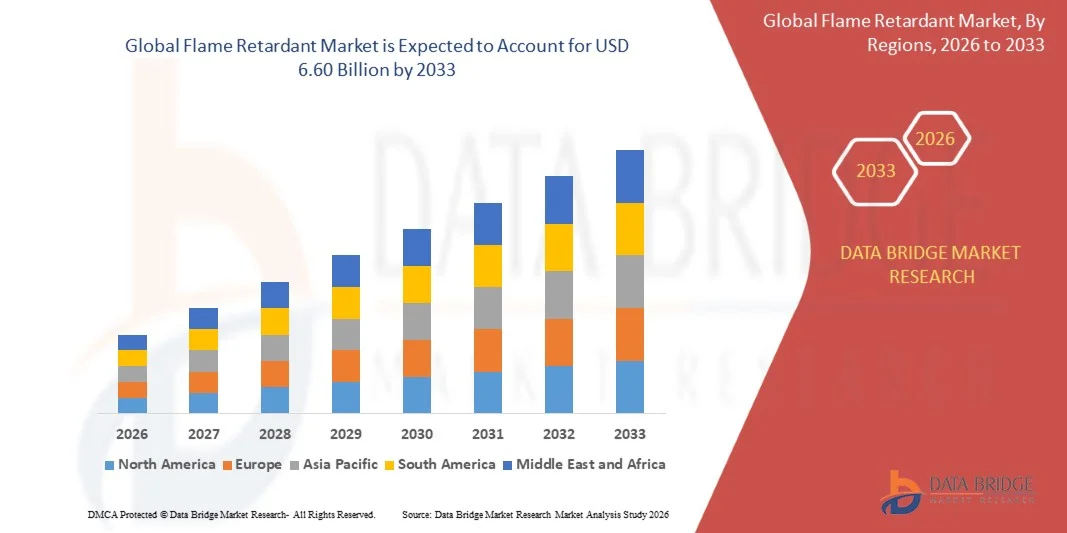
- As per Data Bridge Market Research analysis, the Flame Retardant market was valued at USD 4.10 billion in 2025 and is projected to reach USD 6.60 billion by 2033, growing at a CAGR of 6.13% from 2026 to 2033.
- The market is experiencing consistent growth driven by rising demand for protective workwear in hazardous industrial environments, increasing workplace safety requirements, and growing awareness of the risks associated with thermal exposure, flash fires, and electrical arc hazards. Increasing adoption of flame retardant apparel across oil and gas, petrochemicals, firefighting, electrical utilities, construction, mining, and defense applications is further supporting market expansion.
- The increasing focus on worker protection and compliance with occupational safety standards is encouraging industries to adopt certified flame retardant apparel. Advancements in inherent flame-resistant fibers, treated fabrics, lightweight materials, moisture management, and improved garment durability are enhancing wearer comfort and protection, while stricter workplace safety regulations and growing industrial activity are supporting wider adoption of flame retardant apparel.
Market Size & Forecast
- Global Market Value (2025): USD 4.10 Billion
- Expected Market Value (2033): USD 6.60 Billion
- Forecast CAGR (2026–2033): 6.13%
- Leading Region in 2025: North America
- Fastest Growing Region: Asia Pacific
What are the Major Takeaways of the Flame Retardant Market?
- North America is estimated to have dominated the global flame retardant apparel market with a 34.6% revenue share in 2025, supported by stringent occupational safety requirements, established oil and gas and petrochemical industries, strong electrical utility activity, and widespread use of certified flame-resistant workwear across hazardous industrial environments.
- Asia-Pacific is estimated to be the fastest-growing regional market at a CAGR of 7.8% from 2026 to 2033, driven by rapid industrialization, expansion of oil and gas and manufacturing activities, infrastructure development, improving occupational safety practices, and increasing adoption of protective workwear across China, India, Southeast Asia, Japan, and South Korea.
- The treated fabric segment is estimated to have led the fabric category with a 55.1% share in 2025, supported by its relatively lower production cost, established textile-treatment processes, broad availability, and extensive application in cotton and cotton-blend flame-resistant workwear.
- The inherent fabric segment is estimated to be the fastest-growing fabric category at a CAGR of 7.1% from 2026 to 2033, driven by increasing demand for permanent flame resistance, longer garment service life, improved thermal protection, and rising adoption of aramid- and modacrylic-based fabrics in high-risk industrial applications.
- The FRC coverall segment is estimated to have dominated the product category with a 42.8% share in 2025, supported by its full-body protection, suitability for oil and gas, petrochemical, firefighting, utility, and industrial applications, and increasing emphasis on comprehensive worker protection.
- The shirt segment is estimated to be the fastest-growing product category at a CAGR of 6.8% from 2026 to 2033, supported by increasing demand for lightweight and breathable protective apparel, greater emphasis on worker comfort, and expanding use of flame-resistant shirts for routine industrial operations.
- The durable segment is estimated to have accounted for the largest type share of 85.4% in 2025, driven by repeated-use capability, longer service life, durability under demanding working conditions, and widespread procurement by industrial employers seeking reliable protective garments.
- The disposable segment is estimated to grow at a CAGR of 5.4% from 2026 to 2033, supported by increasing requirements for temporary protection during maintenance, emergency response, chemical handling, and short-duration hazardous operations.
- The oil & gas segment is estimated to have represented the largest end-use share at 25.4% in 2025, supported by the high incidence of fire and flash-fire hazards associated with exploration, drilling, refining, processing, and maintenance activities and the continued requirement for certified protective clothing.
- The petrochemical segment is estimated to be the fastest-growing end-use category at a CAGR of 7.6% from 2026 to 2033, driven by expansion and modernization of petrochemical facilities, increasing fire-safety requirements, greater worker-protection spending, and rising demand for advanced flame-resistant garments.
Report Scope and Flame Retardant Market Segmentation
|
Attributes |
Flame Retardant Key Market Insights |
|
Segments Covered |
|
|
Countries Covered |
North America
Europe
Asia-Pacific
Middle East and Africa
South America
|
|
Key Market Players |
|
|
Market Opportunities |
|
|
Value Added Data Infosets |
In addition to the insights on market scenarios such as market value, growth rate, segmentation, geographical coverage, and major players, the market reports curated by the Data Bridge Market Research also include import export analysis, production capacity overview, production consumption analysis, price trend analysis, climate change scenario, supply chain analysis, value chain analysis, raw material/consumables overview, vendor selection criteria, PESTLE Analysis, Porter Analysis, and regulatory framework. |
What is the Key Trend in the Flame Retardant Market?
- Flame retardant apparel manufacturers are increasingly focusing on lightweight, breathable, durable, and multi-hazard protective garments that provide thermal protection while improving wearer comfort, mobility, and suitability for extended working periods. Product development is increasingly centered on advanced fiber technologies, improved fabric construction, moisture management, and enhanced garment durability.
- For instance, in November 2025, DuPont announced the winners of its R&D 100-related PPE innovation recognition, highlighting the use of Nomex and Kevlar fabrics and fibers for applications involving sustainability, multi-hazard protection, and firefighter safety. The development demonstrates the continuing focus on advanced protective materials for high-risk occupational environments.
- Flame retardant apparel is also increasingly being developed using inherent flame-resistant fibers and high-performance fabric technologies, which provide protection through the properties of the fiber itself and are suitable for repeated industrial use. This trend is particularly relevant to oil and gas, petrochemical, electrical utility, firefighting, and industrial applications.
- For instance, in November 2025, DuPont's PPE innovation recognition highlighted Nomex and Kevlar technologies for protective applications, including firefighter safety and multi-hazard protection, reinforcing the continued development of high-performance protective materials.
- Manufacturers are also increasingly emphasizing multi-hazard protection, with flame retardant garments being designed to provide protection against combinations of thermal, flame, electrical, chemical, and other workplace hazards rather than addressing flame exposure alone.
- For instance, in November 2025, DuPont specifically highlighted multi-hazard protection and firefighter safety in its recognition of PPE innovations using Nomex and Kevlar materials. This indicates the growing focus on protective solutions capable of addressing multiple workplace risks.
- As manufacturers increasingly prioritize thermal protection, wearer comfort, durability, multi-hazard protection, and advanced fiber technologies, the adoption of high-performance flame retardant apparel is expected to increase across oil & gas, petrochemicals, firefighting, utilities, mining, construction, manufacturing, and defense applications.
What are the Key Drivers of the Flame Retardant Market?
- The growing emphasis on occupational safety and protection against thermal and flame hazards is increasing demand for flame retardant apparel across industries where workers may be exposed to flash fires, flames, electrical arcs, and high-temperature environments. The requirement for appropriate protective clothing is particularly important in oil & gas, petrochemicals, utilities, firefighting, manufacturing, and other hazardous industrial operations.
- For instance, in November 2025, DuPont highlighted Nomex and Kevlar-based PPE innovations that support multi-hazard protection and firefighter safety, demonstrating the continuing industry focus on advanced protective materials for workers exposed to high-risk environments.
- The expansion of oil & gas, petrochemical processing, power generation, electrical utilities, mining, and industrial manufacturing is further supporting demand for flame retardant apparel. These industries involve operations where combustible materials, electrical hazards, high temperatures, and fire exposure can create significant occupational risks.
- Increasing adoption of advanced inherent flame-resistant fabrics is also driving market development. Materials such as Nomex and Kevlar are being used in high-performance protective applications because of their ability to provide specialized thermal and flame protection while supporting durability and repeated use.
- For instance, in November 2025, DuPont reported that its recognized PPE innovations used Nomex and Kevlar fabrics and fibers to advance sustainability, multi-hazard protection, and firefighter safety.
- Growing attention to worker comfort and garment performance is creating additional opportunities for lightweight and breathable flame-resistant apparel. End users increasingly require protective garments that can be worn for extended periods without unnecessarily restricting movement or increasing discomfort.
- With industries increasingly prioritizing worker safety, hazard-specific protection, advanced flame-resistant materials, durability, and regulatory compliance, demand for flame retardant apparel is expected to increase throughout the forecast period.
Which Factors are Challenging the Growth of the Flame Retardant Market?
- High costs associated with advanced flame-resistant materials and certified protective garments can restrict adoption, particularly among cost-sensitive industrial users. Inherent flame-resistant fibers, specialized fabric blends, garment engineering, testing, and certification can increase the price of protective apparel compared with conventional workwear.
- For instance, in November 2025, DuPont's PPE innovation recognition highlighted high-performance Nomex and Kevlar materials for multi-hazard protection and firefighter safety, illustrating the specialized material technologies used in high-performance protective apparel. Such advanced materials can involve higher development and manufacturing costs than conventional textile materials.
- Complex performance and certification requirements can also create challenges for manufacturers and end users. Flame-resistant apparel must be selected according to the specific workplace hazard and applicable safety requirements, increasing the complexity of product selection, testing, certification, procurement, and maintenance.
- For instance, in November 2025, DuPont emphasized multi-hazard protection and firefighter safety in its PPE innovation recognition, demonstrating that protective apparel increasingly needs to address specific and sometimes multiple workplace hazards rather than providing only basic flame resistance.
- Heat stress, garment weight, limited breathability, and wearer comfort can also affect the consistent use of flame retardant apparel, particularly in hot climates and physically demanding industrial environments. Manufacturers therefore face the challenge of improving comfort and breathability while maintaining the required level of thermal protection.
- For instance, in November 2025, DuPont's recognition of PPE innovations involving Nomex and Kevlar emphasized multi-hazard protection and firefighter safety, reflecting the continued development of specialized protective materials for demanding working conditions.
- The combination of higher costs, specialized material requirements, certification complexity, comfort considerations, and the need for hazard-specific protection can limit the adoption of flame retardant apparel, particularly among smaller industrial users and in price-sensitive emerging markets..
How is the Flame Retardant Market Segmented?
The global flame retardant apparel market is segmented on the basis of type, fabric, product and end use,
- By Type
On the basis of type, the flame retardant apparel market is segmented into durable and disposable. The durable segment dominated the market with a 85.4% share in 2025, supported by its extended service life, repeated-use capability, and suitability for demanding industrial environments. Durable flame retardant apparel is widely used across oil & gas, petrochemicals, utilities, firefighting, construction, and manufacturing applications where workers require consistent protection against flash fire, heat, and other thermal hazards. The ability to withstand repeated washing and industrial use reduces replacement frequency and supports lower lifecycle costs for employers. Increasing enforcement of workplace safety requirements and greater emphasis on reliable protective clothing are further supporting adoption of durable garments. The segment is also benefiting from improvements in fabric construction that provide greater durability, breathability, comfort, and freedom of movement without compromising thermal protection. Current industry benchmarks similarly identify durable apparel as the largest type segment.
The disposable segment is projected to register the fastest growth at a CAGR of 5.4% during the forecast period, driven by increasing demand for lightweight, task-specific, and single-use protective garments. Disposable flame retardant apparel is increasingly utilized during maintenance, inspection, emergency response, shutdown, and short-duration industrial activities where temporary protection is required. Its ease of replacement and reduced laundering requirements make it suitable for applications involving contamination or limited-duration exposure. Growing industrial maintenance activities, increasing adoption of flexible PPE solutions, and the need to minimize cross-contamination and garment-management requirements are expected to support segment growth.
- By Fabric
On the basis of fabric, the flame retardant apparel market is segmented into inherent and treated. The treated segment dominated the market with a 55.1% share in 2025, supported by its cost-effectiveness, broad availability, and established use across industrial protective clothing applications. Treated fabrics are manufactured by applying flame-retardant chemicals or finishes to textile materials, enabling manufacturers to provide flame-resistant properties while maintaining flexibility in fabric selection and garment design. Treated cotton and cotton-synthetic blends are widely used where a balance between protection, comfort, durability, and cost is required. Strong demand from oil & gas, construction, utilities, and manufacturing industries is supporting the segment. The availability of established treatment technologies and compatibility with large-scale textile production are further contributing to its leading position. Market benchmarks also identify treated fabric as the largest fabric segment globally.
The inherent segment is projected to register the fastest growth at a CAGR of 7.1% during the forecast period, driven by increasing preference for fabrics in which flame-resistant properties are integrated into the fiber structure and remain effective throughout the garment's service life. Inherent fabrics such as aramid- and modacrylic-based materials provide durable protection without relying on surface treatments that can diminish through repeated laundering. Their increasing adoption in high-risk applications is supported by demand for long-lasting protection, improved thermal performance, and reduced maintenance concerns. Advances in fiber engineering are also enabling manufacturers to develop lighter, softer, and more breathable inherent fabrics, supporting their use in premium industrial and specialized protective apparel. The shift toward high-performance protective clothing is expected to further strengthen demand for inherent fabrics.
- By Product
On the basis of product, the flame retardant apparel market is segmented into shirt, pant, FRC coverall, and others. The FRC coverall segment dominated the market with a 42.8% share in 2025, owing to its ability to provide extensive body coverage and integrated protection in high-risk working environments. FRC coveralls are extensively used in oil & gas, petrochemicals, mining, utilities, firefighting, and industrial manufacturing applications where workers can be exposed to flash fire, heat, sparks, and other thermal hazards. Their one-piece construction reduces exposed areas between separate garments and supports consistent protective coverage. Increasing workplace safety requirements and employer preference for standardized protective uniforms are further supporting adoption. Improvements in fabric technology have also resulted in lighter, more breathable, and more comfortable coveralls, increasing their suitability for prolonged industrial use. The FRC coverall segment is also identified as the leading product category in current market research.
The shirt segment is projected to register the fastest growth at a CAGR of 6.8% during the forecast period, driven by increasing demand for lightweight and comfortable flame-resistant clothing for routine industrial activities. Flame retardant shirts provide greater flexibility and ventilation than full-body garments, making them suitable for workers who require thermal protection while performing less intensive or lower-risk tasks. Increasing emphasis on worker comfort, improved fabric breathability, and the development of lightweight inherent and treated fabrics are supporting adoption. Growing use of FR shirts as part of layered workwear systems is also contributing to segment expansion. The rising requirement for protective clothing that combines safety, mobility, and everyday wearability is expected to further accelerate demand. Current market data also indicates strong growth prospects for the shirt segment.
- By End Use
On the basis of end use, the flame retardant apparel market is segmented into defense & law enforcement, firefighting, oil & gas, petrochemicals, mining, energy & power, building & construction, electrical utility, and others. The oil & gas segment dominated the market with a 25.4% share in 2025, supported by the high exposure of workers to flash fires, combustible gases, hydrocarbons, and other thermal hazards across drilling, production, refining, processing, and maintenance activities. Flame-resistant clothing is an important component of PPE programs in operations where flash-fire hazards are identified. OSHA guidance specifically addresses the use of flame-resistant clothing in certain oil and gas drilling, servicing, and production operations and references NFPA 2112 and NFPA 2113 for protective clothing selection and use.
The petrochemicals segment is projected to register the fastest growth at a CAGR of 7.6% during the forecast period, driven by increasing investment in petrochemical production and processing facilities and the high level of thermal and chemical hazards associated with these operations. Workers involved in processing, storage, maintenance, and handling activities may face exposure to combustible substances, high temperatures, sparks, and flash-fire risks, increasing the need for specialized protective apparel. Expansion of downstream petrochemical capacity in Asia Pacific and the Middle East is expected to create additional demand for flame retardant garments. The increasing implementation of workplace safety programs and adoption of advanced protective fabrics are further supporting segment growth. Market research also identifies petrochemicals as one of the faster-growing end-use applications for flame retardant apparel.
Which Region Holds the Largest Share of the Flame Retardant Market?
- North America dominated the flame retardant apparel market with the largest revenue share of 34.6% in 2025, supported by stringent workplace safety requirements, strong demand for protective clothing across oil & gas, firefighting, utilities, defense, and construction industries, and the presence of established flame-resistant apparel manufacturers and suppliers. The region's mature industrial safety infrastructure and widespread adoption of certified protective garments are supporting its leading position in the global market.
- The region also benefits from extensive oil & gas, petrochemical, electrical utility, and industrial manufacturing activities, where workers require protection against flash fire, heat, and thermal hazards. Strong enforcement of occupational safety requirements, increasing employer focus on worker protection, and continued demand for durable and high-performance protective garments are further supporting market growth. The U.S. represents the largest country-level market within North America, supported by substantial demand from oil & gas, firefighting, manufacturing, and other hazardous work environments. Current market benchmarks similarly identify North America as the leading regional market in 2025.
U.S. Flame Retardant Market Insight
The U.S. flame retardant apparel market is witnessing steady growth due to stringent occupational safety requirements and strong demand for protective clothing across oil & gas, firefighting, manufacturing, electrical utilities, construction, and defense applications. The country's large industrial base and established workplace safety framework support widespread adoption of flame-resistant shirts, pants, coveralls, and specialized protective garments. Increasing emphasis on worker protection against flash-fire and thermal hazards is further supporting demand. In addition, continued investments in energy infrastructure, manufacturing facilities, utility networks, and industrial maintenance activities are creating sustained requirements for certified flame-resistant apparel. The U.S. market is also supported by the presence of major protective apparel manufacturers and established distribution networks.
Asia-Pacific Flame Retardant Market Insight
The Asia-Pacific flame retardant apparel market is witnessing strong growth, supported by rapid industrialization, expanding oil & gas and petrochemical capacity, increasing manufacturing activity, and improving workplace safety practices. China, India, Japan, South Korea, and other countries across the region are increasingly adopting flame-resistant apparel across energy, construction, chemical processing, manufacturing, mining, and utility applications. Growing awareness of occupational hazards and increasing implementation of industrial safety requirements are supporting demand for protective clothing. In addition, expanding domestic manufacturing capabilities and investments in advanced textile and fiber technologies are supporting the development of lighter, more durable, and comfortable flame-resistant garments. The region is expected to remain one of the fastest-growing markets during the forecast period, with China and India representing major growth centers
Japan Flame Retardant Market Insight
The Japan flame retardant apparel market is witnessing consistent growth due to the country's advanced manufacturing sector, established industrial safety practices, and demand for high-performance protective clothing. Flame-resistant apparel is used across manufacturing, energy, chemical processing, utilities, construction, and other industrial applications where protection against heat and fire hazards is required. Japan's emphasis on workplace safety, product quality, and advanced textile technologies supports demand for durable and technically engineered protective garments. Furthermore, developments in lightweight fibers, high-performance fabrics, and improved garment comfort are encouraging the adoption of advanced flame-resistant apparel for prolonged industrial use. The country's mature manufacturing ecosystem and focus on worker protection are expected to support steady market development throughout the forecast period.
China Flame Retardant Market Insight
The China flame retardant apparel market is growing rapidly, supported by the country's extensive manufacturing base, large oil & gas and petrochemical industries, expanding construction activity, and increasing emphasis on industrial worker safety. Flame-resistant apparel is increasingly required across high-risk workplaces where employees may be exposed to fire, heat, sparks, and thermal hazards. Increasing enforcement of workplace safety requirements and growing awareness among industrial employers are supporting the adoption of certified protective garments. The country's large textile manufacturing ecosystem also supports domestic production and availability of flame-resistant fabrics and garments. Furthermore, continued investments in petrochemical facilities, energy infrastructure, manufacturing plants, and construction projects are creating additional demand for protective workwear.
U.K. Flame Retardant Market Insight
The U.K. flame retardant apparel market is experiencing steady growth, supported by stringent workplace safety requirements and established demand for protective clothing across energy, utilities, construction, manufacturing, firefighting, and industrial applications. British and European protective-clothing standards support the use of garments designed to provide protection against heat and flame hazards. Increasing employer awareness of occupational risks and continued investment in industrial safety programs are further supporting adoption. The market is also benefiting from innovation in lightweight and comfortable flame-resistant fabrics, enabling workers to receive thermal protection without significantly compromising mobility and comfort.
Germany Flame Retardant Market Insight
The Germany flame retardant apparel market is expanding steadily due to the country's strong manufacturing and chemical industries, high workplace safety standards, and demand for technically advanced protective clothing. Flame-resistant garments are increasingly used across chemical processing, manufacturing, energy, construction, utilities, and industrial maintenance activities. Germany's strong industrial base creates sustained demand for durable protective apparel capable of meeting stringent safety and performance requirements. In addition, increasing focus on worker protection, advanced textile engineering, and sustainable material development is encouraging the adoption of higher-performance flame-resistant garments.
Which are the Top Companies in Flame Retardant Market?
The flame retardant industry is primarily led by well-established companies, including:
- Ansell Limited (Australia)
- 3M (U.S.)
- VF Corporation (U.S.)
- Honeywell International Inc. (U.S.)
- Lakeland Industries, Inc. (U.S.)
- DuPont (U.S.)
- Sioen Industries NV (Belgium)
- W. L. Gore & Associates, Inc. (U.S.)
- Teijin Limited (Japan)
- Solvay S.A. (Belgium)
- National Safety Apparel, Inc. (U.S.)
- Protective Industrial Products, Inc. (U.S.)
- Workrite Fire Service (U.S.)
- Bulwark Protection (U.S.)
- Portwest (Ireland)
- Fristads AB (Sweden)
- Carhartt, Inc. (U.S.)
- Tranemo Group (Sweden)
- Cintas Corporation (U.S.)
- Milliken & Company (U.S.)
- TenCate Protective Fabrics (Netherlands)
- MSA Safety Incorporated (U.S.)
- Mallcom (India) Limited (India)
- Tarasafe International (India)
- Oberon Company (U.S.)
What are Latest Developments in Flame Retardant Market?
- In November 2025, DuPont announced the winners of its 2025 DuPont Innovation Awards for Thermal and Mechanical Protection, recognizing new PPE and emergency-response products using Nomex and Kevlar fabrics and fibers. The winning innovations included Phenix protective clothing made with Nomex Comfort fabric and EcoForce finish for oil and gas, chemical, and electrical applications; Iturri's post-consumer Nomex® Recycled garments for the oil and gas industry; and a Weldforce Welding Suit developed by İşmont Tekstil. The awards also recognized a 40 Cal LAN Series Arc Flash Suit from SureWerx for applications across renewables and electrification. The development highlights increasing industry emphasis on multi-hazard protection, sustainability, recyclability, worker comfort, and advanced flame-resistant apparel.
- In August 2025, DuPont announced an agreement to divest its Aramids business, including the Kevlar and Nomex brands, to Arclin for approximately USD 1.8 billion. Kevlar and Nomex are widely used in high-performance protective applications, including flame-resistant and thermal protective clothing. The transaction represented a significant change in the competitive structure of the protective materials industry and is expected to transfer ownership of two established aramid brands used in industrial PPE and emergency-response applications. The development highlights ongoing portfolio restructuring among major suppliers of advanced flame-resistant fibers and materials.
- In December 2025, National Safety Apparel (NSA) joined with NASCO Industries through an acquisition announced by Blue Point Capital Partners. NASCO Industries manufactures protective rainwear and flame-resistant garments for frontline workers, including products serving oil and gas, utilities, electrical, construction, and other industrial applications. The transaction expanded NSA's portfolio of protective apparel and strengthened its capabilities in specialized outerwear and weather-resistant workwear. The acquisition represents continued consolidation in the flame-resistant apparel industry as protective clothing manufacturers expand product breadth and address specialized industrial safety requirements.
- In July 2024, Ansell completed the acquisition of 100% of the assets constituting Kimberly-Clark's Personal Protective Equipment business. The transaction expanded Ansell's industrial personal protective equipment portfolio and added established protective-product brands and capabilities to its operations. Ansell's portfolio includes protective clothing and AlphaTec solutions designed for chemical, thermal, and other industrial hazards. The acquisition demonstrates increasing consolidation among major PPE manufacturers and supports the expansion of integrated protective solutions for industrial workers.
- In June 2024, National Safety Apparel acquired Tri-Star Glove, a manufacturer of high-performance personal protective products. The acquisition increased NSA's product breadth and depth in protective equipment and complemented its existing flame-resistant apparel portfolio. Tri-Star's capabilities strengthened NSA's offering across industrial safety applications, while the transaction formed part of the company's broader strategy to expand its range of protective solutions for frontline workers. The development highlights increasing consolidation and portfolio expansion among specialized PPE manufacturers serving industrial and high-risk work environments.

- Interactive Data Analysis Dashboard
- Company Analysis Dashboard for high growth potential opportunities
- Research Analyst Access for customization & queries
- Competitor Analysis with Interactive dashboard
- Latest News, Updates & Trend analysis
- Harness the Power of Benchmark Analysis for Comprehensive Competitor Tracking
Global Flame Retardant Apparel Market, Supply Chain Analysis and Ecosystem Framework
To support market growth and help clients navigate the impact of geopolitical shifts, DBMR has integrated in-depth supply chain analysis into its Global Flame Retardant Apparel Market research reports. This addition empowers clients to respond effectively to global changes affecting their industries. The supply chain analysis section includes detailed insights such as Global Flame Retardant Apparel Market consumption and production by country, price trend analysis, the impact of tariffs and geopolitical developments, and import and export trends by country and HSN code. It also highlights major suppliers with data on production capacity and company profiles, as well as key importers and exporters. In addition to research, DBMR offers specialized supply chain consulting services backed by over a decade of experience, providing solutions like supplier discovery, supplier risk assessment, price trend analysis, impact evaluation of inflation and trade route changes, and comprehensive market trend analysis.
Data collection and base year analysis are done using data collection modules with large sample sizes. The stage includes obtaining market information or related data through various sources and strategies. It includes examining and planning all the data acquired from the past in advance. It likewise envelops the examination of information inconsistencies seen across different information sources. The market data is analysed and estimated using market statistical and coherent models. Also, market share analysis and key trend analysis are the major success factors in the market report. To know more, please request an analyst call or drop down your inquiry.
The key research methodology used by DBMR research team is data triangulation which involves data mining, analysis of the impact of data variables on the market and primary (industry expert) validation. Data models include Vendor Positioning Grid, Market Time Line Analysis, Market Overview and Guide, Company Positioning Grid, Patent Analysis, Pricing Analysis, Company Market Share Analysis, Standards of Measurement, Global versus Regional and Vendor Share Analysis. To know more about the research methodology, drop in an inquiry to speak to our industry experts.
Data Bridge Market Research is a leader in advanced formative research. We take pride in servicing our existing and new customers with data and analysis that match and suits their goal. The report can be customized to include price trend analysis of target brands understanding the market for additional countries (ask for the list of countries), clinical trial results data, literature review, refurbished market and product base analysis. Market analysis of target competitors can be analyzed from technology-based analysis to market portfolio strategies. We can add as many competitors that you require data about in the format and data style you are looking for. Our team of analysts can also provide you data in crude raw excel files pivot tables (Fact book) or can assist you in creating presentations from the data sets available in the report.













