


Flavored Candy Market Size
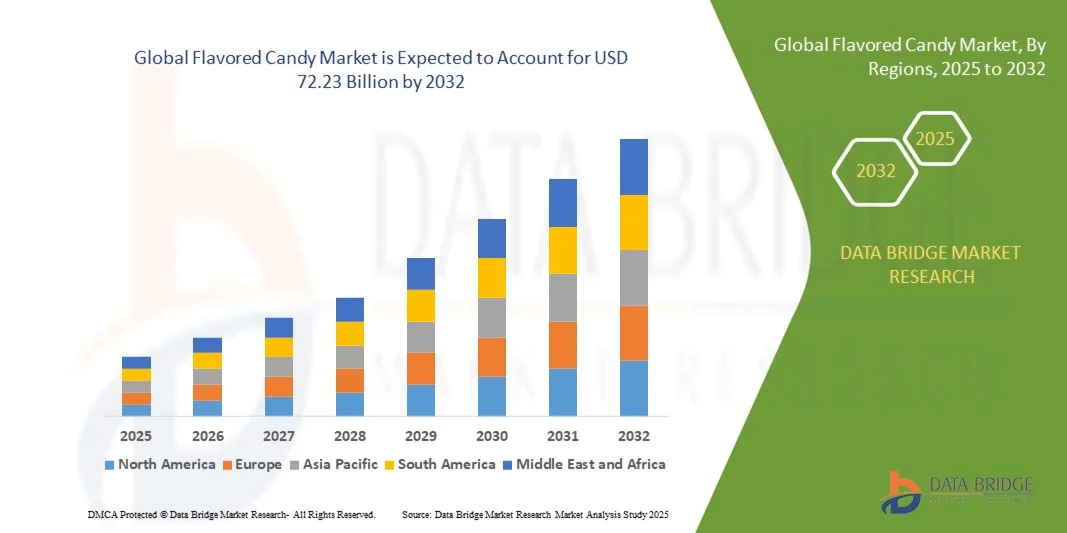
- The global flavored candy market size was valued at USD 33.70 billion in 2024 and is expected to reach USD 72.23 billion by 2032, at a CAGR of 10.00s% during the forecast period
- The market growth is largely fueled by increasing consumer preference for innovative, indulgent, and naturally flavored confectionery products, supported by continuous flavor diversification and premiumization across global brands. Rising demand for fruit-based, sour, and low-sugar variants is driving product innovation, catering to both traditional and health-conscious consumers
- Furthermore, the introduction of protein-enriched, vegan, and functional candies is reshaping the confectionery landscape, attracting a wider demographic seeking guilt-free indulgence. These evolving consumer trends, combined with strong retail expansion and seasonal demand peaks, are significantly boosting the flavored candy industry’s overall growth
Flavored Candy Market Analysis
- Flavored candies, encompassing a wide range of fruit, chocolate, caramel, and mint-based varieties, continue to represent one of the most dynamic segments of the global confectionery market. Their sustained appeal lies in sensory satisfaction, nostalgia-driven consumption, and constant flavor experimentation by manufacturers to capture diverse consumer preferences
- The rising popularity of clean-label and naturally sourced ingredients, alongside strategic marketing through limited editions and regional flavors, is further strengthening brand loyalty and market expansion. With growing innovation in packaging, health-oriented formulations, and digital retail channels, the flavored candy market is expected to maintain steady growth across both developed and emerging economies
- North America dominated the flavored candy market in 2024, due to strong consumer demand for innovative, indulgent, and nostalgia-driven confectionery products
- Asia-Pacific is expected to be the fastest growing region in the flavored candy market during the forecast period due to rising disposable incomes, growing youth population, and evolving snacking habits in countries such as China, Japan, and India
- Fruit flavored segment dominated the market with a market share of 38.1% in 2024, due to its broad consumer appeal across age groups and cultural preferences. The wide range of fruity options such as strawberry, mango, and orange continues to attract consumers seeking refreshing and natural-tasting sweets. Moreover, manufacturers are increasingly using natural fruit extracts and colors, enhancing both the flavor authenticity and the health perception of these candies, which strengthens their market dominance
Report Scope and Flavored Candy Market Segmentation
|
Attributes |
Flavored Candy Key Market Insights |
|
Segments Covered |
|
|
Countries Covered |
North America
Europe
Asia-Pacific
Middle East and Africa
South America
|
|
Key Market Players |
|
|
Market Opportunities |
|
|
Value Added Data Infosets |
In addition to the insights on market scenarios such as market value, growth rate, segmentation, geographical coverage, and major players, the market reports curated by the Data Bridge Market Research also include in-depth expert analysis, pricing analysis, brand share analysis, consumer survey, demography analysis, supply chain analysis, value chain analysis, raw material/consumables overview, vendor selection criteria, PESTLE Analysis, Porter Analysis, and regulatory framework. |
Flavored Candy Market Trends
Growing Demand for Functional and Health-Oriented Candies
- The flavored candy market is evolving rapidly as consumers increasingly seek products that offer both indulgence and functional health benefits. Manufacturers are developing candies enriched with vitamins, herbal extracts, and probiotics, transforming traditional sweets into convenient functional snacks suitable for wellness-conscious consumers
- For instance, The Hershey Company has launched a range of fortified candies infused with natural antioxidants and reduced-sugar formulas aimed at supporting active lifestyles. This shift demonstrates how the confectionery industry is adapting to health-oriented consumption trends while maintaining flavor variety and sensory appeal
- The incorporation of functional ingredients such as collagen, vitamin C, and herbal components such as ginseng and green tea extracts is becoming a key differentiator in new product development. Such candies deliver taste satisfaction and also address growing demand for immune support, energy enhancement, and stress relief
- Natural sweeteners such as stevia, monk fruit, and erythritol are increasingly replacing traditional sugar in modern candy formulations. These alternatives support low-calorie product labeling and cater to diabetic-friendly and keto-conscious consumer segments, aligning with global clean-label preferences
- Brands are also emphasizing transparency and authenticity by offering organic, non-GMO, and allergen-free flavored candies. For instance, Mars Wrigley has expanded its product portfolio to include plant-based and natural fruit-flavored candy variants that appeal to both children and adults seeking balanced indulgence options
- The growing popularity of functional and health-enhancing candies reflects a fundamental transformation in consumer expectations. As the convergence between confectionery and wellness industries strengthens, this trend will continue shaping product innovation and branding strategies across global markets
Flavored Candy Market Dynamics
Driver
Increasing Innovation in Natural and Exotic Flavors
- Rising consumer demand for diverse taste experiences is driving continuous innovation in natural and exotic flavor development within the flavored candy market. Companies are investing in advanced flavor extraction technologies and regional taste inspiration to create unique combinations that appeal to evolving global palates
- For instance, Perfetti Van Melle has introduced candies featuring tropical flavors such as passion fruit and lychee derived from natural fruit concentrates. These launches highlight the growing emphasis on authentic taste profiles and natural sourcing as key elements of premium-positioned candy products
- Flavor innovation is extending beyond traditional fruit-based profiles to include botanical, floral, and spice-infused varieties such as lavender, chili mango, and matcha. This expansion is responding to younger consumers' preferences for experimental and globally inspired flavor experiences in everyday treats
- The demand for natural flavoring ingredients has intensified due to consumer awareness of synthetic additives and artificial enhancers. Candy manufacturers are turning to essential oils, natural extracts, and fermentation-based ingredients to create clean-label formulations with enhanced taste and authenticity
- Cultural diversity and globalization continue to influence flavor development, with regional flavor trends from Asia, Latin America, and the Middle East reshaping confectionery markets worldwide. As companies focus on differentiating their offerings through innovation and localization, the emphasis on exotic and natural flavor portfolios will remain a major growth driver
Restraint/Challenge
Rising Concerns Over Sugar Content and Health Regulations
- Heightened awareness of sugar-related health issues and the tightening of global nutrition regulations present significant challenges for the flavored candy market. Growing concerns over obesity, diabetes, and dental health are prompting consumers and governments to demand reformulated products with reduced sugar and cleaner ingredient lists
- For instance, several European countries, including the United Kingdom, have introduced sugar taxes that directly impact the pricing and formulation strategies of leading confectionery brands such as Mondelez International and Ferrara Candy Company. These regulatory developments are driving companies to accelerate low-sugar and sugar-free product innovation
- Balancing sweetness levels while retaining flavor quality remains a technical challenge, as artificial sweeteners can alter taste perception and mouthfeel. Developing natural, cost-effective sweetening systems without compromising product texture or appeal remains a key obstacle for manufacturers
- Strict labeling norms related to nutritional transparency and marketing restrictions further increase compliance costs for producers. The need for reformulation and continuous monitoring of regional regulatory changes adds complexity to global product distribution and brand management
- To address these challenges, manufacturers are investing in research to optimize natural sweetener blends and exploring portion-controlled packaging to promote responsible consumption. Long-term success in the flavored candy sector will depend on reconciling consumer enjoyment with growing health and regulatory expectations through continuous innovation and ingredient transparency
Flavored Candy Market Scope
The market is segmented on the basis of flavor, type, and distribution channel.
- By Flavor
On the basis of flavor, the flavored candy market is segmented into fruit flavored, chocolate, caramel, butterscotch, cinnamon, coffee, licorice, sour, peanut butter, vanilla, spearmint, and others. The fruit flavored segment dominated the market with the largest market revenue share of 38.1% in 2024, owing to its broad consumer appeal across age groups and cultural preferences. The wide range of fruity options such as strawberry, mango, and orange continues to attract consumers seeking refreshing and natural-tasting sweets. Moreover, manufacturers are increasingly using natural fruit extracts and colors, enhancing both the flavor authenticity and the health perception of these candies, which strengthens their market dominance.
The sour flavor segment is projected to witness the fastest growth rate from 2025 to 2032, driven by the increasing popularity of bold and tangy taste experiences among younger consumers. Sour candies are being innovatively developed with layered intensity and unique coatings to enhance sensory appeal. Their rising presence in social media-driven “challenge” trends and novelty packaging further accelerates their demand. In addition, the incorporation of sour profiles into hybrid fruit-based candies contributes to their strong momentum in both developed and emerging markets.
- By Type
On the basis of type, the flavored candy market is segmented into hard boiled candies, pastilles, gums, jellies and chews, toffees, caramels and nougat, mints, and others. The hard boiled candies segment dominated the market in 2024, capturing the highest revenue share due to their long shelf life, affordability, and widespread consumption. These candies are preferred for their intense flavor retention and convenience in storage and distribution. Furthermore, continuous innovations in flavor layering and transparent sugar compositions have helped hard boiled candies remain a staple in both traditional and modern confectionery assortments.
The jellies and chews segment is anticipated to register the fastest CAGR during 2025–2032, supported by increasing demand for soft-textured and chewable confectionery among children and teenagers. The segment benefits from advancements in gelatin alternatives and plant-based formulations that align with vegan and health-conscious consumer trends. In addition, creative flavor combinations and visually appealing shapes are making jellies and chews a favored choice in the premium and gifting categories, contributing to their rapid expansion.
- By Distribution Channel
On the basis of distribution channel, the flavored candy market is segmented into supermarkets and hypermarkets, convenience stores, specialist retailers, online retail, and others. The supermarkets and hypermarkets segment dominated the market in 2024, as these large-scale retail outlets offer extensive product visibility and easy accessibility to multiple candy brands. Consumers prefer purchasing candies through these channels due to promotional offers, discounts, and the convenience of browsing through a wide variety in one place. Moreover, strong merchandising and impulse-buy placement strategies near billing counters further boost sales in this segment.
The online retail segment is expected to experience the fastest growth from 2025 to 2032, driven by the rapid digitalization of shopping habits and the growing preference for doorstep delivery. E-commerce platforms enable consumers to explore niche and imported candy varieties unavailable in traditional stores. In addition, subscription boxes and personalized flavor assortments offered by online candy retailers enhance consumer engagement and repeat purchases, supporting the strong growth of this channel.
Flavored Candy Market Regional Analysis
- North America dominated the flavored candy market with the largest revenue share in 2024, driven by strong consumer demand for innovative, indulgent, and nostalgia-driven confectionery products
- The region’s well-established candy culture and high per capita confectionery consumption support consistent sales growth
- The presence of leading manufacturers investing in limited-edition flavors and seasonal offerings further enhances market expansion. In addition, the growing trend of clean-label and naturally flavored candies aligns with the increasing preference for healthier treats among consumers in the U.S. and Canada
U.S. Flavored Candy Market Insight
The U.S. flavored candy market captured the largest revenue share in 2024 within North America, fueled by a robust confectionery industry and high product diversity. American consumers show strong interest in fruit-based and sour candies, driven by continuous innovation in taste and packaging. Seasonal launches during holidays such as Halloween and Easter contribute significantly to revenue. Furthermore, the growing demand for low-sugar and organic candies supports sustained market expansion in the U.S.
Europe Flavored Candy Market Insight
The Europe flavored candy market is projected to grow at a significant CAGR throughout the forecast period, driven by the region’s rich confectionery heritage and preference for premium-quality sweets. Increasing demand for artisanal and ethically sourced ingredients enhances the appeal of flavored candies among health-conscious consumers. In addition, manufacturers are focusing on unique regional flavors and sustainable packaging to strengthen their market position. The market also benefits from strong retail infrastructure and established candy brands across major countries such as Germany, the U.K., and France.
U.K. Flavored Candy Market Insight
The U.K. flavored candy market is anticipated to expand at a notable CAGR during the forecast period, supported by a thriving retail sector and increasing innovation in sugar-free and plant-based candies. Consumers are showing growing interest in gourmet and exotic flavors, while festive gifting and on-the-go snacking trends continue to drive demand. The market’s evolution toward health-oriented formulations with natural ingredients positions the U.K. as one of the key growth contributors in Europe.
Germany Flavored Candy Market Insight
The Germany flavored candy market is expected to grow steadily, driven by the country’s established confectionery tradition and preference for quality and authenticity. German consumers prioritize clean ingredients and locally produced sweets, encouraging brands to adopt natural flavors and minimal additives. The market is also witnessing a rise in vegan and allergen-free candy options catering to dietary preferences. Moreover, consistent innovation in packaging and flavor variety sustains consumer interest and brand loyalty.
Asia-Pacific Flavored Candy Market Insight
The Asia-Pacific flavored candy market is projected to grow at the fastest CAGR from 2025 to 2032, driven by rising disposable incomes, growing youth population, and evolving snacking habits in countries such as China, Japan, and India. The increasing penetration of Western confectionery trends, coupled with the introduction of regionally inspired fruit and tea-based flavors, is fueling demand. Expanding retail networks and e-commerce channels further support the accessibility of flavored candies across both urban and rural markets.
China Flavored Candy Market Insight
The China flavored candy market held the largest share within Asia-Pacific in 2024, supported by rapid urbanization, expanding middle-class population, and preference for innovative candy formats. Domestic brands are introducing unique flavors inspired by traditional ingredients such as lychee, green tea, and plum to attract local consumers. The strong presence of online confectionery platforms and rising demand for premium gifting options are major factors propelling market growth in China.
Japan Flavored Candy Market Insight
The Japan flavored candy market is witnessing significant expansion due to the country’s enthusiasm for novelty flavors and high-quality confectionery craftsmanship. Japanese consumers are drawn to limited-edition and seasonal offerings featuring distinct tastes such as matcha, sakura, and yuzu. In addition, the integration of creative packaging and cultural appeal enhances brand differentiation. The demand for convenient, bite-sized candies also aligns with Japan’s fast-paced urban lifestyle, further stimulating market growth.
Flavored Candy Market Share
The flavored candy industry is primarily led by well-established companies, including:
- Nestlé S.A. (Switzerland)
- Meiji Holdings Co., Ltd. (Japan)
- Danone S.A. (France)
- General Mills Inc. (U.S.)
- Mondelez International, Inc. (U.S.)
- Kellogg’s Company (U.S.)
- Mars, Incorporated (U.S.)
- pladis Global (U.K.)
- Crown Confectionary Co., Ltd. (South Korea)
- LOTTE Confectionery Co., Ltd. (South Korea)
- August Storck KG (Germany)
- Perfetti Van Melle (Netherlands)
- HARIBO GmbH & Co. KG (Germany)
- Arcor S.A.I.C. (Argentina)
- Ferrero Group (Italy)
- Turtles (U.S.)
- Ferrara Candy Company (U.S.)
- Cloetta AB (Sweden)
- The Hershey Company (U.S.)
Latest Developments in Global Flavored Candy Market
- In October 2025, Mars Wrigley expanded its M&M’S brand portfolio with the introduction of M&M’S Pop’d Caramel, marking its first venture into the freeze-dried candy segment. This strategic move reflects the company’s commitment to innovation and diversification, catering to evolving consumer preferences for unique textures and snacking experiences. The launch strengthens Mars Wrigley’s competitive positioning in the premium candy category, signaling a shift toward more experimental flavor and format innovation in the flavored candy market
- In October 2025, the confectionery market witnessed another notable development as M&M’s unveiled its freeze-dried candy range under the “Leftovers” collection, alongside a unique beverage collaboration featuring Marvel stars. This initiative highlights the growing convergence of entertainment and confectionery branding, aimed at enhancing consumer engagement through pop culture partnerships. The freeze-dried product line also aligns with the rising trend of texture-driven candies, appealing to younger demographics seeking novel and collectible candy experiences
- In September 2025, Iconic Candy announced a major brand revival, marking the official comeback of 1990s-inspired treats through the launch of seven new flavors, a nationwide rollout at Walmart, and the introduction of its first-ever e-commerce platform. This expansion capitalizes on the growing nostalgia trend driving the flavored candy market, as consumers increasingly seek familiar yet reimagined flavors from their childhood. The move also enhances accessibility and brand visibility, positioning Iconic Candy as a strong player in both retail and digital channels
- In August 2025, Starburst launched an unexpected new candy flavor that generated significant consumer excitement, with fans praising its bold and surprising taste profile. The release underscores the brand’s focus on continuous flavor innovation to maintain consumer interest and brand relevance in a competitive market. By introducing unconventional and conversation-worthy flavors, Starburst reinforces its reputation for creativity and drives engagement through viral consumer reactions and social media buzz
- In September 2024, Protein Candy™ officially launched across North America, introducing the world’s first “super candy” formulated with 14 grams of protein, 4 grams of sugar, 6 grams of prebiotic fiber, and only 140 calories per serving. This innovation represents a disruptive shift in the confectionery landscape, merging indulgence with functionality. The product caters to health-conscious consumers seeking high-protein, low-sugar alternatives, setting a new benchmark for nutritional candy and expanding the market’s reach into the better-for-you snacking category

- Interactive Data Analysis Dashboard
- Company Analysis Dashboard for high growth potential opportunities
- Research Analyst Access for customization & queries
- Competitor Analysis with Interactive dashboard
- Latest News, Updates & Trend analysis
- Harness the Power of Benchmark Analysis for Comprehensive Competitor Tracking
Global Flavored Candy Market, Supply Chain Analysis and Ecosystem Framework
To support market growth and help clients navigate the impact of geopolitical shifts, DBMR has integrated in-depth supply chain analysis into its Global Flavored Candy Market research reports. This addition empowers clients to respond effectively to global changes affecting their industries. The supply chain analysis section includes detailed insights such as Global Flavored Candy Market consumption and production by country, price trend analysis, the impact of tariffs and geopolitical developments, and import and export trends by country and HSN code. It also highlights major suppliers with data on production capacity and company profiles, as well as key importers and exporters. In addition to research, DBMR offers specialized supply chain consulting services backed by over a decade of experience, providing solutions like supplier discovery, supplier risk assessment, price trend analysis, impact evaluation of inflation and trade route changes, and comprehensive market trend analysis.
Data collection and base year analysis are done using data collection modules with large sample sizes. The stage includes obtaining market information or related data through various sources and strategies. It includes examining and planning all the data acquired from the past in advance. It likewise envelops the examination of information inconsistencies seen across different information sources. The market data is analysed and estimated using market statistical and coherent models. Also, market share analysis and key trend analysis are the major success factors in the market report. To know more, please request an analyst call or drop down your inquiry.
The key research methodology used by DBMR research team is data triangulation which involves data mining, analysis of the impact of data variables on the market and primary (industry expert) validation. Data models include Vendor Positioning Grid, Market Time Line Analysis, Market Overview and Guide, Company Positioning Grid, Patent Analysis, Pricing Analysis, Company Market Share Analysis, Standards of Measurement, Global versus Regional and Vendor Share Analysis. To know more about the research methodology, drop in an inquiry to speak to our industry experts.
Data Bridge Market Research is a leader in advanced formative research. We take pride in servicing our existing and new customers with data and analysis that match and suits their goal. The report can be customized to include price trend analysis of target brands understanding the market for additional countries (ask for the list of countries), clinical trial results data, literature review, refurbished market and product base analysis. Market analysis of target competitors can be analyzed from technology-based analysis to market portfolio strategies. We can add as many competitors that you require data about in the format and data style you are looking for. Our team of analysts can also provide you data in crude raw excel files pivot tables (Fact book) or can assist you in creating presentations from the data sets available in the report.













