


Flexible & Printed Electronics Wearables Market Size
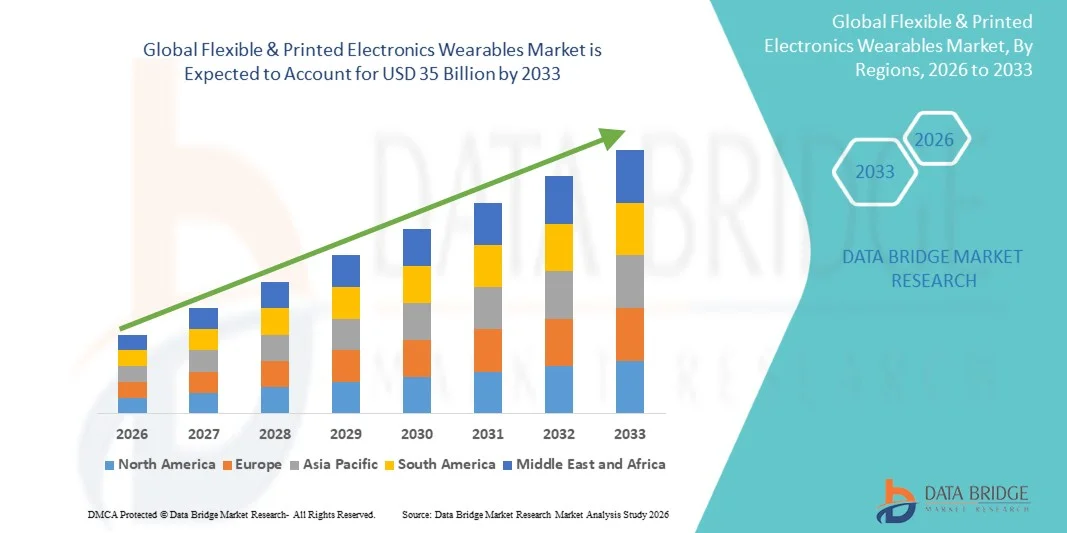
- The global flexible & printed electronics wearables market size was valued at USD 13.5 billion in 2025and is expected to reach USD 35 billion by 2033, at a CAGR of 12.7% during the forecast period
- Market growth is primarily driven by the rapid adoption of next-generation wearable devices enabled by flexible substrates, printed sensors, and ultra-thin electronic components that enhance comfort, durability, and continuous health monitoring capabilities
- In addition, rising demand for real-time health tracking, increasing integration of IoT-enabled wearable systems, and advancements in low-power flexible circuitry are significantly accelerating market expansion across both consumer and professional applications
Flexible & Printed Electronics Wearables Market Analysis
- Flexible and printed electronics wearables integrate stretchable circuits, conductive inks, and lightweight sensor technologies, enabling seamless integration into clothing, skin patches, and compact wearable devices for continuous data collection and monitoring
- The market is witnessing strong momentum due to increasing demand for non-invasive healthcare monitoring, personalized fitness tracking, and smart textiles capable of sensing physiological and environmental parameters in real time
- North America dominated the flexible & printed electronics wearables market in 2025, supported by strong R&D investments, early adoption of advanced wearable technologies, and the presence of leading technology and healthcare device manufacturers, accounting for an estimated 41% market share in 2025
- Asia-Pacific is expected to be the fastest-growing region during the forecast period, driven by expanding consumer electronics manufacturing, rising disposable incomes, and increasing penetration of wearable fitness and health devices across emerging economies, with an estimated highest regional CAGR of 14% during the forecast period
- Smart watches & fitness bands and wearable medical devices collectively accounted for a significant market share in 2025, driven by widespread consumer adoption and growing clinical use in remote patient monitoring and chronic disease management
Report Scope and Flexible & Printed Electronics Wearables Market Segmentation
|
Attributes |
Flexible & Printed Electronics Wearables Key Market Insights |
|
Segments Covered |
|
|
Countries Covered |
North America · U.S. · Canada · Mexico Europe · Germany · France · U.K. · Netherlands · Switzerland · Belgium · Russia · Italy · Spain · Turkey · Rest of Europe Asia-Pacific · China · Japan · India · South Korea · Singapore · Malaysia · Australia · Thailand · Indonesia · Philippines · Rest of Asia-Pacific Middle East and Africa · Saudi Arabia · U.A.E. · South Africa · Egypt · Israel · Rest of Middle East and Africa South America · Brazil · Argentina · Rest of South America |
|
Key Market Players |
|
|
Market Opportunities |
· Expansion of smart textiles and e-textile-based wearables in healthcare and defense sectors · Rising adoption of flexible biosensors for continuous remote patient monitoring and predictive healthcare analytics |
|
Value Added Data Infosets |
In addition to the insights on market scenarios such as market value, growth rate, segmentation, geographical coverage, and major players, the market reports curated by the Data Bridge Market Research also include in-depth expert analysis, patient epidemiology, pipeline analysis, pricing analysis, and regulatory framework |
Flexible & Printed Electronics Wearables Market Trends
“Integration of Smart Textiles and Ultra-Thin Flexible Sensors in Next-Generation Wearables”
- A major trend shaping the market is the increasing integration of flexible sensors, printed circuits, and smart textiles into clothing and skin-adhering devices for continuous biometric and environmental monitoring
- For instance, smart patches and e-textile solutions are being increasingly used for ECG monitoring, hydration tracking, and motion analysis in both healthcare and sports performance applications
- Advances in printed electronics are enabling ultra-lightweight, bendable, and energy-efficient wearable devices that improve user comfort while expanding use cases beyond traditional wrist-worn devices
- Growing convergence of AI, IoT, and flexible electronics is enabling predictive analytics capabilities in wearable devices, supporting real-time health insights and personalized recommendations
- Demand for non-invasive, continuous monitoring solutions is accelerating adoption across healthcare providers, sports organizations, and defense applications
Flexible & Printed Electronics Wearables Market Dynamics
Driver
“Rising Demand for Continuous Health Monitoring and Smart Consumer Wearables”
- The increasing need for real-time health tracking, early disease detection, and remote patient monitoring is a key driver fueling demand for flexible and printed electronics wearables
- Growing consumer preference for lightweight, comfortable, and multifunctional wearable devices is accelerating adoption of smart watches, fitness bands, and smart patches
- Expansion of digital healthcare ecosystems and telemedicine platforms is further driving integration of wearable data into clinical decision-making processes
- Additionally, rising focus on preventive healthcare and wellness tracking is boosting demand across individual consumers and healthcare institutions
- Continuous innovation in flexible materials and low-power electronics is enabling longer battery life and improved device performance
Restraint/Challenge
“High Development Costs and Technical Limitations in Large-Scale Commercialization”
- High manufacturing complexity and cost of advanced flexible electronic components remain a key barrier to large-scale adoption
- Ensuring durability, accuracy, and long-term stability of printed electronic components under real-world usage conditions continues to be a technical challenge
- Limited standardization across wearable platforms and interoperability issues between devices can restrict ecosystem expansion
- Data privacy and security concerns related to continuous biometric monitoring also pose regulatory and consumer adoption challenges
- Addressing these issues through scalable manufacturing processes, improved material science, and stronger data protection frameworks will be essential for sustained market growth
Flexible & Printed Electronics Wearables Market Scope
The market is segmented on the basis of wearable type, application, and end-user.
- By Wearable Type
On the basis of wearable type, the global flexible & printed electronics wearables market is segmented into smart watches & fitness bands, smart clothing / e-textiles, smart patches, AR/VR wearables, hearables, wearable medical devices, and smart glasses. The smart watches & fitness bands segment dominated the market with the largest revenue share of 34% in 2025, driven by strong consumer adoption, continuous health tracking capabilities, and widespread availability across price segments. These devices benefit from mature ecosystem integration with smartphones and cloud platforms, enabling real-time fitness, sleep, and biometric monitoring. Increasing demand for lifestyle-oriented health tracking, coupled with advancements in flexible sensors and low-power displays, further strengthens this segment’s leadership. In addition, strong brand penetration and frequent product upgrades continue to sustain high replacement cycles in the consumer wearable market.
The smart clothing / e-textiles segment is expected to witness the fastest growth during the forecast period, fueled by rapid innovation in conductive fabrics, printed sensors, and stretchable electronics integrated directly into garments. These wearables enable continuous physiological monitoring such as heart rate, respiration, and muscle activity without requiring traditional device form factors. Rising demand in sports performance optimization, defense applications, and healthcare monitoring is accelerating adoption. Increasing investments in textile-integrated electronics and collaborations between apparel and electronics companies are further driving commercialization of smart clothing solutions globally.
- By Application
On the basis of application, the market is segmented into healthcare & medical monitoring, fitness & sports tracking, consumer electronics wearables, military & defense wearables, industrial safety wearables, and others. The consumer electronics wearables segment accounted for the largest market revenue share in 2025, driven by strong global adoption of smart watches, fitness trackers, and connected wearable devices. Continuous advancements in flexible display technologies, miniaturized sensors, and AI-enabled analytics are enhancing user experience and functionality. Growing consumer preference for personalized health insights, lifestyle tracking, and seamless device connectivity further strengthens this segment. The increasing integration of wearable devices with mobile ecosystems and digital health platforms also contributes to sustained dominance.
The healthcare & medical monitoring segment is anticipated to register the fastest growth during the forecast period, driven by rising demand for remote patient monitoring, chronic disease management, and preventive healthcare solutions. Flexible patches and printed biosensors enable continuous, non-invasive monitoring of vital parameters, reducing dependency on hospital visits. Growing adoption of telehealth services and hospital-at-home models is accelerating deployment of wearable medical devices. Increasing focus on early diagnosis, aging populations, and cost-efficient healthcare delivery is further supporting rapid expansion of this segment globally.
- By End-User
On the basis of end-user, the market is segmented into healthcare providers & hospitals, individual consumers, sports & fitness organizations, defense & government agencies, industrial enterprises, OEM wearable device manufacturers, and others. The individual consumers segment dominated the market in 2025, supported by strong adoption of smart watches, fitness bands, and lifestyle-oriented wearable devices. Rising awareness of personal health tracking, increasing fitness consciousness, and affordability of consumer wearables are key factors driving this dominance. Continuous innovation in design, comfort, and battery efficiency further enhances consumer adoption across global markets.
The healthcare providers & hospitals segment is expected to witness the fastest growth during the forecast period, driven by increasing integration of wearable technologies into clinical monitoring and patient care systems. Hospitals are increasingly adopting flexible electronic patches and wearable sensors for real-time patient tracking, post-operative care, and chronic disease management. Growing demand for remote monitoring solutions and data-driven clinical decision-making is further accelerating adoption. Expanding digital health infrastructure and reimbursement support for remote monitoring devices are also contributing to rapid segment growth.
Flexible & Printed Electronics Wearables Market Regional Analysis
- North America dominated the flexible & printed electronics wearables market with the largest revenue share of approximately 41% in 2025, supported by strong R&D investments, early adoption of advanced wearable technologies, and the presence of leading technology and healthcare device manufacturers
- The region benefits from high consumer awareness, advanced digital health infrastructure, and strong integration of wearable devices into healthcare and fitness ecosystems
- Increasing demand for remote patient monitoring, AI-enabled wearables, and smart health tracking devices continues to reinforce regional leadership
U.S. Flexible & Printed Electronics Wearables Market Insight
The U.S. market captured the largest revenue share in North America in 2025, driven by high adoption of smart wearables, strong healthcare digitization, and rapid integration of wearable data into clinical workflows. Growing use of flexible biosensors and smart patches in chronic disease management and preventive healthcare is further supporting market expansion. Strong presence of leading technology companies and continuous innovation in wearable electronics significantly contribute to sustained growth.
Europe Flexible & Printed Electronics Wearables Market Insight
Europe is expected to grow at a steady CAGR during the forecast period, supported by increasing healthcare digitization, strong regulatory frameworks for medical wearables, and rising demand for smart textiles and fitness tracking devices. Growing emphasis on preventive healthcare and aging population trends are accelerating adoption of wearable medical technologies across the region
U.K. Flexible & Printed Electronics Wearables Market Insight
The U.K. flexible & printed electronics wearables market is witnessing steady growth driven by increasing adoption of digital health technologies and strong focus on preventive healthcare. Rising consumer demand for fitness tracking devices, smart textiles, and health monitoring wearables is supporting market expansion across both consumer and healthcare segments. The country’s well-established healthcare system, along with growing integration of wearable data into remote patient monitoring and telehealth platforms, is further strengthening adoption. In addition, supportive government initiatives promoting digital health transformation and innovation in connected medical devices are encouraging the deployment of flexible and printed electronics-based wearables across clinical and homecare settings.
Germany Flexible & Printed Electronics Wearables Market Insight
The Germany flexible & printed electronics wearables market is expanding steadily, supported by strong emphasis on advanced healthcare technologies and precision medicine. High awareness of preventive healthcare, coupled with increasing use of digital monitoring devices in clinical practice, is driving adoption of wearable sensors and smart medical patches. Germany’s strong industrial base in electronics and engineering is also fostering innovation in flexible electronics and smart textile applications. Furthermore, rising demand for workplace safety wearables in industrial sectors and growing integration of IoT-enabled health monitoring systems are contributing to sustained market growth across both medical and non-medical applications.
Asia-Pacific Flexible & Printed Electronics Wearables Market Insight
The Asia-Pacific flexible & printed electronics wearables market is expected to grow at the fastest CAGR during the forecast period, driven by rapid urbanization, expanding consumer electronics manufacturing, and rising disposable incomes. Increasing health awareness and growing adoption of fitness bands, smart watches, and wearable medical devices are significantly boosting demand across emerging economies. Strong government support for digital healthcare initiatives, combined with expanding smartphone penetration and affordable wearable technologies, is accelerating market adoption. In addition, the region’s growing electronics manufacturing ecosystem is enabling large-scale production of flexible sensors and printed electronic components, further strengthening market growth.
Japan Flexible & Printed Electronics Wearables Market Insight
The Japan flexible & printed electronics wearables market is gaining strong momentum due to the country’s aging population and high demand for advanced healthcare monitoring solutions. Increasing adoption of wearable medical devices, smart patches, and compact biosensors is supporting long-term chronic disease management and elderly care. Japan’s strong focus on robotics, precision healthcare, and miniaturized electronics is driving innovation in flexible and printed wearable technologies. Additionally, integration of wearable devices into homecare systems and hospital monitoring frameworks is enhancing patient convenience and improving healthcare efficiency, further supporting market expansion.
India Flexible & Printed Electronics Wearables Market Insight
The India flexible & printed electronics wearables market is witnessing rapid growth, driven by rising health awareness, increasing fitness adoption, and expanding digital connectivity. Growing penetration of affordable smart watches, fitness bands, and wearable health monitoring devices is supporting strong consumer demand. Increasing air pollution levels and rising prevalence of lifestyle-related diseases are further accelerating adoption of health tracking wearables. Government initiatives promoting digital health infrastructure, along with strong domestic electronics manufacturing capabilities, are improving accessibility and affordability of wearable technologies. As a result, India is emerging as one of the fastest-growing markets for flexible and printed electronics-based wearable solutions in the Asia-Pacific region.
Flexible & Printed Electronics Wearables Market Share
The Flexible & printed electronics wearables industry is primarily led by well-established companies, including:
- Apple Inc. (U.S.)
- Samsung Electronics Co., Ltd. (South Korea)
- Sony Group Corporation (Japan)
- Garmin Ltd. (U.S.)
- Xiaomi Corporation (China)
- Philips Healthcare (Netherlands)
- Medtronic plc (Ireland)
- Google LLC (U.S.)
- Huawei Technologies Co., Ltd. (China)
- ABB Ltd. (Switzerland)
- Analog Devices Inc. (U.S.)
- STMicroelectronics N.V. (Switzerland)
- Flex Ltd. (Singapore)
- Texas Instruments Incorporated (U.S.)
- Fitbit (Google) (U.S.)
- Omron Healthcare Co., Ltd. (Japan)
What are the Recent Developments in Global Flexible & Printed Electronics Wearables Market?
- In September 2025, WACKER announced the start of serial production of flexible printed sensor electronics under its Nexipal platform, utilizing roll-to-roll manufacturing technology to produce stretchable and biocompatible sensor laminates for wearable medical devices, robotics, and sports applications, significantly advancing large-scale commercialization of printed electronics in wearable systems
- In September 2025, TracXon raised €4.75 million in funding to scale its hybrid printed electronics platform, focusing on roll-to-roll manufacturing of flexible circuits that can replace traditional rigid PCBs in wearable electronics, IoT devices, and smart sensor applications, strengthening the shift toward low-cost and recyclable wearable electronic systems
- In 2025, Covestro expanded its development of stretchable thermoplastic polyurethane (TPU) films designed for printed electronics applications, enabling advanced smart textiles and skin-contact wearable sensors used in healthcare monitoring and sports performance tracking, enhancing durability and flexibility of wearable electronic substrates
- In 2025, researchers at Harvard University and Wyss Institute developed advanced printed wearable sensor fabrication systems combining stretchable conductive inks and programmable manufacturing techniques, enabling high-resolution flexible sensors for motion tracking and physiological monitoring in healthcare and sports wearables

- Interactive Data Analysis Dashboard
- Company Analysis Dashboard for high growth potential opportunities
- Research Analyst Access for customization & queries
- Competitor Analysis with Interactive dashboard
- Latest News, Updates & Trend analysis
- Harness the Power of Benchmark Analysis for Comprehensive Competitor Tracking
Data collection and base year analysis are done using data collection modules with large sample sizes. The stage includes obtaining market information or related data through various sources and strategies. It includes examining and planning all the data acquired from the past in advance. It likewise envelops the examination of information inconsistencies seen across different information sources. The market data is analysed and estimated using market statistical and coherent models. Also, market share analysis and key trend analysis are the major success factors in the market report. To know more, please request an analyst call or drop down your inquiry.
The key research methodology used by DBMR research team is data triangulation which involves data mining, analysis of the impact of data variables on the market and primary (industry expert) validation. Data models include Vendor Positioning Grid, Market Time Line Analysis, Market Overview and Guide, Company Positioning Grid, Patent Analysis, Pricing Analysis, Company Market Share Analysis, Standards of Measurement, Global versus Regional and Vendor Share Analysis. To know more about the research methodology, drop in an inquiry to speak to our industry experts.
Data Bridge Market Research is a leader in advanced formative research. We take pride in servicing our existing and new customers with data and analysis that match and suits their goal. The report can be customized to include price trend analysis of target brands understanding the market for additional countries (ask for the list of countries), clinical trial results data, literature review, refurbished market and product base analysis. Market analysis of target competitors can be analyzed from technology-based analysis to market portfolio strategies. We can add as many competitors that you require data about in the format and data style you are looking for. Our team of analysts can also provide you data in crude raw excel files pivot tables (Fact book) or can assist you in creating presentations from the data sets available in the report.













