


What is the Flexible Heater Size and Growth Rate?
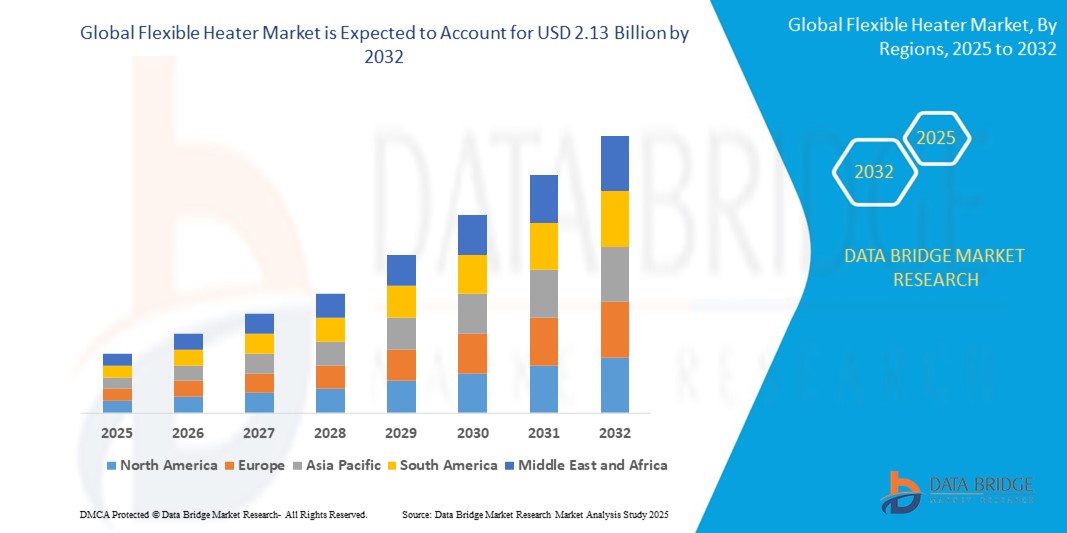
- As per Data Bridge Market Research Analysis the global Flexible Heater market size was valued at USD 1.52 billion in 2024 and is expected to reach USD 2.13 billion by 2032, growing at a CAGR of 4.75% during the forecast period
- The market growth is primarily driven by increasing demand for precise temperature control solutions across industries such as electronics, medical, aerospace, automotive, and oil & gas, alongside ongoing advancements in flexible and thin-film heating technologies
- Additionally, rising adoption of energy-efficient, compact, and customizable heating elements in wearable devices, medical equipment, and industrial applications is propelling the market expansion. These converging factors are accelerating the uptake of Flexible Heater technologies, thereby significantly boosting the industry's growth
Market Size & Forecast
- Global Market Value (2024): USD 1.52 billion
- Expected Market Value (2032): USD 2.13 billion
- Forecast CAGR (2024–2032): 4.75%
What are the Major Takeaways of Flexible Heater?
- A flexible heater is a home appliance device that can conform to the surface which requires heating. Silicone Flexible Heaters are rough, reliable, precise, and moisture and chemical-resistant. They are simply bonded or adhered to other structure parts
- The factors that fuel the growth of the flexible heater market of flexible heaters are the technologically developed features and flexible formation of heaters, the growing functions of heating devices in several industrial sectors, and the increasing adoption of flexible heaters in healthcare and medical applications
- Asia-Pacific dominates the Flexible Heater market with the largest revenue share of 42.5% in 2025, driven by rapid industrialization, a booming electronics and semiconductor manufacturing sector, growing healthcare infrastructure, and strong government initiatives supporting advanced manufacturing technologies. Key countries like China, India, Japan, and South Korea contribute significantly to this dominance due to their expanding industrial base and rising adoption of energy-efficient heating solutions
- North America is expected to be the fastest-growing region in the Flexible Heater market during the forecast period, with a CAGR of approximately 5.3%, fueled by increasing investments in aerospace, medical devices, and automotive sectors, along with growing adoption of IoT-enabled flexible heating solutions
- The electronics and semiconductor segment dominates the largest market revenue share of 34.6% in 2025, driven by the critical need for precise temperature control during manufacturing, testing, and assembly processes
Report Scope and Flexible Heater Market Segmentation
|
Attributes |
Flexible Heater Key Market Insights |
|
Segments Covered |
|
|
Countries Covered |
North America
Europe
Asia-Pacific
Middle East and Africa
South America
|
|
Key Market Players |
|
|
Market Opportunities |
|
|
Value Added Data Infosets |
|
What is the Key Trend in the Flexible Heater?
“Advanced Smart Features and Connectivity”
- A prominent and rapidly evolving trend in the global Flexible Heater market is the widespread integration of advanced smart features and enhanced connectivity, particularly through IoT (Internet of Things) and existing smart home ecosystems. This is significantly boosting user control, energy efficiency, and overall system sophistication
- For instance, many new flexible heating solutions now incorporate built-in sensors and control systems, enabling precise temperature regulation and real-time monitoring. This allows for automated adjustments based on environmental conditions and user preferences, moving beyond simple on/off functionality
- The integration with smart home platforms, often accessible via mobile apps, provides users with remote control capabilities, scheduling options, and energy usage insights. This allows for convenient management of heating from anywhere, contributing to energy savings by preventing unnecessary heating
- Furthermore, the development of more intelligent, connected heaters with embedded sensors and data analytics capabilities is adding a new layer of sophistication to the market, allowing for predictive maintenance and optimized heating patterns based on learned user behavior
- This trend toward highly intelligent and interconnected heating systems is fundamentally reshaping user expectations for thermal management, moving towards more personalized and automated solutions
- The demand for flexible heaters offering seamless smart integration and advanced control is growing rapidly across various sectors, including residential, automotive, and medical, as consumers and industries increasingly prioritize convenience, efficiency, and comprehensive smart functionality
Flexible Heater Market Dynamics
Driver
“Accelerating Demand from Electric Vehicles and Battery Thermal Management”
- A primary driver for the global Flexible Heater market is the rapidly accelerating demand from the electric vehicle (EV) sector, particularly for sophisticated battery thermal management systems. As the automotive industry shifts decisively towards electrification, flexible heaters are becoming indispensable components for maintaining optimal battery performance, efficiency, and lifespan
- For instance, in April 2025, the International Energy Agency (IEA) reported that the proportion of electric cars in the total market hit 18% in 2023 with sales close to 14 million, with sales projected to climb to 17 million in 2024. This significant growth directly translates into a higher need for flexible heaters embedded in EV battery packs to ensure consistent temperature regulation, especially in varying climates
- Cold temperatures can severely reduce battery range and efficiency, making flexible heaters crucial for pre-heating and maintaining optimal operating temperatures. Their thin, conformable nature allows for seamless integration into complex battery module designs, offering uniform heating and mitigating performance degradation
- Automakers are increasingly focusing on improving EV battery performance and reliability, which directly fuels the adoption of advanced flexible heating solutions. The ongoing investment in EV production and the expansion of charging infrastructure further cement this driver's impact on the flexible heater market
- This surge in EV adoption necessitates lightweight, space-saving, and energy-efficient heating solutions, a need perfectly met by flexible heater technology, thereby driving continuous innovation and market expansion in the automotive segment
Restraint/Challenge
“High Manufacturing Costs and Integration Complexity”
- The flexible heater market faces a significant challenge in the form of high manufacturing costs, primarily driven by the use of advanced materials and intricate production processes. This elevated cost can limit their widespread adoption, particularly in price-sensitive applications or regions.
- For instance, the specialized materials like polyimide, silicone rubber, and conductive inks used in flexible heaters are often expensive, contributing substantially to the final product cost. Furthermore, the precision required in manufacturing techniques such as etching and screen printing, especially for complex designs or multiple heating zones, adds to the overall production expenditure.
- In addition to manufacturing costs, the complexity of integrating flexible heaters into various systems and applications presents another hurdle. Ensuring compatibility with diverse equipment and processes often demands careful design and technical expertise, which can increase development time and costs for both manufacturers and end-users.
- This complexity extends to ensuring long-term durability and reliability, as flexible heaters, while bendable, can face issues with wear and tear or damage when subjected to repeated bending or harsh environmental conditions beyond their design limits.
- Overcoming these challenges will require continuous innovation in material science to develop more cost-effective alternatives, coupled with advancements in manufacturing processes to streamline production and reduce complexity, thereby making flexible heaters more accessible across a broader range of applications
How is the Flexible Heater Segmented?
The market is segmented on the basis of type, communication protocol, unlocking mechanism, and application.
- By Type
On the basis of type, the Flexible Heater market is segmented into silicone rubber-based, polyimide-based, polyester-based, mica-based, and others. The silicone rubber-based segment holds the largest market revenue share in 2025, owing to its high durability, flexibility, and resistance to moisture and chemicals. These heaters are widely used in medical, aerospace, and electronics industries where consistent heating performance in harsh environments is critical.
The polyimide-based segment is expected to witness the fastest growth rate from 2025 to 2032, fueled by the rising demand for compact and lightweight heating solutions in electronics and medical devices. Their excellent thermal stability, precise heating, and thin profile make them ideal for applications with tight space constraints.
- By Application
On the basis of application, the Flexible Heater market is segmented into electronics and semiconductor, medical, aerospace and defense, food and beverage, automotive, oil and gas, and others. The electronics and semiconductor segment accounted for the largest market share of 34.6% in 2025, making it the dominant segment in the global Flexible Heater market. This leadership is driven by the critical need for precise temperature control during manufacturing, testing, and assembly processes. Flexible heaters ensure uniform heat distribution, which is essential for preventing defects and ensuring the reliability of sensitive electronic components such as circuit boards, sensors, and microprocessors.
The medical segment is projected to experience the highest CAGR from 2025 to 2032, supported by the expanding use of flexible heaters in diagnostic equipment, patient warming devices, and drug delivery systems. The ongoing advancements in wearable health devices and portable medical tools are further accelerating adoption in this sector.
Which Region Holds the Largest Share of the How is Flexible Heater Segmented?
- Asia-Pacific dominates the Flexible Heater market with the largest revenue share of 42.5% in 2024, driven by rapid industrialization, increasing investments in electronics, semiconductor manufacturing, and expanding healthcare infrastructure across the region.
- Consumers and industries in the region highly value flexible heaters for their energy efficiency, lightweight design, and precise temperature control, essential for applications in electronics, medical devices, aerospace, and automotive sectors.
- This widespread adoption is further supported by rising disposable incomes, government initiatives promoting smart manufacturing and digitalization, and a growing preference for advanced, reliable heating solutions, establishing flexible heaters as a critical component in both industrial and residential applications.
China Flexible Heater Market Insight
The China Flexible Heater market captured the largest revenue share of 32.12% within Asia-Pacific in 2025, driven by rapid industrial growth and widespread adoption of advanced manufacturing technologies. Rising investments in electronics, semiconductor production, and healthcare equipment are key factors propelling demand. Consumers and industries increasingly prioritize energy-efficient and compact heating solutions to support smart manufacturing and digital transformation initiatives. Additionally, government policies promoting smart cities and innovation hubs, along with strong domestic manufacturing capabilities, are significantly contributing to the market’s expansion
Europe Flexible Heater Market Insight
The European Flexible Heater market is projected to expand at a substantial CAGR throughout the forecast period, primarily driven by increasing industrial automation, stringent energy efficiency regulations, and growing demand for advanced heating solutions in electronics, medical, aerospace, and automotive sectors. The rise in smart manufacturing and adoption of IoT-enabled devices is fostering the integration of flexible heaters for precise temperature control and energy savings. European industries and consumers are also attracted by the durability and environmental benefits offered by flexible heater technologies.
U.K. Flexible Heater Market Insight
The U.K. Flexible Heater market is anticipated to grow at a noteworthy CAGR during the forecast period, driven by increasing investments in healthcare, aerospace, and electronics manufacturing, where precise thermal management is critical. The push towards sustainable and energy-efficient manufacturing practices is also encouraging adoption. Additionally, rising awareness about product reliability and miniaturization in medical and semiconductor sectors supports market expansion.
Germany Flexible Heater Market Insight
The German Flexible Heater market is expected to expand at a considerable CAGR during the forecast period, fueled by the country’s leadership in industrial automation, precision engineering, and clean energy technologies. Increasing awareness about energy-efficient heating solutions and stringent environmental regulations are promoting the adoption of flexible heaters in sectors such as automotive, aerospace, and electronics manufacturing. Germany’s well-developed infrastructure and emphasis on sustainable innovation support integration of flexible heater technology in both existing and new industrial systems.
North America Flexible Heater Market Insight
The North America Flexible Heater market is poised to grow at a robust CAGR of 5.3% in 2025, driven by increasing urbanization, rising disposable incomes, and rapid technological advancements in countries such as the U.S., Canada, and Mexico. The region’s strong emphasis on smart homes and industrial automation, supported by government initiatives promoting energy efficiency and digital transformation, is accelerating the adoption of flexible heater solutions. Furthermore, North America serves as a significant hub for research and development, boosting innovation and expanding the accessibility of flexible heaters across residential, commercial, and industrial sectors
U.S. Flexible Heater Market Insight
The U.S. Flexible Heater market is experiencing significant growth due to widespread adoption of connected devices, growing demand for home automation, and expansion in industries such as aerospace, healthcare, and electronics manufacturing. Consumers and businesses alike are focusing on precise temperature control, energy efficiency, and integration with IoT-enabled systems. The availability of advanced manufacturing infrastructure and strong investments in smart technologies are propelling the U.S. market, making it the largest contributor within North America
Canada Flexible Heater Market Insight
The Canadian Flexible Heater market is growing steadily, supported by increased industrial automation and demand for eco-friendly heating solutions in sectors such as oil & gas, medical devices, and automotive manufacturing. Government policies aimed at reducing carbon footprints and promoting energy-efficient technologies further encourage adoption. The country’s cold climate also drives demand for reliable heating applications in both residential and commercial settings, enhancing market growth
Which are the Top Companies in Flexible Heater?
The Flexible Heater industry is primarily led by well-established companies, including:
- Flex Flexible Circuits & Heaters (U.S.)
- The Indian Hume Pipe Co. Ltd. (India)
- NIBE Industrier (Sweden)
- Honeywell International Inc. (U.S.)
- OMEGA Engineering Inc. (U.S.)
- Watlow (U.S.)
- Smiths Group plc (U.K.)
- Chromalox, Inc. (U.S.)
- Rogers Corporation (U.S.)
- Minco Products, Inc. (U.S.)
- Zoppas Industries SpA (Italy)
- Antique Heating Elements (India)
- Birk Manufacturing Inc. (U.S.)
- Keenovo International Group Limited (China)
- Isotherm Internationale (Germany)
- HORN GmbH (Germany)
What are Latest Developments in Flexible Heater?
- In February 2025, Watlow announced the launch of its next-generation flexible heating elements designed for aerospace applications. These new heaters offer improved energy efficiency and precision temperature control, catering to the increasing demand for lightweight, high-performance heating solutions in the aerospace sector
- In January 2025, Honeywell International Inc. expanded its flexible heater product line with advanced thin-film heaters aimed at medical device manufacturers. This development addresses the growing need for compact, reliable heating components in portable and wearable medical devices
- In December 2024, Chromalox, Inc. unveiled a smart flexible heater integrated with IoT-enabled temperature monitoring and control systems. This innovation allows real-time data tracking and remote management, enhancing process reliability in semiconductor manufacturing
- In November 2024, NIBE Industrier announced a strategic partnership with a leading electronics manufacturer to co-develop flexible heating solutions tailored for next-generation consumer electronics, focusing on improved thermal management and product longevity
- In October 2024, OMEGA Engineering Inc. introduced a customizable flexible heater platform with rapid prototyping capabilities, significantly reducing lead times for clients in the automotive and oil & gas industries, enabling faster integration into complex thermal control systems

- Interactive Data Analysis Dashboard
- Company Analysis Dashboard for high growth potential opportunities
- Research Analyst Access for customization & queries
- Competitor Analysis with Interactive dashboard
- Latest News, Updates & Trend analysis
- Harness the Power of Benchmark Analysis for Comprehensive Competitor Tracking
Global Flexible Heater Market, Supply Chain Analysis and Ecosystem Framework
To support market growth and help clients navigate the impact of geopolitical shifts, DBMR has integrated in-depth supply chain analysis into its Global Flexible Heater Market research reports. This addition empowers clients to respond effectively to global changes affecting their industries. The supply chain analysis section includes detailed insights such as Global Flexible Heater Market consumption and production by country, price trend analysis, the impact of tariffs and geopolitical developments, and import and export trends by country and HSN code. It also highlights major suppliers with data on production capacity and company profiles, as well as key importers and exporters. In addition to research, DBMR offers specialized supply chain consulting services backed by over a decade of experience, providing solutions like supplier discovery, supplier risk assessment, price trend analysis, impact evaluation of inflation and trade route changes, and comprehensive market trend analysis.
Data collection and base year analysis are done using data collection modules with large sample sizes. The stage includes obtaining market information or related data through various sources and strategies. It includes examining and planning all the data acquired from the past in advance. It likewise envelops the examination of information inconsistencies seen across different information sources. The market data is analysed and estimated using market statistical and coherent models. Also, market share analysis and key trend analysis are the major success factors in the market report. To know more, please request an analyst call or drop down your inquiry.
The key research methodology used by DBMR research team is data triangulation which involves data mining, analysis of the impact of data variables on the market and primary (industry expert) validation. Data models include Vendor Positioning Grid, Market Time Line Analysis, Market Overview and Guide, Company Positioning Grid, Patent Analysis, Pricing Analysis, Company Market Share Analysis, Standards of Measurement, Global versus Regional and Vendor Share Analysis. To know more about the research methodology, drop in an inquiry to speak to our industry experts.
Data Bridge Market Research is a leader in advanced formative research. We take pride in servicing our existing and new customers with data and analysis that match and suits their goal. The report can be customized to include price trend analysis of target brands understanding the market for additional countries (ask for the list of countries), clinical trial results data, literature review, refurbished market and product base analysis. Market analysis of target competitors can be analyzed from technology-based analysis to market portfolio strategies. We can add as many competitors that you require data about in the format and data style you are looking for. Our team of analysts can also provide you data in crude raw excel files pivot tables (Fact book) or can assist you in creating presentations from the data sets available in the report.













