


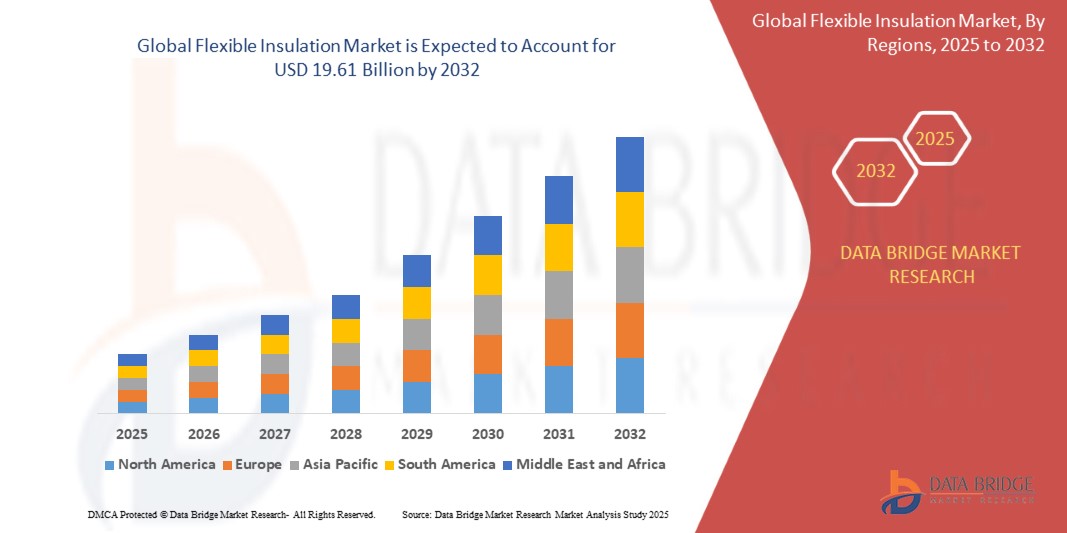
Flexible Insulation Market Size
- The global Flexible Insulation Market was valued at USD 12.61 billion in 2024 and is expected to reach USD 19.61 billion by 2032
- During the forecast period of 2025 to 2032 the market is likely to grow at a CAGR of 5.67%, primarily driven by the increasing emphasis on energy efficiency and thermal management across industrial and residential sectors
- This growth is primarily fueled by stringent government regulations on energy conservation, rising demand for lightweight and efficient insulation materials, and increased construction activity, especially in developing regions
Flexible Insulation Market Analysis
- Flexible insulation materials are essential components used in various thermal and acoustic insulation applications across industries such as construction, HVAC, automotive, aerospace, and industrial processing
- The demand for these materials is significantly driven by the rising need for energy efficiency, regulatory mandates on emissions control, and the growing adoption of sustainable building practices
- The North America region stands out as one of the dominant markets for flexible insulation, supported by stringent energy efficiency regulations, growing retrofit and renovation activities, and a strong presence of insulation manufacturers
- For instance, the U.S. Department of Energy continues to promote building energy codes and rebate programs, encouraging the use of high-performance insulation materials in both commercial and residential sectors
- Globally, flexible insulation is increasingly preferred over rigid alternatives due to its lightweight, ease of installation, durability, and adaptability to complex geometries, making it a crucial element in modern energy-saving solutions across diverse applications
Report Scope and Flexible Insulation Market Segmentation
|
Attributes |
Flexible Insulation Key Market Insights |
|
Segments Covered |
|
|
Countries Covered |
North America
Europe
Asia-Pacific
Middle East and Africa
South America
|
|
Key Market Players |
|
|
Market Opportunities |
|
|
Value Added Data Infosets |
In addition to the insights on market scenarios such as market value, growth rate, segmentation, geographical coverage, and major players, the market reports curated by the Data Bridge Market Research also include import export analysis, production capacity overview, production consumption analysis, price trend analysis, climate change scenario, supply chain analysis, value chain analysis, raw material/consumables overview, vendor selection criteria, PESTLE Analysis, Porter Analysis, and regulatory framework. |
Flexible Insulation Market Trends
“Growing Focus on Sustainable and Energy-Efficient Solutions”
- One prominent trend in the global flexible insulation market is the increasing emphasis on eco-friendly and energy-efficient insulation materials across construction, automotive, and industrial sectors
- Flexible insulation products made from recycled materials, natural fibers, and low-emission polymers are gaining popularity as companies and governments aim to meet net-zero carbon targets and improve building energy performance
- For instance, advanced flexible insulation solutions such as aerogel blankets and bio-based foams are being adopted in green building projects due to their superior thermal resistance, low thickness, and environmental benefits
- In the automotive sector, the trend toward light weighting and electric vehicles is accelerating the use of flexible insulation to reduce thermal loads and improve battery efficiency
- This focus on sustainability is not only reducing carbon footprints but also opening new growth avenues for manufacturers offering innovative, high-performance, and environmentally compliant insulation products
Flexible Insulation Market Dynamics
Driver
“Rising Demand for Energy Efficiency Across Industries”
- The growing emphasis on energy conservation and thermal efficiency across industrial, commercial, and residential sectors is significantly contributing to the increased demand for flexible insulation materials
- Industries such as oil & gas, HVAC, construction, automotive, and aerospace require high-performance insulation to minimize heat loss, lower energy consumption, and maintain temperature stability
- With increasing global focus on reducing carbon emissions and complying with stringent energy regulations, flexible insulation solutions are being rapidly adopted due to their versatility, ease of installation, and effectiveness in tight or irregular spaces
- The demand is particularly high in industrial settings, where equipment like boilers, pipelines, and tanks require reliable thermal insulation to operate efficiently and safely
For instance,
- In September 2023, according to the International Energy Agency (IEA), industrial energy use accounts for over 37% of global final energy consumption, prompting a rise in investments toward insulation retrofits and thermal optimization technologies
- In March 2022, a report from the European Insulation Manufacturers Association (EURIMA) emphasized that enhanced insulation in industrial facilities can lead to energy savings of up to 25%, underlining the importance of flexible insulation in improving operational efficiency
- As a result, rising demand for energy-efficient and sustainable infrastructure and equipment continues to be a strong growth driver for the global flexible insulation market
Opportunity
“Expansion in Green Building Initiatives and Sustainable Construction”
- The increasing global emphasis on sustainable construction and green building certifications, such as LEED and BREEAM, presents a significant opportunity for the flexible insulation market
- Flexible insulation materials, including elastomeric foams, fiberglass, and polyethylene, contribute to improved energy efficiency, reduced emissions, and enhanced indoor air quality, all of which are key criteria in sustainable building standards
- As governments and private stakeholders continue to invest in eco-friendly infrastructure, flexible insulation becomes essential in both new construction and renovation projects, especially for improving thermal performance in walls, HVAC systems, roofs, and ducts
For instance,
- In October 2024, the World Green Building Council announced that 40% of all buildings in G20 countries are expected to be retrofitted by 2030 with sustainable insulation and energy efficiency systems, placing flexible insulation materials in a favorable growth position
- In December 2023, the U.S. Department of Energy (DOE) introduced new building energy codes mandating higher insulation standards for residential and commercial buildings, encouraging the adoption of high-performance flexible insulation products
- This surge in sustainable construction practices provides a long-term opportunity for flexible insulation manufacturers to expand their portfolios with eco-friendly, recyclable, and high-performance insulation solutions designed for green-certified buildings
Restraint/Challenge
“High Material and Installation Costs Limiting Broader Adoption”
- The high cost of flexible insulation materials and their specialized installation requirements can act as a significant barrier to widespread adoption, especially in price-sensitive or developing markets
- Premium flexible insulation products such as aerogels, high-performance elastomeric foams, and multilayer laminates can be considerably more expensive than traditional rigid insulation alternatives
- In addition to material costs, professional installation services are often necessary to ensure optimal thermal performance and code compliance, increasing overall project expenses
For instance,
- In September 2023, a report by Construction Market Research Group revealed that the average cost of flexible insulation installation in commercial buildings is 20–30% higher compared to rigid alternatives, largely due to labor-intensive procedures and the need for skilled technicians
- In April 2024, the International Energy Agency (IEA) noted that cost remains a deterrent for small and medium construction firms and homeowners looking to adopt advanced insulation materials, limiting market penetration in low- to middle-income regions
- As a result, these high upfront costs may discourage potential users from investing in flexible insulation, thereby slowing market growth despite its long-term energy-saving benefits
Flexible Insulation Market Scope
The market is segmented on the basis of material and insulation type.
|
Segmentation |
Sub-Segmentation |
|
By Application |
|
|
By Product Type |
|
Flexible Insulation Market Regional Analysis
“North America is the Dominant Region in the Flexible Insulation Market”
- North America dominates the flexible insulation market, driven by stringent energy efficiency regulations, advanced industrial infrastructure, and high demand for HVAC systems and oil & gas applications
- The U.S. holds a substantial share due to the widespread adoption of energy-efficient construction practices, rising investments in sustainable building technologies, and a strong emphasis on reducing carbon emissions across industries
- Robust government incentives for energy conservation and the presence of major insulation manufacturers further reinforce the region’s market leadership
- In addition, the growing need for thermal insulation in petrochemical facilities, data centers, and cold chain logistics—along with rising retrofitting activities in residential and commercial buildings—is fueling the market expansion across North America
“Asia-Pacific is Projected to Register the Highest Growth Rate”
- The Asia-Pacific region is expected to witness the highest growth rate in the flexible insulation market, driven by rapid industrialization, urban development, and increasing emphasis on energy efficiency across emerging economies
- Countries such as China, India, and South Korea are becoming key markets due to expanding construction activities, growth in HVAC installations, and rising manufacturing output
- China, in particular, is witnessing strong demand for flexible insulation products due to government initiatives promoting green building standards and energy conservation regulations
- India’s fast-paced urban expansion and infrastructure development, coupled with investments in power generation and oil & gas sectors, are further accelerating market growth
- The rising presence of global insulation manufacturers, coupled with increasing awareness about sustainable energy use, is expected to propel the region's flexible insulation market over the forecast period
Flexible Insulation Market Share
The market competitive landscape provides details by competitor. Details included are company overview, company financials, revenue generated, market potential, investment in research and development, new market initiatives, global presence, production sites and facilities, production capacities, company strengths and weaknesses, product launch, product width and breadth, application dominance. The above data points provided are only related to the companies' focus related to market.
The Major Market Leaders Operating in the Market Are:
- Dow (U.S.)
- BASF SE (Germany)
- Covestro AG (Germany)
- Saint-Gobain (France)
- Owens Corning (U.S.)
- Kingspan Group (Ireland)
- Johns Manville (U.S.)
- Knauf Insulation (Germany)
- Armacell (Germany)
- Aspen Aerogels, Inc (U.S.)
- Cabot Corporation (U.S.)
- Huntsman International LLC. (U.S.)
- Lapolla Industries, Inc. (U.S.)
- SAFCO Foam Insulation (U.S.)
- CAJUN FOAM INSULATION. (U.S.)
- Saint-Gobain Group. (France)
- EnergyGuard Foam Insulators, LP (U.S.)
- Continental AG (Germany)
Latest Developments in Global Flexible Insulation Market
- In September 2024, Armacell inaugurated a new aerogel insulation manufacturing facility in India. This plant aims to enhance the company's production capabilities for next-generation aerogel products, catering to the growing demand for high-performance insulation solutions in the construction and industrial sectors
- In November 2023, Kingspan Group introduced Hemkor, its first bio-based flexible insulation product. Hemkor is designed to deliver high-performance insulation while utilizing renewable resources, aligning with the industry's shift towards sustainable building materials
- In 2023, Etex acquired Skamol, a Danish insulation specialist. This strategic move aims to strengthen Etex's portfolio in high-temperature insulation solutions and expand its presence in the flexible insulation market
- As of March 2024, the global flexible insulation market was valued at approximately USD 10.0 billion and is projected to reach USD 17.2 billion by 2034, growing at a compound annual growth rate (CAGR) of 5.6%. This growth is driven by increasing emphasis on energy efficiency and sustainability in construction

- Interactive Data Analysis Dashboard
- Company Analysis Dashboard for high growth potential opportunities
- Research Analyst Access for customization & queries
- Competitor Analysis with Interactive dashboard
- Latest News, Updates & Trend analysis
- Harness the Power of Benchmark Analysis for Comprehensive Competitor Tracking
Global Flexible Insulation Market, Supply Chain Analysis and Ecosystem Framework
To support market growth and help clients navigate the impact of geopolitical shifts, DBMR has integrated in-depth supply chain analysis into its Global Flexible Insulation Market research reports. This addition empowers clients to respond effectively to global changes affecting their industries. The supply chain analysis section includes detailed insights such as Global Flexible Insulation Market consumption and production by country, price trend analysis, the impact of tariffs and geopolitical developments, and import and export trends by country and HSN code. It also highlights major suppliers with data on production capacity and company profiles, as well as key importers and exporters. In addition to research, DBMR offers specialized supply chain consulting services backed by over a decade of experience, providing solutions like supplier discovery, supplier risk assessment, price trend analysis, impact evaluation of inflation and trade route changes, and comprehensive market trend analysis.
Data collection and base year analysis are done using data collection modules with large sample sizes. The stage includes obtaining market information or related data through various sources and strategies. It includes examining and planning all the data acquired from the past in advance. It likewise envelops the examination of information inconsistencies seen across different information sources. The market data is analysed and estimated using market statistical and coherent models. Also, market share analysis and key trend analysis are the major success factors in the market report. To know more, please request an analyst call or drop down your inquiry.
The key research methodology used by DBMR research team is data triangulation which involves data mining, analysis of the impact of data variables on the market and primary (industry expert) validation. Data models include Vendor Positioning Grid, Market Time Line Analysis, Market Overview and Guide, Company Positioning Grid, Patent Analysis, Pricing Analysis, Company Market Share Analysis, Standards of Measurement, Global versus Regional and Vendor Share Analysis. To know more about the research methodology, drop in an inquiry to speak to our industry experts.
Data Bridge Market Research is a leader in advanced formative research. We take pride in servicing our existing and new customers with data and analysis that match and suits their goal. The report can be customized to include price trend analysis of target brands understanding the market for additional countries (ask for the list of countries), clinical trial results data, literature review, refurbished market and product base analysis. Market analysis of target competitors can be analyzed from technology-based analysis to market portfolio strategies. We can add as many competitors that you require data about in the format and data style you are looking for. Our team of analysts can also provide you data in crude raw excel files pivot tables (Fact book) or can assist you in creating presentations from the data sets available in the report.













