


Floor Adhesive Market Overview
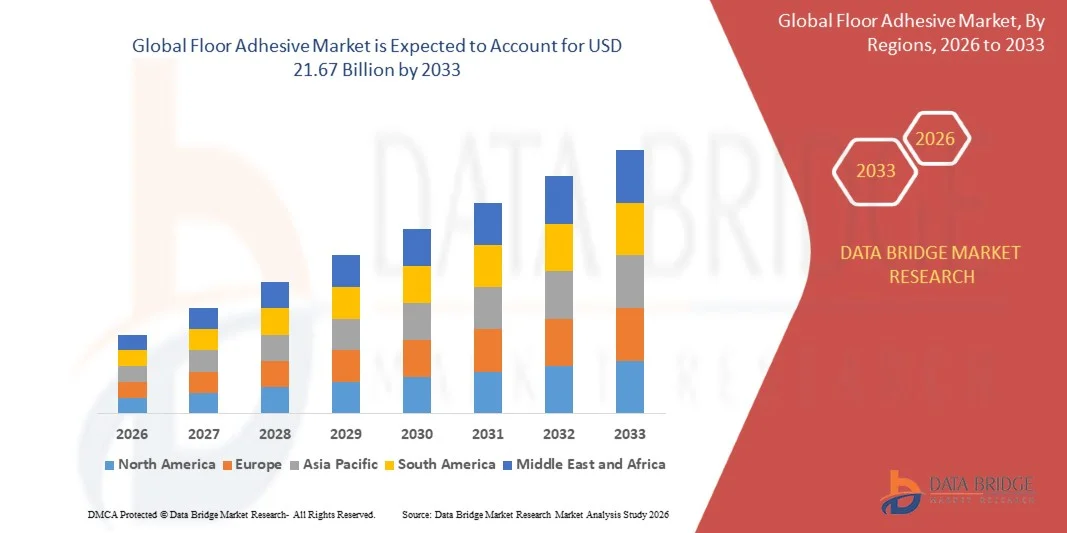
As per Data Bridge Market Research analysis the global floor adhesive market was valued at USD 13.60 billion in 2025 and is projected to reach USD 21.67 billion by 2033, growing at a CAGR of 6.00% from 2026 to 2033. The global floor adhesive market is experiencing steady growth driven by increasing construction activities, rising demand for durable and high-performance flooring solutions, and growing adoption of advanced adhesive technologies across residential, commercial, and industrial applications. The widespread use of epoxy, polyurethane, acrylic, and hybrid adhesive formulations enables manufacturers and contractors to achieve stronger bonding, improved moisture resistance, enhanced durability, and longer flooring lifecycles across various substrates, including wood, vinyl, ceramic tiles, carpet, and resilient flooring materials. Continuous advancements in low-VOC, eco-friendly, and sustainable adhesive formulations are further supporting market expansion as construction industries increasingly focus on environmental compliance and green building standards.
The increasing development of residential infrastructure, commercial buildings, healthcare facilities, educational institutions, and industrial spaces, coupled with rising renovation and remodeling activities, is encouraging flooring manufacturers, construction companies, and adhesive producers to invest in advanced floor adhesive solutions. Growing demand for lightweight flooring systems, faster installation methods, and improved indoor air quality is accelerating the adoption of water-based, solvent-free, and sustainable adhesive technologies. Furthermore, the integration of smart manufacturing processes, bio-based raw materials, and advanced polymer technologies is enabling companies to develop high-performance adhesives with improved bonding strength, thermal stability, and environmental performance, strengthening market growth across developed and emerging economies.
Market Size & Forecast
- Market Value (2025): USD 13.60 Billion
- Expected Market Value (2033): USD 21.67 Billion
- Forecast CAGR (2026–2033): 6.00%
- Leading Region in 2025: Asia-Pacific
- Fastest Growing Region: North America
Key Market Trends & Insights
- Asia-Pacific dominated the global floor adhesive market with the largest revenue share of 48.00% in 2025, supported by rapid urbanization, large-scale residential and commercial construction activities, increasing infrastructure investments, and rising demand for advanced flooring solutions across China, India, Japan, and Southeast Asian countries. The region benefits from expanding real estate development, growing renovation activities, and increasing adoption of high-performance adhesives for applications such as vinyl flooring, wood flooring, tiles, and resilient flooring systems.
- The water-based adhesive segment dominated the market with an estimated 27% share in 2025 owing to increasing environmental regulations restricting volatile organic compound (VOC) emissions and the growing adoption of eco-friendly construction materials.
- North America is expected to be the fastest-growing region at a CAGR of 9.11% from 2026 to 2033, driven by increasing residential renovation and remodeling activities, rising demand for premium flooring materials, growing construction of commercial and healthcare facilities, and increasing adoption of sustainable low-emission adhesive technologies. The region is witnessing strong demand for advanced floor adhesive solutions due to stringent building standards, growing preference for eco-friendly products, and continuous investments in modern infrastructure across the United States and Canada.
- The hot-melt adhesive segment is anticipated to witness the fastest CAGR of 3% from 2026 to 2033, driven by increasing demand for rapid installation processes, higher production efficiency, and solvent-free bonding technologies.
- The wood segment is projected to witness the fastest CAGR of 1% from 2026 to 2033, driven by increasing consumer preference for engineered wood flooring, luxury residential interiors, and sustainable building materials.
Report Scope and Floor Adhesive Market Segmentation
|
Attributes |
Floor Adhesive Key Market Insights |
|
Segments Covered |
|
|
Countries Covered |
North America
Europe
Asia-Pacific
Middle East and Africa
South America
|
|
Key Market Players |
|
|
Market Opportunities |
|
|
Value Added Data Infosets |
In addition to the insights on market scenarios such as market value, growth rate, segmentation, geographical coverage, and major players, the market reports curated by the Data Bridge Market Research also include in-depth expert analysis, geographically represented company-wise production and capacity, network layouts of distributors and partners, detailed and updated price trend analysis and deficit analysis of supply chain and demand. |
Floor Adhesive Market Trends
Trend: Rising Adoption of Low-VOC and Sustainable Floor Adhesive Solutions
The global floor adhesive market is witnessing a strong shift toward low-VOC (volatile organic compound), solvent-free, and environmentally sustainable adhesive technologies as governments continue implementing stricter indoor air quality regulations and green building standards. Construction companies, flooring installers, and infrastructure developers are increasingly selecting adhesives that comply with certifications such as LEED, BREEAM, EMICODE, and GreenGuard while maintaining high bonding strength and durability. Water-based and silane-modified polymer adhesives are gaining significant traction due to their lower emissions, improved moisture resistance, and compatibility with modern flooring materials including luxury vinyl tiles (LVT), engineered wood, laminate, and ceramic tiles. Manufacturers are also focusing on rapid-curing formulations that reduce installation time and labor costs for commercial and residential projects. For instance, in July 2024, MAPEI S.p.A expanded its eco-friendly flooring installation portfolio by promoting Keraquick S1 Zero, a carbon-offset tile adhesive with a very low-VOC formulation designed for ceramic, porcelain, and natural stone installations, supporting sustainable construction practices. This reflects the industry's growing emphasis on combining high performance with environmental responsibility in flooring installation systems.
Global Floor Adhesive Market Dynamics
Key Market Driver: Growing Construction and Renovation Activities Worldwide
The increasing number of residential, commercial, industrial, and infrastructure projects worldwide is a major driver of the global floor adhesive market. Rapid urbanization, government investments in housing and transportation infrastructure, and rising renovation activities are significantly increasing demand for high-performance flooring installation materials. Modern flooring systems such as luxury vinyl tiles, engineered wood, ceramic tiles, and resilient flooring require advanced adhesive technologies that provide superior bonding strength, moisture resistance, and long-term durability. In response, manufacturers are continuously expanding production capacity and introducing innovative installation solutions. For instance, in August 2024, Sika AG significantly expanded the production capacity of its Bekasi manufacturing facility in Indonesia to meet rising regional demand for construction mortars and tile adhesive products serving residential, commercial, and infrastructure projects across Southeast Asia. The investment demonstrates how leading manufacturers are strengthening manufacturing capabilities to support growing global construction activity and increasing demand for advanced floor adhesive solutions.
Key Restraint/Challenge: Volatility in Raw Material Prices and Environmental Regulations
One of the major challenges affecting the global floor adhesive market is the volatility in prices of petrochemical-based raw materials, including acrylics, polyurethane resins, epoxy resins, and specialty polymers used in adhesive manufacturing. Fluctuations in crude oil prices, supply chain disruptions, and increasing transportation costs can significantly increase manufacturing expenses and reduce profit margins for adhesive producers. In addition, increasingly stringent environmental regulations governing VOC emissions, hazardous chemicals, and workplace safety require manufacturers to continuously reformulate products and invest in sustainable technologies. Compliance with green building standards and environmental certification requirements also increases research and development costs. While these regulations encourage innovation in low-emission adhesives, they present operational and financial challenges, particularly for small and medium-sized manufacturers operating in highly competitive markets. For instance, in February 2024, Arkema reported that persistent inflation, higher raw material and energy costs, and a slower construction market continued to impact demand across its Adhesive Solutions segment, highlighting the cost pressures faced by adhesive manufacturers despite ongoing investments in sustainable product development.
Key Market Opportunity: Development of High-Performance Adhesives for Advanced Flooring Systems
Growing demand for premium flooring materials presents significant opportunities for manufacturers to develop next-generation floor adhesive technologies offering faster curing, higher durability, moisture mitigation, and improved installation efficiency. Increasing adoption of luxury vinyl tiles (LVT), engineered wood flooring, resilient flooring, and large-format ceramic tiles requires adhesives specifically designed for enhanced flexibility and long-term performance. Companies are investing heavily in product innovation to improve installer productivity while meeting sustainability requirements. For instance, in January 2025, Bostik announced new flooring installation technologies and advanced soft-floor adhesive solutions to improve installation efficiency and long-term flooring performance at The International Surface Event (TISE), highlighting innovations designed to simplify installation while supporting evolving customer requirements. Such product innovations are expected to create substantial growth opportunities as construction companies increasingly prioritize durable, sustainable, and labor-efficient flooring installation systems.
Global Floor Adhesive Market Scope
The global floor adhesive market is segmented on the basis of resin type, technology, application, and end user.
-
By Resin Type
On the basis of resin type, the global floor adhesive market is segmented into epoxy adhesive, polyurethane adhesive, acrylic adhesive, vinyl adhesive, and others. The polyurethane adhesive segment dominated the market with an estimated 36.84% share in 2025 owing to its superior flexibility, excellent bonding strength, moisture resistance, and compatibility with a wide variety of flooring materials including wood, vinyl, engineered flooring, and concrete substrates. Polyurethane-based products are increasingly preferred across residential, commercial, and industrial construction projects because they provide durable adhesion while accommodating substrate movement caused by temperature and humidity fluctuations. The rising adoption of premium flooring solutions, growing renovation activities, and increasing investments in sustainable infrastructure have further supported demand. In addition, manufacturers are introducing low-VOC and environmentally compliant polyurethane formulations to meet stringent building regulations and green construction standards. Continuous innovation in high-performance flooring systems and increasing demand for long-lasting adhesive solutions are expected to maintain the dominance of the polyurethane adhesive segment throughout the forecast period.
The epoxy adhesive segment is projected to witness the fastest CAGR of 6.8% from 2026 to 2033, driven by increasing demand for heavy-duty flooring applications requiring exceptional mechanical strength, chemical resistance, and long-term durability. Epoxy adhesives are witnessing growing adoption across industrial facilities, warehouses, manufacturing plants, healthcare institutions, and commercial buildings where high load-bearing capacity is essential. The expansion of industrial infrastructure, logistics centers, and advanced manufacturing facilities is accelerating product demand worldwide. Rising investments in high-performance flooring systems, coupled with increasing preference for moisture-resistant and solvent-free adhesive formulations, are further supporting market growth. Continuous advancements in epoxy resin technologies, faster curing systems, and sustainable product development are expected to strengthen the growth of this segment during the forecast period.
-
By Technology
On the basis of technology, the global floor adhesive market is segmented into water-based adhesive, solvent-based adhesive, and hot-melt adhesive. The water-based adhesive segment dominated the market with an estimated 49.27% share in 2025 owing to increasing environmental regulations restricting volatile organic compound (VOC) emissions and the growing adoption of eco-friendly construction materials. Water-based technologies offer low odor, improved indoor air quality, easier application, and strong bonding performance across wood, vinyl, carpet, and laminate flooring installations. Rising green building certifications and increasing awareness regarding sustainable construction practices have encouraged builders and contractors to shift toward water-based formulations. Furthermore, continuous improvements in polymer technology have enhanced product durability, moisture resistance, and curing efficiency, making these adhesives suitable for both residential and commercial flooring applications. Growing investments in sustainable construction materials are expected to reinforce the leadership of the water-based adhesive segment over the forecast period.
The hot-melt adhesive segment is anticipated to witness the fastest CAGR of 7.3% from 2026 to 2033, driven by increasing demand for rapid installation processes, higher production efficiency, and solvent-free bonding technologies. Hot-melt adhesives provide fast curing, excellent bonding strength, minimal waste generation, and improved manufacturing productivity, making them increasingly popular in modular flooring and prefabricated construction applications. The growing use of automated flooring installation systems and industrial manufacturing processes is further accelerating demand. Manufacturers are also introducing advanced hot-melt formulations offering enhanced thermal stability, flexibility, and moisture resistance. Rising investments in industrial automation, modular construction, and sustainable flooring technologies are expected to create significant growth opportunities for the hot-melt adhesive segment during the forecast period.
-
By Application
On the basis of application, the global floor adhesive market is segmented into tile and stone, wood, carpet, laminate, and others. The tile and stone segment dominated the market with an estimated 38.91% share in 2025 owing to the widespread use of ceramic tiles, porcelain tiles, marble, granite, and natural stone flooring across residential, commercial, and institutional construction projects. Rapid urbanization, increasing infrastructure development, and growing investments in premium housing have significantly increased demand for reliable adhesive systems capable of supporting heavy flooring materials. Modern tile adhesives offer superior water resistance, crack prevention, and long-term bonding performance while simplifying installation procedures. Rising renovation activities, particularly in kitchens, bathrooms, hospitals, hotels, and commercial spaces, continue to strengthen demand. Continuous product innovations focused on improved flexibility, faster curing, and enhanced durability are expected to support the dominance of the tile and stone segment throughout the forecast period.
The wood segment is projected to witness the fastest CAGR of 7.1% from 2026 to 2033, driven by increasing consumer preference for engineered wood flooring, luxury residential interiors, and sustainable building materials. Growing adoption of hardwood, parquet, bamboo, and engineered wood flooring across premium residential and commercial projects is creating strong demand for specialized wood flooring adhesives. These products provide enhanced flexibility, sound insulation, moisture protection, and dimensional stability while ensuring long-term performance. Rising disposable incomes, increasing home renovation activities, and expanding luxury real estate developments are further supporting segment growth. Continuous innovations in low-emission adhesive technologies and environmentally friendly wood flooring solutions are expected to accelerate the expansion of the wood segment over the forecast period.
-
By End User
On the basis of end user, the global floor adhesive market is segmented into residential floor adhesive, commercial floor adhesive, and industrial floor adhesive. The commercial floor adhesive segment dominated the market with an estimated 44.16% share in 2025 owing to extensive flooring installations across offices, retail outlets, hospitals, educational institutions, hospitality facilities, airports, and commercial complexes. Increasing investments in commercial infrastructure development and renovation projects have significantly boosted demand for high-performance adhesive solutions capable of supporting heavy foot traffic and long-term durability. Commercial flooring applications require products offering strong adhesion, moisture resistance, rapid curing, and compatibility with multiple flooring materials. Growing adoption of sustainable construction practices and premium interior designs has further increased demand for advanced adhesive technologies. Continuous expansion of commercial real estate and public infrastructure projects is expected to sustain the leadership of the commercial floor adhesive segment throughout the forecast period.
The industrial floor adhesive segment is anticipated to witness the fastest CAGR of 7.5% from 2026 to 2033, driven by expanding manufacturing facilities, warehouses, logistics centers, pharmaceutical plants, food processing units, and automotive production facilities. Industrial flooring systems require adhesives capable of withstanding heavy machinery, chemical exposure, abrasion, and continuous operational stress. Increasing industrialization, rising investments in factory modernization, and growing demand for high-performance flooring systems are accelerating product adoption globally. Manufacturers are introducing advanced industrial adhesive formulations with enhanced chemical resistance, faster curing times, and improved mechanical performance. Furthermore, increasing investments in industrial automation, smart manufacturing, and large-scale infrastructure development are expected to significantly support the growth of the industrial floor adhesive segment during the forecast period.
Floor Adhesive Market Regional Analysis
Asia-Pacific dominated the global floor adhesive market and accounted for the largest revenue share of 48.00% in 2025, supported by rapid urbanization, large-scale residential and commercial construction activities, increasing infrastructure investments, and rising demand for advanced flooring solutions across China, India, Japan, South Korea, and Southeast Asian countries. The region benefits from expanding real estate development, rapid industrialization, and increasing renovation activities, which continue to drive demand for floor adhesive products across residential, commercial, and industrial applications. Growing adoption of premium flooring materials, including wood, vinyl, laminate, ceramic tiles, and resilient flooring systems, is further accelerating market expansion. Increasing government investments in smart cities, transportation infrastructure, affordable housing, and public buildings are creating significant opportunities for adhesive manufacturers. Furthermore, rising preference for low-VOC, water-based, and environmentally sustainable adhesive technologies is supporting product innovation. The presence of leading flooring manufacturers and expanding construction activities are expected to maintain Asia-Pacific's dominant position throughout the forecast period.
Japan Floor Adhesive Market Insight
The Japan floor adhesive market is witnessing steady growth owing to the country's well-established construction industry, increasing renovation of aging residential and commercial buildings, and growing demand for premium flooring materials. Rising adoption of engineered wood flooring, luxury vinyl tiles, and environmentally friendly flooring systems is increasing the need for high-performance adhesive solutions. Japanese manufacturers are focusing on low-emission, water-based, and high-durability adhesive technologies that comply with strict environmental and indoor air quality regulations. In addition, increasing investments in commercial infrastructure, healthcare facilities, hospitality projects, and smart buildings are supporting market expansion. Continuous innovation in fast-curing and moisture-resistant adhesive formulations is further enhancing product adoption across the country.
China Floor Adhesive Market Insight
The China floor adhesive market is experiencing robust growth due to rapid urbanization, large-scale residential housing developments, expanding commercial construction, and continuous investments in industrial infrastructure. The country's booming real estate sector and increasing renovation of existing buildings are significantly driving demand for advanced flooring adhesives across tile, wood, laminate, and vinyl flooring applications. Growing government investments in transportation infrastructure, public facilities, and smart city initiatives continue to support construction activities nationwide. In addition, rising adoption of sustainable building materials and low-VOC adhesive technologies, supported by stricter environmental regulations, is encouraging manufacturers to develop eco-friendly flooring solutions. The presence of large domestic manufacturers and increasing exports of construction materials further strengthen China's position as a key market for floor adhesive products.
North America Floor Adhesive Market Insight
North America is expected to witness the fastest growth in the global floor adhesive market, registering a CAGR of 9.11% from 2026 to 2033. Growth is driven by increasing residential renovation and remodeling activities, rising demand for premium flooring materials, growing construction of commercial buildings, healthcare facilities, educational institutions, and logistics infrastructure across the United States and Canada. The region is witnessing strong demand for advanced floor adhesive solutions due to stringent building standards, increasing preference for sustainable low-emission products, and continuous investments in modern infrastructure. Rising adoption of water-based adhesive technologies, rapid growth in luxury vinyl tile and engineered wood flooring installations, and increasing focus on green building certifications are further supporting market expansion. Continuous technological advancements and product innovations are expected to accelerate the adoption of high-performance floor adhesive solutions throughout the forecast period.
U.S. Floor Adhesive Market Insight
The U.S. floor adhesive market is witnessing strong growth owing to increasing investments in residential housing projects, commercial office developments, healthcare facilities, educational infrastructure, and large-scale renovation activities. Rising consumer preference for luxury vinyl flooring, engineered wood flooring, ceramic tiles, and sustainable construction materials is significantly increasing demand for advanced adhesive technologies. Manufacturers are increasingly introducing water-based, low-VOC, and high-performance adhesive products that comply with stringent environmental regulations and green building standards. Furthermore, growing investments in infrastructure modernization, expanding warehouse and logistics construction, and increasing adoption of modular construction techniques are driving product demand. Continuous innovation in moisture-resistant, fast-curing, and durable adhesive formulations is expected to further strengthen the growth of the U.S. floor adhesive market during the forecast period.
Canada Floor Adhesive Market Insight
The Canada floor adhesive market is witnessing steady growth driven by increasing residential renovation activities, expanding commercial construction, and rising investments in sustainable infrastructure projects. Growing demand for luxury vinyl tiles, engineered wood flooring, ceramic tiles, and laminate flooring is supporting the adoption of high-performance floor adhesive solutions across residential, commercial, and institutional applications. The country's strong focus on green building practices and stringent environmental regulations is accelerating the shift toward low-VOC and water-based adhesive technologies. In addition, increasing investments in healthcare facilities, educational institutions, office spaces, and public infrastructure are creating new growth opportunities for adhesive manufacturers. The growing popularity of energy-efficient buildings, coupled with rising demand for durable and moisture-resistant flooring systems, is further strengthening market expansion. Continuous product innovations focused on faster curing, improved bonding strength, and enhanced sustainability are expected to support the long-term growth of the Canada floor adhesive market.
Floor Adhesive Market Share
The floor adhesive industry is primarily led by well-established companies, including:
- Sika AG (Switzerland)
- MAPEI S.p.A. (Italy)
- Arkema (France)
- Henkel AG & Co. KGaA (Germany)
- H.B. Fuller Company (U.S.)
- Bostik (France)
- Dow Inc. (U.S.)
- Pidilite Industries Limited (India)
- Fosroc International Limited (U.K.)
- Wacker Chemie AG (Germany)
- Soudal Group (Belgium)
- RPM International Inc. (U.S.)
- Saint-Gobain S.A. (France)
- Franklin International (U.S.)
- SABIC (Saudi Arabia)
- Aica Kogyo Co., Ltd. (Japan)
- Huntsman Corporation (U.S.)
Latest Developments in Floor Adhesive Market
- In January 2021, L'Oréal unveiled Perso, its AI-powered at-home skincare and cosmetic personalization device at CES 2021. The device uses artificial intelligence, environmental data, and facial analysis to formulate customized skincare products based on an individual's skin condition, weather, UV exposure, and personal preferences. This launch marked one of the earliest commercial applications of AI-driven personalized skincare for consumers
Reference: L'Oréal Perso Announcement - In July 2024, Perfect Corp. announced the launch of its HD AI Skin Analysis Solution, featuring skin scans with twice the image resolution of previous models. The upgraded AI engine delivers more precise analysis of wrinkles, pores, texture, moisture, redness, and other skin concerns, enabling skincare brands, dermatologists, and aesthetic clinics to provide highly personalized skincare recommendations and treatment plans
Reference: Perfect Corp. HD AI Skin Analysis Launch - In January 2025, L'Oréal introduced Cell BioPrint at CES 2025, an AI-enabled tabletop skin analysis device developed in collaboration with NanoEntek. The system combines proteomics with artificial intelligence to analyze skin biomarkers from a simple facial tape sample and generate personalized skincare ingredient recommendations based on biological skin aging, responsiveness to active ingredients, and future skin health predictions
Reference: - In January 2025, AI announced the commercial availability of SkinGPT together with its Generative.Skin platform. The generative AI technology enables users to virtually visualize skincare treatment outcomes and ingredient effects before purchasing products, allowing beauty brands to deliver scientifically personalized skincare recommendations and improve consumer engagement
Reference: Haut.AI SkinGPT Launch - In April 2025, AI launched Deep C.A.R.E. (Context-aware AI Recommendation Engine), an advanced AI recommendation platform that combines detailed skin profiling with AI-powered product intelligence to generate transparent, evidence-based, and highly personalized skincare recommendations. The platform helps brands improve recommendation accuracy while optimizing product development and customer experience
Reference: Haut.AI Deep C.A.R.E. Launch

- Interactive Data Analysis Dashboard
- Company Analysis Dashboard for high growth potential opportunities
- Research Analyst Access for customization & queries
- Competitor Analysis with Interactive dashboard
- Latest News, Updates & Trend analysis
- Harness the Power of Benchmark Analysis for Comprehensive Competitor Tracking
Global Floor Adhesive Market, Supply Chain Analysis and Ecosystem Framework
To support market growth and help clients navigate the impact of geopolitical shifts, DBMR has integrated in-depth supply chain analysis into its Global Floor Adhesive Market research reports. This addition empowers clients to respond effectively to global changes affecting their industries. The supply chain analysis section includes detailed insights such as Global Floor Adhesive Market consumption and production by country, price trend analysis, the impact of tariffs and geopolitical developments, and import and export trends by country and HSN code. It also highlights major suppliers with data on production capacity and company profiles, as well as key importers and exporters. In addition to research, DBMR offers specialized supply chain consulting services backed by over a decade of experience, providing solutions like supplier discovery, supplier risk assessment, price trend analysis, impact evaluation of inflation and trade route changes, and comprehensive market trend analysis.
Data collection and base year analysis are done using data collection modules with large sample sizes. The stage includes obtaining market information or related data through various sources and strategies. It includes examining and planning all the data acquired from the past in advance. It likewise envelops the examination of information inconsistencies seen across different information sources. The market data is analysed and estimated using market statistical and coherent models. Also, market share analysis and key trend analysis are the major success factors in the market report. To know more, please request an analyst call or drop down your inquiry.
The key research methodology used by DBMR research team is data triangulation which involves data mining, analysis of the impact of data variables on the market and primary (industry expert) validation. Data models include Vendor Positioning Grid, Market Time Line Analysis, Market Overview and Guide, Company Positioning Grid, Patent Analysis, Pricing Analysis, Company Market Share Analysis, Standards of Measurement, Global versus Regional and Vendor Share Analysis. To know more about the research methodology, drop in an inquiry to speak to our industry experts.
Data Bridge Market Research is a leader in advanced formative research. We take pride in servicing our existing and new customers with data and analysis that match and suits their goal. The report can be customized to include price trend analysis of target brands understanding the market for additional countries (ask for the list of countries), clinical trial results data, literature review, refurbished market and product base analysis. Market analysis of target competitors can be analyzed from technology-based analysis to market portfolio strategies. We can add as many competitors that you require data about in the format and data style you are looking for. Our team of analysts can also provide you data in crude raw excel files pivot tables (Fact book) or can assist you in creating presentations from the data sets available in the report.













