


What is the Flooring Chemical Market Size and Growth Rate?
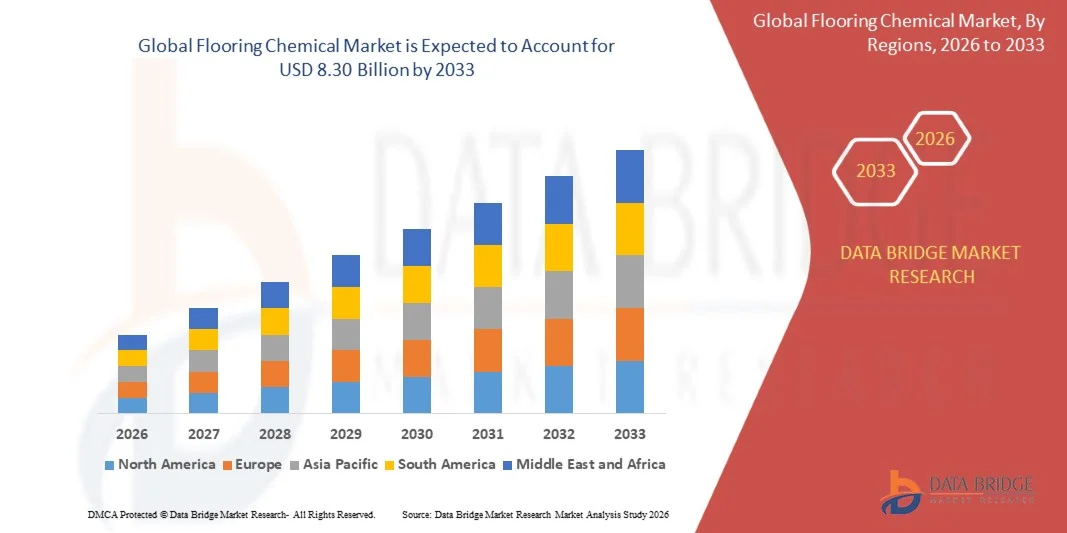
As per Data Bridge Market Research analysis, the flooring chemical market was valued at USD 5.45 Billion in 2025 and is projected to reach USD 8.30 Billion by 2033, growing at a CAGR of 5.40% from 2026 to 2033 Market growth is primarily driven by increasing investments in residential, commercial, and industrial construction projects, coupled with the rising adoption of high-performance flooring systems that offer enhanced durability, chemical resistance, and aesthetic appeal. The growing demand for sustainable, low-VOC, and environmentally friendly flooring chemicals is encouraging manufacturers to develop advanced formulations that comply with stringent environmental regulations while meeting evolving customer requirements.
Furthermore, rapid urbanization, expanding infrastructure development, and increasing renovation and remodeling activities across both developed and emerging economies are creating substantial growth opportunities for flooring chemical manufacturers. Continuous advancements in epoxy, polyurethane, acrylic, and vinyl-based technologies have improved flooring performance, enabling greater resistance to abrasion, moisture, heavy loads, and harsh chemicals. In addition, the growing adoption of flooring chemicals in warehouses, manufacturing facilities, healthcare institutions, educational buildings, retail spaces, and transportation infrastructure is supporting sustained market expansion. Increasing investments in smart buildings and green construction projects, along with innovations in fast-curing and bio-based flooring solutions, are expected to further accelerate market growth throughout the forecast period.
Market Size & Forecast
- Global Market Value (2025): USD 5.45 Billion
- Expected Market Value (2033): USD 8.30 Billion
- Forecast CAGR (2026–2033): 5.40%
- Leading Region in 2025: Asia-Pacific
- Fastest Growing Region: North America
What are the Major Takeaways of Flooring Chemical Market?
- Asia-Pacific dominated the flooring chemical market with the largest revenue share of 36.5% in 2025, supported by rapid urbanization, expanding residential and commercial construction, and increasing investments in industrial and infrastructure development across China, India, Japan, and Southeast Asia.
- North America is expected to witness the fastest growth rate from 2026 to 2033, primarily driven by advanced construction practices, high renovation and remodeling activity, and widespread adoption of high-performance flooring systems across the U.S. and Canada.
- The resilient segment held the largest market revenue share of approximately 38.5% in 2025, driven by its extensive use across vinyl, rubber, and linoleum flooring systems. Increasing demand for durable, moisture-resistant, and low-maintenance flooring solutions in residential, commercial, healthcare, and educational facilities continues to support segment growth.
- The soft covering segment is expected to witness the fastest growth during the forecast period from 2026 to 2033, driven by increasing demand for carpets, rugs, and textile-based flooring systems across residential buildings, hotels, offices, and commercial spaces.
- The industrial/commercial segment held the largest market revenue share in 2025, driven by the extensive use of flooring chemicals in manufacturing facilities, warehouses, healthcare institutions, educational buildings, retail centers, and office spaces.
- The vinyl segment is expected to witness the fastest growth during the forecast period from 2026 to 2033, driven by the rising adoption of luxury vinyl tiles (LVT) and resilient flooring systems due to their durability, moisture resistance, ease of maintenance, and cost-effectiveness.
Report Scope and Flooring Chemical Market Segmentation
|
Attributes |
Flooring Chemical Market Key Market Segments |
|
Segments Covered |
|
|
Countries Covered |
North America
Europe
Asia-Pacific
Middle East and Africa
South America
|
|
Key Market Players |
|
|
Market Opportunities |
|
|
Value Added Data Infosets |
In addition to the insights on market scenarios such as market value, growth rate, segmentation, geographical coverage, and major players, the market reports curated by the Data Bridge Market Research also include import export analysis, production capacity overview, production consumption analysis, price trend analysis, climate change scenario, supply chain analysis, value chain analysis, raw material/consumables overview, vendor selection criteria, PESTLE Analysis, Porter Analysis, and regulatory framework. |
What is the Key Trend in the Flooring Chemical Market?
- The flooring chemical market is witnessing a strong shift toward sustainable, low-VOC, and low-emission resin technologies as building owners, contractors, and architects increasingly prioritize indoor air quality and green building certifications.
- Manufacturers are reformulating epoxy, polyurethane, and polyaspartic flooring systems to reduce volatile organic compound (VOC) emissions while maintaining durability, chemical resistance, and aesthetic performance across industrial, commercial, and residential applications.
- For instance, BASF and Sika jointly introduced Baxxodur EC 151, an amine-based hardener for epoxy flooring systems used in industrial facilities, warehouses, parking structures, and production plants. The hardener enables ultra-low-VOC epoxy formulations, reducing VOC emissions by up to 90% compared with conventional hardeners while allowing greater use of mineral fillers to improve sustainability and cost efficiency.
- Growing adoption of green building standards and stricter indoor air quality regulations is expected to accelerate the development and commercialization of sustainable flooring chemical formulations worldwide.
What are the Key Drivers of the Flooring Chemical Market?
- Expanding residential, commercial, and infrastructure construction activities are driving demand for flooring chemicals, including adhesives, primers, self-leveling compounds, epoxy coatings, and polyurethane resin systems.
- Rising renovation projects and new building construction are increasing the adoption of high-performance flooring systems that offer enhanced durability, moisture resistance, and ease of installation across residential, commercial, healthcare, and industrial facilities.
- For instance, in February 2025, Sika launched SikaBond-5900 and SikaBond-5800 resilient flooring adhesives for the installation of luxury vinyl tile (LVT), luxury vinyl plank (LVP), vinyl sheet flooring, carpet tiles, and rubber flooring in residential and commercial applications.
- The new products feature pressure-sensitive technology, high moisture resistance, and an extended shelf life, supporting the growing demand for advanced flooring installation solutions.
- As construction and renovation activities continue to expand worldwide, demand for advanced flooring chemicals is expected to remain strong, supported by increasing adoption of durable, moisture-resistant, and sustainable flooring systems.
Which Factors are Challenging the Growth of the Flooring Chemical Market?
- Increasing regulatory restrictions on diisocyanates and solvent-based formulations remain a major challenge for flooring chemical manufacturers. Producers of polyurethane flooring adhesives and coatings must comply with increasingly stringent occupational health and environmental regulations, leading to higher reformulation, testing, and compliance costs.
- For instance, Commission Regulation (EU) 2020/1149 under the REACH Regulation introduced restrictions on the industrial and professional use of diisocyanates above 0.1% by weight unless workers complete mandatory safety training.
- The regulation has significantly affected manufacturers of polyurethane-based flooring adhesives and coatings across Europe.
- As environmental and workplace safety regulations continue to tighten globally, manufacturers will need to invest in safer raw materials, low-emission formulations, and regulatory compliance, increasing production costs while accelerating the transition toward alternative flooring chemistries.
What are the Key Opportunities in the Flooring Chemical Market?
- Rising demand for sustainable construction materials and green building certifications such as LEED and BREEAM is creating significant opportunities for flooring chemical manufacturers to develop low-carbon, bio-based, and recycled-content flooring adhesives and coatings.
- Increasing emphasis on reducing embodied carbon and improving indoor environmental quality is encouraging innovation in sustainable flooring solutions.
- For instance, Sika has expanded its portfolio of low-emission flooring solutions under its Sikafloor product range, including products that comply with major indoor air quality certifications such as EMICODE EC1 Plus and other green building standards, supporting sustainable construction projects across commercial and industrial buildings.
- As sustainability becomes a key purchasing criterion in construction projects, demand for environmentally friendly flooring adhesives, coatings, and resin systems is expected to create substantial long-term growth opportunities for manufacturers.
How is the Flooring Chemical Market Segmented?
The flooring chemical market is segmented based on type, application, and product.
- By Type
On the basis of type, the flooring chemical market is segmented into soft covering, resilient, non-resilient, and others. The resilient segment held the largest market revenue share of approximately 38.5% in 2025, driven by its extensive use across vinyl, rubber, and linoleum flooring systems. Increasing demand for durable, moisture-resistant, and low-maintenance flooring solutions in residential, commercial, healthcare, and educational facilities continues to support segment growth. Continuous advancements in resilient flooring materials and the growing adoption of luxury vinyl tiles (LVT) are further strengthening the segment's market position.
The soft covering segment is expected to witness the fastest growth during the forecast period from 2026 to 2033, driven by increasing demand for carpets, rugs, and textile-based flooring systems across residential buildings, hotels, offices, and commercial spaces. Rising consumer preference for enhanced comfort, acoustic performance, and aesthetically appealing flooring solutions is expected to support segment growth.
- By Application
On the basis of application, the flooring chemical market is segmented into residential, industrial/commercial, infrastructure, and repair structures. The industrial/commercial segment held the largest market revenue share in 2025, driven by the extensive use of flooring chemicals in manufacturing facilities, warehouses, healthcare institutions, educational buildings, retail centers, and office spaces. Growing demand for durable, chemically resistant, and high-performance flooring systems in industrial and commercial environments continues to support the segment's dominant position.
The infrastructure segment is expected to witness the fastest growth during the forecast period from 2026 to 2033, driven by increasing investments in transportation, public infrastructure, airports, railways, healthcare facilities, and government construction projects. Rising demand for durable flooring systems capable of withstanding heavy traffic and harsh operating conditions is expected to accelerate segment growth.
- By Product
On the basis of product, the flooring chemical market is segmented into woods, vinyl, tiles, carpets & rugs, and others. The tiles segment held the largest market revenue share in 2025, driven by the widespread use of ceramic and porcelain tiles in residential, commercial, healthcare, and institutional buildings. Increasing demand for high-performance tile adhesives, grouts, sealants, and protective coatings continues to support the segment's dominant market position.
The vinyl segment is expected to witness the fastest growth during the forecast period from 2026 to 2033, driven by the rising adoption of luxury vinyl tiles (LVT) and resilient flooring systems due to their durability, moisture resistance, ease of maintenance, and cost-effectiveness. Growing renovation activities and increasing demand for aesthetically appealing, long-lasting flooring solutions are expected to further accelerate segment growth.
Flooring Chemical Market Analysis
Asia-Pacific Flooring Chemical Market Insight
Asia-Pacific dominated the flooring chemical market with the largest revenue share of 36.5% in 2025, supported by rapid urbanization, expanding residential and commercial construction, and increasing investments in industrial and infrastructure development across China, India, Japan, and Southeast Asia.
Rising government expenditure on smart cities, transportation infrastructure, and affordable housing projects continues to drive demand for high-performance flooring chemicals. The region's strong manufacturing base, growing adoption of sustainable and low-VOC flooring materials, and increasing renovation activities further strengthen its market leadership.
China Flooring Chemical Market Insight
China accounted for the largest share of the Asia-Pacific flooring chemical market in 2025, driven by rapid urbanization, expanding residential and commercial construction, and significant investments in industrial facilities and public infrastructure. The country's strong ceramic tile, vinyl flooring, and construction materials manufacturing base, coupled with increasing adoption of high-performance and environmentally friendly flooring chemicals, continues to support market growth. Government initiatives promoting green buildings, smart cities, and sustainable construction are further strengthening demand.
Japan Flooring Chemical Market Insight
Japan is expected to witness significant growth during the forecast period, driven by increasing renovation and refurbishment activities, growing adoption of premium epoxy and polyurethane flooring systems, and stringent environmental regulations encouraging the use of low-VOC and sustainable flooring chemicals. Rising investments in high-quality construction materials and durable flooring solutions are expected to support market expansion.
North America Flooring Chemical Market Insight
North America is expected to witness the fastest growth rate from 2026 to 2033, primarily driven by advanced construction practices, high renovation and remodeling activity, and widespread adoption of high-performance flooring systems across the U.S. and Canada. Growing demand for epoxy, polyurethane, and low-VOC flooring chemicals in commercial buildings, healthcare facilities, manufacturing plants, warehouses, and educational institutions continues to support market expansion. Increasing investments in sustainable construction and modernization of industrial and commercial infrastructure are further driving regional growth.
U.S. Flooring Chemical Market Insight
The U.S. accounted for the largest share of the North America flooring chemical market in 2025, driven by robust residential renovation activities, expanding commercial construction, and strong demand from industrial and institutional facilities. Growing adoption of epoxy, polyurethane, acrylic, and low-VOC flooring chemicals across warehouses, manufacturing plants, healthcare facilities, educational institutions, and retail buildings continues to support market growth. Rising investments in sustainable construction and durable flooring systems are expected to sustain demand throughout the forecast period.
Europe Flooring Chemical Market Insight
Europe is expected to witness significant growth during the forecast period, supported by stringent environmental regulations, high-quality construction standards, and increasing adoption of sustainable building materials. Growing demand for low-VOC, water-based, and bio-based flooring chemicals across residential, commercial, and industrial applications continues to support market expansion. Rising renovation activities, compliance with green building regulations, and continuous product innovation are further accelerating the adoption of advanced flooring chemical solutions.
Germany Flooring Chemical Market Insight
Germany accounted for the largest share of the Europe flooring chemical market in 2025, supported by its well-established construction and manufacturing industries and strong emphasis on sustainable building practices. Increasing demand for epoxy, polyurethane, and environmentally friendly flooring chemicals across commercial buildings, industrial facilities, healthcare infrastructure, and renovation projects continues to strengthen market growth. Continuous investments in green construction technologies and product innovation are expected to reinforce Germany's market position.
U.K. Flooring Chemical Market Insight
The U.K. flooring chemical market is expected to witness significant growth during the forecast period, supported by increasing investments in residential renovation, commercial construction, and sustainable infrastructure development. Rising demand for low-VOC, water-based, epoxy, and polyurethane flooring chemicals across offices, healthcare facilities, educational institutions, retail spaces, and industrial buildings continues to drive market growth. Growing adoption of green building certifications and modernization of aging infrastructure are expected to further support market expansion.
Which are the Top Companies in Flooring Chemical Market?
The flooring chemical market is primarily led by well-established companies, including:
- BASF (Germany)
- Sika AG (Switzerland)
- MAPEI S.p.A. (Italy)
- Arkema (France)
- RPM International Inc. (U.S.)
- The Sherwin-Williams Company (U.S.)
- PPG Industries, Inc. (U.S.)
- Dow (U.S.)
- Huntsman International LLC. (U.S.)
- Covestro AG (Germany)
- Akzo Nobel N.V. (Netherlands)
- Fosroc, Inc. (U.K.)
- Saint-Gobain (France)
- Henkel AG & Co. KGaA (Germany)
- Flowcrete (U.K.)
- SABA (Netherlands)
- Tremco CPG Inc. (U.S.)
- MAPEI Corporation (U.S.)
- MYK LATICRETE India, Inc. (India)
What are Latest Developments in Flooring Chemical Market?
- In February 2025, Saint-Gobain completed the acquisition of Fosroc, strengthening its construction chemicals portfolio and expanding its presence across India, the Middle East, and Asia-Pacific. The acquisition also enhances its flooring chemicals portfolio, including epoxy floor coating solutions.
- In March 2025, BASF partnered with Sika to develop a new amine curing agent for liquid epoxy resins. Marketed under the Baxxodur EC 151 brand, the product is designed for industrial flooring applications, including warehouses, assembly halls, and parking garages.
- In October 2024, Atul Ltd. expanded its liquid epoxy resin production capacity in India from 30,000 tpa to 50,000 tpa, supported by an investment of INR 200 crore, to meet growing demand from the construction and flooring chemicals sectors.
- In November 2024, Covestro expanded its presence in the Asia-Pacific region by advancing the production of partly bio-based raw materials for coating applications used in construction and infrastructure projects.

- Interactive Data Analysis Dashboard
- Company Analysis Dashboard for high growth potential opportunities
- Research Analyst Access for customization & queries
- Competitor Analysis with Interactive dashboard
- Latest News, Updates & Trend analysis
- Harness the Power of Benchmark Analysis for Comprehensive Competitor Tracking
Global Flooring Chemical Market, Supply Chain Analysis and Ecosystem Framework
To support market growth and help clients navigate the impact of geopolitical shifts, DBMR has integrated in-depth supply chain analysis into its Global Flooring Chemical Market research reports. This addition empowers clients to respond effectively to global changes affecting their industries. The supply chain analysis section includes detailed insights such as Global Flooring Chemical Market consumption and production by country, price trend analysis, the impact of tariffs and geopolitical developments, and import and export trends by country and HSN code. It also highlights major suppliers with data on production capacity and company profiles, as well as key importers and exporters. In addition to research, DBMR offers specialized supply chain consulting services backed by over a decade of experience, providing solutions like supplier discovery, supplier risk assessment, price trend analysis, impact evaluation of inflation and trade route changes, and comprehensive market trend analysis.
Data collection and base year analysis are done using data collection modules with large sample sizes. The stage includes obtaining market information or related data through various sources and strategies. It includes examining and planning all the data acquired from the past in advance. It likewise envelops the examination of information inconsistencies seen across different information sources. The market data is analysed and estimated using market statistical and coherent models. Also, market share analysis and key trend analysis are the major success factors in the market report. To know more, please request an analyst call or drop down your inquiry.
The key research methodology used by DBMR research team is data triangulation which involves data mining, analysis of the impact of data variables on the market and primary (industry expert) validation. Data models include Vendor Positioning Grid, Market Time Line Analysis, Market Overview and Guide, Company Positioning Grid, Patent Analysis, Pricing Analysis, Company Market Share Analysis, Standards of Measurement, Global versus Regional and Vendor Share Analysis. To know more about the research methodology, drop in an inquiry to speak to our industry experts.
Data Bridge Market Research is a leader in advanced formative research. We take pride in servicing our existing and new customers with data and analysis that match and suits their goal. The report can be customized to include price trend analysis of target brands understanding the market for additional countries (ask for the list of countries), clinical trial results data, literature review, refurbished market and product base analysis. Market analysis of target competitors can be analyzed from technology-based analysis to market portfolio strategies. We can add as many competitors that you require data about in the format and data style you are looking for. Our team of analysts can also provide you data in crude raw excel files pivot tables (Fact book) or can assist you in creating presentations from the data sets available in the report.













