What is the Global Floral Extract Market Size and Growth Rate?
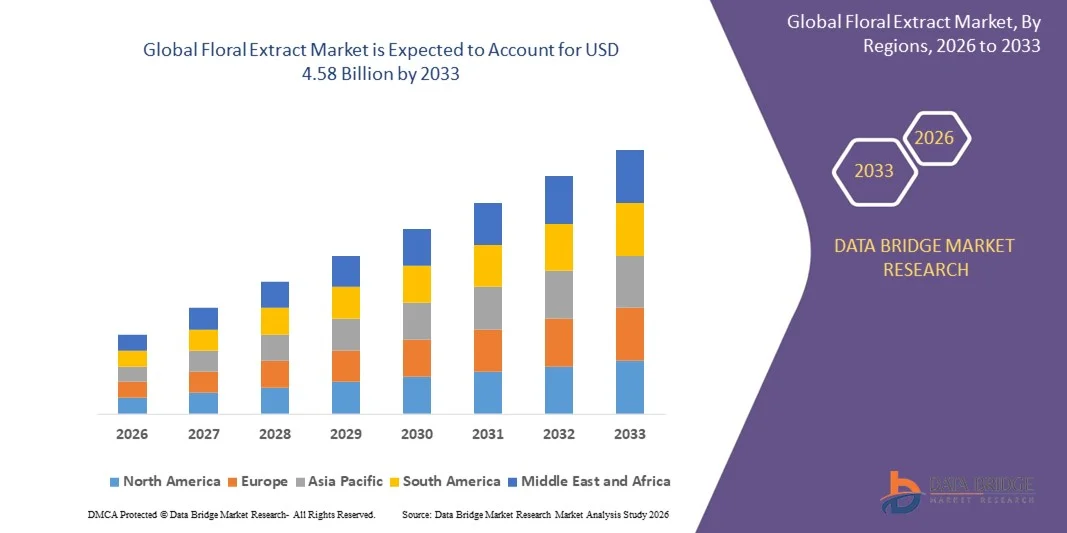
- The global floral extract market size was valued at USD 3.05 billion in 2025 and is expected to reach USD 4.58 billion by 2033, at a CAGR of12.30% during the forecast period
- The rise in the usage and demand for natural products is one of the major factors anticipated to drive the floral extract market growth rate. Moreover, the high demand for natural cosmetics and increase in the awareness are also expected to fuel the growth of the floral extract market
What are the Major Takeaways of Floral Extract Market?
- The market is largely driven by the rise in the consumers demand for natural or organic products. In addition, the high demand for natural products from floral extract particularly essential oil and high adoption of the flower extract-based products is also expected to highly impact the growth of the floral extract market
- While, high demand for the natural ingredients that are extracted from the flower in the processed food industry and high growth of the cosmetic industry and the organic food industry are also amongst the major factors expected to fuel the growth of the floral extract market
- Asia-Pacific dominated the floral extract market with a 38.84% revenue share in 2025, driven by abundant availability of floral raw materials, long-standing traditions in natural fragrances, and strong presence of extraction and processing facilities across countries such as China, India, Japan, and Southeast Asia
- North America is projected to register the fastest CAGR of 10.58% from 2026 to 2033, driven by rising consumer preference for natural, organic, and clean-label ingredients across cosmetics, personal care, food, and wellness industries
- The Liquid segment dominated the market with a 52.6% share in 2025, driven by its high solubility, ease of blending, and widespread use in fragrances, cosmetics, personal care, and beverages
Report Scope and Floral Extract Market Segmentation
|
Attributes |
Floral Extract Key Market Insights |
|
Segments Covered |
|
|
Countries Covered |
North America
Europe
Asia-Pacific
Middle East and Africa
South America
|
|
Key Market Players |
|
|
Market Opportunities |
|
|
Value Added Data Infosets |
In addition to the insights on market scenarios such as market value, growth rate, segmentation, geographical coverage, and major players, the market reports curated by the Data Bridge Market Research also include in-depth expert analysis, pricing analysis, brand share analysis, consumer survey, demography analysis, supply chain analysis, value chain analysis, raw material/consumables overview, vendor selection criteria, PESTLE Analysis, Porter Analysis, and regulatory framework. |
What is the Key Trend in the Floral Extract Market?
Growing Shift Toward Natural, Clean-Label, and Premium Floral Extract Solutions
- The floral extract market is witnessing increasing adoption of natural, solvent-free, and minimally processed extracts derived from flowers such as rose, lavender, hibiscus, chamomile, and jasmine
- Manufacturers are focusing on advanced extraction techniques, including supercritical CO₂ extraction, cold pressing, and enzymatic extraction, to preserve aroma, bioactive compounds, and purity
- Rising demand for clean-label ingredients in food, beverages, cosmetics, and personal care products is accelerating usage of floral extracts across premium and wellness-focused brands
- For instance, companies such as Givaudan, Firmenich, Symrise, Robertet, and Mane are expanding portfolios of sustainably sourced and high-quality floral extracts for flavor and fragrance applications
- Increasing consumer preference for natural fragrances, botanical flavors, and plant-based formulations is strengthening demand across global markets
- As consumers shift toward wellness-oriented and natural products, floral extracts are expected to play a vital role in premium ingredient innovation
What are the Key Drivers of Floral Extract Market?
- Rising demand for natural flavoring and fragrance ingredients as alternatives to synthetic chemicals across food, beverage, and cosmetic industries
- For instance, in 2024–2025, leading companies such as Givaudan, Firmenich, and Symrise increased investments in botanical sourcing, extraction facilities, and sustainable farming partnerships
- Growing adoption of herbal, organic, and functional products in nutraceuticals and personal care is boosting demand across North America, Europe, and Asia-Pacific
- Advancements in extraction technologies, encapsulation methods, and shelf-life stabilization are enhancing product quality and application versatility
- Rising use of floral extracts in aromatherapy, functional beverages, premium cosmetics, and natural food formulations continues to support market expansion
- Supported by strong consumer trends toward wellness and sustainability, the Floral Extract market is expected to witness steady long-term growth
Which Factor is Challenging the Growth of the Floral Extract Market?
- High production costs associated with premium floral raw materials, seasonal availability, and labor-intensive extraction processes limit price competitiveness
- For instance, during 2024–2025, fluctuations in flower yields due to climate variability and supply chain disruptions increased sourcing costs for several extract manufacturers
- Limited shelf life and sensitivity to light, heat, and oxidation pose storage and transportation challenges
- Lack of standardization and regulatory variations across regions complicates global commercialization
- Competition from synthetic flavors, fragrances, and aroma chemicals continues to create pricing pressure
- To address these challenges, companies are focusing on sustainable sourcing, process optimization, encapsulation technologies, and long-term supplier partnerships to strengthen market adoption
How is the Floral Extract Market Segmented?
The market is segmented on the basis of form, extracts, nature, source, method, and application.
- By Form
On the basis of form, the floral extract market is segmented into Liquid, Powder, and Others. The Liquid segment dominated the market with a 52.6% share in 2025, driven by its high solubility, ease of blending, and widespread use in fragrances, cosmetics, personal care, and beverages. Liquid floral extracts offer superior aroma dispersion, consistent quality, and compatibility with both water- and oil-based formulations, making them the preferred choice for manufacturers.
The Powder segment is expected to grow at the fastest CAGR from 2026 to 2033, supported by rising demand for longer shelf life, ease of storage, and improved stability. Powdered extracts are increasingly used in nutraceuticals, dry cosmetics, and functional foods, particularly where precise dosing and transport efficiency are required.
- By Extract Type
Based on extract type, the market is segmented into Concretes, Absolutes, Essential Oils, and Others. The Essential Oils segment dominated the market with a 44.1% share in 2025, owing to extensive use in perfumes, aromatherapy, cosmetics, and personal care products. Essential oils are valued for their concentrated aroma, therapeutic properties, and versatility across applications.
The Absolutes segment is projected to register the fastest CAGR from 2026 to 2033, driven by growing demand for premium, high-end fragrances and luxury cosmetic products. Absolutes offer deeper, richer scent profiles and are increasingly used by fine fragrance manufacturers and niche perfume brands.
- By Nature
On the basis of nature, the floral extract market is segmented into Organic and Conventional. The Conventional segment dominated the market with a 61.3% share in 2025, supported by cost efficiency, wider availability of raw materials, and established supply chains. Conventional extracts remain widely used across mass-market cosmetics, fragrances, and food applications.
The Organic segment is expected to grow at the fastest CAGR from 2026 to 2033, driven by rising consumer preference for clean-label, chemical-free, and sustainably sourced ingredients. Increasing regulatory support and premiumization of personal care and wellness products further support organic segment growth.
- By Source
By source, the market is segmented into Jasmine, Rose, Lavender, Tuberose, Mimosa, Marigold, Lotus, Ylang Ylang, Frangipani, Champak, and Others. The Rose segment dominated the market with a 29.8% share in 2025, owing to its extensive use in fine fragrances, skincare, and aromatherapy. Rose extracts are highly valued for their soothing properties and premium aroma.
The Jasmine segment is expected to grow at the fastest CAGR from 2026 to 2033, driven by rising demand in luxury perfumes, haircare, and wellness products, particularly across Asia-Pacific and Europe.
- By Method
On the basis of method, the market is segmented into Solvent Extraction, Distillation, Enfleurage, and Others. The Distillation segment dominated the market with a 47.5% share in 2025, due to its efficiency, scalability, and widespread use in essential oil production.
The Solvent Extraction segment is projected to grow at the fastest CAGR from 2026 to 2033, supported by increasing demand for high-purity absolutes and delicate floral compounds that cannot withstand heat-based extraction.
- By Application
Based on application, the floral extract market is segmented into Creams, Lotion, Haircare, Makeup, Body Care & Toiletries, and Fragrances. The Fragrances segment dominated the market with a 34.6% share in 2025, driven by strong demand from luxury perfumes, deodorants, and home fragrances.
The Haircare segment is expected to grow at the fastest CAGR from 2026 to 2033, supported by increasing use of botanical ingredients in shampoos, conditioners, and scalp-care products.
Which Region Holds the Largest Share of the Floral Extract Market?
- Asia-Pacific dominated the floral extract market with a 38.84% revenue share in 2025, driven by abundant availability of floral raw materials, long-standing traditions in natural fragrances, and strong presence of extraction and processing facilities across countries such as China, India, Japan, and Southeast Asia
- High production of jasmine, rose, marigold, lotus, ylang ylang, and tuberose supports large-scale manufacturing of floral extracts for fragrances, cosmetics, and personal care products
- Leading regional players are expanding capacity and adopting advanced extraction technologies to meet rising global demand
- Strong export-oriented supply chains, cost-effective labor, and increasing investment in natural ingredient processing further reinforce Asia-Pacific’s market leadership
China Floral Extract Market Insight
China is the largest contributor within Asia-Pacific, supported by extensive cultivation of floral crops, large-scale extraction facilities, and strong export demand for essential oils and absolutes. Growing use of floral extracts in cosmetics, personal care, and traditional wellness products continues to drive market expansion. Government support for natural ingredient processing and sustainable agriculture further strengthens domestic production.
India Floral Extract Market Insight
India plays a key role due to abundant availability of jasmine, marigold, champak, and tuberose, along with a strong essential oils and fragrance industry. Increasing exports, rising domestic consumption of herbal and natural products, and growing investment in extraction infrastructure support sustained market growth.
Japan Floral Extract Market Insight
Japan shows steady growth driven by high demand for premium fragrances, cosmetics, and clean-label personal care products. Strong emphasis on quality, purity, and traceability supports adoption of high-grade floral extracts, particularly in luxury and wellness segments.
North America Floral Extract Market
North America is projected to register the fastest CAGR of 10.58% from 2026 to 2033, driven by rising consumer preference for natural, organic, and clean-label ingredients across cosmetics, personal care, food, and wellness industries. Increasing awareness regarding synthetic chemical alternatives and strong demand for premium fragrances and botanical formulations are accelerating market growth.
U.S. Floral Extract Market Insight
The U.S. is the primary growth engine in North America, supported by strong demand from fragrance houses, cosmetic brands, and nutraceutical manufacturers. Increasing use of floral extracts in clean beauty, aromatherapy, and functional food products drives rapid adoption. Strong presence of global fragrance companies and innovation-focused startups further supports growth.
Canada Floral Extract Market Insight
Canada contributes to regional growth through rising adoption of natural ingredients in personal care and wellness products. Increasing focus on sustainability, organic certification, and clean-label formulations supports expanding use of floral extracts across domestic brands.
Which are the Top Companies in Floral Extract Market?
The floral extract industry is primarily led by well-established companies, including:
- Wild Hibiscus Flower Co. (Australia)
- Naturalin Bio-Resources Co., Ltd. (China)
- NESSO-Natural & Essential Oils Pvt. Ltd. (India)
- Katyani Exports (India)
- Carrubba INC. (U.S.)
- Firmenich SA (Switzerland)
- Givaudan (Switzerland)
- HDDES GROUP (France)
- Herbarom (France)
- Kalishankar Export (India)
- Mane (France)
- Lebermuth, Inc. (U.S.)
- NATEVA SAS. (France)
- PLANTEX (India)
- Robertet (France)
- Symrise (Germany)
- Synthite Industries Ltd. (India)
- GREEN FLORA (India)
- Asean Aromatics Pvt Ltd. (India)
- A. Fakhry & Co (Egypt)
What are the Recent Developments in Global Floral Extract Market?
- In October 2024, Symrise introduced Flowerconcentrole, a new range of sustainably sourced olfactive floral extracts designed to support well-being, offering antimicrobial properties and effective odor-masking while meeting clean beauty requirements, with the 100% natural-origin extracts enhanced by the company’s Actimood technology to deliver neurocosmetic benefits and easy formulation integration, thereby strengthening innovation in sustainable and wellness-focused floral ingredients
- In May 2024, Swiss-based company Climeworks launched Mammoth, the world’s largest carbon dioxide extraction plant in Iceland, developed to remove CO₂ directly from the atmosphere and significantly reduce climate pollution, representing a major milestone in carbon removal technology, thereby advancing global efforts to mitigate climate change and support sustainability goals

- Interactive Data Analysis Dashboard
- Company Analysis Dashboard for high growth potential opportunities
- Research Analyst Access for customization & queries
- Competitor Analysis with Interactive dashboard
- Latest News, Updates & Trend analysis
- Harness the Power of Benchmark Analysis for Comprehensive Competitor Tracking
Data collection and base year analysis are done using data collection modules with large sample sizes. The stage includes obtaining market information or related data through various sources and strategies. It includes examining and planning all the data acquired from the past in advance. It likewise envelops the examination of information inconsistencies seen across different information sources. The market data is analysed and estimated using market statistical and coherent models. Also, market share analysis and key trend analysis are the major success factors in the market report. To know more, please request an analyst call or drop down your inquiry.
The key research methodology used by DBMR research team is data triangulation which involves data mining, analysis of the impact of data variables on the market and primary (industry expert) validation. Data models include Vendor Positioning Grid, Market Time Line Analysis, Market Overview and Guide, Company Positioning Grid, Patent Analysis, Pricing Analysis, Company Market Share Analysis, Standards of Measurement, Global versus Regional and Vendor Share Analysis. To know more about the research methodology, drop in an inquiry to speak to our industry experts.
Data Bridge Market Research is a leader in advanced formative research. We take pride in servicing our existing and new customers with data and analysis that match and suits their goal. The report can be customized to include price trend analysis of target brands understanding the market for additional countries (ask for the list of countries), clinical trial results data, literature review, refurbished market and product base analysis. Market analysis of target competitors can be analyzed from technology-based analysis to market portfolio strategies. We can add as many competitors that you require data about in the format and data style you are looking for. Our team of analysts can also provide you data in crude raw excel files pivot tables (Fact book) or can assist you in creating presentations from the data sets available in the report.