


Flow Battery Market Size
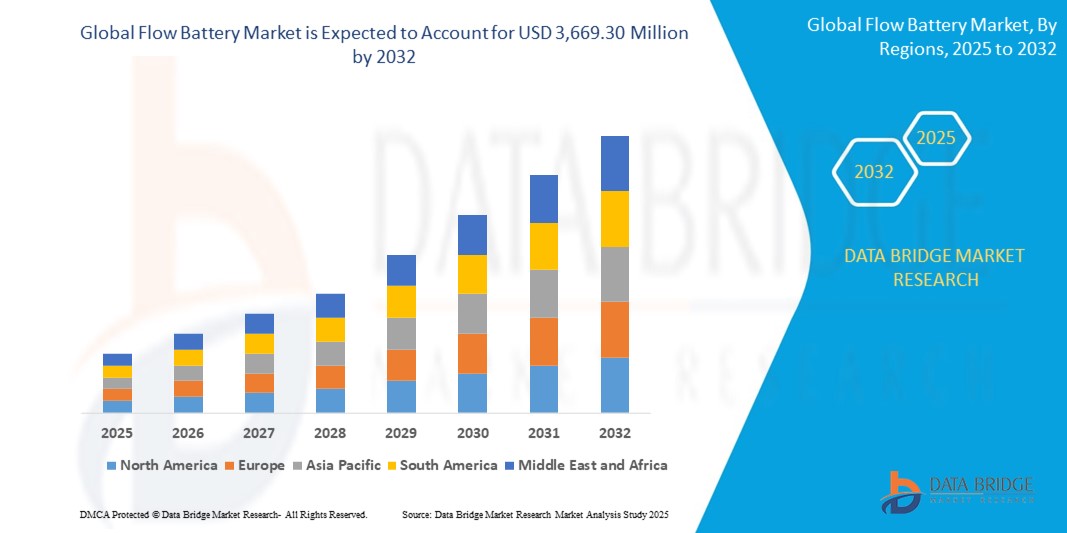
- The global Flow Battery market size was valued at USD 490.71 million in 2024 and is expected to reach USD 3,669.30 million by 2032, at a CAGR of 28.60% during the forecast period
- The market growth is largely fueled by increasing investments in renewable energy infrastructure and the growing demand for reliable and long-duration energy storage solutions to support the integration of these renewable sources into the grid
- Furthermore, rising government initiatives and supportive policies promoting clean energy technologies and grid modernization are establishing Flow Batteries as a key solution for energy storage applications. These converging factors are accelerating the uptake of Flow Battery solutions, thereby significantly boosting the industry's growth
Flow Battery Market Analysis
- Flow Batteries, offering scalable and long-duration energy storage solutions, are increasingly vital components of modern energy infrastructure and renewable energy systems in both utility-scale and commercial/industrial settings due to their ability to provide grid stability, integrate intermittent renewable energy sources, and enhance energy resilience
- The escalating demand for Flow Batteries is primarily fueled by the global shift towards renewable energy generation, the growing need for grid modernization to support these renewables, and a rising preference for safe, reliable, and long-lasting energy storage technologies
- Asia-Pacific dominates the Flow Battery market with the largest revenue share of 40.11% in 2024, driven by increasing investments in renewable energy infrastructure and strong government support for energy storage solutions across key countries such as China, Japan, and India
- European Flow Battery market is projected to expand at a highest Compound Annual Growth Rate (CAGR) of 23.77% throughout the forecast period. This growth is primarily driven by stringent security regulations implemented across the European Union and the escalating need for enhanced security measures in both residential homes and commercial office spaces
- The redox segment accounted for the maximum share of over 79.43% in 2025. This is driven by the more established nature and wider commercialization of redox flow battery technologies, particularly Vanadium Redox Flow Batteries (VRFBs), in grid-scale energy storage applications
Report Scope and Flow Battery Market Segmentation
|
Attributes |
Flow Battery Key Market Insights |
|
Segments Covered |
|
|
Countries Covered |
North America
Europe
Asia-Pacific
Middle East and Africa
South America
|
|
Key Market Players |
|
|
Market Opportunities |
|
|
Value Added Data Infosets |
In addition to the insights on market scenarios such as market value, growth rate, segmentation, geographical coverage, and major players, the market reports curated by the Data Bridge Market Research also include in-depth expert analysis, pricing analysis, brand share analysis, consumer survey, demography analysis, supply chain analysis, value chain analysis, raw material/consumables overview, vendor selection criteria, PESTLE Analysis, Porter Analysis, and regulatory framework. |
Flow Battery Market Trends
“Increasing Deployment for Renewable Energy Integration and Grid Stabilization”
- A significant and accelerating trend in the global Flow Batteries market is their increasing deployment to support the integration of renewable energy sources such as solar and wind power into the electricity grid. Flow batteries are particularly well-suited for this application due to their long discharge durations and ability to handle intermittent power generation
- For instance, projects around the world are utilizing flow batteries to store excess energy generated during peak renewable production times and release it when needed, thus stabilizing the grid. Companies such as Invinity Energy Systems and ESS Inc. are involved in deploying such utility-scale energy storage projects with their flow battery technologies
- Flow batteries are being adopted for grid stabilization services, such as frequency regulation and voltage support, helping to maintain the reliability and quality of the electricity supply as the penetration of renewables increases. Their ability to cycle frequently without degradation makes them ideal for these demanding applications
- This trend is further driven by government incentives and regulations promoting the deployment of energy storage solutions to support renewable energy targets and enhance grid resilience. Many countries are recognizing the crucial role of long-duration storage in achieving their clean energy transitions
- Consequently, the market is witnessing a growing number of partnerships and investments focused on deploying flow battery technology at scale for grid-connected applications, signifying a clear trend towards their increased utilization in the renewable energy sector
Flow Battery Market Dynamics
Driver
“Growing Need for Long-Duration Energy Storage”
- The growing need for long-duration energy storage solutions is a significant driver for the Flow Batteries market. Unlike some other battery technologies that are better suited for shorter durations, flow batteries excel at providing several hours, or even days, of continuous power, making them ideal for applications requiring extended backup or storage capacity
- Flow batteries are being increasingly considered for applications such as providing backup power for critical infrastructure, supporting microgrids with high renewable energy penetration, and enabling energy arbitrage by storing electricity during off-peak hours and discharging it during peak demand period
- The increasing frequency of extreme weather events, leading to power outages, is also driving the demand for reliable long-duration energy storage to ensure business continuity and public safety. Flow batteries offer a robust solution for these critical backup power needs
- Furthermore, the expanding adoption of off-grid renewable energy systems in remote areas is creating a demand for long-duration storage solutions such as flow batteries to provide a stable and continuous power supply independent of the main grid
- This growing recognition of the value of long-duration energy storage across various sectors is expected to continue to propel the growth of the Flow Batteries market
Restraint/Challenge
“High Upfront Cost and Technological Maturity Compared to Other Battery Technologies”
- A notable restraint on the broader adoption of Flow Batteries is their relatively high upfront cost compared to more established battery technologies such as lithium-ion. While the total cost of ownership can be competitive over the lifespan of the battery due to longer cycle life and minimal degradation, the initial investment can be a barrier for some potential customers
- In addition, while flow battery technology has been around for decades, it is still considered less mature commercially compared to lithium-ion, which has benefited from massive investments and widespread adoption in consumer electronics and electric vehicles. This means that the supply chain and manufacturing infrastructure for flow batteries are not as well-established
- Overcoming this challenge will require continued technological innovation to improve performance and reduce costs, as well as increased investment in manufacturing capacity to achieve economies of scale and make flow batteries more price-competitive in the broader energy storage market
Flow Battery Market Scope
The market is segmented on the basis of type, material, storage, application, component, and ownership.
- By Type
On the basis of type, the global flow battery market includes Redox and Hybrid. The redox segment accounted for the maximum share of over 79.43% in 2025. This is driven by the more established nature and wider commercialization of redox flow battery technologies, particularly Vanadium Redox Flow Batteries (VRFBs), in grid-scale energy storage applications. Their proven reliability and scalability contribute to their significant market presence.
The Hybrid segment is also experiencing increasing global interest and development. These batteries, which combine features of redox and battery-capacitor systems, are being explored for applications requiring both high energy density and high power density. As this technology matures and finds specific niche applications, it is expected to see robust growth in the coming years.
- By Material
On the basis of material, the Global Flow Battery market is divided into Vanadium and Zinc–Bromine. The Vanadium segment held the largest share of 64.05% in the global market revenue in 2025. This is primarily due to the maturity and proven performance of Vanadium Redox Flow Battery technology, which has seen significant deployments in utility-scale energy storage and renewable energy integration projects globally.
The Zinc–Bromine segment is projected to experience a rapid growth rate globally from 2025 to 2032. This growth is fueled by the potential for lower material costs compared to vanadium and its suitability for commercial and industrial applications, as well as longer duration energy storage. Ongoing advancements in zinc-bromine battery technology are expanding its market reach.
- By Storage
On the basis of storage, the Global Flow Battery market is segmented into Compact and Large Scale. The Large Scale segment likely accounted for the largest share of the global market revenue in 2025. This dominance is driven by the significant demand for grid-scale energy storage solutions to support the integration of renewable energy sources, enhance grid stability, and provide ancillary services to the electricity grid globally.
The Compact segment is expected to witness substantial global growth, with a projected CAGR indicating increasing adoption from 2025 to 2032. This expansion is driven by the growing interest in flow batteries for commercial and industrial applications, microgrids, and potentially for electric vehicle charging infrastructure in the future, requiring more compact and modular energy storage solutions.
- By Application
On the basis of application, the Global Flow Battery market is segmented into Utilities, Commercial and Industrial, Military, and EV Charging Station. The Utilities segment such asly accounted for the largest share of the global market revenue in 2025. This is due to the widespread use of flow batteries for grid-scale energy storage, supporting renewable energy integration, and providing grid services in utility applications across the world.
The EV Charging Station segment is expected to witness the most rapid growth rate globally from 2025 to 2032. This significant growth is anticipated as the demand for fast and efficient charging infrastructure for electric vehicles increases, and flow batteries emerge as a potential solution for providing high-power and sustainable energy storage at charging stations.
- By Component
On the basis of component, the Global Flow Battery market is divided into Membrane, Power Conditioning System (PCS), Heat Exchanger, Graphite Felt, Bipolar Plate, and Other. The Power Conditioning System (PCS) segment likely held the largest share of the global market revenue in 2025. The PCS is a critical and often high-value component responsible for converting and managing the electrical power flow in the battery system, contributing significantly to the overall system cost.
The Membrane segment is projected to experience a rapid growth rate globally from 2025 to 2032. The membrane is a key component affecting the performance and efficiency of flow batteries, and ongoing research and development efforts focused on improving membrane properties and reducing costs are expected to drive significant advancements and market growth in this segment.
- By Ownership
On the basis of ownership, the Global Flow Battery market is segmented into Customer-Owned, Third-party Owned, and Utility Owned. The Customer-Owned segment likely accounted for the largest share of the global market revenue in 2025. This includes flow batteries directly purchased and operated by end-users across various applications for their specific energy storage needs.
The Third-party Owned segment is expected to witness a significant global growth rate from 2025 to 2032. This model, where energy storage assets are owned and operated by third-party companies and offered as a service, is gaining traction as it can reduce upfront costs and operational complexities for end-users, facilitating broader adoption of flow battery technology.
Flow Battery Market Regional Analysis
- Asia-Pacific dominates the Flow Battery market with the largest revenue share of 40.11% in 2024, driven by increasing investments in renewable energy infrastructure and strong government support for energy storage solutions across key countries such as China, Japan, and India
- Consumers and industries in the region highly value the scalability and long discharge durations offered by flow batteries for grid modernization and renewable integration.
- This adoption is supported by rapid industrialization, urbanization, and a growing focus on energy security
U.S. Flow Battery Market Insight
The U.S. Flow Battery market captured the largest revenue share within North America in 2025. This substantial share is fueled by the rapid uptake of interconnected devices and the expanding trend of complete home automation ecosystems. American consumers are increasingly prioritizing the enhancement of their home security through the implementation of intelligent, keyless entry systems that offer a blend of security and convenience. The growing preference for do-it-yourself smart home setups, combined with a robust demand for voice-controlled systems and seamless mobile application integration for remote access and management, further propels the Flow Battery industry forward within the United States. Moreover, the increasing integration of smart home technology platforms, such as Amazon Alexa, Google Assistant, and Apple HomeKit, is significantly contributing to the market's continuous expansion by enhancing interoperability and user experience.
Europe Flow Battery Market Insight
The European Flow Battery market is projected to expand at a highest Compound Annual Growth Rate (CAGR) of 23.77% throughout the forecast period. This growth is primarily driven by stringent security regulations implemented across the European Union and the escalating need for enhanced security measures in both residential homes and commercial office spaces. The ongoing increase in urbanization across Europe, coupled with a rising demand for seamlessly connected devices that offer both security and convenience, is fostering the widespread adoption of Flow Battery systems. European consumers are also increasingly drawn to the added convenience and potential energy efficiency benefits that these intelligent locking devices offer. The region is experiencing significant growth across various application sectors, including residential buildings, commercial establishments, and multi-family housing units, with Flow Batterys being proactively incorporated into both new construction projects and existing building renovation initiatives aimed at modernizing security infrastructure.
U.K. Flow Battery Market Insight
The U.K. Flow Battery market is anticipated to grow at a noteworthy CAGR during the forecast period. This growth is significantly driven by the escalating trend of comprehensive home automation adoption among consumers and a growing desire for heightened levels of security and overall convenience in managing property access. In addition, increasing concerns regarding the prevalence of burglary and the need for enhanced personal and property safety are strongly encouraging both individual homeowners and commercial businesses to choose advanced keyless entry solutions over traditional locking mechanisms . The United Kingdom's considerable embrace of connected smart devices, alongside its well-established e-commerce and retail infrastructure that facilitates easy access to these technologies, is expected to continue to significantly stimulate robust market growth within the country for the foreseeable future .
Germany Flow Battery Market Insight
The German Flow Battery market is expected to expand at a considerable CAGR during the forecast period. This expansion is primarily fueled by an increasing level of public awareness regarding the importance of digital security in modern living and a strong consumer demand for technologically advanced and environmentally conscious (eco-conscious) security solutions . Germany’s well-developed technological infrastructure, combined with its national emphasis on innovation across industries and a growing societal focus on sustainability, collectively promotes the broader adoption of Flow Battery systems, particularly within residential homes and commercial buildings. Furthermore, the seamless integration of Flow Batterys with comprehensive home automation systems is also becoming increasingly prevalent among German consumers, who exhibit a strong preference for secure and privacy-focused technological solutions that align with local consumer expectations and stringent data protection standards.
Asia-Pacific Flow Battery Market Insight
Asia-Pacific dominates the Flow Battery market with the largest revenue share of 40.11% in 2024, driven by increasing investments in renewable energy infrastructure and strong government support for energy storage solutions across key countries such as China, Japan, and India. This rapid growth is primarily driven by accelerating urbanization trends across the region, a consistent rise in disposable incomes among the burgeoning middle class, and significant technological advancements being made in key countries such as China, Japan, and India. The region's increasing inclination towards the adoption of smart home technologies, which is further supported by various government initiatives aimed at promoting widespread digitalization across sectors, is a major factor driving the adoption of Flow Battery systems. Furthermore, as the Asia-Pacific region increasingly emerges as a global manufacturing hub for Flow Battery components and complete systems, the overall affordability and accessibility of these advanced security solutions are expanding to reach a much wider consumer base throughout the diverse and rapidly evolving markets within APAC .
Japan Flow Battery Market Insight
The Japan Flow Battery market is steadily gaining momentum, primarily driven by the country’s deeply ingrained high-tech culture, the ongoing rapid pace of urbanization leading to denser living environments, and a strong consumer demand for enhanced convenience in daily life. The Japanese market places a particularly significant emphasis on security and reliability in all aspects of technology, and the increasing adoption of Flow Battery systems is directly correlated with the rising number of smart homes and interconnected buildings being developed across the nation . The seamless integration of Flow Batterys with a wide array of other Internet of Things (IoT) devices, such as sophisticated home security camera systems and intelligent lighting setups, is further fueling market growth. Moreover, Japan's aging population is also such asly to spur increased demand for easier-to-use yet highly secure access solutions in both residential homes and commercial establishments, catering to the specific needs of elderly individuals.
China Flow Battery Market Insight
The China Flow Battery market accounted for the largest market revenue share within the Asia Pacific region in 2025. This dominant position can be primarily attributed to the country's rapidly expanding middle class, the continuous and extensive urbanization occurring across its vast landscape, and the remarkably high rates of technological adoption observed among its large consumer base. China stands out as one of the largest global markets for a wide range of smart home devices, and Flow Battery systems are becoming increasingly popular in private residential properties and in various commercial buildings and rental accommodations. The strong government push towards the development of smart cities throughout China, coupled with the increasing availability of affordable Flow Battery options offered by strong domestic manufacturers, are identified as key factors that are currently propelling the significant market growth being witnessed within the country.
Flow Battery Market Share
The Flow Battery industry is primarily led by well-established companies, including:
- Lockheed Martin Corporation (U.S.)
- ViZn Energy Systems (U.S.)
- Sumitomo Electric Industries, Ltd. (Japan)
- Invinity Energy Systems (U.S.)
- Iqony Solar Energy Solutions (Germany)
- ESS Tech, Inc. (U.S.)
- Primus Power (U.S.) (listed twice; included once)
- nanoFlowcell Management AG (Switzerland)
- Gelion plc (Australia)
- UniEnergy Technologies Battery (U.S.)
- Elestor (Netherlands)
- Jena Flow Batteries GmbH (Germany)
- Volterion GmbH & Co. KG (Germany)
- VoltStorage (Germany)
- KEMIWATT (France)
Latest Developments in Global Flow Battery Market
- In October 2024, Enerox GmbH was awarded a combination of funding by the U.S. Department of Defense Innovation Unit (DIU) to deploy its advanced megawatt-scale vanadium flow battery (VFB) system along with its management platform. This initiative highlights Enerox’s strategic role in advancing resilient energy storage technologies for defense applications in the U.S.
- In September 2024, ESS Tech, Inc.’s Australian partner, Energy Storage Industries - Asia Pacific (ESI), secured major investments from the Queensland Government and private investors to accelerate clean energy initiatives across Australia and Oceania. The capital will be used to establish a new facility in Queensland that will assemble ESS’s iron flow battery systems for regional distribution, strengthening local energy infrastructure
- In September 2024, VRB Energy secured a USD 55 million investment, with USD 20 million specifically allocated to developing a vanadium redox flow battery manufacturing facility in Arizona, U.S. This investment positions VRB Energy to expand its manufacturing footprint and meet growing demand for grid-scale storage solutions in North America
- In June 2024, Invinity Energy Systems finalized a 4 MWh battery sale to PowerFlex for a California Energy Commission-backed solar microgrid project for the Rincon Band of Luiseño Indians. This project will utilize 18 Invinity VS3 batteries integrated with a solar array at Harrah's Resort Southern California, supporting sustainable and on-demand clean energy use
- In February 2023, Sumitomo Electric Industries, Ltd. announced its expansion of the redox flow battery business in the U.S. at DISTRIBUTECH International, a prominent smart grid technology conference. This move will help Sumitomo explore opportunities for establishing redox battery production capabilities in North America, aligning with the region’s clean energy transition goals

- Interactive Data Analysis Dashboard
- Company Analysis Dashboard for high growth potential opportunities
- Research Analyst Access for customization & queries
- Competitor Analysis with Interactive dashboard
- Latest News, Updates & Trend analysis
- Harness the Power of Benchmark Analysis for Comprehensive Competitor Tracking
Global Flow Battery Market, Supply Chain Analysis and Ecosystem Framework
To support market growth and help clients navigate the impact of geopolitical shifts, DBMR has integrated in-depth supply chain analysis into its Global Flow Battery Market research reports. This addition empowers clients to respond effectively to global changes affecting their industries. The supply chain analysis section includes detailed insights such as Global Flow Battery Market consumption and production by country, price trend analysis, the impact of tariffs and geopolitical developments, and import and export trends by country and HSN code. It also highlights major suppliers with data on production capacity and company profiles, as well as key importers and exporters. In addition to research, DBMR offers specialized supply chain consulting services backed by over a decade of experience, providing solutions like supplier discovery, supplier risk assessment, price trend analysis, impact evaluation of inflation and trade route changes, and comprehensive market trend analysis.
Data collection and base year analysis are done using data collection modules with large sample sizes. The stage includes obtaining market information or related data through various sources and strategies. It includes examining and planning all the data acquired from the past in advance. It likewise envelops the examination of information inconsistencies seen across different information sources. The market data is analysed and estimated using market statistical and coherent models. Also, market share analysis and key trend analysis are the major success factors in the market report. To know more, please request an analyst call or drop down your inquiry.
The key research methodology used by DBMR research team is data triangulation which involves data mining, analysis of the impact of data variables on the market and primary (industry expert) validation. Data models include Vendor Positioning Grid, Market Time Line Analysis, Market Overview and Guide, Company Positioning Grid, Patent Analysis, Pricing Analysis, Company Market Share Analysis, Standards of Measurement, Global versus Regional and Vendor Share Analysis. To know more about the research methodology, drop in an inquiry to speak to our industry experts.
Data Bridge Market Research is a leader in advanced formative research. We take pride in servicing our existing and new customers with data and analysis that match and suits their goal. The report can be customized to include price trend analysis of target brands understanding the market for additional countries (ask for the list of countries), clinical trial results data, literature review, refurbished market and product base analysis. Market analysis of target competitors can be analyzed from technology-based analysis to market portfolio strategies. We can add as many competitors that you require data about in the format and data style you are looking for. Our team of analysts can also provide you data in crude raw excel files pivot tables (Fact book) or can assist you in creating presentations from the data sets available in the report.













