


What is the Flu Vaccines Market Size and Growth Rate?
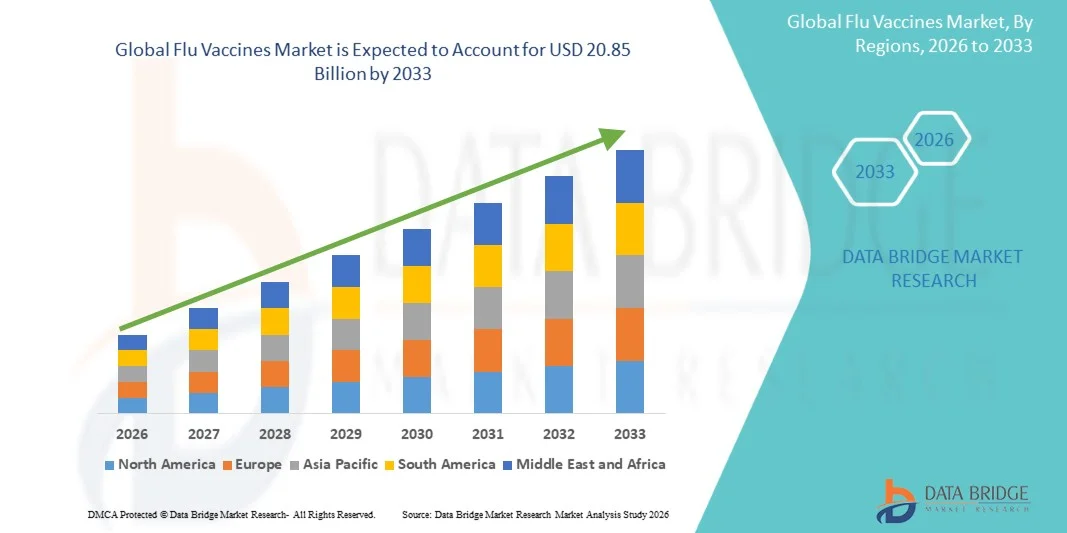
- As per Data Bridge Market Research analysis, the flu vaccines market was valued at USD 10.54 billion in 2025 and is projected to reach USD 20.85 billion by 2033, growing at a CAGR of 8.90% from 2026 to 2033.
- The market is witnessing steady growth driven by increasing seasonal influenza outbreaks, expanding government-led immunization programs, and continuous advancements in vaccine manufacturing technologies, including cell-based and recombinant influenza vaccines.
- The growing awareness of preventive healthcare, coupled with rising vaccination coverage among high-risk populations such as older adults, children, pregnant women, and individuals with chronic diseases, is accelerating demand for flu vaccines across both developed and emerging economies.
Market Size & Forecast
- Global Market Value (2025): USD 10.54 Billion
- Expected Market Value (2033): USD 20.85 Billion
- Forecast CAGR (2026–2033): 8.90%
What are the Major Takeaways of the Flu Vaccines Market?
- North America dominated the flu vaccines market with the largest revenue share in 2025, supported by well-established seasonal influenza immunization programs, high public awareness, and strong government funding for vaccine procurement.
- Asia-Pacific flu vaccines market is expected to witness the fastest growth rate from 2026 to 2033, supported by expanding immunization programs, improving healthcare infrastructure, rising healthcare expenditure, and increasing awareness of influenza prevention across China, Japan, India, South Korea, and Australia.
- The seasonal segment held the largest market revenue share in 2025, driven by annual immunization programs, recurring influenza outbreaks, and widespread government vaccination campaigns. Seasonal influenza vaccines are routinely administered across all age groups and are recommended by national immunization authorities, making them the dominant segment globally.
- The zoonotic segment is projected to register the fastest growth at a CAGR from 2026 to 2033, driven by increasing surveillance of avian and swine influenza viruses, rising pandemic preparedness initiatives, and growing investments in stockpiling vaccines against emerging influenza strains.
- The egg-based segment accounted for the largest market revenue share in 2025, supported by its long-established manufacturing infrastructure, large-scale production capacity, and broad regulatory approvals worldwide. It remains the primary production method for seasonal influenza vaccines.
- The recombinant-based segment is expected to witness the fastest CAGR from 2026 to 2033, driven by its ability to shorten production timelines, eliminate egg dependency, and improve vaccine effectiveness against evolving influenza viruses.
Report Scope and Flu Vaccines Market Segmentation
|
Attributes |
Flu Vaccines Key Market Insights |
|
Segments Covered |
|
|
Countries Covered |
North America
Europe
Asia-Pacific
Middle East and Africa
South America
|
|
Key Market Players |
|
|
Market Opportunities |
|
|
Value Added Data Infosets |
In addition to the insights on market scenarios such as market value, growth rate, segmentation, geographical coverage, and major players, the market reports curated by the Data Bridge Market Research also include depth expert analysis, patient epidemiology, pipeline analysis, pricing analysis, and regulatory framework. |
What is the Key Trend in the Flu Vaccines Market?
- Vaccine manufacturers are increasingly expanding the use of cell-based, recombinant, and mRNA technologies to improve vaccine effectiveness, accelerate production timelines, and strengthen preparedness against emerging influenza strains.
- For instance, in May 2024, Moderna announced positive Phase 3 results for its investigational mRNA-1010 seasonal influenza vaccine, demonstrating strong immune responses against all four influenza strains included in the vaccine, supporting the advancement of next-generation influenza immunization.
- Manufacturers are also increasing investments in flexible manufacturing platforms capable of responding more rapidly to annual strain updates recommended by global health authorities.
- For instance, in June 2024, CSL Seqirus announced that the U.S. FDA approved FLUAD Trivalent, an adjuvanted influenza vaccine formulated in line with updated recommendations for the 2024–2025 influenza season following the transition from quadrivalent to trivalent vaccines.
- As governments and vaccine manufacturers continue to prioritize more effective and rapidly adaptable influenza vaccines, adoption of advanced vaccine technologies is expected to accelerate, strengthening long-term market growth.
What are the Key Drivers of the Flu Vaccines Market?
- Increasing seasonal influenza burden, aging populations, and expanding government immunization programs are significantly driving global demand for influenza vaccines across both developed and emerging economies.
- For instance, in February 2025, the World Health Organization (WHO) released its recommendations for the viral composition of influenza vaccines for the 2025–2026 Northern Hemisphere influenza season, enabling manufacturers to begin timely vaccine production and distribution.
- Public health agencies and healthcare providers are strengthening vaccination campaigns to improve coverage among older adults, children, pregnant women, and individuals with chronic diseases, reducing influenza-related hospitalizations and mortality.
- For instance, in June 2024, the U.S. Centers for Disease Control and Prevention (CDC) recommended the use of updated 2024–2025 seasonal influenza vaccines for everyone aged six months and older before the influenza season begins, supporting widespread vaccination efforts.
- With governments continuing to expand national vaccination strategies and public awareness initiatives, seasonal influenza vaccines are expected to remain an essential component of global preventive healthcare programs.
Which Factors are Challenging the Growth of the Flu Vaccines Market?
- Seasonal influenza vaccines require annual reformulation and production based on predicted circulating virus strains, creating manufacturing complexity and the risk of reduced effectiveness when circulating viruses differ from forecasts.
- These challenges increase production costs, create supply chain pressures, and may affect public confidence during seasons with lower vaccine effectiveness.
- For instance, in February 2025, the World Health Organization (WHO) issued updated recommendations for influenza vaccine virus composition for the 2025–2026 Northern Hemisphere season, highlighting the continuous need for annual strain selection and manufacturing adjustments.
- The recurring requirement for annual vaccine updates, together with production timelines, regulatory coordination, and occasional strain mismatch, continues to limit operational efficiency for manufacturers and vaccination programs. These factors can affect vaccine availability and uptake in certain regions, creating ongoing challenges despite growing global demand for influenza immunization.
How is the Flu Vaccines Market Segmented?
The market is segmented on the basis of influenza type, manufacturing technology, vaccine type, age group, end user, and dosage form.
- By Influenza Type
On the basis of influenza type, the flu vaccines market is segmented into seasonal and zoonotic. The seasonal segment held the largest market revenue share in 2025, driven by annual immunization programs, recurring influenza outbreaks, and widespread government vaccination campaigns. Seasonal influenza vaccines are routinely administered across all age groups and are recommended by national immunization authorities, making them the dominant segment globally.
The zoonotic segment is projected to register the fastest growth at a CAGR from 2026 to 2033, driven by increasing surveillance of avian and swine influenza viruses, rising pandemic preparedness initiatives, and growing investments in stockpiling vaccines against emerging influenza strains.
- By Manufacturing Technology
On the basis of manufacturing technology, the flu vaccines market is segmented into egg-based, cell culture-based, and recombinant-based. The egg-based segment accounted for the largest market revenue share in 2025, supported by its long-established manufacturing infrastructure, large-scale production capacity, and broad regulatory approvals worldwide. It remains the primary production method for seasonal influenza vaccines.
The recombinant-based segment is expected to witness the fastest CAGR from 2026 to 2033, driven by its ability to shorten production timelines, eliminate egg dependency, and improve vaccine effectiveness against evolving influenza viruses.
- By Vaccine Type
On the basis of vaccine type, the flu vaccines market is segmented into quadrivalent influenza vaccines, trivalent influenza vaccines, whole virus vaccines, split virus vaccines, subunit vaccines, and live attenuated virus vaccines. The quadrivalent influenza vaccines segment dominated the market with a revenue share in 2025, owing to broader protection against four influenza virus strains and increasing adoption across national immunization programs.
The subunit vaccines segment is anticipated to register the fastest growth at a CAGR from 2026 to 2033, supported by improved safety profiles, lower reactogenicity, and growing use among older adults and individuals with underlying medical conditions.
- By Age Group
On the basis of age group, the flu vaccines market is segmented into pediatric and adult. The adult segment held the largest market revenue share in 2025, driven by high vaccination rates among older adults, healthcare workers, and individuals with chronic diseases, along with expanding government-funded adult immunization programs.
The pediatric segment is projected to grow at the fastest CAGR from 2026 to 2033, supported by increasing childhood vaccination awareness, school-based immunization initiatives, and recommendations from public health authorities.
- By End User
On the basis of end user, the flu vaccines market is segmented into hospitals and clinics, research organizations and academic institutes, and others. The hospitals and clinics segment accounted for the largest market revenue share in 2025, owing to their role as the primary vaccination centers for seasonal immunization campaigns, routine healthcare services, and mass vaccination programs.
The research organizations and academic institutes segment is expected to register the fastest CAGR from 2026 to 2033, driven by increasing research on next-generation influenza vaccines, pandemic preparedness, and advanced vaccine platform development.
- By Dosage Form
On the basis of dosage form, the flu vaccines market is segmented into nasal spray, intramuscular injection, and intradermal shot. The intramuscular injection segment dominated the market with a revenue share in 2025, driven by its widespread clinical acceptance, strong immunogenicity, and extensive use across national vaccination programs for all eligible age groups.
The nasal spray segment is projected to witness the fastest CAGR from 2026 to 2033, supported by increasing preference for needle-free vaccination, improved patient compliance among children, and expanding approvals for live attenuated influenza vaccines.
Which Region Holds the Largest Share of the Flu Vaccines Market?
- North America dominated the flu vaccines market with the largest revenue share in 2025, supported by well-established seasonal influenza immunization programs, high public awareness, and strong government funding for vaccine procurement.
- The region benefits from advanced healthcare infrastructure, favorable reimbursement policies, and the presence of leading vaccine manufacturers. Annual recommendations from public health agencies, including the U.S. Centers for Disease Control and Prevention (CDC) and the Public Health Agency of Canada, continue to drive high vaccination coverage among high-risk populations, strengthening regional market growth.
U.S. Flu Vaccines Market Insight
The U.S. flu vaccines market captured the largest revenue share in 2025 within North America, fueled by nationwide annual influenza vaccination campaigns, high healthcare spending, and strong participation from pharmacies, hospitals, and primary care providers. The country's expanding adult immunization initiatives, increasing adoption of high-dose and adjuvanted vaccines for older adults, and continuous investments in advanced vaccine technologies are further supporting market expansion. Strong regulatory support from the U.S. FDA and recommendations from the CDC continue to encourage widespread vaccine uptake.
Europe Flu Vaccines Market Insight
Europe flu vaccines market is expected to witness the fastest growth rate from 2026 to 2033, primarily driven by expanding national immunization programs, increasing awareness of influenza prevention, and the growing elderly population. The region is strengthening pandemic preparedness strategies while encouraging broader vaccination coverage among vulnerable populations. Continued investments in advanced vaccine manufacturing technologies and favorable public healthcare policies are expected to further accelerate market growth across European countries.
U.K. Flu Vaccines Market Insight
The U.K. flu vaccines market is expected to witness the fastest growth rate from 2026 to 2033, driven by the National Health Service's annual influenza vaccination campaigns and increasing immunization coverage among older adults, children, pregnant women, and individuals with chronic medical conditions. Growing public awareness regarding seasonal influenza prevention and expanding access through community pharmacies and healthcare providers are expected to continue supporting market growth.
Germany Flu Vaccines Market Insight
Germany flu vaccines market is expected to witness the fastest growth rate from 2026 to 2033, fueled by increasing government vaccination initiatives, rising awareness of preventive healthcare, and a growing aging population. The country's advanced healthcare infrastructure, strong pharmaceutical manufacturing capabilities, and continued investment in vaccine innovation are supporting broader adoption of seasonal influenza vaccines. Increased recommendations for annual vaccination among high-risk groups are also contributing to sustained market expansion.
Asia-Pacific Flu Vaccines Market Insight
The Asia-Pacific flu vaccines market is expected to witness the fastest growth rate from 2026 to 2033, supported by expanding immunization programs, improving healthcare infrastructure, rising healthcare expenditure, and increasing awareness of influenza prevention across China, Japan, India, South Korea, and Australia. Government initiatives to strengthen infectious disease preparedness, combined with growing domestic vaccine manufacturing capabilities, are contributing significantly to regional market growth.
Japan Flu Vaccines Market Insight
Japan flu vaccines market is expected to witness the fastest growth rate from 2026 to 2033 due to the country's aging population, well-established seasonal vaccination programs, and strong emphasis on preventive healthcare. Government recommendations encouraging annual influenza vaccination among elderly individuals, children, and healthcare workers continue to support vaccine demand. The presence of advanced vaccine manufacturers and continued investments in innovative vaccine technologies further strengthen the market.
China Flu Vaccines Market Insight
The China flu vaccines market accounted for the largest market revenue share in Asia-Pacific in 2025, attributed to its large population, expanding public health initiatives, increasing vaccination awareness, and rapidly improving healthcare infrastructure. Government efforts to strengthen infectious disease prevention, combined with growing domestic vaccine production capacity and increasing adoption of seasonal influenza vaccination in urban populations, are key factors driving market growth across the country.
Which are the Top Companies in Flu Vaccines Market?
The flu vaccines industry is primarily led by well-established companies, including:
- AstraZeneca (U.K.)
- BioDiem (Canada)
- Novasep (France)
- Merck KGaA (Germany)
- Charles River Laboratories (U.K.)
- uniQure N.V. (Netherlands)
- Waisman Biomanufacturing (U.S.)
- Creative-Biogene (U.S.)
- Aldevron (U.S.)
- Oxford Biomedica (U.K.)
- Thermo Fisher Scientific Inc. (U.S.)
- Fujifilm Corporation (Japan)
- Spark Therapeutics Inc. (U.S.)
- ABL Inc. (U.S.)
- Boehringer Ingelheim International GmbH (Germany)
- Brammer Bio (U.S.)
- Pfizer Inc. (U.S.)
What are Latest Developments in Flu Vaccines Market?
- In July 2025, GSK plc announced the commencement of shipments of its trivalent seasonal influenza vaccines, FLULAVAL and FLUARIX, to U.S. healthcare providers and pharmacies for the 2025–26 flu season. The rollout followed U.S. FDA licensing and lot-release approval, with both vaccines available for individuals aged six months and older. The timely supply is expected to support seasonal immunization programs and improve vaccine availability ahead of the flu season. The development strengthens GSK’s position in the U.S. influenza vaccine market and supports broader vaccination coverage.
- In February 2025, Zydus Lifesciences announced the launch of its seasonal influenza vaccine in India, developed according to the WHO-recommended quadrivalent influenza virus composition for the 2025 Southern Hemisphere season. The development provides protection against the influenza strains recommended for the season and expands access to locally available influenza vaccination. The launch is expected to support India's seasonal flu prevention efforts and strengthen domestic vaccine availability. It also reflects the growing participation of Indian pharmaceutical companies in the influenza vaccines market.

- Interactive Data Analysis Dashboard
- Company Analysis Dashboard for high growth potential opportunities
- Research Analyst Access for customization & queries
- Competitor Analysis with Interactive dashboard
- Latest News, Updates & Trend analysis
- Harness the Power of Benchmark Analysis for Comprehensive Competitor Tracking
Data collection and base year analysis are done using data collection modules with large sample sizes. The stage includes obtaining market information or related data through various sources and strategies. It includes examining and planning all the data acquired from the past in advance. It likewise envelops the examination of information inconsistencies seen across different information sources. The market data is analysed and estimated using market statistical and coherent models. Also, market share analysis and key trend analysis are the major success factors in the market report. To know more, please request an analyst call or drop down your inquiry.
The key research methodology used by DBMR research team is data triangulation which involves data mining, analysis of the impact of data variables on the market and primary (industry expert) validation. Data models include Vendor Positioning Grid, Market Time Line Analysis, Market Overview and Guide, Company Positioning Grid, Patent Analysis, Pricing Analysis, Company Market Share Analysis, Standards of Measurement, Global versus Regional and Vendor Share Analysis. To know more about the research methodology, drop in an inquiry to speak to our industry experts.
Data Bridge Market Research is a leader in advanced formative research. We take pride in servicing our existing and new customers with data and analysis that match and suits their goal. The report can be customized to include price trend analysis of target brands understanding the market for additional countries (ask for the list of countries), clinical trial results data, literature review, refurbished market and product base analysis. Market analysis of target competitors can be analyzed from technology-based analysis to market portfolio strategies. We can add as many competitors that you require data about in the format and data style you are looking for. Our team of analysts can also provide you data in crude raw excel files pivot tables (Fact book) or can assist you in creating presentations from the data sets available in the report.













