


Flue Gas Analyser Market Size
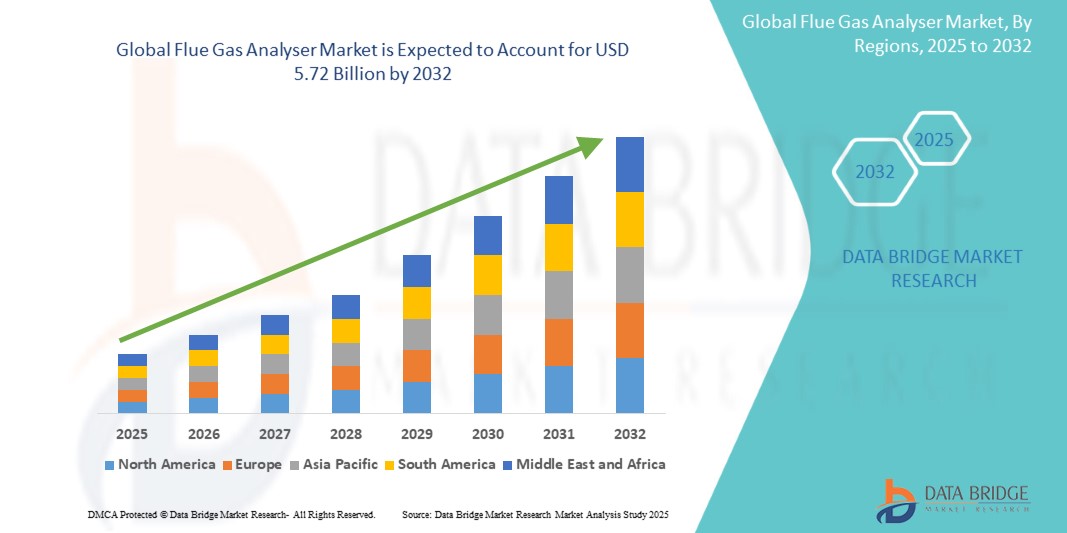
- The global ophthalmic operational microscope market was valued at USD 3.56 billion in 2024 and is expected to reach USD 5.72 billion by 2032
- During the forecast period of 2025 to 2032 the market is likely to grow at a CAGR of 6.10%, primarily driven by the rising emphasis on industrial emission monitoring and regulatory compliance
- This growth is driven by factors such as tightening environmental regulations, increasing demand for energy-efficient systems, and the integration of smart technologies in emission monitoring equipment
Flue Gas Analyser Market Analysis
- Flue gas analysers are essential instruments used to measure the composition of gases emitted by industrial processes, ensuring compliance with environmental regulations and optimizing combustion efficiency
- The demand for these microscopes is significantly driven by the increasing prevalence of age-related eye conditions and advancements in surgical techniques. Over half of the global demand is driven by the need for cataract surgeries, with the highest need seen in regions with aging population
- The demand for these analysers is significantly driven by the growing global focus on reducing greenhouse gas emissions and the enforcement of strict air quality monitoring standards. A large portion of the global demand is fueled by the need to monitor pollutants such as CO₂, NOx, and SO₂, especially in countries with rapidly industrializing economies
- The Europe region stands out as one of the dominant regions for flue gas analysers, driven by its rigorous environmental policies under frameworks such as the EU Industrial Emissions Directive and high adoption of advanced emission control technologies
- For instance, major European economies such as Germany and the UK have implemented stringent emission caps and continuous emission monitoring systems (CEMS), boosting the demand for high-precision flue gas analysers in both fixed and portable formats
- Globally, flue gas analysers are regarded as a critical component in environmental compliance systems, second only to air quality monitoring stations, and play a pivotal role in enabling industries to operate sustainably while minimizing their environmental footprint
Report Scope and Flue Gas Analyser Market Segmentation
|
Attributes |
Flue Gas Analyser Key Market Insights |
|
Segments Covered |
|
|
Countries Covered |
North America
Europe
Asia-Pacific
Middle East and Africa
South America
|
|
Key Market Players |
|
|
Market Opportunities |
|
|
Value Added Data Infosets |
In addition to the insights on market scenarios such as market value, growth rate, segmentation, geographical coverage, and major players, the market reports curated by the Data Bridge Market Research also include import export analysis, production capacity overview, production consumption analysis, price trend analysis, climate change scenario, supply chain analysis, value chain analysis, raw material/consumables overview, vendor selection criteria, PESTLE Analysis, Porter Analysis, and regulatory framework. |
Flue Gas Analyser Market Trends
“Integration of Smart Sensors and IoT Connectivity”
- One prominent trend in the global flue gas analyser market is the increasing integration of smart sensors and IoT connectivity in emission monitoring systems
- These advanced technologies enhance real-time data acquisition, diagnostics, and remote monitoring capabilities, allowing industries to optimize combustion processes and ensure environmental compliance with greater efficiency
- For instance, smart analysers equipped with IoT can transmit continuous emission data to centralized systems, enabling predictive maintenance and reducing equipment downtime — a crucial factor for industries operating under stringent emission norms
- The adoption of cloud-based platforms and wireless communication in these systems also facilitates seamless data logging, analysis, and regulatory reporting
- This trend is transforming traditional flue gas analysis into a more intelligent, automated, and connected process, boosting the demand for next-generation analysers and setting a new benchmark in industrial emission monitoring practices
Flue Gas Analyser Market Dynamics
Driver
“Growing Need Due to Rising Emissions and Environmental Regulations”
- The increasing emphasis on reducing harmful emissions from industrial activities is significantly contributing to the growing demand for flue gas analyzers across the globe
- As air pollution becomes a pressing global issue, governments and environmental bodies are implementing stringent regulations to monitor and control emissions from power plants, manufacturing units, chemical industries, and other industrial sources
- Flue gas analyzers are essential for detecting and measuring concentrations of gases such as CO₂, CO, NOx, SO₂, and O₂ in the exhaust flue gases, ensuring compliance with environmental standards
- The rising adoption of flue gas analyzers is also driven by industries’ efforts to improve operational efficiency, reduce fuel consumption, and ensure workplace safety by monitoring toxic gas levels
- Technological advancements such as portable and wireless flue gas analyzers, enhanced sensor accuracy, and real-time data transmission further support the growing utility of these devices across diverse industrial sectors
For instance,
- In March 2024, Testo SE & Co. KGaA launched its new Testo 350 flue gas analyzer, equipped with advanced Bluetooth-enabled sensors and AI-driven analytics. This next-gen device enables real-time emission monitoring and automatic calibration alerts, aligning with new European Union emission regulations effective from 2024
- As industries strive to meet evolving regulatory standards and environmental sustainability goals, the global demand for flue gas analyzers is expected to grow steadily, ensuring safer emissions monitoring and regulatory compliance
Opportunity
“Revolutionizing Emission Monitoring with Artificial Intelligence Integration”
- The integration of Artificial Intelligence (AI) into flue gas analyzers presents a major opportunity to enhance emission monitoring by increasing precision, enabling predictive analytics, and automating compliance processes
- AI-powered analyzers can process large volumes of real-time emissions data, automatically detect anomalies, and provide instant alerts, allowing operators to make timely adjustments and prevent violations
- These smart systems can also learn from historical data patterns, predicting equipment maintenance needs and emission trends, which helps in optimizing fuel usage and reducing operational costs
- In addition, AI-enhanced analyzers can ensure more accurate and continuous data reporting, simplifying compliance with increasingly stringent environmental regulations
For instance,
- In February 2024, ABB Ltd. introduced a new generation of AI-enabled flue gas analyzers under its Aventics line, which can self-calibrate, detect faults autonomously, and generate predictive maintenance schedules, reducing downtime in industrial facilities
- The integration of AI not only streamlines emissions control but also enhances environmental transparency, paving the way for smarter, greener industrial operations. As industries prioritize sustainability, AI-powered flue gas analyzers offer a strategic advantage in achieving compliance and operational excellence
Restraint/Challenge
“High Equipment Costs Hindering Market Penetration”
- The high cost associated with flue gas analyzers poses a considerable challenge to the growth of the market, especially in price-sensitive and developing regions
- Advanced flue gas analyzers equipped with multiple sensors, AI capabilities, and continuous monitoring features can be expensive, with units ranging from several thousand to tens of thousands of dollars depending on their complexity and industrial application
- For small and medium-sized enterprises (SMEs) and industries operating on tight margins, these high upfront costs often discourage investment in modern analyzers, leading them to rely on manual methods or outdated equipment
For instance,
- In October 2024, according to a white paper published by Nova Analytical Systems, the average cost of a fully integrated, high-end continuous emissions monitoring system (CEMS), including a flue gas analyzer, installation, and support, can exceed $100,000 USD. Such high costs act as a barrier, especially for companies operating in low-regulation regions or emerging economies
- As a result, the high capital investment requirement can lead to uneven adoption across geographies, with advanced markets progressing toward stricter emissions control and real-time monitoring, while others lag behind
Flue Gas Analyser Market Scope
The market is segmented on the basis of installation type, technology, gas component, application, and end user.
|
Segmentation |
Sub-Segmentation |
|
By Installation Type |
Type
Systems
|
|
By Technology |
|
|
By Gas Component |
|
|
By Application |
|
|
By End User |
|
Flue Gas Analyser Market Regional Analysis
“North America is the Dominant Region in the Flue Gas Analyzer Market”
- North America leads the global flue gas analyzer market, propelled by stringent environmental regulations, advanced industrial infrastructure, and widespread adoption of emission monitoring technologies
- The U.S. holds a substantial market share, driven by strict enforcement of air quality standards by agencies such as the Environmental Protection Agency (EPA), and the widespread use of analyzers in industries such as power generation, petrochemicals, and manufacturing
- The presence of key industry players, such as Thermo Fisher Scientific, Emerson Electric Co., and AMETEK Inc., contributes to continuous innovation and availability of advanced analyzer systems across the region
- In addition, the growing emphasis on sustainability, carbon neutrality, and workplace safety has prompted industries in the region to invest heavily in real-time emission monitoring systems and data-driven decision-making tools
- Furthermore, the region benefits from supportive governmental initiatives and funding for pollution control technologies, which accelerate the deployment of high-precision flue gas analyzers across multiple sectors
“Asia-Pacific is Projected to Register the Highest Growth Rate”
- The Asia-Pacific region is expected to experience the fastest growth in the flue gas analyzer market, driven by rapid industrialization, urbanization, and tightening environmental regulations across key economies
- Countries such as China, India, and Japan are emerging as significant markets due to the growing need for emission monitoring in sectors like power generation, cement, chemicals, and steel manufacturing
- India is projected to experience the fastest compound annual growth rate (CAGR) in the flue gas analyzer market, driven by rapid industrial expansion and heightened regulatory scrutiny over emissions.
- The increasing presence of global and regional flue gas analyzer manufacturers, combined with growing awareness about industrial pollution and workplace safety, is fueling widespread adoption of analyzers across the region. Government-led clean energy initiatives and incentives for greener technologies are further accelerating market expansion
Flue Gas Analyser Market Share
The market competitive landscape provides details by competitor. Details included are company overview, company financials, revenue generated, market potential, investment in research and development, new market initiatives, global presence, production sites and facilities, production capacities, company strengths and weaknesses, product launch, product width and breadth, application dominance. The above data points provided are only related to the companies' focus related to market.
The Major Market Leaders Operating in the Market Are:
- ABB (Switzerland)
- SICK AG(Germany)
- Teledyne Analytical Instruments (U.S.)
- Emerson (U.S.)
- AMETEK (U.S.)
- HORIBA (Japan)
- California Analytical Instruments, Inc., (U.S.)
- Environnement (France)
- Testo (Germany)
- Testo SE & Co. KGaA (U.S.)
- Dragerwerk (Germany)
- Thermo Fisher Scientific (U.S.)
- Teledyne FLIR LLC (U.S.)
- Fluenta (Norway)
- Honeywell International Inc. (U.S.)
- Advanced Energy Industries, Inc. (U.S.)
- Siemens (Germany)
Latest Developments in Global Flue Gas Analyser Market
- In March 2024, ABB Ltd. unveiled its cutting-edge AI-driven flue gas analyzer, equipped with state-of-the-art wireless connectivity and real-time calibration features. These systems are engineered to significantly boost emission monitoring accuracy while minimizing industrial downtime
- In February 2024, Honeywell introduced its next-generation flue gas analyzer system. This advanced solution incorporates IoT capabilities to enable smooth data integration and remote monitoring. Its design focuses on improving predictive maintenance and ensuring greater efficiency in controlling industrial emissions
- In January 2024, Siemens introduced its innovative IoT-based emission monitoring platform, which leverages advanced sensor technology to provide continuous, real-time flue gas analysis. This solution is designed to address tightening regulatory requirements while enhancing overall operational efficiency in industrial settings
- In November 2023, Nova Analytical Systems published an in-depth white paper that spotlighted key advancements in continuous emissions monitoring systems (CEMS). The document detailed the latest improvements in analyzer technology and demonstrated how these innovations are playing a pivotal role in reducing industrial emissions
- In October 2023, the International Energy Agency (IEA) released a report emphasizing emerging trends in industrial emissions control. The report highlighted the accelerating adoption of smart flue gas analyzers, especially in the Asia-Pacific and North American regions, reflecting a broader shift toward digitally integrated and more efficient emission monitoring technologies

- Interactive Data Analysis Dashboard
- Company Analysis Dashboard for high growth potential opportunities
- Research Analyst Access for customization & queries
- Competitor Analysis with Interactive dashboard
- Latest News, Updates & Trend analysis
- Harness the Power of Benchmark Analysis for Comprehensive Competitor Tracking
Data collection and base year analysis are done using data collection modules with large sample sizes. The stage includes obtaining market information or related data through various sources and strategies. It includes examining and planning all the data acquired from the past in advance. It likewise envelops the examination of information inconsistencies seen across different information sources. The market data is analysed and estimated using market statistical and coherent models. Also, market share analysis and key trend analysis are the major success factors in the market report. To know more, please request an analyst call or drop down your inquiry.
The key research methodology used by DBMR research team is data triangulation which involves data mining, analysis of the impact of data variables on the market and primary (industry expert) validation. Data models include Vendor Positioning Grid, Market Time Line Analysis, Market Overview and Guide, Company Positioning Grid, Patent Analysis, Pricing Analysis, Company Market Share Analysis, Standards of Measurement, Global versus Regional and Vendor Share Analysis. To know more about the research methodology, drop in an inquiry to speak to our industry experts.
Data Bridge Market Research is a leader in advanced formative research. We take pride in servicing our existing and new customers with data and analysis that match and suits their goal. The report can be customized to include price trend analysis of target brands understanding the market for additional countries (ask for the list of countries), clinical trial results data, literature review, refurbished market and product base analysis. Market analysis of target competitors can be analyzed from technology-based analysis to market portfolio strategies. We can add as many competitors that you require data about in the format and data style you are looking for. Our team of analysts can also provide you data in crude raw excel files pivot tables (Fact book) or can assist you in creating presentations from the data sets available in the report.













