


Fluid Management Equipment Market Overview
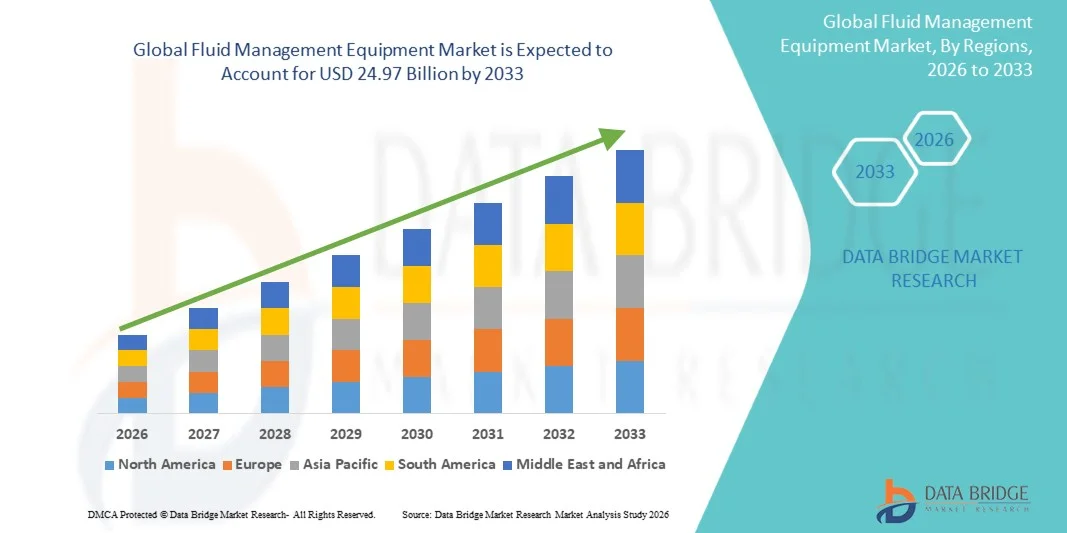
The Fluid Management Equipment Market was valued at USD 15.67 billion in 2025 and is projected to reach USD 24.97 billion by 2033, growing at a CAGR of 6.00% from 2026 to 2033. The market is witnessing steady growth driven by increasing surgical volumes, rising prevalence of chronic diseases, and growing demand for efficient fluid monitoring and control systems across hospitals, ambulatory surgical centers, and specialty clinics.
The rising adoption of minimally invasive procedures, along with the growing need for accurate fluid balance management in critical care and surgical settings, is accelerating the demand for advanced fluid management technologies. Automated fluid monitoring systems, irrigation devices, suction equipment, and integrated fluid waste management solutions are increasingly replacing conventional manual methods in many healthcare facilities, offering improved patient safety, enhanced workflow efficiency, and reduced risk of contamination during medical procedures.
Key Market Trends & Insights
- North America dominated the Fluid Management Equipment Market with the largest revenue share of 36.42% in 2025, supported by advanced healthcare infrastructure, high surgical procedure volumes, and strong adoption of technologically advanced medical devices.
- The Infusion Therapy Products segment led the market with a 46.38% share in 2025, driven by the widespread use of infusion pumps, IV administration systems, and fluid delivery devices across hospitals and critical care settings.
- Asia-Pacific is expected to be the fastest-growing region at a CAGR of 7.4% from 2026 to 2033, fueled by expanding healthcare infrastructure, rising hospitalization rates, and increasing investments in minimally invasive surgical technologies across China, India, and Japan.
- Endoscopic Fluid Management Products are the fastest-growing product, projected to register a CAGR of 7.1%, reflecting the surge in adoption of minimally invasive and endoscopic surgical procedures worldwide.
- The Urology segment dominated the application category with a 34.62% revenue share in 2025, led by increasing prevalence of kidney disorders, urinary tract diseases, and growing demand for irrigation-intensive urological procedures.
- Automated Fluid Monitoring Systems accounted for 38.47% of the market, preferred by the growing need for accurate real-time fluid balance monitoring during surgical procedures and critical care treatments.
- The AI-Assisted Monitoring Systems segment is the fastest-growing technology category, with a CAGR of 7.5%, driven by the increasing integration of artificial intelligence and predictive analytics into healthcare operations.
Market Size & Forecast
- Global Market Value (2025): USD 15.67 Billion
- Expected Market Value (2033): USD 24.97 Billion
- Forecast CAGR (2026–2033): 6.00%
- Leading Region in 2025: North America
- Fastest Growing Region: Asia Pacific
Report Scope and Fluid Management Equipment Market Segmentation
|
Attributes |
Fluid Management Equipment Key Market Insights |
|
Segments Covered |
|
|
Countries Covered |
North America · U.S. · Canada · Mexico Europe · Germany · France · U.K. · Netherlands · Switzerland · Belgium · Russia · Italy · Spain · Turkey · Rest of Europe Asia-Pacific · China · Japan · India · South Korea · Singapore · Malaysia · Australia · Thailand · Indonesia · Philippines · Rest of Asia-Pacific Middle East and Africa · Saudi Arabia · U.A.E. · South Africa · Egypt · Israel · Rest of Middle East and Africa South America · Brazil · Argentina · Rest of South America |
|
Key Market Players |
· Baxter (U.S.) · B. Braun SE (Germany) · Fresenius Medical Care AG (Germany) · Stryker (U.S.) · Medtronic (Ireland) · Olympus Corporation (Japan) · Smith+Nephew (U.K.) · Zimmer Biomet (U.S.) · KARL STORZ SE & Co. KG (Germany) · CONMED Corporation (U.S.) · Boston Scientific Corporation (U.S.) · Nipro Corporation (Japan) · ICU Medical, Inc. (U.S.) · Cook Medical (U.S.) · Merit Medical Systems, Inc. (U.S.) · AngioDynamics, Inc. (U.S.) · Getinge AB (Sweden) · Richard Wolf GmbH (Germany) · STERIS plc (Ireland) · Hologic, Inc. (U.S.) |
|
Market Opportunities |
· Growing adoption of minimally invasive and robotic-assisted surgeries · Expansion of healthcare infrastructure and surgical care facilities · Increasing integration of digital health technologies and IoT-enabled monitoring platforms |
|
Value Added Data Infosets |
In addition to the insights on market scenarios such as market value, growth rate, segmentation, geographical coverage, and major players, the market reports curated by the Data Bridge Market Research also include in-depth expert analysis, patient epidemiology, pipeline analysis, pricing analysis, and regulatory framework. |
Fluid Management Equipment Market Trends
Trend: Rising Adoption of Integrated Fluid Monitoring in Minimally Invasive Surgeries
Healthcare providers are increasingly adopting advanced fluid management equipment to improve accuracy, efficiency, and patient safety during minimally invasive and robotic-assisted procedures. Integrated systems with automated monitoring, suction, irrigation, and fluid waste collection capabilities are helping surgeons maintain precise fluid balance while reducing contamination risks and procedure times. Hospitals and ambulatory surgical centers are also implementing digital and real-time monitoring technologies that streamline surgical workflows and support better clinical outcomes across high-volume operating environments. For instance, companies such as Stryker Corporation and Olympus Corporation continue expanding advanced fluid management and endoscopy solutions for minimally invasive surgical applications.
Fluid Management Equipment Market Dynamics
Key Market Driver: Increasing Surgical Procedures and Demand for Patient Safety
The rising number of surgical procedures worldwide, combined with growing emphasis on infection prevention and accurate fluid balance management, is significantly driving demand for advanced fluid management equipment. Hospitals and specialty clinics are increasingly deploying automated irrigation, suction, and fluid monitoring systems to improve procedural efficiency, reduce manual errors, and enhance patient outcomes during complex surgeries and critical care treatments. The growing adoption of minimally invasive procedures is further accelerating the need for reliable and integrated fluid control technologies across healthcare facilities globally. For instance, Baxter International Inc. and Fresenius Medical Care AG are strengthening fluid management and dialysis technology portfolios to support increasing global treatment volumes.
Key Restraint/Challenge: High Cost of Advanced Fluid Management Systems
A major restraint in the Fluid Management Equipment Market is the high procurement and maintenance cost associated with technologically advanced systems. Modern platforms integrate automated monitoring technologies, digital controls, disposable components, and real-time data management capabilities, resulting in significant investment requirements for healthcare providers. Additional expenses related to software upgrades, system integration, staff training, and equipment servicing further increase the total cost of ownership, limiting adoption among small hospitals, ambulatory centers, and healthcare facilities in cost-sensitive emerging markets.
For instance, the deployment of integrated surgical fluid management platforms in large multispecialty hospitals often requires substantial infrastructure upgrades and long-term maintenance investments, restricting wider adoption among smaller healthcare providers.
Key Market Opportunity: Expansion of Smart and IoT-Enabled Fluid Management Technologies
The growing integration of smart monitoring technologies and IoT-enabled healthcare systems presents a significant opportunity for the fluid management equipment market. Advanced platforms capable of real-time fluid tracking, automated alerts, predictive maintenance, and centralized data management are helping healthcare providers improve operational efficiency and clinical decision-making. Increasing investments in digital healthcare infrastructure and connected operating rooms are also supporting the adoption of intelligent fluid management systems across hospitals, ambulatory surgical centers, and specialty care facilities worldwide. For instance, B. Braun SE and Medtronic plc are expanding connected surgical and fluid monitoring technologies to support digitally integrated healthcare environments.
Fluid Management Equipment Market Scope
The fluid management equipment market is segmented on the basis of product, application, technology, and end-use.
- By Product
On the basis of product, the Fluid Management Equipment Market is segmented into infusion therapy products, endoscopic fluid management products, and renal fluid management products. The Infusion Therapy Products segment dominated the market with a 46.38% revenue share in 2025, owing to the widespread use of infusion pumps, IV administration systems, and fluid delivery devices across hospitals and critical care settings. These products are extensively utilized for medication delivery, hydration therapy, nutritional support, and blood transfusion procedures. Increasing prevalence of chronic diseases and rising hospitalization rates are significantly driving demand for infusion-based therapies worldwide. Healthcare providers are increasingly adopting advanced infusion systems with automated monitoring and safety features to reduce medication errors and improve patient outcomes. The segment also benefits from the growing geriatric population requiring long-term fluid and drug administration. Strong integration of smart infusion technologies and digital monitoring platforms continues to reinforce the dominance of this segment globally.
The Endoscopic Fluid Management Products segment is projected to register the fastest growth at a CAGR of 7.1% from 2026 to 2033, driven by the increasing adoption of minimally invasive and endoscopic surgical procedures worldwide. These systems play a critical role in maintaining fluid balance, irrigation, and visualization during endoscopic interventions across gastroenterology, urology, and gynecology applications. Rising patient preference for minimally invasive treatments due to faster recovery times and lower complication risks is accelerating demand for advanced endoscopic fluid management technologies. Technological advancements in automated suction, irrigation, and fluid waste management systems are significantly improving surgical efficiency and safety. Growing investments in ambulatory surgical centers and modern operating room infrastructure are further supporting market expansion. Increasing procedural volumes and expanding applications of endoscopic surgeries continue to create strong growth opportunities for this segment.
- By Application
On the basis of application, the Fluid Management Equipment Market is segmented into cardiology, urology, neurology, orthopaedic/osteology, gastroenterology, oncology, and others. The Urology segment led the market with a 34.62% revenue share in 2025, driven by the increasing prevalence of kidney disorders, urinary tract diseases, and growing demand for irrigation-intensive urological procedures. Fluid management equipment is widely used in endoscopic urology surgeries, dialysis procedures, and bladder irrigation treatments to ensure accurate fluid monitoring and patient safety. Rising adoption of minimally invasive urological procedures is significantly boosting the utilization of advanced fluid control systems. Hospitals and specialty clinics are increasingly deploying automated irrigation and suction technologies to improve procedural efficiency and reduce infection risks. Technological advancements in endourology devices and increasing awareness regarding renal healthcare are also contributing to segment growth. The expanding elderly population prone to urological conditions further strengthens the dominance of this application segment.
The Gastroenterology segment is expected to witness the fastest growth at a CAGR of 7.3% from 2026 to 2033, fueled by rising incidence of gastrointestinal disorders and increasing demand for endoscopic diagnostic and therapeutic procedures. Fluid management systems are essential during gastrointestinal endoscopies to maintain visualization, irrigation, and fluid evacuation during procedures. Growing preference for minimally invasive gastrointestinal treatments and early disease diagnosis is accelerating adoption across healthcare facilities. Advancements in endoscopic imaging and integrated fluid control technologies are significantly enhancing procedural precision and patient outcomes. Expanding healthcare infrastructure in emerging economies and rising awareness regarding digestive health are also supporting market growth. Increasing screening programs for colorectal cancer and other gastrointestinal conditions continue to create substantial opportunities for this segment.
- By Technology
On the basis of technology, the Fluid Management Equipment Market is segmented into automated fluid monitoring systems, digital & integrated fluid control systems, manual fluid management systems, IoT-enabled fluid management equipment, and AI-assisted monitoring systems. The Automated Fluid Monitoring Systems segment dominated the market with a 38.47% share in 2025, owing to the growing need for accurate real-time fluid balance monitoring during surgical procedures and critical care treatments. These systems help healthcare professionals improve patient safety, reduce manual calculation errors, and optimize fluid administration efficiency. Hospitals are increasingly adopting automated monitoring technologies to support high surgical volumes and complex clinical workflows. Integration with digital dashboards and alarm systems is enhancing operational accuracy and workflow management across healthcare facilities. The segment also benefits from increasing investments in smart hospital infrastructure and technologically advanced operating rooms. Rising emphasis on precision healthcare and improved clinical outcomes continues to strengthen the adoption of automated monitoring systems globally.
The AI-Assisted Monitoring Systems segment is projected to experience the fastest growth at a CAGR of 7.5% from 2026 to 2033, driven by increasing integration of artificial intelligence and predictive analytics into healthcare operations. These systems enable advanced data analysis, automated alerts, and predictive fluid management capabilities that improve clinical decision-making and patient monitoring. AI-powered platforms are increasingly being adopted to reduce complications related to fluid imbalance and optimize treatment protocols in critical care environments. Growing demand for intelligent healthcare automation and connected medical devices is significantly accelerating technological adoption. Healthcare providers are also investing in AI-enabled systems to improve workflow efficiency, reduce operational burdens, and support personalized patient care strategies. Continuous advancements in machine learning algorithms and digital healthcare infrastructure are expected to further boost segment growth during the forecast period.
- By End-Use
On the basis of end-use, the Fluid Management Equipment Market is segmented into hospitals, clinics, diagnostic centres, home care setting, and others. The Hospitals segment accounted for the largest market share of 58.91% in 2025, supported by high patient admissions, increasing surgical procedure volumes, and the availability of advanced healthcare infrastructure. Hospitals extensively utilize fluid management equipment across operating rooms, emergency departments, intensive care units, and dialysis centers to ensure accurate fluid administration and monitoring. Growing adoption of minimally invasive surgeries and technologically advanced treatment procedures is significantly driving equipment demand in hospital settings. Large healthcare institutions are increasingly investing in integrated and automated fluid management systems to improve operational efficiency and patient outcomes. The segment also benefits from strong reimbursement structures and higher spending capacity for advanced medical technologies. Rising focus on infection control and patient safety continues to reinforce hospital dominance within the market.
The Home Care Setting segment is anticipated to witness the fastest growth at a CAGR of 7.0% from 2026 to 2033, driven by the increasing preference for home-based healthcare and long-term chronic disease management. Patients requiring infusion therapy, dialysis support, and post-operative care are increasingly adopting portable and easy-to-use fluid management devices in home environments. Technological advancements in compact and user-friendly monitoring systems are improving accessibility and convenience for home healthcare applications. Rising healthcare costs and growing pressure on hospital resources are encouraging the shift toward decentralized patient care models. Increasing geriatric population and demand for remote patient monitoring solutions are further accelerating market growth in this segment. Supportive government initiatives and expanding telehealth infrastructure are also contributing to the rapid adoption of home-based fluid management technologies globally.
Fluid Management Equipment Market Regional Analysis
North America dominated the Fluid Management Equipment Market with the largest revenue share of 36.42% in 2025, supported by advanced healthcare infrastructure, high surgical procedure volumes, and strong adoption of technologically advanced medical devices. The region also benefits from increasing investments in minimally invasive surgeries, growing prevalence of chronic diseases, and rising integration of automated fluid monitoring and digital healthcare systems across hospitals and specialty clinics. Expanding demand for patient safety, efficient surgical workflows, and real-time fluid management technologies continues to strengthen North America’s leadership position in the global market.
U.S. Fluid Management Equipment Market Insight
The U.S. fluid management equipment market is witnessing strong growth due to rising surgical procedure volumes, increasing adoption of minimally invasive treatments, and growing investments in advanced healthcare technologies. The country’s well-established healthcare infrastructure, along with increasing utilization of automated fluid monitoring, irrigation, and suction systems, is driving demand across hospitals, ambulatory surgical centers, and specialty clinics. In addition, growing emphasis on patient safety, infection prevention, and efficient surgical workflow management is accelerating the adoption of advanced fluid management equipment across healthcare facilities.
Europe Fluid Management Equipment Market Insight
The Europe fluid management equipment market remains a major contributor to global revenue, driven by strong healthcare infrastructure, technological innovation, and high demand for advanced surgical and critical care solutions. The widespread use of fluid management systems in minimally invasive procedures, dialysis treatments, and endoscopic applications is supporting market expansion across the region. Increasing investments in automated healthcare technologies, coupled with strict patient safety regulations and rising healthcare spending, continue to enhance the adoption of fluid management equipment throughout Europe.
U.K. Fluid Management Equipment Market Insight
The U.K. fluid management equipment market is experiencing steady growth, supported by rising adoption of technologically advanced surgical systems, increasing healthcare modernization initiatives, and growing demand for minimally invasive treatment procedures. Increasing investments in hospital infrastructure and growing preference for automated fluid monitoring and integrated irrigation systems are contributing to market growth. Furthermore, integration of digital healthcare technologies and real-time patient monitoring solutions is improving clinical efficiency and patient outcomes, positioning the U.K. as a key innovation hub in the fluid management equipment industry.
Germany Fluid Management Equipment Market Insight
The Germany fluid management equipment market is expanding steadily due to the country’s advanced healthcare system, strong medical device manufacturing base, and increasing adoption of next-generation surgical technologies. Hospitals, specialty clinics, and healthcare providers are increasingly utilizing fluid management systems for surgical procedures, dialysis treatments, and critical care applications. Continuous advancements in automated monitoring technologies, digital integration, and minimally invasive surgical equipment, along with strong government focus on healthcare quality and patient safety, are further driving market growth in Germany.
Asia-Pacific Fluid Management Equipment Market Insight
The Asia-Pacific fluid management equipment market is expected to witness rapid growth, driven by expanding healthcare infrastructure, rising surgical procedure volumes, and increasing investments in advanced medical technologies across countries such as China, India, and Japan. Growing awareness regarding patient safety, increasing adoption of minimally invasive procedures, and rising demand for cost-effective healthcare solutions are supporting regional market expansion. Additionally, the growing presence of medical device manufacturers and improving access to modern healthcare facilities are accelerating fluid management equipment adoption across hospitals and specialty care centers.
Japan Fluid Management Equipment Market Insight
The Japan fluid management equipment market is witnessing consistent growth due to rising investments in advanced surgical technologies, increasing healthcare automation, and growing focus on patient safety initiatives. Healthcare providers, hospitals, and specialty treatment centers are increasingly adopting automated fluid monitoring and minimally invasive surgical systems for improved treatment outcomes and operational efficiency. Moreover, increasing integration of digital healthcare technologies and the country’s emphasis on high-quality and efficient medical care are further contributing to market growth.
China Fluid Management Equipment Market Insight
The China fluid management equipment market is growing rapidly, driven by expanding healthcare infrastructure, rising hospitalization rates, and increasing government focus on improving healthcare quality and surgical safety standards. Growing adoption of automated and digitally integrated fluid management systems across hospitals, ambulatory centers, and specialty clinics is significantly boosting market demand. In addition, rising investments in healthcare modernization, increasing awareness regarding infection prevention, and rapid technological advancements are positioning China as one of the fastest-growing markets for fluid management equipment globally.
Fluid Management Equipment Market Share
The fluid management equipment industry is primarily led by well-established companies, including:
- Baxter (U.S.)
- Braun SE (Germany)
- Fresenius Medical Care AG (Germany)
- Stryker (U.S.)
- Medtronic (Ireland)
- Olympus Corporation (Japan)
- Smith+Nephew (U.K.)
- Zimmer Biomet (U.S.)
- KARL STORZ SE & Co. KG (Germany)
- CONMED Corporation (U.S.)
- Boston Scientific Corporation (U.S.)
- Nipro Corporation (Japan)
- ICU Medical, Inc. (U.S.)
- Cook Medical (U.S.)
- Merit Medical Systems, Inc. (U.S.)
- AngioDynamics, Inc. (U.S.)
- Getinge AB (Sweden)
- Richard Wolf GmbH (Germany)
- STERIS plc (Ireland)
- Hologic, Inc. (U.S.)
Latest Developments in Fluid Management Equipment Market
- In March 2026, Olympus Corporation announced the European launch of its OFP-3 and OFP-3 PLUS endoscopic flushing pump systems, developed to improve irrigation control and fluid management during gastrointestinal endoscopic procedures. The systems feature configurable flow-rate controls, bottle illumination functionality, and integrated warming support for enhanced usability and patient comfort. This development strengthens Olympus’ portfolio of advanced endoscopic fluid management technologies for minimally invasive healthcare applications
- In December 2025, Medtronic plc announced the successful early commercial use of its Liberant™ thrombectomy system for peripheral vascular procedures. The system utilizes intelligent aspiration algorithms and advanced catheter technologies to improve clot removal efficiency while reducing blood loss during interventions. This development highlights ongoing innovation in fluid-assisted vascular management and minimally invasive interventional technologies aimed at improving procedural safety and patient outcomes
- In October 2025, Olympus Corporation announced the launch of its THUNDERBEAT II surgical energy device, designed for advanced soft tissue management, vessel sealing, and hemostatic cutting during laparoscopic and open surgeries. The platform integrates three energy modes, including a new ultrasonic energy setting, enabling improved surgical precision, reduced thermal impact, and enhanced workflow efficiency in minimally invasive procedures. This launch highlights Olympus’ focus on expanding advanced surgical and fluid management technologies for modern operating environments
- In September 2025, Medtronic plc launched the Valleylab™ FT10 energy platform in India, introducing advanced electrosurgical and vessel sealing generators for enhanced surgical precision and tissue management. The system incorporates TissueFect™ sensing technology, which automatically adjusts energy delivery based on tissue conditions to improve safety and efficiency in operating rooms. This launch reflects Medtronic’s strategy to expand intelligent surgical and fluid-integrated technologies across emerging healthcare markets
- In September 2025, Olympus Corporation announced the U.S. launch of its VISERA S imaging platform for ENT and urological applications, designed to support advanced diagnostic visualization and minimally invasive procedures. The platform integrates Narrow Band Imaging technology, digital recording capabilities, and compatibility with flexible endoscopes to improve procedural accuracy and workflow management. This launch demonstrates the growing integration of imaging, irrigation, and fluid management technologies within modern endoscopic systems

- Interactive Data Analysis Dashboard
- Company Analysis Dashboard for high growth potential opportunities
- Research Analyst Access for customization & queries
- Competitor Analysis with Interactive dashboard
- Latest News, Updates & Trend analysis
- Harness the Power of Benchmark Analysis for Comprehensive Competitor Tracking
Data collection and base year analysis are done using data collection modules with large sample sizes. The stage includes obtaining market information or related data through various sources and strategies. It includes examining and planning all the data acquired from the past in advance. It likewise envelops the examination of information inconsistencies seen across different information sources. The market data is analysed and estimated using market statistical and coherent models. Also, market share analysis and key trend analysis are the major success factors in the market report. To know more, please request an analyst call or drop down your inquiry.
The key research methodology used by DBMR research team is data triangulation which involves data mining, analysis of the impact of data variables on the market and primary (industry expert) validation. Data models include Vendor Positioning Grid, Market Time Line Analysis, Market Overview and Guide, Company Positioning Grid, Patent Analysis, Pricing Analysis, Company Market Share Analysis, Standards of Measurement, Global versus Regional and Vendor Share Analysis. To know more about the research methodology, drop in an inquiry to speak to our industry experts.
Data Bridge Market Research is a leader in advanced formative research. We take pride in servicing our existing and new customers with data and analysis that match and suits their goal. The report can be customized to include price trend analysis of target brands understanding the market for additional countries (ask for the list of countries), clinical trial results data, literature review, refurbished market and product base analysis. Market analysis of target competitors can be analyzed from technology-based analysis to market portfolio strategies. We can add as many competitors that you require data about in the format and data style you are looking for. Our team of analysts can also provide you data in crude raw excel files pivot tables (Fact book) or can assist you in creating presentations from the data sets available in the report.













