


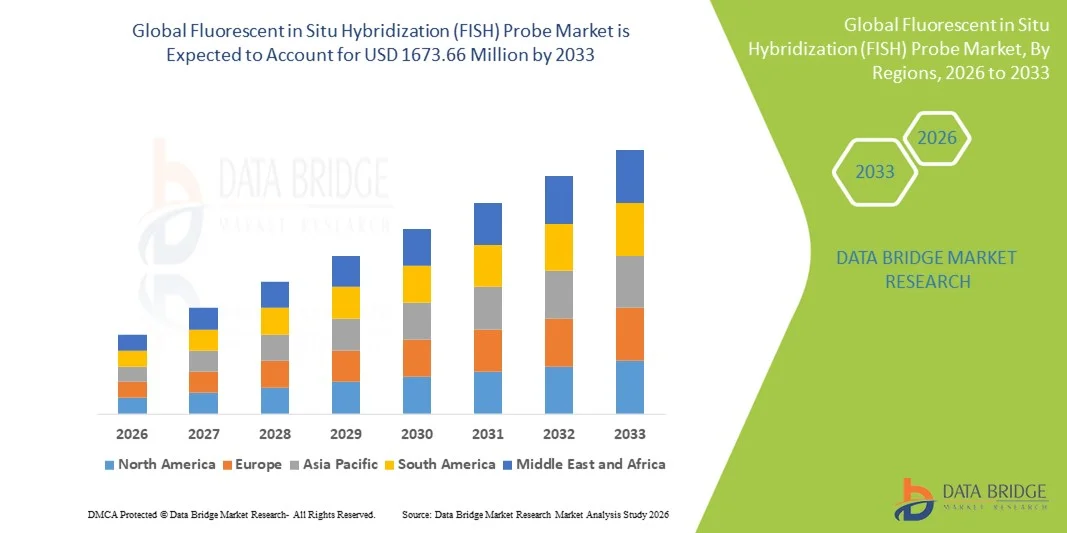
Fluorescent in Situ Hybridization (FISH) Probe Market Size
- The global fluorescent in situ hybridization (FISH) probe market size was valued at USD 1003.71 Million in 2025 and is expected to reach USD 1673.66 Million by 2033, at a CAGR of 6.60% during the forecast period
- The market growth is largely fueled by the increasing adoption of advanced molecular diagnostic techniques in clinical and research laboratories, along with continuous technological progress in genomic and cytogenetic analysis, leading to rising demand for accurate, sensitive, and rapid detection of genetic abnormalities in both oncology and prenatal testing
- Furthermore, the growing prevalence of cancer and genetic disorders, increasing use of personalized medicine, and rising investments in precision diagnostics are establishing Fluorescent in Situ Hybridization (FISH) probes as a critical tool in modern disease diagnosis and research. These converging factors are accelerating the uptake of FISH probe solutions, thereby significantly boosting the industry's growth
Fluorescent in Situ Hybridization (FISH) Probe Market Analysis
- Fluorescent in Situ Hybridization (FISH) probes, used for the precise detection and localization of specific DNA or RNA sequences in cells, are increasingly vital in modern clinical diagnostics and biomedical research due to their high sensitivity, accuracy, and ability to identify chromosomal abnormalities in diseases such as cancer and genetic disorders across both hospital and laboratory settings
- The escalating demand for FISH probes is primarily fueled by the rising prevalence of cancer and hereditary diseases, growing adoption of precision medicine, and increasing use of cytogenetic and molecular diagnostic techniques in clinical and research applications, strengthening their role as an essential tool in advanced genetic testing
- North America dominated the fluorescent in situ hybridization (FISH) Probe market with the largest revenue share of 41.7% in 2025, characterized by strong healthcare infrastructure, high R&D investments, and a robust presence of leading biotechnology and diagnostic companies, with the U.S. experiencing substantial growth in the utilization of FISH probes in oncology and prenatal diagnostics, supported by advanced laboratory facilities and favorable reimbursement policies
- Asia-Pacific is expected to be the fastest growing region in the fluorescent in situ hybridization (FISH) Probe market during the forecast period, registering a strong CAGR, due to expanding healthcare facilities, increasing investment in genomic research, rising awareness of early disease diagnosis, and growing demand for advanced diagnostic technologies in countries such as China, India, and Japan
- The DNA segment dominated the largest market revenue share of 58.4% in 2025, due to its extensive usage in detecting chromosomal abnormalities, gene amplifications, deletions, and translocations
Report Scope and Fluorescent in Situ Hybridization (FISH) Probe Market Segmentation
|
Attributes |
Fluorescent in Situ Hybridization (FISH) Probe Key Market Insights |
|
Segments Covered |
|
|
Countries Covered |
North America
Europe
Asia-Pacific
Middle East and Africa
South America
|
|
Key Market Players |
• Thermo Fisher Scientific (U.S.) |
|
Market Opportunities |
|
|
Value Added Data Infosets |
In addition to the insights on market scenarios such as market value, growth rate, segmentation, geographical coverage, and major players, the market reports curated by the Data Bridge Market Research also include in-depth expert analysis, patient epidemiology, pipeline analysis, pricing analysis, and regulatory framework. |
Fluorescent in Situ Hybridization (FISH) Probe Market Trends
Enhanced Precision Through Technological Advancements in Probe Design
- A significant and accelerating trend in the global fluorescent in situ hybridization (FISH) probe market is the continuous advancement in probe design and labeling technologies, enabling higher precision, stronger signal intensity, and improved sensitivity in genetic and molecular diagnostics
- For instance, the development of multicolor and multiplex FISH probes allows researchers and clinicians to detect multiple genetic targets simultaneously, enhancing efficiency in cancer cytogenetics and rare disease detection
- Advancements in fluorescent dyes and signal amplification methods are significantly improving image clarity, enabling more accurate chromosome visualization and identification of complex genetic abnormalities
- The integration of automated hybridization systems and digital imaging platforms is also simplifying complex laboratory workflows, reducing manual error, and increasing reproducibility in FISH-based testing
- The growing application of FISH probes in oncology diagnostics, prenatal testing, and infectious disease analysis is pushing manufacturers to develop more targeted and application-specific probe panels
- This trend toward higher-resolution, faster-processing, and more reliable FISH probe solutions is reshaping the expectations of laboratories and diagnostic centers worldwide
Fluorescent in Situ Hybridization (FISH) Probe Market Dynamics
Driver
Rising Incidence of Genetic Disorders and Cancer
- The increasing global prevalence of genetic disorders, chromosomal abnormalities, and various cancers is a major driver for the growing adoption of Fluorescent in Situ Hybridization (FISH) probes
- For instance, FISH is widely used in the diagnosis of leukemia, lymphoma, breast cancer (HER2 testing), and prenatal genetic screening, making it a critical component of modern clinical diagnostics
- As awareness about early disease detection continues to grow, healthcare providers are increasingly turning to advanced molecular techniques such as FISH for accurate and rapid diagnosis
- Government initiatives and funding for genetic research, cancer screening programs, and molecular diagnostics infrastructure are further accelerating demand for FISH probes across both developed and emerging economies
- In addition, the expansion of personalized medicine and targeted therapy approaches is reinforcing the importance of precise genetic characterization, in which FISH probes play a crucial supporting role
Restraint/Challenge
High Cost and Technical Complexity of FISH Procedures
- The relatively high cost associated with FISH probes, advanced imaging equipment, and specialized laboratory infrastructure acts as a significant barrier to widespread adoption, particularly in low- and middle-income regions
- For instance, setting up and maintaining a fully equipped cytogenetics laboratory requires substantial investment in fluorescence microscopes, sample preparation tools, and trained personnel
- The FISH technique also requires a high level of technical expertise, as improper handling and interpretation can result in inaccurate outcomes
- In addition, the time-consuming nature of the process compared to some alternative molecular techniques may limit its preference in high-throughput settings
- Limited availability of skilled professionals and the need for continuous training further add to operational challenges faced by diagnostic centers
- Overcoming these barriers through automation, cost reduction strategies, and expanded training programs will be essential for improving accessibility and fostering long-term market growth
Fluorescent in Situ Hybridization (FISH) Probe Market Scope
The market is segmented on the basis of technology, type, application, and end-user.
- By Technology
On the basis of technology, the Fluorescent In Situ Hybridization (FISH) Probe market is segmented into Q-FISH, FLOW-FISH, and Others. The Q-FISH segment dominated the largest market revenue share of 46.8% in 2025, driven by its superior accuracy in telomere length measurement and high-resolution chromosomal analysis. Q-FISH is widely used in cancer research and cellular aging studies due to its quantitative precision and ability to analyze individual cells. The technique offers enhanced signal clarity and better reproducibility, which is essential for clinical and academic research settings. Its increasing usage in studying chromosomal instability in oncology cases significantly contributed to revenue growth. Furthermore, rising investments in genomic research and personalized medicine initiatives have led to wider adoption of Q-FISH in specialized laboratories. The increasing availability of automated imaging systems has further improved its efficiency. High reliability and improved turnaround times have encouraged laboratories to adopt Q-FISH over conventional methods. The growing number of cytogenetic and molecular diagnostic laboratories worldwide has also strengthened its dominance. In addition, technological advancements in probe labeling and fluorescence microscopy support higher demand. With rising cases of genetic disorders and chronic diseases, Q-FISH continues to remain the preferred choice among researchers and diagnostic professionals.
The FLOW-FISH segment is expected to witness the fastest CAGR of 22.6% from 2026 to 2033, supported by its ability to analyze telomere length in large cell populations using flow cytometry. FLOW-FISH provides high-throughput analysis, making it highly suitable for large-scale research and clinical studies. It is increasingly being adopted in immunology, hematological malignancies, and aging-related research. The technique allows simultaneous evaluation of thousands of cells per second, which significantly reduces analysis time. Its combination with flow cytometry enhances efficiency and improves quantitative assessment. Growing demand for rapid diagnostic tools in clinical laboratories is boosting the adoption of FLOW-FISH. Technological improvements in flow cytometry instrumentation are also supporting its growth. In addition, the rising focus on cell-based research and immune profiling contributes to high demand. Academic and pharmaceutical institutions are increasingly implementing FLOW-FISH in experimental workflows. Continuous funding for biomedical research is expected to further fuel this growth. As a result, FLOW-FISH is emerging as a highly promising and rapidly expanding technology segment in the forecast period.
- By Type
On the basis of type, the Fluorescent In Situ Hybridization (FISH) Probe market is segmented into DNA and RNA. The DNA segment dominated the largest market revenue share of 58.4% in 2025, due to its extensive usage in detecting chromosomal abnormalities, gene amplifications, deletions, and translocations. DNA-based FISH probes are widely used in cancer diagnostics, prenatal screening, and genetic disorder analysis. Their ability to provide stable and highly specific hybridization results increases their demand in clinical settings. Healthcare professionals rely on DNA probes for confirming several malignancies such as breast cancer, leukemia, and lymphoma. The growing incidence of hereditary diseases and chromosomal mutations has significantly contributed to increased adoption. DNA probes also provide better storage stability, making them preferable for long-term laboratory use. Strong demand from research institutes and hospitals has reinforced this dominance. Increased government funding for genetic screening programs has further boosted market penetration. Moreover, the availability of a wide range of DNA probe kits enhances accessibility across regions. As a result, DNA FISH probes continue to lead the market.
The RNA segment is expected to witness the fastest CAGR of 24.1% from 2026 to 2033, propelled by the growing importance of studying gene expression at the RNA level. RNA FISH enables visualization of mRNA within cells, helping researchers understand gene regulation and disease mechanisms. It is increasingly used in cancer research, virology, and neurological studies. Rising interest in transcriptomics and cellular heterogeneity is driving RNA probe demand. Biotechnology and pharmaceutical companies are utilizing RNA FISH for drug development and biomarker discovery. Advanced multiplex RNA FISH technologies are improving research capabilities. Growing funding in genomics and transcriptomic research programs supports rapid expansion. The increasing adoption of single-cell analysis techniques further accelerates market growth. Academic institutions worldwide are integrating RNA FISH into ongoing research. Improved sensitivity and specificity of RNA probes also enhance reliability. These factors together position the RNA segment as the fastest-growing type in the FISH probe market.
- By Application
On the basis of application, the Fluorescent In Situ Hybridization (FISH) Probe market is segmented into Cancer Research, Genetic Diseases, and Other. The Cancer Research segment dominated the largest market revenue share of 51.7% in 2025, driven by the increasing prevalence of cancer and the critical role of FISH in tumor classification and prognosis. FISH is extensively used to detect chromosomal and gene abnormalities associated with breast, lung, prostate, and blood cancers. Its ability to provide highly accurate and visualized genetic alterations improves treatment planning. Pharmaceutical companies use FISH for drug development and testing targeted therapies. The rising demand for precision medicine has boosted the need for advanced cancer research tools. Government initiatives supporting oncology research further strengthen this segment. The continuous increase in clinical trials related to cancer increases the use of FISH probes. Hospitals and research centers rely on FISH for clinical decision-making. Growing awareness regarding early cancer detection has intensified adoption. Technological enhancements in imaging also improve diagnostic efficiency. These cumulative factors have established Cancer Research as the dominant application segment.
The Genetic Diseases segment is expected to witness the fastest CAGR of 23.4% from 2026 to 2033, due to the increasing number of inherited disorders and prenatal screening programs. FISH is widely used to detect genetic abnormalities such as Down syndrome, Turner syndrome, and microdeletion disorders. Rising awareness about genetic conditions and early diagnosis is driving market growth. Expanding neonatal screening programs globally are boosting demand for advanced techniques. Improved accessibility to genetic testing in developing countries contributes to faster growth. Advances in probe technology enhance the accuracy of genetic analysis. Growing interest in personalized medicine and preventive healthcare also supports expansion. Increased collaboration between research institutes and healthcare organizations improves adoption. The availability of more affordable genetic testing solutions encourages wider use. Growing government initiatives for genetic disorder control further accelerate the market. Hence, the genetic diseases segment is projected to grow at a robust pace during the forecast period.
- By End-User
On the basis of end-user, the Fluorescent In Situ Hybridization (FISH) Probe market is segmented into Research, Clinical, and Companion Diagnostics. The Clinical segment dominated the largest market revenue share of 47.9% in 2025, due to the rising demand for accurate and rapid diagnosis of genetic and oncological disorders. Hospitals and diagnostic centers employ FISH as a routine testing method for disease confirmation. The increasing number of diagnostic laboratories worldwide strengthens this segment. FISH is widely accepted for HER2 testing in breast cancer and various hematological malignancies. Growing patient volume and increased healthcare spending boost clinical usage. Favorable reimbursement policies in developed nations further support dominance. The presence of advanced healthcare infrastructure accelerates technology adoption. Rising use of molecular diagnostics in hospitals also increases demand. Improved testing accuracy has made FISH a standard technique. Continuous upgrades in laboratory equipment foster its sustained growth. Therefore, the clinical segment continues to lead the market in terms of revenue generation.
The Companion Diagnostics segment is expected to witness the fastest CAGR of 25.2% from 2026 to 2033, owing to the expanding adoption of targeted therapies in oncology and genetic medicine. FISH is playing a crucial role in identifying suitable patients for specific treatments. The growing focus on personalized medicine is a key factor driving this segment. Pharmaceutical companies increasingly depend on FISH to determine treatment eligibility. Rising approval of targeted drugs requires corresponding diagnostic tests. Technological integration with advanced drugs enhances precision. The continuous development of biomarker-based therapeutics stimulates demand. Clinical trials increasingly use companion diagnostics for improved outcomes. The rise in chronic diseases also supports faster growth. Healthcare providers are adopting precision medicine approaches at a higher rate. Consequently, the companion diagnostics segment is expected to expand significantly over the forecast period.
Fluorescent in Situ Hybridization (FISH) Probe Market Regional Analysis
- North America dominated the fluorescent in situ hybridization (FISH) probe market with the largest revenue share of 41.7% in 2025
- Characterized by strong healthcare infrastructure, high R&D investments, and a robust presence of leading biotechnology and diagnostic companies
- The U.S. experiencing substantial growth in the utilization of FISH probes in oncology and prenatal diagnostics, supported by advanced laboratory facilities and favorable reimbursement policies
U.S. Fluorescent in Situ Hybridization (FISH) Probe Market Insight
The U.S. fluorescent in situ hybridization (FISH) probe market captured the largest revenue share of 78% in 2025 within North America, fueled by the increasing prevalence of genetic diseases and cancers. Adoption of FISH probes in prenatal and oncology diagnostics, combined with advanced laboratory infrastructure and supportive regulatory frameworks, is driving the market expansion. Moreover, growing investments in biotechnology research and favorable reimbursement policies for genetic tests are boosting demand.
Europe Fluorescent in Situ Hybridization (FISH) Probe Market Insight
The Europe fluorescent in situ hybridization (FISH) probe market is projected to expand at a substantial CAGR throughout the forecast period, driven by increasing R&D investments, rising prevalence of genetic disorders, and the growing need for personalized medicine. Countries such as Germany, France, and the U.K. are witnessing strong adoption of FISH probes in clinical and research laboratories.
U.K. Fluorescent in Situ Hybridization (FISH) Probe Market Insight
The U.K. fluorescent in situ hybridization (FISH) probe market is anticipated to grow at a noteworthy CAGR during the forecast period due to rising demand for cancer and prenatal diagnostics. Increasing government funding for genomic research and awareness programs for early disease detection further propel the market growth.
Germany Fluorescent in Situ Hybridization (FISH) Probe Market Insight
The Germany fluorescent in situ hybridization (FISH) probe market is expected to expand at a considerable CAGR during the forecast period, supported by well-established healthcare infrastructure, high research expenditure, and increasing use of FISH technology in clinical diagnostics and research applications.
Asia-Pacific Fluorescent in Situ Hybridization (FISH) Probe Market Insight
The Asia-Pacific fluorescent in situ hybridization (FISH) probe market ised to grow at the fastest CAGR during the forecast period, driven by increasing healthcare investments, expanding molecular diagnostics infrastructure, and rising prevalence of chronic and genetic diseases. Growth is particularly strong in China, India, and Japan due to large patient populations, government initiatives in healthcare modernization, and rising awareness of advanced diagnostic techniques.
Japan Fluorescent in Situ Hybridization (FISH) Probe Market Insight
The Japan fluorescent in situ hybridization (FISH) probe market is gaining momentum due to rapid advancements in genomics research, high adoption of molecular diagnostics, and increasing focus on early detection of cancer and genetic disorders. Integration of FISH technology in clinical laboratories and research centers is driving growth.
China Fluorescent in Situ Hybridization (FISH) Probe Market Insight
The China fluorescent in situ hybridization (FISH) probe market accounted for the largest market revenue share in Asia-Pacific in 2025, attributed to rising prevalence of genetic disorders, rapid expansion of healthcare infrastructure, and increased investments in molecular diagnostics. Strong government initiatives to promote precision medicine and increasing awareness of early disease detection are major factors fueling market growth.
Fluorescent in Situ Hybridization (FISH) Probe Market Share
The Fluorescent in Situ Hybridization (FISH) Probe industry is primarily led by well-established companies, including:
• Thermo Fisher Scientific (U.S.)
• Agilent Technologies (U.S.)
• Leica Biosystems (Germany)
• Cytocell Ltd (U.K.)
• Empire Genomics (Canada)
• ZytoVision GmbH (Germany)
• MetaSystems (Germany)
• Roche Diagnostics (Switzerland)
• GE Healthcare (U.S.)
• PerkinElmer (U.S.)
• Oxford Gene Technology (U.K.)
• Invitrogen (U.S.)
• Sigma-Aldrich (U.S.)
• QIAGEN (Germany)
• Cell Marque (U.S.)
• Vysis (U.S.)
• Agilent Dako (U.S.)
Latest Developments in Global Fluorescent in Situ Hybridization (FISH) Probe Market
- In March 2023, Sysmex Corporation introduced the first IVDR‑compliant DNA FISH probes — ready‑to‑use, premixed and directly labeled probes designed for in‑situ detection of genetic changes across various sample types. This launch aimed to ensure batch‑to‑batch consistency, reduce scoring time, lower retest rates, and align FISH diagnostics with evolving European regulatory standards
- In July 2023, KromaTiD launched more than 300 new centromere, telomere, and gene probes for their directional Genomic Hybridization (dGH) “in‑Site” assays. These probes were developed to enhance detection of genomic structural variations and to support advanced research — including in gene‑editing and cell‑therapy workflows
- In June 2025, a major market report forecasted that the FISH probe market would reach a valuation of around USD 1,485.88 million by 2030, driven by growing global demand for precise diagnostics driven by rising cancer and genetic disease incidence

- Interactive Data Analysis Dashboard
- Company Analysis Dashboard for high growth potential opportunities
- Research Analyst Access for customization & queries
- Competitor Analysis with Interactive dashboard
- Latest News, Updates & Trend analysis
- Harness the Power of Benchmark Analysis for Comprehensive Competitor Tracking
Data collection and base year analysis are done using data collection modules with large sample sizes. The stage includes obtaining market information or related data through various sources and strategies. It includes examining and planning all the data acquired from the past in advance. It likewise envelops the examination of information inconsistencies seen across different information sources. The market data is analysed and estimated using market statistical and coherent models. Also, market share analysis and key trend analysis are the major success factors in the market report. To know more, please request an analyst call or drop down your inquiry.
The key research methodology used by DBMR research team is data triangulation which involves data mining, analysis of the impact of data variables on the market and primary (industry expert) validation. Data models include Vendor Positioning Grid, Market Time Line Analysis, Market Overview and Guide, Company Positioning Grid, Patent Analysis, Pricing Analysis, Company Market Share Analysis, Standards of Measurement, Global versus Regional and Vendor Share Analysis. To know more about the research methodology, drop in an inquiry to speak to our industry experts.
Data Bridge Market Research is a leader in advanced formative research. We take pride in servicing our existing and new customers with data and analysis that match and suits their goal. The report can be customized to include price trend analysis of target brands understanding the market for additional countries (ask for the list of countries), clinical trial results data, literature review, refurbished market and product base analysis. Market analysis of target competitors can be analyzed from technology-based analysis to market portfolio strategies. We can add as many competitors that you require data about in the format and data style you are looking for. Our team of analysts can also provide you data in crude raw excel files pivot tables (Fact book) or can assist you in creating presentations from the data sets available in the report.













