


What is the Global Foggy Guard Coating (FGC) Market Size and Growth Rate?
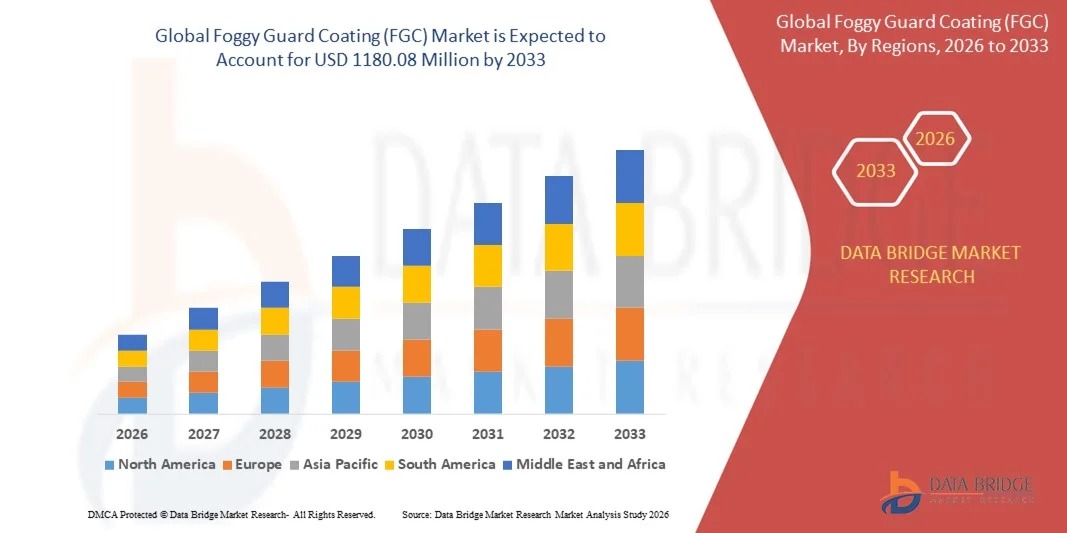
- As per Data Bridge Market Research analysis that the global Foggy Guard Coating (FGC) market size was valued at USD 855.67 million in 2025 and is expected to reach USD 1180.08 million by 2033, at a CAGR of 8.10% during the forecast period
- The market growth is largely driven by the increasing adoption of personal protective equipment, industrial safety gear, and cold-chain equipment, which require enhanced visibility and fog-resistant performance. Rising awareness regarding workplace safety standards, healthcare protection, and consumer safety is reinforcing the demand for effective anti-fog coatings across multiple applications
- Furthermore, technological advancements in coating formulations, including durable, eco-friendly, and high-clarity solutions, are improving performance on various substrates such as PET, PVC, and glass. These developments are enabling broader adoption across healthcare, automotive, sports, and commercial refrigeration sectors, thereby accelerating market expansion
Market Size & Forecast
Global Market Value (2025): USD 855.67 Million
Expected Market Value (2033): USD 1180.08 Million
Forecast CAGR (2026–2033): 8.10%
What are the Major Takeaways of Foggy Guard Coating (FGC) Market?
- Foggy Guard Coatings, designed to prevent condensation and maintain clear visibility on films, sheets, visors, and glass surfaces, are becoming critical in industrial, healthcare, and consumer safety applications. Their importance is increasing as users prioritize safety, hygiene, and operational efficiency in environments prone to fogging
- The rising demand for FGC solutions is primarily fueled by stringent safety regulations, the growing use of protective and transparent equipment, and the need for high-performance, durable, and sustainable anti-fog coatings. Expanding end-use sectors such as medical, automotive, cold storage, and sports are further propelling market growth
- North America dominated the Foggy Guard Coating (FGC) market in 2025, due to strong demand from healthcare, industrial safety, automotive, and cold-chain applications
- Asia-Pacific is expected to be the fastest growing region in the Foggy Guard Coating (FGC) market during the forecast period due to rapid industrialization, expanding healthcare infrastructure, and rising safety awareness
- PET segment dominated the market with a market share of 39% in 2025, due to its widespread use in lightweight, transparent, and impact-resistant substrates across safety and consumer applications. PET surfaces benefit significantly from fog-resistant coatings due to frequent exposure to temperature variations and moisture. Strong adoption of PET in protective equipment and display materials further supports sustained demand for FGC solutions in this segment
Report Scope and Foggy Guard Coating (FGC) Market Segmentation
|
Attributes |
Foggy Guard Coating (FGC) Key Market Insights |
|
Segments Covered |
|
|
Countries Covered |
North America
Europe
Asia-Pacific
Middle East and Africa
South America
|
|
Key Market Players |
|
|
Market Opportunities |
|
|
Value Added Data Infosets |
In addition to the insights on market scenarios such as market value, growth rate, segmentation, geographical coverage, and major players, the market reports curated by the Data Bridge Market Research also include import export analysis, production capacity overview, production consumption analysis, price trend analysis, climate change scenario, supply chain analysis, value chain analysis, raw material/consumables overview, vendor selection criteria, PESTLE Analysis, Porter Analysis, and regulatory framework. |
Foggy Guard Coating (FGC) Market Trends
Growing Use of Anti-Fog Coatings in Healthcare and Safety Gear
- A prominent trend in the Foggy Guard Coating (FGC) market is the increasing adoption of anti-fog coatings across healthcare, industrial, and safety equipment sectors, driven by the need to maintain clear visibility and operational efficiency. The rising focus on worker safety, patient care, and compliance with hygiene standards is elevating the demand for durable and reliable anti-fog solutions
- For instance, 3M supplies advanced anti-fog coatings for surgical masks, protective goggles, and face shields that maintain visibility under prolonged usage. Such applications ensure safety personnel and healthcare workers can operate efficiently in environments where fogging could impair vision
- The use of FGCs is expanding in personal protective equipment (PPE) for industrial workers, including helmets and safety glasses, where clear visibility is crucial for accident prevention and operational accuracy. Coatings enhance user confidence and reduce downtime caused by fog accumulation
- Sports and recreational gear manufacturers are incorporating anti-fog treatments into goggles, visors, and eyewear to improve performance under varying environmental conditions. This trend is encouraging product differentiation and driving innovation in coating technologies
- The automotive and aviation sectors are exploring anti-fog coatings for interior glass surfaces, including windshields and cockpit instruments, to improve safety and enhance passenger experience. This adoption is positioning FGC as an essential material for environments requiring uninterrupted visibility
- The market is witnessing a growing preference for multifunctional coatings that combine anti-fog properties with scratch resistance, antimicrobial effects, and chemical durability. These innovations are accelerating product upgrades and reinforcing FGC’s strategic relevance across multiple industries
Foggy Guard Coating (FGC) Market Dynamics
Driver
Rising Demand for Durable, High-Visibility Protective Surfaces
- The demand for coatings that maintain clarity, resist wear, and enhance safety is driving the Foggy Guard Coating market. Industries are increasingly prioritizing high-performance surfaces that can withstand harsh conditions while ensuring consistent visibility
- For instance, Honeywell provides anti-fog coatings for industrial safety goggles and face shields that offer long-lasting clarity under extreme temperature and humidity conditions. These durable coatings reduce replacement frequency and enhance worker productivity
- Healthcare facilities are investing in anti-fog coatings for surgical and diagnostic equipment, ensuring critical procedures are not compromised by visual obstructions. This trend is boosting demand for coatings that meet stringent hygiene and performance standards
- Consumer electronics and wearable device manufacturers are integrating anti-fog coatings on camera lenses, screens, and optical sensors to ensure clear performance under fluctuating temperatures and moisture conditions. This trend is supporting broader applications of FGC beyond traditional protective gear
- The rising awareness of occupational safety standards and regulatory compliance requirements is prompting industries to adopt anti-fog coatings across diverse equipment and surfaces. The focus on reducing accident risks and improving operational efficiency continues to drive market growth
Restraint/Challenge
High Cost of Advanced Anti-Fog Coatings
- The Foggy Guard Coating market faces challenges from the high costs associated with producing advanced anti-fog formulations that combine durability, transparency, and multifunctional properties. These cost considerations limit adoption in price-sensitive sectors and small-scale applications
- For instance, PPG Industries manufactures premium anti-fog coatings with enhanced scratch and chemical resistance for medical and industrial applications, which involve expensive raw materials and sophisticated production processes. The high unit cost can restrict widespread usage
- Manufacturing FGCs requires specialized equipment, controlled environmental conditions, and strict quality assurance to ensure consistent performance. These factors increase operational expenses and impact overall pricing strategies
- Supply chain fluctuations in specialty chemicals and polymers used for coating formulations further contribute to cost volatility. Companies face challenges in balancing performance requirements with economic feasibility
- Market expansion is constrained by the trade-off between advanced functionality and affordability, particularly in emerging regions where budget limitations affect procurement decisions. Addressing cost barriers while maintaining high-quality performance remains a critical challenge for FGC manufacturers
How is the Foggy Guard Coating (FGC) Market Segmented?
The market is segmented on the basis of product type and application.
- By Product
On the basis of product, the Foggy Guard Coating (FGC) market is segmented into PVC, PET, glass, and others. The PET segment dominated the market with the largest revenue share of 39% in 2025, driven by its widespread use in lightweight, transparent, and impact-resistant substrates across safety and consumer applications. PET surfaces benefit significantly from fog-resistant coatings due to frequent exposure to temperature variations and moisture. Strong adoption of PET in protective equipment and display materials further supports sustained demand for FGC solutions in this segment.
The glass segment is anticipated to witness the fastest growth rate from 2026 to 2033, supported by increasing use of anti-fog treated glass in automotive, commercial refrigeration, and architectural applications. Rising emphasis on visibility, safety, and premium aesthetics is accelerating the adoption of fog-resistant coatings on glass surfaces. Advancements in coating durability and optical clarity are further strengthening growth prospects for this segment.
- By Applications
On the basis of applications, the Foggy Guard Coating (FGC) market is segmented into helmet visors and face shields, flat polycarbonate sheets, commercial freezer windows, and others. The helmet visors and face shields segment dominated the market in 2025, driven by high usage across industrial safety, healthcare, and sports sectors. Fog prevention is critical in these applications to ensure clear visibility and user safety under humid and high-breathing conditions. Regulatory focus on worker and rider safety continues to reinforce consistent demand for fog-resistant coatings in this segment.
The commercial freezer window segment is expected to grow at the fastest rate during the forecast period, owing to expanding cold-chain infrastructure and retail refrigeration installations. Frequent temperature differentials in freezer environments create persistent fogging issues, increasing the need for effective anti-fog coatings. Growth in organized retail and food preservation facilities is further accelerating adoption across this application segment.
Foggy Guard Coating (FGC) Market Regional Analysis
- North America dominated the Foggy Guard Coating (FGC) market with the largest revenue share in 2025, driven by strong demand from healthcare, industrial safety, automotive, and cold-chain applications
- Widespread adoption of personal protective equipment, stringent workplace safety standards, and high awareness regarding visibility and safety performance are significantly supporting market growth across the region
- This dominance is further reinforced by advanced manufacturing capabilities, early adoption of performance-enhancing coatings, and consistent investments in healthcare infrastructure and cold storage facilities, positioning fog-resistant coatings as a critical functional solution
U.S. Foggy Guard Coating (FGC) Market Insight
The U.S. Foggy Guard Coating market captured the largest revenue share within North America in 2025, supported by extensive usage of anti-fog coatings in medical face shields, industrial safety gear, and commercial refrigeration systems. Strong regulatory emphasis on worker safety, along with continuous innovation in coating technologies, is accelerating adoption across multiple end-use sectors. The growing presence of organized retail and cold-chain logistics is further strengthening market expansion.
Europe Foggy Guard Coating (FGC) Market Insight
The Europe Foggy Guard Coating market is projected to grow at a substantial CAGR during the forecast period, driven by strict occupational safety regulations and rising demand for advanced protective equipment. Increased use of fog-resistant coatings in healthcare, food storage, and automotive glazing applications is contributing to market growth. Sustainability-driven innovation and preference for durable, high-performance coatings are further supporting adoption across the region.
U.K. Foggy Guard Coating (FGC) Market Insight
The U.K. Foggy Guard Coating market is expected to witness notable growth during the forecast period, supported by rising healthcare expenditure and increased focus on worker safety compliance. Growing adoption of anti-fog solutions in face shields, helmet visors, and refrigeration display units is boosting demand. Expansion of organized retail and cold storage infrastructure continues to positively influence market penetration.
Germany Foggy Guard Coating (FGC) Market Insight
The Germany Foggy Guard Coating market is anticipated to expand at a considerable CAGR, fueled by strong industrial safety norms and advanced manufacturing practices. High demand from automotive, healthcare, and industrial sectors is driving the use of fog-resistant coatings on glass and polymer surfaces. Germany’s emphasis on high-quality, long-lasting functional coatings further enhances market growth.
Asia-Pacific Foggy Guard Coating (FGC) Market Insight
The Asia-Pacific Foggy Guard Coating market is poised to grow at the fastest CAGR during the forecast period of 2026 to 2033, driven by rapid industrialization, expanding healthcare infrastructure, and rising safety awareness. Increasing production of helmets, face shields, and refrigeration equipment across emerging economies is accelerating demand. Cost-effective manufacturing and growing export-oriented production further strengthen regional market growth.
Japan Foggy Guard Coating (FGC) Market Insight
The Japan Foggy Guard Coating market is gaining steady traction due to strong demand for high-performance coatings in healthcare, automotive, and electronics-related applications. Emphasis on precision, quality, and visibility enhancement is driving adoption of advanced anti-fog technologies. The country’s focus on innovation and safety-centric product design continues to support market development.
China Foggy Guard Coating (FGC) Market Insight
The China Foggy Guard Coating market accounted for the largest revenue share in Asia-Pacific in 2025, driven by rapid industrial growth, large-scale manufacturing of safety equipment, and expanding cold-chain logistics. Rising investments in healthcare facilities and increasing adoption of protective gear are key growth drivers. Strong domestic production capabilities and competitive pricing are further accelerating market expansion across multiple applications.
Which are the Top Companies in Foggy Guard Coating (FGC) Market?
The Foggy Guard Coating (FGC) industry is primarily led by well-established companies, including:
- 3M (U.S.)
- Covestro AG (Germany)
- Mitsubishi Chemical Corporation (Japan)
- SABIC (Saudi Arabia)
- WeeTect, Inc. (U.S.)
- Kafrit Industries Ltd (Israel)
- Ningbo Zhongding Plastic Co., Ltd (China)
- TEKRA, LLC. (U.S.)
- United States Plastic Corporation (U.S.)
- Wiman Corporation (U.S.)
- Rowland Technologies, Inc (U.S.)
- Gallina India (India)
- Isik Plastik. Her Hakki Saklidir. (Turkey)
- Palram Industries Ltd. (Israel)
- Plazit Polygal (Israel)
Latest Developments in Global Foggy Guard Coating (FGC) Market
- In July 2024, Arkema entered a strategic partnership with Medtronic to co-develop biocompatible anti-fog coatings for surgical and endoscopic instruments, strengthening the penetration of fog-resistant coatings in high-value medical applications. This collaboration is enhancing innovation in precision coating technologies while expanding the addressable market within regulated healthcare environments where visibility and safety are critical
- In March 2024, Hydromer received FDA 510(k) clearance for its advanced anti-fog coating designed for medical face shields and protective eyewear, significantly improving market credibility and adoption across healthcare safety equipment. Regulatory approval is enabling wider commercialization and accelerating demand from hospitals and medical device manufacturers
- In February 2024, Hydromer introduced water-based, eco-friendly anti-fog coating solutions aimed at reducing solvent usage and improving environmental compliance. This development is supporting the market’s shift toward sustainable coating technologies while increasing adoption across packaging, medical, and industrial safety applications
- In January 2024, WeeTect launched specialized anti-fog coatings for helmet visors, expanding usage across motorcycle, sports, and personal safety equipment markets. The product launch is improving rider visibility and safety while driving increased demand for durable fog-resistant coatings in consumer protective gear
- In November 2023, 3M expanded its anti-fog coating portfolio with enhanced durability solutions targeted at automotive and industrial applications. This development is strengthening 3M’s competitive position and supporting broader adoption of long-lasting fog-resistant coatings in demanding operating environments

- Interactive Data Analysis Dashboard
- Company Analysis Dashboard for high growth potential opportunities
- Research Analyst Access for customization & queries
- Competitor Analysis with Interactive dashboard
- Latest News, Updates & Trend analysis
- Harness the Power of Benchmark Analysis for Comprehensive Competitor Tracking
Global Foggy Guard Coating Fgc Market, Supply Chain Analysis and Ecosystem Framework
To support market growth and help clients navigate the impact of geopolitical shifts, DBMR has integrated in-depth supply chain analysis into its Global Foggy Guard Coating Fgc Market research reports. This addition empowers clients to respond effectively to global changes affecting their industries. The supply chain analysis section includes detailed insights such as Global Foggy Guard Coating Fgc Market consumption and production by country, price trend analysis, the impact of tariffs and geopolitical developments, and import and export trends by country and HSN code. It also highlights major suppliers with data on production capacity and company profiles, as well as key importers and exporters. In addition to research, DBMR offers specialized supply chain consulting services backed by over a decade of experience, providing solutions like supplier discovery, supplier risk assessment, price trend analysis, impact evaluation of inflation and trade route changes, and comprehensive market trend analysis.
Data collection and base year analysis are done using data collection modules with large sample sizes. The stage includes obtaining market information or related data through various sources and strategies. It includes examining and planning all the data acquired from the past in advance. It likewise envelops the examination of information inconsistencies seen across different information sources. The market data is analysed and estimated using market statistical and coherent models. Also, market share analysis and key trend analysis are the major success factors in the market report. To know more, please request an analyst call or drop down your inquiry.
The key research methodology used by DBMR research team is data triangulation which involves data mining, analysis of the impact of data variables on the market and primary (industry expert) validation. Data models include Vendor Positioning Grid, Market Time Line Analysis, Market Overview and Guide, Company Positioning Grid, Patent Analysis, Pricing Analysis, Company Market Share Analysis, Standards of Measurement, Global versus Regional and Vendor Share Analysis. To know more about the research methodology, drop in an inquiry to speak to our industry experts.
Data Bridge Market Research is a leader in advanced formative research. We take pride in servicing our existing and new customers with data and analysis that match and suits their goal. The report can be customized to include price trend analysis of target brands understanding the market for additional countries (ask for the list of countries), clinical trial results data, literature review, refurbished market and product base analysis. Market analysis of target competitors can be analyzed from technology-based analysis to market portfolio strategies. We can add as many competitors that you require data about in the format and data style you are looking for. Our team of analysts can also provide you data in crude raw excel files pivot tables (Fact book) or can assist you in creating presentations from the data sets available in the report.













