What is the Food Allergen Testing Market Size and Growth Rate?
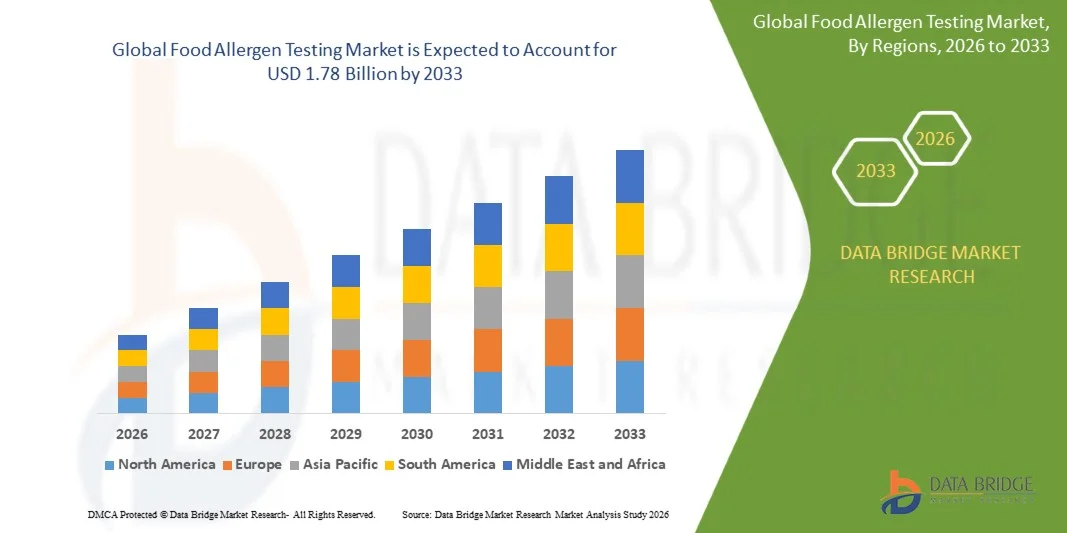
- As per Data Bridge Market Research analysis, the Food Allergen Testing market was valued at USD 1 billion in 2025 and is projected to reach USD 1.78 billion by 2033, growing at a CAGR of 7.40% from 2026 to 2033.
- The market is experiencing robust growth driven by stringent food safety regulations, increasing consumer awareness of food allergies, and the rising prevalence of food allergies globally. The expanding food processing industry, particularly in developing economies, and the increasing demand for accurate and rapid allergen detection methods are further fueling market expansion.
- The increasing incidence of food allergies worldwide, combined with stricter government regulations on allergen labeling and food safety, is compelling food manufacturers, retailers, and regulatory bodies to adopt advanced allergen testing solutions. Immunoassay-based and PCR-based tests are becoming the standard in many markets, offering rapid, sensitive, and reliable detection of allergenic substances in food products.
Market Size & Forecast
- Global Market Value (2025): USD 1 Billion
- Expected Market Value (2033): USD 1.78 Billion
- Forecast CAGR (2026 to 2033): 7.40%
- Leading Region in 2025: North America
- Fastest Growing Region: Asia Pacific
What are the Major Takeaways of the Food Allergen Testing Market?
- North America dominated the global food allergen testing market with the largest revenue share of 35.2% in 2025, supported by stringent FDA regulations, strong allergen labeling laws, and advanced laboratory infrastructure.
- Asia Pacific is expected to be the fastest-growing region, with the market valued at USD 128.52 million in 2025 and projected to reach USD 206.39 million by 2033, driven by rapid urbanization, expanding processed food industries, and strengthening regulatory frameworks in China, India, and Japan.
- The immunoassay/ELISA-based technology segment led the market with a 41.37% share in 2025, driven by widespread adoption in food allergen testing due to high sensitivity, accuracy, and cost-effectiveness for detecting allergens in various food matrices.
- The PCR-based testing segment is the fastest-growing technology, projected to register a CAGR of 7.60% from 2026 to 2033, reflecting the surge in demand for rapid, reliable, and high-throughput testing methods for allergen detection.
- The bakery and confectionery products segment dominated the food tested category with a 25.60% share in 2025, supported by increasing consumer demand for allergen-free baked goods and stringent labeling requirements for wheat and gluten-containing products.
- The peanut and soy allergen type segment accounted for a 20.12% share of the market in 2025, driven by the high prevalence of peanut allergies worldwide and growing demand for accurate testing of these common allergens.
- The food manufacturers segment dominated the end user category with a 32.45% share in 2025, supported by increasing investments in in-house testing capabilities, growing focus on ensuring product safety, and rising food recall costs driving preventive testing adoption.
Report Scope and Food Allergen Testing Market Segmentation
|
Attributes |
Food Allergen Testing Key Market Insights |
|
Segments Covered |
|
|
Countries Covered |
North America
Europe
Asia-Pacific
Middle East and Africa
South America
|
|
Key Market Players |
|
|
Market Opportunities |
|
|
Value Added Data Infosets |
In addition to the insights on market scenarios such as market value, growth rate, segmentation, geographical coverage, and major players, the market reports curated by the Data Bridge Market Research also include in-depth expert analysis, pricing analysis, brand share analysis, consumer survey, demography analysis, supply chain analysis, value chain analysis, raw material/consumables overview, vendor selection criteria, PESTLE Analysis, Porter Analysis, and regulatory framework. |
What is the Key Trend in the Food Allergen Testing Market?
- The food allergen testing market is undergoing transformative shifts driven by rapid technological breakthroughs and regulatory emphasis, with technology adoption shifting toward multiplex PCR and mass-spectrometry platforms while AI tools shorten turnaround times and reduce false positives.
- For instance, emerging technologies such as hyperspectral imaging (HSI), FTIR spectroscopy, and Computer Vision (CV) are being incorporated in cloud-based allergen control systems, enabling non-destructive and rapid allergen detection.
- For instance, in January 2026, a portable handheld food-testing device was unveiled at CES 2026, designed to detect common allergens and gluten in prepared meals within minutes, representing a significant advancement in point-of-care testing solutions.
- The accelerated adoption of online platforms for food allergen testing purchases is reshaping distribution channels, with companies strengthening domestic supply chains and acquiring suppliers strategically to avoid tariff issues.
- For instance, major testing laboratories such as Eurofins Scientific and SGS are increasingly investing in AI-powered allergen detection platforms to enhance accuracy and reduce testing turnaround times.
- As food safety regulations continue to tighten and consumer awareness of food allergies grows, food allergen testing will remain indispensable for ensuring product safety and regulatory compliance across the global food supply chain.
What are the Key Drivers of the Food Allergen Testing Market?
- The increasing prevalence of food allergies worldwide is a primary driver, with eight foods - milk, eggs, fish, peanuts, tree nuts, shellfish, wheat, and soy - accounting for 90% of food allergic reactions, pushing manufacturers to test products for safety.
- Stringent food safety regulations and labeling requirements are significantly driving market growth, with the FDA's FSMA Section 204 traceability requirements taking effect in January 2026.
- For instance, undeclared allergens remain the primary cause of recalls globally, with UK food safety data showing 53 cases of undeclared allergen recalls in 2024, a 10% increase highlighting the ongoing challenge of cross-contamination control.
- Growing consumer awareness and demand for allergen-free and clean-label products are driving market expansion, with Gen Z consumers showing strong preference for "better-for-you" products.
- Advancements in testing technologies, including immunoassay-based/ELISA, PCR-based, and biosensor technologies, provide faster, more sensitive, and specific methods for detecting allergens in food.
- With the food industry increasingly relying on allergen testing to ensure safety and comply with regulations, food allergen testing will remain indispensable for the development of safe, allergen-free food products.
Which Factors are Challenging the Growth of the Food Allergen Testing Market?
- High testing costs serve as a significant restraint, with LC-MS/MS systems for confirmatory allergen analysis requiring initial investments exceeding USD 500,000 and annual maintenance costs reaching USD 100,000 per instrument.
- These high costs limit adoption among small and medium-sized food manufacturers that constitute the majority of global food production capacity, as well as in cost-sensitive regions.
- For instance, the sharp rise in U.S. tariffs and resulting trade tensions could hinder U.S. diagnostic capabilities by inflating prices of IgE immunoassay kits developed in Germany and Japan.
- The potential for false positives and the complexity of multi-allergen protocols restrain penetration among smaller manufacturers, requiring continuous innovation in analytical chemistry.
- Regulatory uncertainty and changing standards across different countries pose significant challenges, with compliance with both FDA and EFSA requirements demanding dual testing protocols.
- The high capital investment and recurring operational costs continue to restrict adoption in emerging economies, slowing market penetration in price-sensitive regions despite growing demand.
How is the Food Allergen Testing Market Segmented?
The Food Allergen Testing market is segmented on the basis of technology, allergen type, food tested, and end user.
- By Technology
On the basis of technology, the global food allergen testing market is segmented into immunoassay/ELISA-based, PCR-based, biosensors, and others. The immunoassay/ELISA-based technology segment dominated the market with a 41.37% share in 2025, driven by widespread adoption in food allergen testing due to high sensitivity, accuracy, and cost-effectiveness for detecting allergens in various food matrices. These technologies deliver reliable and rapid results, making them the preferred choice for food manufacturers, testing laboratories, and regulatory bodies.
The PCR-based testing segment is projected to register the fastest growth at a CAGR of 7.60% from 2026 to 2033, driven by increasing demand for rapid, reliable, and high-throughput testing methods for allergen detection. Advances in molecular diagnostics, growing automation, and rising adoption in food safety testing are accelerating segment expansion.
-
By Allergen Type
On the basis of allergen type, the global food allergen testing market is segmented into peanut and soy, wheat and gluten, milk and dairy, egg, tree nuts, and others. The peanut and soy allergen type segment dominated the market with a 20.12% share in 2025, driven by the high prevalence of peanut allergies worldwide and growing demand for accurate testing of these common allergens. Stringent labeling requirements and increasing consumer awareness regarding peanut and soy allergies are reinforcing the leading position of this segment.
The tree nuts segment is expected to witness the fastest growth at a CAGR of 8.00% from 2026 to 2033, driven by increasing prevalence of tree nut allergies, rising consumer demand for accurate allergen testing, and growing regulatory scrutiny on tree nut labeling. Advances in detection technologies and expanding product portfolios are accelerating segment expansion.
- By Food Tested
On the basis of food tested, the global food allergen testing market is segmented into bakery and confectionery products, dairy and frozen desserts, processed foods, beverages, and others. The bakery and confectionery products segment dominated the market with a 25.60% share in 2025, supported by increasing consumer demand for allergen-free baked goods and stringent labeling requirements for wheat and gluten-containing products. Rising product recalls and growing focus on food safety are reinforcing the leading position of this segment.
The beverages segment is expected to witness the fastest growth at a CAGR of 9.40% from 2026 to 2033, driven by increasing consumer demand for plant-based milk alternatives, growing allergen concerns in beverage formulations, and rising regulatory requirements for allergen labeling in liquid food products.
-
By End User
On the basis of end user, the global food allergen testing market is segmented into food manufacturers, testing laboratories, research institutions, and regulatory bodies. The food manufacturers segment dominated the market with a 32.45% share in 2025, supported by increasing investments in in-house testing capabilities and growing focus on ensuring product safety and regulatory compliance. Rising food recall costs, brand protection concerns, and consumer demand for transparency are reinforcing the leading position of this segment.
The testing laboratories segment is expected to witness the fastest growth at a CAGR of 8.20% from 2026 to 2033, driven by increasing outsourcing of allergen testing services, rising number of accredited testing facilities, and growing demand for third-party certification. Advances in testing technologies and expanding service portfolios are accelerating segment expansion.
Which Region Holds the Largest Share of the Food Allergen Testing Market?
- North America dominated the global food allergen testing market and accounted for the largest revenue share of 35.2% in 2025 , supported by stringent food safety regulations, strong enforcement of allergen labeling laws, and advanced laboratory infrastructure across the region. The region's dominance is driven by the high prevalence of food allergies, with the U.S. food allergen testing market reaching USD 228.8 million in 2025.
- The region also benefits from robust regulatory frameworks such as the Food Allergen Labeling and Consumer Protection Act (FALCPA) and the Food Safety Modernization Act (FSMA), which continue to drive the adoption of allergen testing solutions across the supply chain. Increasing focus on preventive testing strategies and consumer protection continues to strengthen North America's leadership position in the global market.
U.S. Food Allergen Testing Market Insight
The U.S. food allergen testing market is experiencing robust growth, supported by rising consumer awareness regarding food allergies, stringent food safety regulations enforced by the U.S. Food and Drug Administration (FDA), and a well-established food processing industry. The FDA's implementation of Food Safety Modernization Act (FSMA) Section 204 traceability requirements, taking effect in January 2026, requires digital tracking systems that will increase the visibility of allergen control failures and associated liability exposure. Furthermore, integration of advanced testing technologies such as digital PCR, advanced immunoassays, and rapid point-of-use test kits are enabling faster, more sensitive allergen detection, positioning the U.S. as a key innovation hub in the food allergen testing industry.
Europe Food Allergen Testing Market Insight
The European food allergen testing market is expanding steadily due to the region's strong food safety culture, advanced testing capabilities, and stringent regulatory frameworks enforced by the European Food Safety Authority (EFSA). Germany leads the Europe food allergen testing market, supported by its advanced analytical testing infrastructure, strong food processing industry, and rigorous food safety regulations. The United Kingdom remains a key market due to strict allergen labeling requirements and growing consumer demand for safe and transparent food products. Food manufacturers, testing laboratories, and regulatory bodies are increasingly utilizing allergen testing solutions for compliance verification, product safety assessment, and consumer protection.
Asia-Pacific Food Allergen Testing Market Insight
The Asia-Pacific food allergen testing market is expected to witness rapid growth, driven by increasing urbanization, rising disposable incomes, expanding middle-class population, and growing awareness regarding food safety and food allergies. The region is expected to be the fastest-growing market during the forecast period, with emerging markets demonstrating significant growth driven by regulatory updates, increasing consumer awareness, and the growing presence of international food manufacturers and testing laboratories. Additionally, the growing consumption of processed and packaged foods and increasing investments in food safety infrastructure are accelerating market adoption across commercial and consumer sectors.
Japan Food Allergen Testing Market Insight
The Japan food allergen testing market is witnessing consistent growth due to rising health consciousness, increasing focus on food safety, and growing adoption of allergen testing solutions across the food industry. Food manufacturers, testing laboratories, and research institutions are increasingly adopting allergen testing technologies for product safety assessment, regulatory compliance, and quality assurance. Moreover, increasing integration of advanced testing methods and the country's focus on food safety and consumer protection are further contributing to market growth.
China Food Allergen Testing Market Insight
The China food allergen testing market is growing rapidly, driven by increasing urbanization, rising disposable incomes, and expanding middle-class population seeking safe and high-quality food products. Growing adoption of allergen testing solutions across commercial, food processing, and export sectors is significantly boosting market demand. In addition, rising investments in food safety infrastructure, increasing awareness regarding food allergies, and rapid technological advancements in testing methods are positioning China as one of the fastest-growing markets for food allergen testing globally.
Which are the Top Companies in Food Allergen Testing Market?
The Food Allergen Testing industry is primarily led by well-established companies, including:
- SGS SA (Switzerland)
- Intertek Group PLC (U.K.)
- Eurofins Scientific SE (Luxembourg)
- Bureau Veritas SA (France)
- ALS Limited (Australia)
- Mérieux NutriSciences (U.S.)
- Neogen Corporation (U.S.)
- Thermo Fisher Scientific Inc. (U.S.)
- Bio-Rad Laboratories Inc. (U.S.)
- Romer Labs Division Holding GmbH (Austria)
- Microbac Laboratories Inc. (U.S.)
- TÜV SÜD (Germany)
- Agilent Technologies Inc. (U.S.)
- 3M (U.S.)
- R-Biopharm AG (Germany)
- AsureQuality Ltd (New Zealand)
- FoodChain ID Group Inc. (U.S.)
What are Latest Developments in Food Allergen Testing Market?
- In 2025, Mérieux NutriSciences completed the acquisition of Bureau Veritas' food testing activities in North America, adding 12 laboratories and 400 colleagues across the United States and Canada. The acquisition significantly strengthens Mérieux NutriSciences' position in the food allergen testing market by extending its reach across North American food manufacturing, retail, and foodservice sectors, enabling food producers to access comprehensive testing services for allergen detection and food safety compliance.
- In June 2025, Mérieux NutriSciences and AsureQuality announced the official launch of their joint venture, Mérieux NutriSciences AQ (MNAQ), following the successful completion of Mérieux NutriSciences' acquisition of Bureau Veritas' worldwide food testing activities. The joint venture combines the food testing capabilities of both companies to provide comprehensive testing services across Southeast Asia, Australia, and other markets, strengthening their position in the rapidly growing Asia Pacific food testing market.
- In October 2025, Shimadzu Diagnostics began offering a new food allergen detection kit for cashew nuts, expanding the range of rapid immunochromatographic testing options available for food allergen detection. The new kit enables food manufacturers and testing laboratories to detect cashew nut allergens quickly and reliably, addressing the growing demand for testing solutions for tree nut allergens.
- In June 2025, Tsukuba Food Evaluation Center launched a new allergen detection kit for cashew nuts as part of its "Allergen Eye Immunochromatography for Heating" series, enabling testing completion in approximately one hour. The new kit addresses the growing demand for rapid and reliable testing solutions for tree nut allergens in the food industry.
- In May 2025, Reacta Healthcare achieved a significant milestone with the launch of its first production run of pharmaceutical-grade milk and egg challenge meals. The company also announced plans to transform into a multi-allergen manufacturing facility, expanding its product portfolio to include peanut, milk, and egg challenge tests.

- Interactive Data Analysis Dashboard
- Company Analysis Dashboard for high growth potential opportunities
- Research Analyst Access for customization & queries
- Competitor Analysis with Interactive dashboard
- Latest News, Updates & Trend analysis
- Harness the Power of Benchmark Analysis for Comprehensive Competitor Tracking
Global Food Allergen Testing Market, Supply Chain Analysis and Ecosystem Framework
To support market growth and help clients navigate the impact of geopolitical shifts, DBMR has integrated in-depth supply chain analysis into its Global Food Allergen Testing Market research reports. This addition empowers clients to respond effectively to global changes affecting their industries. The supply chain analysis section includes detailed insights such as Global Food Allergen Testing Market consumption and production by country, price trend analysis, the impact of tariffs and geopolitical developments, and import and export trends by country and HSN code. It also highlights major suppliers with data on production capacity and company profiles, as well as key importers and exporters. In addition to research, DBMR offers specialized supply chain consulting services backed by over a decade of experience, providing solutions like supplier discovery, supplier risk assessment, price trend analysis, impact evaluation of inflation and trade route changes, and comprehensive market trend analysis.
Data collection and base year analysis are done using data collection modules with large sample sizes. The stage includes obtaining market information or related data through various sources and strategies. It includes examining and planning all the data acquired from the past in advance. It likewise envelops the examination of information inconsistencies seen across different information sources. The market data is analysed and estimated using market statistical and coherent models. Also, market share analysis and key trend analysis are the major success factors in the market report. To know more, please request an analyst call or drop down your inquiry.
The key research methodology used by DBMR research team is data triangulation which involves data mining, analysis of the impact of data variables on the market and primary (industry expert) validation. Data models include Vendor Positioning Grid, Market Time Line Analysis, Market Overview and Guide, Company Positioning Grid, Patent Analysis, Pricing Analysis, Company Market Share Analysis, Standards of Measurement, Global versus Regional and Vendor Share Analysis. To know more about the research methodology, drop in an inquiry to speak to our industry experts.
Data Bridge Market Research is a leader in advanced formative research. We take pride in servicing our existing and new customers with data and analysis that match and suits their goal. The report can be customized to include price trend analysis of target brands understanding the market for additional countries (ask for the list of countries), clinical trial results data, literature review, refurbished market and product base analysis. Market analysis of target competitors can be analyzed from technology-based analysis to market portfolio strategies. We can add as many competitors that you require data about in the format and data style you are looking for. Our team of analysts can also provide you data in crude raw excel files pivot tables (Fact book) or can assist you in creating presentations from the data sets available in the report.