


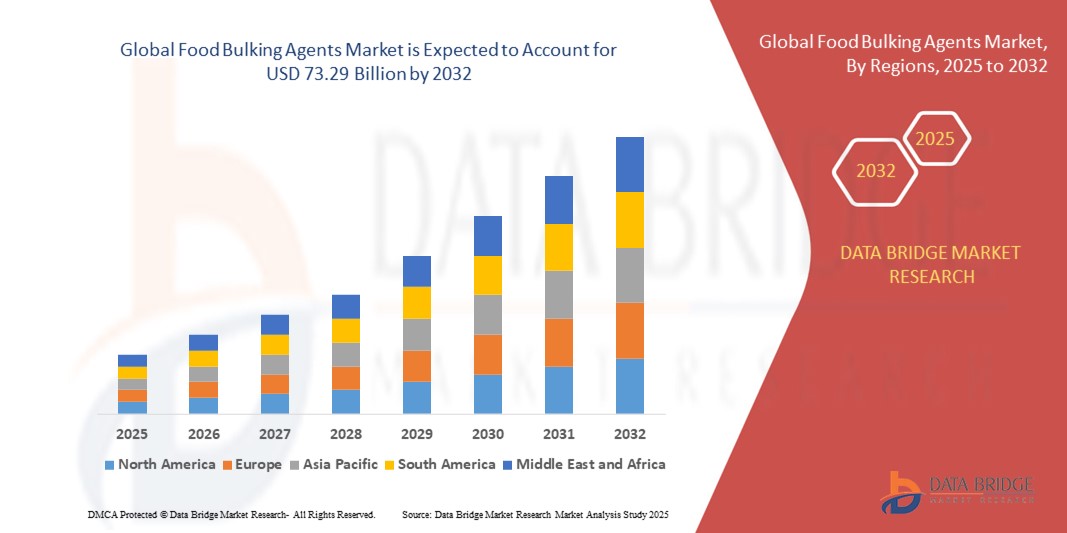
Food Bulking Agents Market Size
- The global food bulking agents market size was valued at USD 51.53 billion in 2024 and is expected to reach USD 73.29 billion by 2032, at a CAGR of 4.50% during the forecast period
- The market growth is largely fueled by the rising demand for low-calorie, sugar-free, and functional food products, as consumers increasingly prioritize health, wellness, and clean-label formulations in their diets
- Furthermore, the growing application of bulking agents in bakery, beverages, and confectionery, combined with innovations in plant-based and fiber-enriched ingredients, is accelerating adoption across both developed and emerging economies. These converging factors are significantly boosting the demand for food bulking agents worldwide
Food Bulking Agents Market Analysis
- Food bulking agents are functional ingredients added to food and beverage formulations to enhance volume, texture, and stability without significantly contributing calories. They play a critical role in sugar reduction, calorie control, and fiber enrichment, making them integral to healthier product innovation in bakery, dairy, beverages, and processed foods
- The escalating demand for food bulking agents is primarily fueled by rising consumer preference for clean-label, plant-based, and fortified foods, combined with rapid expansion of the functional and convenience food sectors. Increasing health awareness, urbanization, and government support for food innovation are further strengthening market growth
- Asia-Pacific dominated the food bulking agents market with a share of 35.5% in 2024, due to expanding bakery and confectionery industries, rising consumption of functional foods, and strong demand for clean-label ingredients across developing economies
- North America is expected to be the fastest growing region in the food bulking agents market during the forecast period due to rising demand for functional foods, sports nutrition, and sugar-free beverages
- Plant-based segment dominated the market with a market share of 64.7% in 2024, due to the rapid shift toward vegan and vegetarian lifestyles globally. Increasing demand for plant-derived additives in clean-label and natural formulations has positioned plant-based bulking agents as the preferred choice among food manufacturers. Their compatibility with a wide range of applications, from bakery to beverages, and their ability to align with sustainability and health-conscious trends further support their dominance. Rising consumer trust in plant-based sources also reinforces their acceptance in functional food development
Report Scope and Food Bulking Agents Market Segmentation
|
Attributes |
Food Bulking Agents Key Market Insights |
|
Segments Covered |
|
|
Countries Covered |
North America
Europe
Asia-Pacific
Middle East and Africa
South America
|
|
Key Market Players |
|
|
Market Opportunities |
|
|
Value Added Data Infosets |
In addition to the insights on market scenarios such as market value, growth rate, segmentation, geographical coverage, and major players, the market reports curated by the Data Bridge Market Research also include import export analysis, production capacity overview, production consumption analysis, price trend analysis, climate change scenario, supply chain analysis, value chain analysis, raw material/consumables overview, vendor selection criteria, PESTLE Analysis, Porter Analysis, and regulatory framework. |
Food Bulking Agents Market Trends
Rising Health and Wellness Trends
- The global demand for food bulking agents is rapidly increasing as consumers prioritize health and wellness in their dietary choices. Bulking agents such as fiber-based additives are widely adopted to enhance satiety, lower calorie content, and support weight management in daily diets
- For instance, Cargill has introduced specialty fiber-based bulking agents that aid in sugar reduction while maintaining taste and texture. These products cater to the demand for low-calorie and healthier food formulations, aligning with growing health-conscious consumer groups
- The heightened preference for low-sugar and reduced-fat products has increased the need for effective substitutes that preserve product quality. Bulking agents fulfill this role by providing texture, volume, and mouthfeel in reformulated food products while ensuring reduced calorie impact
- In addition, the surge of plant-based diets and functional foods has reinforced the importance of bulking agents in next-generation formulations. They contribute nutritional benefits such as improved digestion and gut health, making them highly relevant for wellness-oriented product launches
- The increasing consumer shift towards preventive healthcare and nutritional solutions is shaping innovation in the bulking agents market. Companies are promoting fiber-enriched snacks, beverages, and bakery items that directly address wellness demands
- Altogether, the alignment of food bulking agents with global wellness trends emphasizes their long-term role in advancing healthier diets. Their capacity to enhance nutrition, support dietary goals, and meet clean-label expectations ensures sustained demand growth
Food Bulking Agents Market Dynamics
Driver
Growing Popularity of Functional Foods and Nutraceuticals
- The rising demand for functional foods and nutraceuticals is strongly propelling the adoption of bulking agents, as these products frequently rely on fiber- and protein-based agents for formulation consistency. This demand is closely tied to consumers’ preference for nutrient-rich, health-supportive options
- For instance, Ingredion Incorporated has expanded its bulking agent portfolio by introducing new dietary fibers designed for functional foods and nutraceuticals. Their products support digestive health while enabling sugar and calorie reduction in diverse product categories
- Consumers are increasingly seeking food that offers added benefits such as improved immunity, enhanced energy, or better digestion. Bulking agents allow manufacturers to achieve desired product structures while incorporating functional nutrients seamlessly into everyday consumption formats
- In addition, the nutraceutical sector’s growth in emerging regions is creating significant demand for bulking components. Functional beverages, cereals, and energy bars are being widely reformulated to include bulking agents that deliver both nutritional and functional improvements
- The integration of bulking agents into functional foods confirms their role as essential ingredients in the wellness supply chain. As awareness of health-boosting products grows, their importance in both mainstream and premium functional foods is set to expand further
Restraint/Challenge
Consumer Perception and Acceptance
- Despite the multiple advantages of bulking agents, consumer perception remains a key challenge. Many consumers are skeptical of additives in food products, even when they are fiber or plant-based, often associating them with artificial processing or reduced taste quality
- `For instance, companies such as Tate & Lyle face barriers in winning consumer trust for bulking agents used in sugar replacement. Despite their functional role, consumers in some markets view such ingredients as compromised alternatives rather than health-enhancing products
- The perception of bulking agents as “fillers” rather than beneficial dietary components reduces acceptance, particularly in markets where clean-label and minimally processed foods dominate consumer choices
- In addition, inadequate consumer education about the nutritional benefits of bulking agents contributes to lower uptake. Limited awareness about their positive role in digestion, weight management, and calorie reduction prevents them from achieving full market potential
- Addressing these concerns requires transparent labeling, consumer education initiatives, and innovations that align bulking agents with natural and clean-label product claims. Building consumer trust and acceptance will be central to driving long-term adoption of food bulking agents
Food Bulking Agents Market Scope
The market is segmented on the basis of type, source, and application.
- By Type
On the basis of type, the food bulking agents market is segmented into maltodextrin, polydextrose, cellulose, lactose, and others. The maltodextrin segment dominated the largest market revenue share in 2024, attributed to its widespread use in bakery, confectionery, and beverage applications as a filler and texture enhancer. Its neutral taste, ease of blending, and cost-effectiveness make it highly preferred by manufacturers across both developed and developing markets. In addition, its role as a stabilizer in low-calorie foods and sports nutrition products further cements its strong presence in the market. Growing consumer demand for functional foods and clean-label formulations has reinforced the reliance on maltodextrin as a versatile bulking agent.
The polydextrose segment is expected to witness the fastest growth rate from 2025 to 2032, fueled by its increasing application in low-calorie and sugar-free products. Rising consumer awareness of obesity, diabetes, and other lifestyle-related health concerns has accelerated the adoption of polydextrose as a dietary fiber and sugar substitute. Its ability to provide bulk and texture without significantly altering flavor profiles makes it highly attractive for use in beverages, dairy, and confectionery. The market also benefits from the regulatory approval of polydextrose as a safe additive, encouraging manufacturers to incorporate it into functional and weight-management food categories.
- By Source
On the basis of source, the food bulking agents market is segmented into plant-based and animal-based. The plant-based segment dominated the largest market revenue share of 64.7% in 2024, driven by the rapid shift toward vegan and vegetarian lifestyles globally. Increasing demand for plant-derived additives in clean-label and natural formulations has positioned plant-based bulking agents as the preferred choice among food manufacturers. Their compatibility with a wide range of applications, from bakery to beverages, and their ability to align with sustainability and health-conscious trends further support their dominance. Rising consumer trust in plant-based sources also reinforces their acceptance in functional food development.
The animal-based segment is projected to register the fastest CAGR from 2025 to 2032, driven by its specialized applications in dairy and confectionery products. Animal-based bulking agents, particularly lactose, play a critical role in enhancing texture, flavor balance, and product stability. Their demand is being sustained by traditional dairy consumption patterns in emerging economies and their nutritional advantages in protein-rich formulations. Although the growth is relatively niche compared to plant-based, innovation in dairy-derived bulking agents is helping this segment expand into performance nutrition and premium food categories.
- By Application
On the basis of application, the food bulking agents market is segmented into bakery products, beverages, sauces and dressings, dairy products, confectionery, processed meat products, and others. The bakery products segment dominated the largest market share in 2024, driven by the widespread use of bulking agents in bread, cakes, pastries, and biscuits to improve texture, volume, and stability. The growing consumption of baked goods, particularly in urban areas, combined with innovation in gluten-free and fiber-enriched bakery products, has reinforced demand for bulking agents. Manufacturers rely on agents such as maltodextrin and cellulose to maintain product quality and consistency while catering to evolving consumer preferences for healthier alternatives.
The beverages segment is anticipated to witness the fastest growth rate from 2025 to 2032, fueled by the rising demand for low-calorie, sugar-free, and functional drinks. Bulking agents such as polydextrose and maltodextrin are increasingly incorporated into health beverages, sports drinks, and meal replacements to add body and improve mouthfeel without contributing excessive calories. The rapid growth of the functional beverage industry, coupled with consumer focus on wellness, hydration, and nutritional balance, is driving this trend. Expansion of ready-to-drink (RTD) beverages and the popularity of fortified drinks further highlight the growing importance of bulking agents in this segment.
Food Bulking Agents Market Regional Analysis
- Asia-Pacific dominated the food bulking agents market with the largest revenue share of 35.5% in 2024, driven by expanding bakery and confectionery industries, rising consumption of functional foods, and strong demand for clean-label ingredients across developing economies
- The region’s cost-effective manufacturing environment, growing investments in plant-based ingredient production, and increasing urbanization are accelerating market expansion
- The availability of raw materials, favorable government policies supporting food processing, and rising consumer demand for healthy and fortified products are contributing to the growing consumption of food bulking agents in the region
China Food Bulking Agents Market Insight
China held the largest share in the Asia-Pacific food bulking agents market in 2024, supported by its extensive food processing industry and strong demand for bakery, beverage, and dairy products. The country’s well-established manufacturing base, rising disposable incomes, and large-scale production of maltodextrin and cellulose have reinforced its leading position. Export-oriented production and continuous government support for food innovation also play a key role in market expansion.
India Food Bulking Agents Market Insight
India is witnessing the fastest growth in the Asia-Pacific region, fueled by a rapidly growing bakery and confectionery sector, increasing adoption of processed foods, and rising demand for dietary fiber-enriched products. The country’s focus on plant-based and natural food ingredients, coupled with supportive government initiatives in food processing under “Make in India,” is accelerating market penetration. Expanding health-conscious consumer base and the growing retail food sector are further strengthening India’s growth outlook.
Europe Food Bulking Agents Market Insight
The Europe food bulking agents market is expanding steadily, supported by high consumer preference for clean-label, low-calorie, and fiber-rich products. The region emphasizes strict food safety regulations, innovation in natural ingredient formulations, and widespread use of bulking agents in bakery, confectionery, and dairy products. Growing investments in sustainable ingredient production and advancements in functional food development are further contributing to Europe’s market growth.
Germany Food Bulking Agents Market Insight
Germany’s food bulking agents market is driven by its leadership in bakery and confectionery manufacturing, strong demand for maltodextrin and polydextrose, and emphasis on high-quality formulations. The country’s advanced R&D ecosystem, collaborations with food technology institutes, and strong focus on product innovation have reinforced its dominant role. Demand is particularly strong in functional and fortified food categories, aligning with consumer health and wellness trends.
U.K. Food Bulking Agents Market Insight
The U.K. market is supported by rising consumer preference for plant-based and low-calorie products, alongside innovation in bakery and beverage categories. Strong emphasis on reformulation to reduce sugar and calorie content in processed foods is boosting the use of bulking agents such as polydextrose and cellulose. A robust retail distribution network, combined with increasing investments in clean-label food innovation, positions the U.K. as a key contributor to the European market.
North America Food Bulking Agents Market Insight
North America is projected to grow at the fastest CAGR from 2025 to 2032, driven by rising demand for functional foods, sports nutrition, and sugar-free beverages. A strong emphasis on health and wellness, coupled with the region’s innovation in dietary supplements and fortified foods, is supporting increased adoption of bulking agents. Growing investments in clean-label and plant-based ingredients, alongside technological advancements in food formulation, are accelerating market expansion.
U.S. Food Bulking Agents Market Insight
The U.S. accounted for the largest share in the North America food bulking agents market in 2024, owing to its expansive food processing sector, high demand for convenience foods, and leadership in functional and fortified food innovation. Strong R&D capabilities, robust presence of ingredient manufacturers, and growing consumer preference for low-calorie and fiber-enriched products reinforce its dominance. The country’s mature distribution networks and advanced regulatory framework further strengthen the U.S.’s leading role in the regional market.
Food Bulking Agents Market Share
The food bulking agents industry is primarily led by well-established companies, including:
- BEHN MEYER (Germany)
- Ingredion (U.S.)
- Cargill, Incorporated (U.S.)
- DuPont (U.S.)
- Symrise (Germany)
- CP Kelco U.S., Inc (U.S.)
- VW-Ingredients (Germany)
- ADM (U.S.)
- Roquette Frères (France)
- Kerry Group plc (Ireland)
- BASF SE (Germany)
- T.Hasegawa USA Inc. (U.S)
Latest Developments in Global Food Bulking Agents Market
- In February 2025, Flowers Foods, Inc. acquired Simple Mills, Inc. for USD 795 million. The acquisition strengthens Flowers Foods’ presence in the better-for-you and snacking categories by integrating Simple Mills’ nutrient-rich, gluten-free product line. Operating as an independent subsidiary, Simple Mills enhances Flowers Foods’ portfolio with a focus on health-conscious consumers, enabling the company to capture a larger share of the rapidly growing clean-label and functional snack segments
- In November 2024, Tate & Lyle announced the launch of TASTEVA M Stevia Sweetener with Bulking Solutions, aimed at providing sugar-reduction options without compromising taste or texture. This development highlights Tate & Lyle’s focus on supporting the rising demand for low-calorie, fiber-enriched foods. By offering bulking solutions alongside sweeteners, the company strengthens its position in the functional ingredients market, catering to manufacturers reformulating products for health-conscious consumers
- In June 2023, T. Hasegawa USA introduced two new flavor enhancer technologies, namely HASEAROMA and ChefAroma. These solutions are designed to create more authentic taste experiences in food and beverages, improving consumer acceptance of reformulated products. Their introduction aligns with the broader market trend of combining flavor with bulking agents, ensuring that healthier, reduced-sugar, or clean-label products do not compromise on taste, thereby boosting adoption in both processed and functional food categories
- In December 2021, Omya, a Swiss ingredients producer, launched Omyafood 120, an advanced anti-caking agent designed to enhance powder handling and processing efficiency. Based on functionalized calcium carbonate (FCC) particles created through a patented recrystallization process, this innovation improves ingredient flowability and stability in powdered food applications. By addressing key processing challenges, Omya strengthens its role in supplying functional bulking and texturizing solutions to global food manufacturers
- In September 2021, Ingredion Incorporated expanded its plant-based portfolio by launching NOVATION® Indulge 2920, a functional starch solution that provides bulking, creaminess, and stability in low-fat and reduced-sugar products. This launch underscores Ingredion’s strategy to address growing consumer demand for healthier formulations while supporting manufacturers with versatile bulking options. The innovation also strengthens Ingredion’s competitive positioning in clean-label and plant-based food categories

- Interactive Data Analysis Dashboard
- Company Analysis Dashboard for high growth potential opportunities
- Research Analyst Access for customization & queries
- Competitor Analysis with Interactive dashboard
- Latest News, Updates & Trend analysis
- Harness the Power of Benchmark Analysis for Comprehensive Competitor Tracking
Global Food Bulking Agents Market, Supply Chain Analysis and Ecosystem Framework
To support market growth and help clients navigate the impact of geopolitical shifts, DBMR has integrated in-depth supply chain analysis into its Global Food Bulking Agents Market research reports. This addition empowers clients to respond effectively to global changes affecting their industries. The supply chain analysis section includes detailed insights such as Global Food Bulking Agents Market consumption and production by country, price trend analysis, the impact of tariffs and geopolitical developments, and import and export trends by country and HSN code. It also highlights major suppliers with data on production capacity and company profiles, as well as key importers and exporters. In addition to research, DBMR offers specialized supply chain consulting services backed by over a decade of experience, providing solutions like supplier discovery, supplier risk assessment, price trend analysis, impact evaluation of inflation and trade route changes, and comprehensive market trend analysis.
Data collection and base year analysis are done using data collection modules with large sample sizes. The stage includes obtaining market information or related data through various sources and strategies. It includes examining and planning all the data acquired from the past in advance. It likewise envelops the examination of information inconsistencies seen across different information sources. The market data is analysed and estimated using market statistical and coherent models. Also, market share analysis and key trend analysis are the major success factors in the market report. To know more, please request an analyst call or drop down your inquiry.
The key research methodology used by DBMR research team is data triangulation which involves data mining, analysis of the impact of data variables on the market and primary (industry expert) validation. Data models include Vendor Positioning Grid, Market Time Line Analysis, Market Overview and Guide, Company Positioning Grid, Patent Analysis, Pricing Analysis, Company Market Share Analysis, Standards of Measurement, Global versus Regional and Vendor Share Analysis. To know more about the research methodology, drop in an inquiry to speak to our industry experts.
Data Bridge Market Research is a leader in advanced formative research. We take pride in servicing our existing and new customers with data and analysis that match and suits their goal. The report can be customized to include price trend analysis of target brands understanding the market for additional countries (ask for the list of countries), clinical trial results data, literature review, refurbished market and product base analysis. Market analysis of target competitors can be analyzed from technology-based analysis to market portfolio strategies. We can add as many competitors that you require data about in the format and data style you are looking for. Our team of analysts can also provide you data in crude raw excel files pivot tables (Fact book) or can assist you in creating presentations from the data sets available in the report.













