


What is the Food Coating Equipment Market Size and Growth Rate?
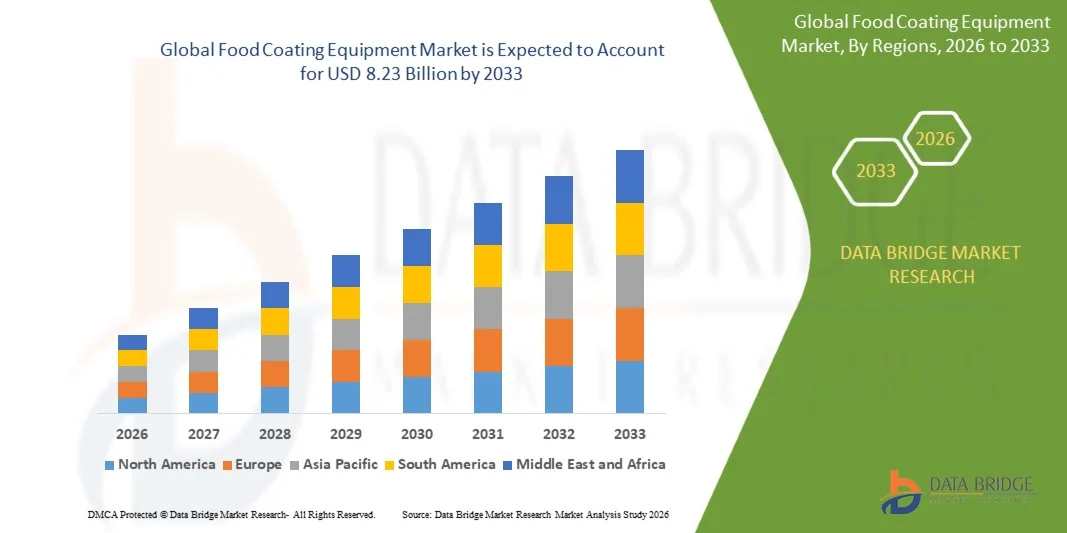
- As per Data Bridge Market Research analysis the food coating equipment market was valued at USD 5.83 billion in 2025 and is projected to reach USD 8.23 billion by 2033, growing at a CAGR of 4.40% from 2026 to 2033.
- The market is witnessing steady growth driven by increasing demand for processed and convenience foods, rising adoption of automated food processing equipment, and growing investments in advanced coating technologies to improve product quality, consistency, and production efficiency.
- The expanding consumption of coated bakery products, snacks, meat, seafood, and confectionery, along with stringent food safety regulations and the need for hygienic, high-capacity processing systems, is encouraging food manufacturers to invest in modern food coating equipment.
Market Size & Forecast
- Market Value (2025): USD 5.83 Billion
- Expected Market Value (2033): USD 8.23 Billion
- Forecast CAGR (2026–2033): 4.40%
- Leading Region in 2025: North America
- Fastest Growing Region: Asia-Pacific
What are the Major Takeaways of the Food Coating Equipment Market?
- North America dominated the food coating equipment market with the largest revenue share of 24.6% in 2025, supported by the strong presence of leading food processing companies, extensive adoption of automated production technologies, and high consumption of processed and convenience foods.
- Asia-Pacific food coating equipment market is expected to witness the fastest growth rate from 2026 to 2033, supported by rapid urbanization, rising disposable incomes, expanding food processing industries, and increasing consumption of packaged and convenience foods.
- The flours segment held the largest market revenue share of approximately 21.40% in 2025 driven by its widespread use as the primary base coating ingredient across fried poultry, seafood, meat products, bakery items, and snack foods. Flour-based coating systems provide superior adhesion, consistent texture, and cost-effective processing, making them the preferred choice among industrial food manufacturers.
- The cocoa and chocolate segment is projected to register the fastest growth at a CAGR from 2026 to 2033, driven by increasing demand for premium chocolate-coated confectionery, biscuits, cereal bars, and bakery products. Growing investments in automated enrobing technologies and premium confectionery manufacturing are accelerating segment expansion.
- The fried foods segment held the largest market revenue share of approximately 31.7% in 2025 driven by increasing global consumption of coated chicken, seafood, potato products, and other quick-service restaurant offerings. Rising demand for convenience foods, coupled with expanding fast-food chains and investments in automated frying and coating production lines, continues to strengthen the segment's market leadership.
- The snacks and appetizers segment is projected to register the fastest growth at a CAGR from 2026 to 2033, driven by increasing consumer demand for flavored chips, coated nuts, extruded snacks, and innovative convenience food products. Continuous product innovation and premium snack launches are further accelerating segment growth.
Report Scope and Food Coating Equipment Market Segmentation
|
Attributes |
Food Coating Equipment Key Market Insights |
|
Segments Covered |
|
|
Countries Covered |
North America
Europe
Asia-Pacific
Middle East and Africa
South America
|
|
Key Market Players |
|
|
Market Opportunities |
|
|
Value Added Data Infosets |
In addition to the insights on market scenarios such as market value, growth rate, segmentation, geographical coverage, and major players, the market reports curated by the Data Bridge Market Research also include in-depth expert analysis, pricing analysis, brand share analysis, consumer survey, demography analysis, supply chain analysis, value chain analysis, raw material/consumables overview, vendor selection criteria, PESTLE Analysis, Porter Analysis, and regulatory framework. |
What is the Key Trend in the Food Coating Equipment Market?
- Food manufacturers are increasingly adopting automated, hygienic, and energy-efficient coating equipment to improve coating consistency, reduce product waste, and support the production of premium coated snacks, bakery products, confectionery, meat, poultry, and plant-based foods.
- For instance, in May 2025, Bühler Group launched OptiBake, the world's first inductively heated wafer oven, reducing energy consumption by up to 50% compared with conventional gas-fired wafer ovens while improving process control and product consistency, supporting more sustainable food coating and baking operations
- Manufacturers are also integrating digital process controls, recipe management systems, and hygienic machine designs to minimize downtime, improve traceability, and enable rapid product changeovers across diverse coated food applications.
- For instance, in June 2025, GEA introduced its new GEA Bake Extruder with modular configurations, servo-driven controls, and hygienic design features to enhance flexibility, precision, and productivity in high-volume bakery production.
- As food processors continue to prioritize production efficiency, sustainability, and consistent product quality, demand for intelligent and automated food coating equipment is expected to accelerate, reinforcing advanced coating technologies as a key component of modern food manufacturing.
What are the Key Drivers of the Food Coating Equipment Market?
- The growing global demand for processed, convenience, and ready-to-eat foods is significantly increasing investments in automated food coating equipment capable of delivering consistent product quality, high throughput, and compliance with stringent food safety standards.
- For instance, in March 2025, JBT Marel showcased its integrated alco Coating Line at IFFA 2025, featuring predusters, battering machines, drum breaders, and seasoning systems designed to improve production flexibility and coating performance for meat and poultry processors.
- Food manufacturers are increasingly investing in advanced coating systems to improve yield, reduce ingredient waste, increase operational efficiency, and support the growing demand for coated snacks, bakery products, seafood, and plant-based foods.
- For instance, in May 2025, GEA showcased its latest bakery processing technologies at IBA 2025, including high-speed depositing and extrusion solutions designed to increase production capacity, simplify cleaning, and improve manufacturing efficiency. Source:
- With food processors focusing on automation, hygiene, and production flexibility to meet evolving consumer demand, investment in advanced food coating equipment is expected to remain a major driver of market growth.
Which Factors are Challenging the Growth of the Food Coating Equipment Market?
- Advanced food coating equipment requires substantial capital investment due to sophisticated automation systems, precision coating technologies, hygienic stainless-steel construction, and integrated digital controls.
- These high acquisition, installation, and maintenance costs limit adoption among small and medium-sized food manufacturers, particularly in developing economies.
- For instance, in November 2025, Bühler Group introduced CompactMix, an integrated solution for spreads, fillings, and coating applications combining mixing and grinding technologies to improve efficiency and product consistency, highlighting the increasing technological complexity and investment associated with next-generation food processing systems.
- In addition to high initial costs, manufacturers must also invest in operator training, preventive maintenance, sanitation compliance, and production line integration, increasing the total cost of ownership for advanced coating equipment.
- The combination of significant capital expenditure and ongoing operational costs continues to restrain market adoption, particularly among small food processors and businesses operating in price-sensitive markets, despite the growing demand for automated food coating solutions.
How is the Food Coating Equipment Market Segmented?
The market is segmented on the basis of ingredient type, application, mode of operation, form, and equipment type.
- By Ingredient Type
On the basis of ingredient type, the food coating equipment market is segmented into batter, flours, cocoa and chocolate, sugar and syrups, and others. The flours segment held the largest market revenue share of approximately 21.40% in 2025 driven by its widespread use as the primary base coating ingredient across fried poultry, seafood, meat products, bakery items, and snack foods. Flour-based coating systems provide superior adhesion, consistent texture, and cost-effective processing, making them the preferred choice among industrial food manufacturers.
The cocoa and chocolate segment is projected to register the fastest growth at a CAGR from 2026 to 2033, driven by increasing demand for premium chocolate-coated confectionery, biscuits, cereal bars, and bakery products. Growing investments in automated enrobing technologies and premium confectionery manufacturing are accelerating segment expansion.
- By Application
On the basis of application, the food coating equipment market is segmented into fried foods, baked foods, snacks and appetizers, processed foods, confectionery, and others. The fried foods segment held the largest market revenue share of approximately 31.7% in 2025 driven by increasing global consumption of coated chicken, seafood, potato products, and other quick-service restaurant offerings. Rising demand for convenience foods, coupled with expanding fast-food chains and investments in automated frying and coating production lines, continues to strengthen the segment's market leadership.
The snacks and appetizers segment is projected to register the fastest growth at a CAGR from 2026 to 2033, driven by increasing consumer demand for flavored chips, coated nuts, extruded snacks, and innovative convenience food products. Continuous product innovation and premium snack launches are further accelerating segment growth
- By Mode of Operation
On the basis of mode of operation, the food coating equipment market is segmented into automatic, semi-automatic, and others. The automatic segment held the largest market revenue share in 2025 driven by increasing adoption of fully automated production lines offering higher throughput, improved hygiene, consistent coating quality, and reduced labor requirements. Large food manufacturers continue to prioritize automation to enhance operational efficiency and production capacity.
The semi-automatic segment is projected to register the fastest growth at a CAGR from 2026 to 2033, driven by rising adoption among small and medium-sized food manufacturers seeking cost-effective automation solutions with greater production flexibility.
- By Form
On the basis of form, the food coating equipment market is segmented into dry and liquid. The dry segment held the largest market revenue share in 2025 driven by its widespread use in breading, flour coating, seasoning applications, and dry ingredient processing for poultry, seafood, snack foods, and bakery products. Dry coating equipment offers efficient ingredient utilization, uniform product coverage, and reduced material wastage.
The liquid segment is projected to register the fastest growth at a CAGR from 2026 to 2033, driven by increasing demand for batter coatings, chocolate enrobing, glazes, syrups, and specialty liquid coatings used in premium bakery and confectionery production.
- By Equipment Type
On the basis of equipment type, the food coating equipment market is segmented into coaters & applicators and enrobers. The coaters & applicators segment held the largest market revenue share in 2025 driven by their extensive deployment across meat, poultry, seafood, bakery, and snack processing facilities. Their versatility, high production capacity, and compatibility with multiple coating materials make them the preferred equipment category among industrial food manufacturers.
The enrobers segment is projected to register the fastest growth at a CAGR from 2026 to 2033, driven by increasing production of chocolate-coated confectionery, cereal bars, biscuits, bakery products, and premium snack items. Rising investments in automated confectionery processing lines continue to support segment expansion.
Which Region Holds the Largest Share of the Food Coating Equipment Market?
- North America dominated the food coating equipment market with the largest revenue share of 24.6% in 2025, supported by the strong presence of leading food processing companies, extensive adoption of automated production technologies, and high consumption of processed and convenience foods.
- Food manufacturers across the region are increasingly investing in hygienic, energy-efficient, and high-capacity coating equipment to improve product quality, production efficiency, and compliance with stringent food safety regulations. The growing demand for coated poultry, snacks, bakery products, and ready-to-eat foods continues to strengthen the regional market.
U.S. Food Coating Equipment Market Insight
The U.S. food coating equipment market captured the largest revenue share in 2025 within North America, fueled by the country's well-established food processing industry and increasing demand for value-added convenience foods. Manufacturers are continuously upgrading processing facilities with automated battering, breading, seasoning, and enrobing systems to improve throughput, reduce labor costs, and maintain consistent product quality. Rising investments in frozen foods, meat processing, bakery, and snack manufacturing are further supporting market expansion.
Europe Food Coating Equipment Market Insight
Europe food coating equipment market is expected to witness the fastest growth rate from 2026 to 2033, primarily driven by rising demand for premium bakery, confectionery, and processed food products, alongside stringent food safety and hygiene regulations. Manufacturers across the region are increasingly adopting automated coating technologies to improve operational efficiency, reduce food waste, and support sustainable food production. Growing investments in advanced food processing facilities are further accelerating market growth.
U.K. Food Coating Equipment Market Insight
The U.K. food coating equipment market is expected to witness the fastest growth rate from 2026 to 2033, driven by increasing consumption of convenience foods, ready meals, coated meat products, and bakery items. Food manufacturers are investing in automated processing equipment to improve production flexibility, ensure regulatory compliance, and address labor shortages. The expansion of premium snack and frozen food production is expected to continue supporting market growth.
Germany Food Coating Equipment Market Insight
Germany food coating equipment market is expected to witness the fastest growth rate from 2026 to 2033, fueled by its advanced food manufacturing sector, strong engineering capabilities, and continuous investments in automation technologies. The country's focus on energy-efficient processing equipment, hygienic production systems, and Industry 4.0 integration is accelerating the adoption of next-generation food coating equipment across bakery, confectionery, meat, and processed food applications.
Asia-Pacific Food Coating Equipment Market Insight
The Asia-Pacific food coating equipment market is expected to witness the fastest growth rate from 2026 to 2033, supported by rapid urbanization, rising disposable incomes, expanding food processing industries, and increasing consumption of packaged and convenience foods. Growing investments in modern food manufacturing facilities across China, India, Japan, and Southeast Asia are accelerating the adoption of automated coating equipment. Rising demand for processed meat, snacks, bakery products, and confectionery continues to strengthen regional market growth.
Japan Food Coating Equipment Market Insight
Japan food coating equipment market is expected to witness the fastest growth rate from 2026 to 2033 due to the country's highly automated food manufacturing industry, increasing demand for premium processed foods, and strong emphasis on food quality and hygiene. Manufacturers are adopting advanced coating and enrobing technologies to improve production efficiency, reduce food waste, and support innovative product development. The growing popularity of premium confectionery and ready-to-eat foods is further contributing to market expansion.
China Food Coating Equipment Market Insight
The China food coating equipment market accounted for the largest market revenue share in Asia-Pacific in 2025, attributed to the country's expanding food processing industry, rising urban population, and increasing demand for processed, frozen, and convenience foods. China continues to invest heavily in automated food production technologies to enhance manufacturing efficiency, product consistency, and food safety compliance. The presence of a large domestic consumer base and continuous expansion of food manufacturing capacity are key factors driving market growth.
Which are the Top Companies in Food Coating Equipment Market?
The food coating equipment industry is primarily led by well-established companies, including:
- GEA Group Aktiengesellschaft (Germany)
- Bühler (Switzerland)
- JBT Marel (U.S.)
- Heat and Control, Inc. (U.S.)
- TNA Australia Pty Limited. (Australia)
- Reading Bakery Systems (U.S.)
- Sollich (Germany)
- Royal Houdijk (Netherlands)
- spoonerindustries.com (U.K.)
- Selo. (Netherlands)
- Tecnopool SPA (Italy)
- Nothum (U.S.)
What are Latest Developments in Food Coating Equipment Market?
- In September 2025, Westfalia Fruit announced a strategic partnership with AgroSustain to showcase Afondo, a food-grade edible coating developed from bio-based vegetable oils and emulsifiers. The solution is designed to reduce moisture loss, extend storage and shelf life, and significantly reduce post-harvest fungicide use. The development supports sustainable food preservation technologies while helping food processors and fresh produce suppliers minimize waste and improve product quality.
- In February 2025, Solina completed the acquisition of Sokol as part of its expansion strategy. The acquisition strengthens Solina's portfolio of customized sweet and savory sauces for food manufacturing, retail, and foodservice applications, enhancing its product development capabilities and enabling broader coating and ingredient solutions for the global food industry.
- In January 2025, Solina acquired Advanced Food Systems (AFS) to expand its customized dry seasoning and ingredient solutions for meat, poultry, frozen foods, sauces, and marinades. The acquisition enhances the company's seasoning and coating ingredient portfolio, strengthens manufacturing capabilities, and supports innovation in value-added food coating solutions for processors worldwide.

- Interactive Data Analysis Dashboard
- Company Analysis Dashboard for high growth potential opportunities
- Research Analyst Access for customization & queries
- Competitor Analysis with Interactive dashboard
- Latest News, Updates & Trend analysis
- Harness the Power of Benchmark Analysis for Comprehensive Competitor Tracking
Global Food Coating Equipment Market, Supply Chain Analysis and Ecosystem Framework
To support market growth and help clients navigate the impact of geopolitical shifts, DBMR has integrated in-depth supply chain analysis into its Global Food Coating Equipment Market research reports. This addition empowers clients to respond effectively to global changes affecting their industries. The supply chain analysis section includes detailed insights such as Global Food Coating Equipment Market consumption and production by country, price trend analysis, the impact of tariffs and geopolitical developments, and import and export trends by country and HSN code. It also highlights major suppliers with data on production capacity and company profiles, as well as key importers and exporters. In addition to research, DBMR offers specialized supply chain consulting services backed by over a decade of experience, providing solutions like supplier discovery, supplier risk assessment, price trend analysis, impact evaluation of inflation and trade route changes, and comprehensive market trend analysis.
Data collection and base year analysis are done using data collection modules with large sample sizes. The stage includes obtaining market information or related data through various sources and strategies. It includes examining and planning all the data acquired from the past in advance. It likewise envelops the examination of information inconsistencies seen across different information sources. The market data is analysed and estimated using market statistical and coherent models. Also, market share analysis and key trend analysis are the major success factors in the market report. To know more, please request an analyst call or drop down your inquiry.
The key research methodology used by DBMR research team is data triangulation which involves data mining, analysis of the impact of data variables on the market and primary (industry expert) validation. Data models include Vendor Positioning Grid, Market Time Line Analysis, Market Overview and Guide, Company Positioning Grid, Patent Analysis, Pricing Analysis, Company Market Share Analysis, Standards of Measurement, Global versus Regional and Vendor Share Analysis. To know more about the research methodology, drop in an inquiry to speak to our industry experts.
Data Bridge Market Research is a leader in advanced formative research. We take pride in servicing our existing and new customers with data and analysis that match and suits their goal. The report can be customized to include price trend analysis of target brands understanding the market for additional countries (ask for the list of countries), clinical trial results data, literature review, refurbished market and product base analysis. Market analysis of target competitors can be analyzed from technology-based analysis to market portfolio strategies. We can add as many competitors that you require data about in the format and data style you are looking for. Our team of analysts can also provide you data in crude raw excel files pivot tables (Fact book) or can assist you in creating presentations from the data sets available in the report.













