


What is the Food Container Market Size and Growth Rate?
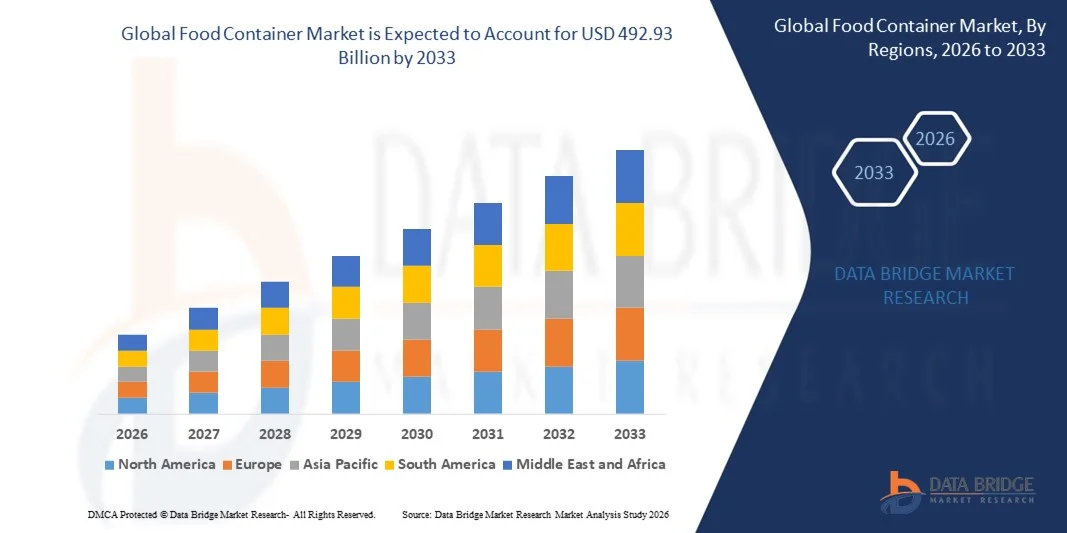
- As per Data Bridge Market Research Analysis the global food container market size was valued at USD 346.62 billion in 2025 and is expected to reach USD 492.93 billion by 2033, at a CAGR of 4.50% during the forecast period
- The market growth is largely fuelled by the increasing demand for convenient food packaging solutions across households, restaurants, and food delivery services
- Rising consumption of ready-to-eat and takeaway food products along with the expansion of online food delivery platforms is further supporting market growth
Market Size & Forecast
- Global Market Value (2025): USD 346.62 billion in 2025
- Expected Market Value (2033): USD 492.93 billion by 2033
- Forecast CAGR (2026–2033): 4.50%
Food Container Market Analysis
- The market is witnessing steady growth due to the increasing need for safe, durable, and portable packaging solutions that help preserve food quality and prevent contamination during storage and transportation
- Moreover, the rapid expansion of the food service industry, increasing urbanization, and rising preference for eco-friendly and reusable packaging solutions are contributing to the growing demand for food containers across residential and commercial applications
- North America dominated the food container market with the largest revenue share of 38.75% in 2025, driven by rising demand for convenient and sustainable packaging solutions across foodservice and retail sectors
- Asia-Pacific region is expected to witness the highest growth rate in the global food container market, driven by increasing demand from emerging economies, rapid expansion of retail and foodservice sectors, and growing adoption of sustainable and innovative food packaging solutions
- The bottles segment held the largest market revenue share in 2025 driven by its extensive use in beverages, sauces, edible oils, and liquid food products. Bottles offer secure sealing, convenient handling, and effective protection against contamination, making them widely preferred by both manufacturers and consumers
Report Scope and Food Container Market Segmentation
|
Attributes |
Food Container Key Market Insights |
|
Segments Covered |
|
|
Countries Covered |
North America
Europe
Asia-Pacific
Middle East and Africa
South America
|
|
Key Market Players |
|
|
Market Opportunities |
|
|
Value Added Data Infosets |
In addition to the market insights such as market value, growth rate, market segments, geographical coverage, market players, and market scenario, the market report curated by the Data Bridge Market Research team includes in-depth expert analysis, import/export analysis, pricing analysis, production consumption analysis, and pestle analysis. |
What is the Food Container Market Size and Growth Rate?
Growing Demand for Convenient and Sustainable Food Packaging
- The increasing demand for convenient and reliable food packaging solutions is significantly shaping the food container market, as consumers and food service providers seek safe and practical storage options for prepared and takeaway meals. Food containers are widely used to maintain freshness, prevent contamination, and ensure easy transportation of food products, making them essential across restaurants, catering services, and household applications
- Rapid growth in online food delivery platforms and takeaway services has accelerated the demand for durable and portable food containers. Restaurants and cloud kitchens require packaging solutions that maintain food quality and temperature during transit while offering leak-proof and lightweight designs. This trend is encouraging manufacturers to develop innovative container designs that improve functionality and user convenience
- Sustainability trends are also influencing the market, with increasing emphasis on biodegradable, recyclable, and reusable packaging materials. Consumers and regulatory authorities are encouraging the adoption of environmentally friendly food containers made from paper-based materials, compostable plastics, and other sustainable alternatives. These developments are pushing manufacturers to adopt eco-conscious production practices and reduce reliance on traditional single-use plastics
- For instance, in 2024, companies such as Amcor in Switzerland and Tetra Pak in Sweden introduced sustainable food packaging solutions designed to improve recyclability and reduce environmental impact. These innovations were widely adopted by food service companies and retailers seeking environmentally responsible packaging options while maintaining product safety and quality
- While demand for food containers continues to grow, sustained market expansion depends on improving material sustainability, enhancing durability, and maintaining cost-effective production. Manufacturers are focusing on research and development initiatives to create packaging solutions that balance functionality, environmental responsibility, and affordability for broader market adoption
Food Container Market Dynamics
Driver
Increasing Demand for Takeaway and Ready-To-Eat Food Packaging
- Rising consumer preference for convenience foods and takeaway meals is a major driver for the food container market. Urban lifestyles and busy work schedules have increased reliance on ready-to-eat and packaged meals, encouraging restaurants and food delivery platforms to adopt durable and secure packaging solutions. Food containers play a vital role in maintaining food hygiene, freshness, and portability
- Expanding food service industries, including quick-service restaurants, cafes, and cloud kitchens, are also contributing to market growth. These businesses require large quantities of packaging solutions to support daily operations and ensure efficient food delivery services. Food containers enable businesses to manage high volumes of orders while maintaining food quality and presentation
- Manufacturers are actively developing innovative container designs with improved sealing mechanisms, temperature retention, and lightweight materials. These innovations help businesses reduce packaging waste and improve the overall consumer experience. At the same time, companies are promoting sustainable materials to meet growing environmental concerns and regulatory requirements
- For instance, in 2023, companies such as Nestlé in Switzerland and PepsiCo in the U.S. increased the use of recyclable and reusable food containers across their ready-to-eat and takeaway product lines. These initiatives were introduced to improve sustainability and reduce packaging waste while maintaining product safety and shelf stability
- Although the increasing demand for takeaway food supports market growth, widespread adoption depends on cost-effective packaging materials, efficient supply chains, and compliance with environmental regulations. Continued innovation in sustainable packaging technology will be crucial for meeting the evolving requirements of the global food container market
Restraint/Challenge
Environmental Concerns And Regulatory Restrictions On Plastic Packaging
- Environmental concerns associated with plastic waste represent a major challenge for the food container market. Traditional plastic containers contribute significantly to environmental pollution and landfill accumulation, prompting governments and regulatory authorities to introduce stricter regulations on single-use plastic packaging
- Regulatory policies in several countries are encouraging the transition toward recyclable and biodegradable packaging materials. While these regulations support environmental sustainability, they also increase compliance costs for manufacturers and require significant investment in alternative materials and production processes
- Supply chain and material sourcing challenges can also impact the availability and cost of eco-friendly packaging solutions. Sustainable materials such as biodegradable plastics, molded fiber, and paper-based packaging often require specialized production techniques and raw materials, which can increase overall manufacturing costs
- For instance, in 2024, food service operators in countries such as Germany and Canada reported higher operational costs associated with switching from conventional plastic containers to biodegradable alternatives. Compliance with environmental regulations and the adoption of certified sustainable materials also increased procurement and production expenses for packaging suppliers
- Addressing these challenges will require innovation in sustainable materials, improved recycling infrastructure, and collaborative efforts between manufacturers, regulators, and food service companies. Developing cost-effective eco-friendly packaging solutions and expanding consumer awareness about sustainable food containers will be essential for long-term market growth.
Food Container Market Scope
The market is segmented on the basis of type, packaging, material, and application.
- By Type
On the basis of type, the food container market is segmented into Bottles, Jars, Cans, Boxes, Cups, and Tubs. The bottles segment held the largest market revenue share in 2025 driven by its extensive use in beverages, sauces, edible oils, and liquid food products. Bottles offer secure sealing, convenient handling, and effective protection against contamination, making them widely preferred by both manufacturers and consumers.
The cups segment is expected to witness the fastest growth rate from 2026 to 2033, driven by the rising consumption of ready-to-eat foods, desserts, and dairy-based products. Cups are commonly used for packaging items such as yogurt, ice cream, and instant meals, offering convenience and portion control. Increasing demand for takeaway food and on-the-go consumption is further supporting the growth of this segment.
- By Packaging
On the basis of packaging, the food container market is segmented into Flexible Packaging and Rigid Packaging. The rigid packaging segment accounted for the largest market revenue share in 2025 due to its durability, strength, and ability to provide enhanced protection for food products during storage and transportation. Rigid containers are widely used across packaged foods, beverages, and processed food products as they help maintain product integrity and shelf stability.
The flexible packaging segment is expected to witness the fastest growth rate from 2026 to 2033, driven by its lightweight structure, cost efficiency, and reduced material usage. Flexible packaging solutions are increasingly adopted for snacks, processed foods, and ready-to-eat meals as they offer convenience, easy storage, and improved transportation efficiency.
- By Material
On the basis of material, the food container market is segmented into Paperboard, Plastic, Metal, and Glass. The plastic segment held the largest market revenue share in 2025 driven by its versatility, lightweight properties, and cost effectiveness. Plastic containers are widely used across food packaging applications due to their durability, moisture resistance, and ability to be molded into various shapes and sizes.
The paperboard segment is expected to witness the fastest growth rate from 2026 to 2033 due to the increasing demand for sustainable and recyclable packaging materials. Paperboard containers are gaining popularity as environmentally friendly alternatives to plastic packaging, supported by regulatory initiatives and rising consumer awareness regarding eco-friendly packaging solutions.
- By Application
On the basis of application, the food container market is segmented into Grain Mill Products, Dairy Goods, Fruits and Vegetables, Bakery Products, Meat Processed Products, and Others. The dairy goods segment held the largest market revenue share in 2025 driven by the high consumption of packaged milk, yogurt, cheese, and other dairy-based products. Food containers play a critical role in maintaining freshness, hygiene, and shelf life for dairy items.
The bakery products segment is expected to witness the fastest growth rate from 2026 to 2033, driven by increasing consumption of packaged breads, cakes, pastries, and snacks. Rising demand for convenient and ready-to-eat bakery products, combined with the growth of retail bakeries and online food delivery services, is further boosting the demand for specialized food containers in this segment.
Food Container Market Regional Analysis
- North America dominated the food container market with the largest revenue share of 38.75% in 2025, driven by rising demand for convenient and sustainable packaging solutions across foodservice and retail sectors
- Consumers in the region highly value the durability, versatility, and eco-friendly attributes offered by modern food containers, which support portion control, storage efficiency, and longer shelf life
- This widespread adoption is further supported by high disposable incomes, busy lifestyles, and growing awareness of food safety and hygiene standards, establishing food containers as essential for both commercial and household use
U.S. Food Container Market Insight
The U.S. food container market captured the largest revenue share in 2025 within North America, fueled by increasing demand for ready-to-eat meals, takeout, and delivery services. Consumers and foodservice operators are prioritizing containers that ensure freshness, convenience, and compliance with safety regulations. The adoption of innovative packaging solutions, including reusable and recyclable containers, is further boosting market growth. Moreover, integration of sustainable materials and advanced designs is helping brands reduce environmental impact while meeting consumer expectations.
Europe Food Container Market Insight
The Europe food container market is expected to witness the fastest growth rate from 2026 to 2033, driven by stringent food safety regulations, rising environmental awareness, and the adoption of sustainable packaging solutions. European consumers are increasingly seeking eco-friendly and recyclable containers, encouraging manufacturers to innovate with biodegradable materials and lightweight designs. The growth is significant across restaurants, grocery stores, and home usage, with containers being incorporated in both foodservice operations and retail packaging.
U.K. Food Container Market Insight
The U.K. food container market is expected to witness the fastest growth rate from 2026 to 2033, fueled by increasing demand for convenience foods, meal delivery services, and sustainable packaging. Consumers are emphasizing hygiene, durability, and reusability in containers, while retailers and restaurants are prioritizing solutions that reduce plastic waste and improve operational efficiency. The U.K.’s advanced retail infrastructure and e-commerce growth are supporting the widespread adoption of innovative food container options.
Germany Food Container Market Insight
The Germany food container market is expected to witness the fastest growth rate from 2026 to 2033, driven by rising awareness of sustainable packaging and the demand for reusable and recyclable materials. Germany’s strong foodservice and retail sectors, combined with consumer preference for eco-conscious solutions, promote the adoption of food containers made from paperboard, glass, and metal. Manufacturers are increasingly focusing on innovative designs that enhance durability, portability, and product presentation, aligning with local environmental and quality standards.
Asia-Pacific Food Container Market Insight
The Asia-Pacific food container market is expected to witness the fastest growth rate from 2026 to 2033, driven by rapid urbanization, rising disposable incomes, and increasing demand for packaged and takeaway foods in countries such as China, Japan, and India. The region’s growing foodservice industry, coupled with government initiatives promoting sustainable packaging, is accelerating adoption. Moreover, APAC is emerging as a major production hub for innovative containers, making eco-friendly and affordable options more accessible to consumers.
Japan Food Container Market Insight
The Japan food container market is expected to witness the fastest growth rate from 2026 to 2033, due to the country’s high demand for convenience, safety, and hygiene in food storage and packaging. Japanese consumers emphasize compact, durable, and environmentally responsible containers, driving manufacturers to innovate with reusable and lightweight solutions. The integration of containers with bento-style meals, home storage, and meal delivery services further fuels market growth
China Food Container Market Insight
The China food container market accounted for the largest market revenue share in Asia-Pacific in 2025, attributed to the country’s expanding middle class, rapid urbanization, and increasing consumption of ready-to-eat and takeaway foods. China’s push towards modern retail, e-commerce, and sustainable packaging solutions is promoting widespread adoption of containers made from recyclable, biodegradable, and high-performance materials. Strong domestic manufacturing capabilities are enabling affordable, innovative options for both commercial and household use
Which are the Top Companies in Food Container Market?
The Food Container industry is primarily led by well-established companies, including:
- Bemis Manufacturing Company (U.S.)
- Amcor plc (U.K.)
- BALL CORPORATION (U.S.)
- Crown (U.S.)
- Silgan Holdings Inc (U.S.)
- Anchor Glass Container Corporation (U.S.)
- PLASTIPAK HOLDINGS INC. (U.S.)
- DS Smith (U.K.)
- Mondi Group (U.K.)
- Sealed Air (U.S.)
- Rio Tinto (U.K.)
- Sonoco Products Company (U.S.)
- Printpack (U.S.)
- Rdagh Group S.A (U.K.)
- Graham Packaging Company (U.S.)
- Consolidated Container Company (U.S.)
- Weener (U.K.)
Latest Developments in Global Food Container Market
- In October 2024, Tupperware Brands Corporation announced a restructuring agreement with a consortium of lenders, forming The New Tupperware Company. The initiative aims to adopt a start-up methodology with agile operations, enabling iterative product development and faster market responsiveness. It is expected to improve operational efficiency, reduce costs, and enhance competitiveness in the global food container market. The restructuring will also allow Tupperware to focus on innovation and customer-centric product lines.
- In June 2024, Sonoco Products Company completed the acquisition of Eviosys for approximately USD 3.9 billion. This strategic move strengthens Sonoco’s core business in sustainable metal packaging and expands its product portfolio for food, consumer goods, and promotional sectors. The acquisition enhances Sonoco’s global footprint, accelerates its innovation capabilities, and supports the shift toward environmentally responsible packaging solutions. It is expected to boost market share and profitability in premium packaging segments.
- In December 2023, Novolex launched a new range of recyclable food packaging containers made with a minimum of 10% post-consumer recycled content. The product line includes tamper-evident containers, dessert cups, cake boxes, and bakery clamshells. This launch addresses increasing consumer demand for sustainable and eco-friendly packaging solutions while complying with environmental regulations. It strengthens Novolex’s presence in retail and foodservice sectors and promotes brand differentiation through sustainability.
- In February 2023, Chuk, an initiative of Yash Pakka, introduced 100% compostable food delivery containers made from bagasse. The containers are designed to replace single-use plastics and reduce environmental impact in the foodservice industry. This development supports global sustainability trends and aligns with the rising consumer preference for eco-conscious packaging. It also enables restaurants and delivery platforms to meet regulatory and market demands for biodegradable solutions.
- In October 2022, Molded Fiber Glass Tray Company (MFG Tray) acquired product line tooling from Orbis Corporation. This acquisition expands production capabilities, allowing the company to offer a wider range of industrial and food-grade containers. The move supports growing market demand for durable and versatile packaging solutions. It also enhances MFG Tray’s operational efficiency, enabling faster turnaround for customized orders and boosting competitiveness in North America.
- In May 2021, Berry Global launched the CombiLight pot, a lightweight circular food container reducing plastic content by 60% compared to traditional containers. The product meets consumer demand for sustainable, strong, and cost-effective packaging solutions. It supports circular economy principles, reduces environmental impact, and provides food manufacturers with high-performance, eco-friendly options. The innovation strengthens Berry Global’s market position and encourages adoption across retail and foodservice applications

- Interactive Data Analysis Dashboard
- Company Analysis Dashboard for high growth potential opportunities
- Research Analyst Access for customization & queries
- Competitor Analysis with Interactive dashboard
- Latest News, Updates & Trend analysis
- Harness the Power of Benchmark Analysis for Comprehensive Competitor Tracking
Data collection and base year analysis are done using data collection modules with large sample sizes. The stage includes obtaining market information or related data through various sources and strategies. It includes examining and planning all the data acquired from the past in advance. It likewise envelops the examination of information inconsistencies seen across different information sources. The market data is analysed and estimated using market statistical and coherent models. Also, market share analysis and key trend analysis are the major success factors in the market report. To know more, please request an analyst call or drop down your inquiry.
The key research methodology used by DBMR research team is data triangulation which involves data mining, analysis of the impact of data variables on the market and primary (industry expert) validation. Data models include Vendor Positioning Grid, Market Time Line Analysis, Market Overview and Guide, Company Positioning Grid, Patent Analysis, Pricing Analysis, Company Market Share Analysis, Standards of Measurement, Global versus Regional and Vendor Share Analysis. To know more about the research methodology, drop in an inquiry to speak to our industry experts.
Data Bridge Market Research is a leader in advanced formative research. We take pride in servicing our existing and new customers with data and analysis that match and suits their goal. The report can be customized to include price trend analysis of target brands understanding the market for additional countries (ask for the list of countries), clinical trial results data, literature review, refurbished market and product base analysis. Market analysis of target competitors can be analyzed from technology-based analysis to market portfolio strategies. We can add as many competitors that you require data about in the format and data style you are looking for. Our team of analysts can also provide you data in crude raw excel files pivot tables (Fact book) or can assist you in creating presentations from the data sets available in the report.













