

Global Food Dehydrator Market
Market Size in USD Billion
CAGR :
% 
 USD
1.75 Billion
USD
2.77 Billion
2025
2033
USD
1.75 Billion
USD
2.77 Billion
2025
2033
 Forecast Period Forecast Period |
2026 –2033 |
 Market Size (Base Year) Market Size (Base Year) |
USD 1.75 Billion |
 Market Size (Forecast Year) Market Size (Forecast Year) |
USD 2.77 Billion |
 CAGR CAGR |
% |
| Major Markets Players |
|
What is the Global Food Dehydrator Market Size and Growth Rate?
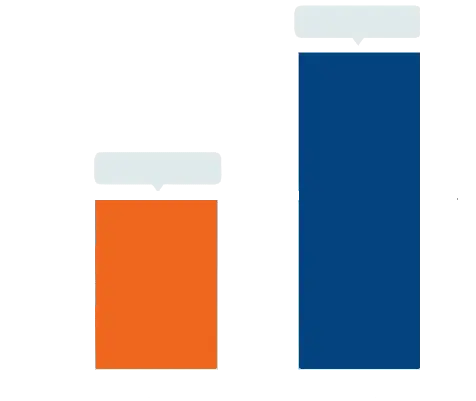
- The global food dehydrator market size was valued at USD 1.75 billion in 2025 and is expected to reach USD 2.77 billion by 2033, at a CAGR of 5.92% during the forecast period
- Rising availability of convenience food items and surge in the awareness in regards to the food wastage are the major factors fostering the growth of the market
- Changing and evolving lifestyle, growth in the penetration of e-commerce platforms especially in the developing economies, growth and expansion of food processing industry and rising initiatives by the government to reduce the wastage of food are other important factors acting as market growth determinants
What are the Major Takeaways of Food Dehydrator Market?
- Increased focus of the manufacturers on upgrading the technology involved in manufacturing food dehydrators and surging improvement in the packaging technology will further induce growth in the market value
- However, fluctuations in the prices of raw materials used for packaging will pose a major challenge to the growth of the market. Lack of awareness and resources in the underdeveloped economies will also hamper the market growth rate
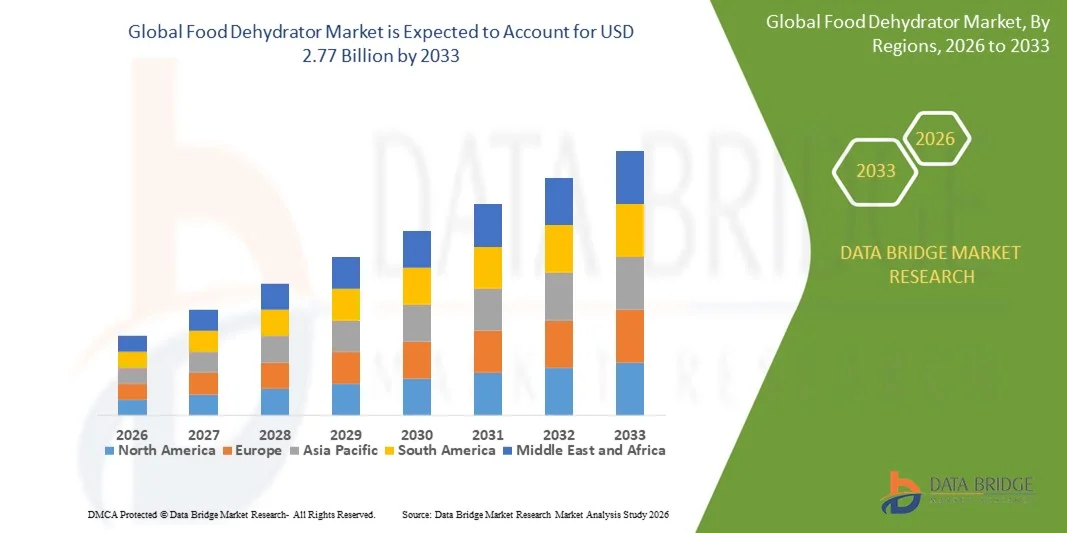
- Europe dominated the Food Dehydrator market with a 43.2% revenue share in 2025, driven by strong adoption of advanced kitchen appliances, growing health and wellness awareness, and rapid modernization of the food processing and hospitality sectors across Germany, France, the U.K., Italy, and Spain
- Asia-Pacific is projected to register the fastest CAGR of 11.2% from 2026 to 2033, driven by rapid urbanization, growing middle-class population, increasing health-conscious consumers, and expanding food processing and nutraceutical industries across China, India, Japan, South Korea, and Southeast Asia
- The Stackable Food Dehydrators segment dominated the market with a 41.2% share in 2025, driven by their space-saving design, modular tray systems, and ease of handling for home and commercial users
Report Scope and Food Dehydrator Market Segmentation
|
Attributes |
Food Dehydrator Key Market Insights |
|
Segments Covered |
|
|
Countries Covered |
North America
Europe
Asia-Pacific
Middle East and Africa
South America
|
|
Key Market Players |
|
|
Market Opportunities |
|
|
Value Added Data Infosets |
In addition to the insights on market scenarios such as market value, growth rate, segmentation, geographical coverage, and major players, the market reports curated by the Data Bridge Market Research also include in-depth expert analysis, pricing analysis, brand share analysis, consumer survey, demography analysis, supply chain analysis, value chain analysis, raw material/consumables overview, vendor selection criteria, PESTLE Analysis, Porter Analysis, and regulatory framework. |
What is the Key Trend in the Food Dehydrator Market?
Increasing Shift Toward Smart, Energy-Efficient, and Multi-Functional Food Dehydrators
- The food dehydrator market is witnessing strong adoption of smart, digitally controlled dehydrators equipped with precise temperature control, programmable timers, and uniform airflow systems to ensure consistent drying performance
- Manufacturers are introducing stackable tray systems, stainless-steel chamber designs, horizontal airflow technology, and noise-reduction features to enhance durability, hygiene, and operational efficiency
- Growing demand for compact, countertop, and home-use dehydrators is increasing due to rising interest in healthy snacking, food preservation, and clean-label homemade products
- For instance, companies such as Hamilton Beach Brands, Inc., National Presto Industries, Inc., LEM Products, STX International, and Aroma Housewares Company are expanding their product portfolios with upgraded digital displays, automatic shut-off systems, and higher-capacity tray configurations
- Increasing consumer focus on reducing food waste and preserving seasonal fruits, vegetables, herbs, and meats is accelerating household adoption
- As demand for natural snacks and long-shelf-life foods rises globally, Food Dehydrators will remain essential for efficient home and commercial food preservation solutions
What are the Key Drivers of Food Dehydrator Market?
- Rising consumer awareness regarding healthy eating habits and preservative-free snacks is driving demand for home-based food drying solutions
- For instance, in 2025, several leading kitchen appliance brands introduced energy-efficient dehydrators with digital control panels and enhanced airflow systems to attract health-conscious consumers
- Growing popularity of plant-based diets, jerky products, dried fruits, and herbal supplements is boosting product adoption across households and small food businesses
- Expansion of e-commerce platforms and direct-to-consumer sales channels has improved product accessibility globally
- Increasing demand from small-scale food processors and specialty snack manufacturers is strengthening commercial adoption
- Supported by innovation in heating elements, airflow distribution, and energy-saving technologies, the Food Dehydrator market is expected to witness steady long-term growth
Which Factor is Challenging the Growth of the Food Dehydrator Market?
- High upfront costs of premium stainless-steel and large-capacity dehydrators limit adoption among price-sensitive consumers
- For instance, during 2024–2025, fluctuations in raw material prices and electronic component costs increased manufacturing expenses for appliance producers
- Energy consumption concerns and longer drying times may discourage usage in regions with high electricity tariffs
- Limited awareness in developing markets regarding the benefits of food dehydration slows penetration rates
- Competition from alternative preservation methods such as freezing, vacuum sealing, and ready-to-eat packaged snacks creates pricing pressure
- To address these challenges, companies are focusing on compact designs, energy-efficient systems, competitive pricing strategies, and consumer education initiatives to expand global adoption of food dehydrators
How is the Food Dehydrator Market Segmented?
The market is segmented on the basis of type, technology, source, and end user.
- By Type
On the basis of type, the food dehydrator market is segmented into Stackable Food Dehydrators, Shelf Food Dehydrators, and Others. The Stackable Food Dehydrators segment dominated the market with a 41.2% share in 2025, driven by their space-saving design, modular tray systems, and ease of handling for home and commercial users. These dehydrators provide uniform airflow, support multi-level drying, and are widely preferred for small-scale food processing, herbal drying, and snack preparation. Their versatility, reliability, and compatibility with digital temperature controls ensure strong adoption across households, small food businesses, and specialty product manufacturers.
The Others segment, including compact or countertop variants, is expected to grow at the fastest CAGR from 2026 to 2033, fueled by increasing demand for portable, energy-efficient, and multifunctional dehydrators suitable for limited-space environments and urban households. Continuous innovation in tray materials, airflow systems, and heating mechanisms is further driving adoption globally.
- By Technology
On the basis of technology, the food dehydrator market is segmented into Electricity, Biofuel, Solar, and Others. The Electricity-powered segment dominated the market with a 52.7% share in 2025, supported by consistent heating, programmable temperature controls, and easy integration with modern digital timers and airflow systems. Electric dehydrators are widely used in households, commercial kitchens, and small-scale food processing units due to reliability, rapid drying times, and low maintenance.
The Solar-powered segment is projected to grow at the fastest CAGR from 2026 to 2033, driven by the rising focus on sustainable, off-grid, and energy-efficient solutions for eco-conscious consumers, remote locations, and developing regions. Government incentives for renewable energy appliances and growing interest in environmentally friendly food preservation solutions are expected to accelerate adoption. Innovations in solar panel efficiency, thermal insulation, and hybrid systems further support market expansion.
- By Source
On the basis of source, the market is categorized into Electricity, Biofuel, Solar, and Others. The Electricity segment dominated the market with a 50.8% share in 2025, owing to high availability, ease of installation, and compatibility with smart household appliances. These dehydrators ensure precise temperature control, uniform drying, and adaptability for fruits, vegetables, meats, and herbs.
The Biofuel segment is anticipated to grow at the fastest CAGR from 2026 to 2033, driven by sustainability initiatives, growing off-grid applications, and rising energy costs. Small-scale food manufacturers and rural users prefer biofuel dehydrators for efficient operation without reliance on electricity. Advancements in hybrid energy systems, improved fuel efficiency, and cost-effective designs further support the adoption of alternative source dehydrators in emerging markets.
- By End User Industry
On the basis of end-user industry, the food dehydrator market is segmented into Food & Beverage Industry, Nutraceutical Industry, Herbal Products Industry, Hotels, Restaurants & Catering (HoReCa) Sector, Domestic Sector, and Others. The Food & Beverage Industry dominated the market with a 38.9% share in 2025, driven by extensive use in snack production, dried fruit and vegetable processing, and specialty food preparation. These users rely on high-capacity, durable, and temperature-precise dehydrators to maintain product quality, extend shelf life, and meet regulatory standards.
The Domestic Sector is expected to grow at the fastest CAGR from 2026 to 2033, fueled by rising health consciousness, preference for homemade preservative-free snacks, and increased availability of compact, energy-efficient household dehydrators. Continuous innovation in smart controls, low-noise operation, and multifunctional tray designs is further boosting market penetration in residential applications.
Which Region Holds the Largest Share of the Food Dehydrator Market?
- Europe dominated the Food Dehydrator market with a 43.2% revenue share in 2025, driven by strong adoption of advanced kitchen appliances, growing health and wellness awareness, and rapid modernization of the food processing and hospitality sectors across Germany, France, the U.K., Italy, and Spain
- High penetration of compact and energy-efficient dehydrators in commercial kitchens, nutraceutical production, and herbal product processing continues to support market dominance
- Leading manufacturers in Europe are introducing smart, IoT-enabled dehydrators, multi-tray designs, and energy-optimized units, strengthening the region’s technological edge. Continuous investment in R&D, premium kitchen appliance innovation, and regulatory focus on food safety further reinforce market leadership
Germany Food Dehydrator Market Insight
Germany is the largest contributor in Europe, supported by high consumer awareness of health-oriented appliances, extensive use of dehydrators in commercial food processing, and strong distribution networks. Adoption of stackable and shelf dehydrators for fruit, vegetable, and meat drying is widespread. Presence of major appliance manufacturers and focus on sustainability drives continued growth.
France Food Dehydrator Market Insight
France contributes significantly due to growing domestic demand for natural, preservative-free foods and nutraceutical products. Premium appliances with advanced temperature control, low energy consumption, and versatile drying functions are increasingly used in households and small-scale production units.
Asia-Pacific Food Dehydrator Market
Asia-Pacific is projected to register the fastest CAGR of 11.2% from 2026 to 2033, driven by rapid urbanization, growing middle-class population, increasing health-conscious consumers, and expanding food processing and nutraceutical industries across China, India, Japan, South Korea, and Southeast Asia. High-volume production of dehydrators, affordable appliance pricing, and rising penetration of energy-efficient and compact appliances are accelerating market growth. Manufacturers are focusing on electric, solar, and biofuel-powered dehydrators to meet diverse consumer needs.
China Food Dehydrator Market Insight
China is the largest contributor to Asia-Pacific due to high domestic demand for household and commercial dehydrators, strong manufacturing capacity, and competitive pricing. Rapid expansion of small-scale food processing units, herbal product manufacturing, and nutraceutical businesses drives market adoption.
India Food Dehydrator Market Insight
India is emerging as a major growth hub, supported by rising health awareness, government-backed initiatives for food processing, and growing HoReCa sector demand. Compact and energy-efficient dehydrators are increasingly preferred for domestic and commercial use.
Japan and South Korea Food Dehydrator Market Insight
These countries contribute significantly due to high adoption of advanced kitchen appliances, strong R&D in energy-efficient technologies, and rising demand from hotels, restaurants, and nutraceutical industries. Innovative features such as smart control, multi-tray systems, and solar-assisted models are strengthening market growth.
Southeast Asia Food Dehydrator Market Insight
Southeast Asia shows promising growth driven by urbanization, increasing disposable income, and expanding domestic food processing industries. Affordable and compact dehydrators for small businesses and home use are driving adoption across the region.
Which are the Top Companies in Food Dehydrator Market?
The food dehydrator industry is primarily led by well-established companies, including:
- Hamilton Beach Brands, Inc. (U.S.)
- National Presto Industries, Inc. (U.S.)
- LEM Products (U.S.)
- Aroma Housewares Company (U.S.)
- STX International (U.S.)
- Tribest (U.S.)
- Koolatron US (U.S.)
- Excalibur Dehydrator (U.S.)
- The Sausage Maker Inc. (U.S.)
- NutriChef Kitchen, LLC. (U.S.)
- Buffalo (U.S.)
- Avantco Equipment (U.S.)
- Vitality 4 Life USA LLC. (U.S.)
- Guangdong Weierxin Industrial Co., Ltd. (China)
- Kerone Engineering Solutions LTD. (India)
- Weston Brands LLC. (U.S.)
- Salton Corp. (U.S.)
- tsmproducts (U.S.)
- RONCO Kitchen Accessories (U.S.)
- Samma Service (U.S.)
What are the Recent Developments in Global Food Dehydrator Market?
- In December 2022, the Food Drying Co. announced the launch of its new drying hub network in New Zealand, providing services for both animal and human food processors and featuring premium-grade capabilities through leasing agreements, reflecting the company’s strategic expansion plans and commitment to supporting food processing industries
- In December 2022, JUA Technologies International (JTI), an India-based agriculture technology startup, announced receiving a 2-year funding grant from the U.S. Department of Agriculture, which will be used to develop multipurpose dehydration technology powered by solar energy, signaling innovation in sustainable food drying solutions
- In September 2021, BioChef launched the BioChef Savana Dehydrator Pro, a commercial-grade dehydrator featuring 10 stainless steel trays, a rear-mounted fan, and a digital controller with preset temperature and timer settings, highlighting the company’s focus on efficient and versatile drying solutions for commercial users
- In August 2021, Nesco introduced the FD-2000 Digital Square Dehydrator, a commercial-grade appliance with a 4.5-square-foot drying area and a digital controller with programmable temperature and timer settings, marking a significant step in enhancing precision and convenience for food processing
SKU-
Get online access to the report on the World's First Market Intelligence Cloud

- Interactive Data Analysis Dashboard
- Company Analysis Dashboard for high growth potential opportunities
- Research Analyst Access for customization & queries
- Competitor Analysis with Interactive dashboard
- Latest News, Updates & Trend analysis
- Harness the Power of Benchmark Analysis for Comprehensive Competitor Tracking
Global Food Dehydrator Market, Supply Chain Analysis and Ecosystem Framework
To support market growth and help clients navigate the impact of geopolitical shifts, DBMR has integrated in-depth supply chain analysis into its Global Food Dehydrator Market research reports. This addition empowers clients to respond effectively to global changes affecting their industries. The supply chain analysis section includes detailed insights such as Global Food Dehydrator Market consumption and production by country, price trend analysis, the impact of tariffs and geopolitical developments, and import and export trends by country and HSN code. It also highlights major suppliers with data on production capacity and company profiles, as well as key importers and exporters. In addition to research, DBMR offers specialized supply chain consulting services backed by over a decade of experience, providing solutions like supplier discovery, supplier risk assessment, price trend analysis, impact evaluation of inflation and trade route changes, and comprehensive market trend analysis.
Research Methodology
Data collection and base year analysis are done using data collection modules with large sample sizes. The stage includes obtaining market information or related data through various sources and strategies. It includes examining and planning all the data acquired from the past in advance. It likewise envelops the examination of information inconsistencies seen across different information sources. The market data is analysed and estimated using market statistical and coherent models. Also, market share analysis and key trend analysis are the major success factors in the market report. To know more, please request an analyst call or drop down your inquiry.
The key research methodology used by DBMR research team is data triangulation which involves data mining, analysis of the impact of data variables on the market and primary (industry expert) validation. Data models include Vendor Positioning Grid, Market Time Line Analysis, Market Overview and Guide, Company Positioning Grid, Patent Analysis, Pricing Analysis, Company Market Share Analysis, Standards of Measurement, Global versus Regional and Vendor Share Analysis. To know more about the research methodology, drop in an inquiry to speak to our industry experts.
Customization Available
Data Bridge Market Research is a leader in advanced formative research. We take pride in servicing our existing and new customers with data and analysis that match and suits their goal. The report can be customized to include price trend analysis of target brands understanding the market for additional countries (ask for the list of countries), clinical trial results data, literature review, refurbished market and product base analysis. Market analysis of target competitors can be analyzed from technology-based analysis to market portfolio strategies. We can add as many competitors that you require data about in the format and data style you are looking for. Our team of analysts can also provide you data in crude raw excel files pivot tables (Fact book) or can assist you in creating presentations from the data sets available in the report.