




Global Food Enzymes Market
Market Size in USD Billion
CAGR :
% 
 USD
4.01 Billion
USD
7.22 Billion
2025
2033
USD
4.01 Billion
USD
7.22 Billion
2025
2033
 Forecast Period Forecast Period |
2026 –2033 |
 Market Size (Base Year) Market Size (Base Year) |
USD 4.01 Billion |
 Market Size (Forecast Year) Market Size (Forecast Year) |
USD 7.22 Billion |
 CAGR CAGR |
% |
| Major Markets Players |
|
Food Enzymes Market Size
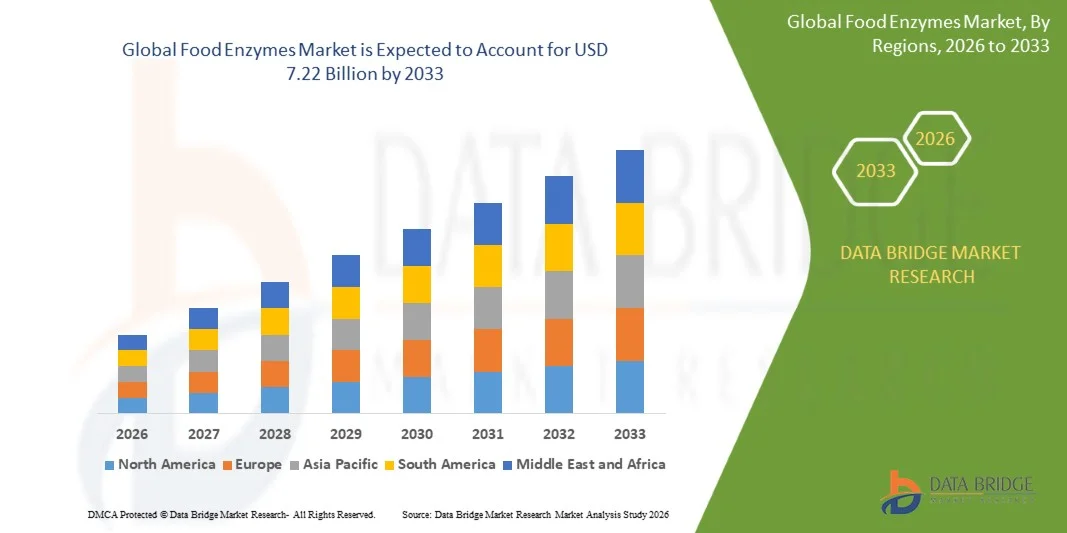
- The global food enzymes market size was valued at USD 4.01 billion in 2025 and is expected to reach USD 7.22 billion by 2033, at a CAGR of 7.64% during the forecast period
- The market growth is largely fueled by the rising demand for processed, packaged, and convenience foods, which is increasing the need for efficient food processing solutions that improve yield, texture, and shelf life
- Furthermore, growing consumer preference for clean-label, natural, and additive-free food products is accelerating the shift from chemical additives to enzyme-based alternatives, strengthening market adoption across food manufacturing industries
Food Enzymes Market Analysis
- Food enzymes are biological catalysts used in food processing to improve product quality, enhance nutritional value, and optimize production efficiency in applications such as bakery, dairy, beverages, and meat processing
- The escalating demand for food enzymes is primarily driven by advancements in biotechnology, expanding food and beverage production, and increasing focus on sustainable and cost-effective food processing solutions
- North America dominated the food enzymes market with a share of 33.8% in 2025, due to strong demand from processed food, beverage, bakery, and dairy industries along with rising preference for clean label ingredients
- Asia-Pacific is expected to be the fastest growing region in the food enzymes market during the forecast period due to rapid urbanization, rising disposable incomes, and increasing consumption of processed foods in countries such as China, India, and Japan
- Microorganisms segment dominated the market with a market share of 62.5% in 2025, due to its high efficiency in large-scale enzyme production and cost-effective fermentation processes. Enzymes derived from bacteria, yeast, and fungi are widely used in industrial food processing such as baking, brewing, and dairy applications. Strong scalability and consistent enzyme yield further strengthen its leading position in the market
Report Scope and Food Enzymes Market Segmentation
|
Attributes |
Food Enzymes Key Market Insights |
|
Segments Covered |
|
|
Countries Covered |
North America
Europe
Asia-Pacific
Middle East and Africa
South America
|
|
Key Market Players |
|
|
Market Opportunities |
|
|
Value Added Data Infosets |
In addition to the insights on market scenarios such as market value, growth rate, segmentation, geographical coverage, and major players, the market reports curated by the Data Bridge Market Research also include in-depth expert analysis, pricing analysis, brand share analysis, consumer survey, demography analysis, supply chain analysis, value chain analysis, raw material/consumables overview, vendor selection criteria, PESTLE Analysis, Porter Analysis, and regulatory framework. |
Food Enzymes Market Trends
“Increasing Adoption of Clean-Label and Natural Food Ingredients”
- A significant trend in the food enzymes market is the increasing shift toward clean-label and natural ingredient formulations, driven by rising consumer awareness regarding food safety, transparency, and health-focused diets. Food manufacturers are increasingly replacing synthetic additives with enzyme-based solutions to meet evolving regulatory expectations and consumer preferences for minimally processed foods
- For instance, Novonesis and Kerry Group supply enzyme-based solutions that support clean-label bakery, dairy, and beverage applications, enabling manufacturers to improve product quality without artificial additives. Such enzyme systems help maintain texture, freshness, and processing efficiency while aligning with natural ingredient positioning
- The adoption of food enzymes is expanding across bakery and dairy processing, where enzymes such as amylases, proteases, and lipases are used to improve dough stability, protein modification, and flavor development. This is supporting product innovation in healthier and more natural food formulations across global markets
- Food manufacturers are increasingly integrating enzyme-based processing solutions to reduce reliance on chemical preservatives and improve nutritional profiles of finished products. This transition is strengthening the role of enzymes in modern food production systems focused on clean-label positioning
- The trend is further reinforced by regulatory support for natural food additives in regions such as Europe and North America, where food safety standards encourage reduced chemical usage. This is accelerating adoption of enzyme technologies across large-scale food processing industries
- The growing consumer preference for transparency in ingredient sourcing continues to reinforce demand for enzyme-based solutions, positioning food enzymes as key enablers of clean-label transformation across the global food and beverage industry
Food Enzymes Market Dynamics
Driver
“Rising Demand for Processed and Convenience Foods Driving Enzyme Utilization”
- The rising consumption of processed and convenience foods is a key driver of the food enzymes market, as manufacturers increasingly rely on enzymes to enhance production efficiency, improve texture, and extend shelf life. Urbanization, changing lifestyles, and increasing disposable incomes are accelerating demand for ready-to-eat and packaged food products globally
- For instance, companies such as Novozymes (Novonesis) and Amano Enzyme Co. Ltd. provide specialized enzyme solutions used in large-scale bakery and beverage production to improve consistency, fermentation, and product stability. These enzymes help manufacturers maintain quality while optimizing production costs and processing time
- The expansion of bakery, dairy, and beverage industries is increasing the use of enzymes such as amylases, lactases, and proteases to improve product yield and processing efficiency. This supports large-scale food production systems that require consistent quality and high throughput
- Food service and retail sectors are also contributing to enzyme demand as manufacturers focus on standardized, long-shelf-life products that meet global distribution requirements. Enzymes play a critical role in maintaining freshness and reducing food waste during supply chain distribution
- The continuous expansion of industrial food processing infrastructure across emerging and developed markets is reinforcing the need for enzyme-based solutions. This sustained demand is positioning food enzymes as essential components in modern food manufacturing systems
Restraint/Challenge
“High Production and Development Costs of Specialized Enzyme Formulations”
- The food enzymes market faces a key challenge due to the high costs associated with research, development, and production of specialized enzyme formulations, which require advanced biotechnology, fermentation systems, and controlled manufacturing environments. These requirements significantly increase operational complexity and capital investment for manufacturers
- For instance, companies such as DSM-Firmenich and BASF SE invest heavily in enzyme engineering and microbial strain development to produce high-performance food enzymes. These advanced R&D processes involve significant costs, long development cycles, and strict quality validation standards
- The production of enzymes requires precision fermentation technology and high-quality raw materials, which adds to manufacturing expenses and limits scalability for smaller producers. Maintaining consistent enzyme activity and stability further increases technical complexity in production
- Regulatory compliance requirements across regions such as Europe, the U.S., and Asia-Pacific also add cost burdens due to extensive testing, approval processes, and safety validations. These requirements extend time-to-market and increase overall development expenses
- The combination of high R&D investment, complex production processes, and regulatory barriers continues to challenge market expansion. This cost intensity remains a key restraint influencing adoption rates, particularly among small and mid-sized food manufacturers
Food Enzymes Market Scope
The market is segmented on the basis of source, form, type, and application.
• By Source
On the basis of source, the food enzymes market is segmented into microorganisms, plants, and animals. The microorganisms segment dominated the largest market revenue share of 62.5% in 2025 due to its high efficiency in large-scale enzyme production and cost-effective fermentation processes. Enzymes derived from bacteria, yeast, and fungi are widely used in industrial food processing such as baking, brewing, and dairy applications. Strong scalability and consistent enzyme yield further strengthen its leading position in the market. In addition, microorganisms enable controlled production of highly specific enzymes suitable for diverse food formulations.
The plants segment is anticipated to witness the fastest growth rate from 2026 to 2033 driven by rising demand for clean label and plant-derived food ingredients. Consumers are increasingly preferring natural enzyme sources extracted from fruits and plant tissues for food processing applications. For instance Novozymes is actively expanding plant-based enzyme development for clean label food solutions supporting sustainable production practices. Growing preference for non-animal and minimally processed ingredients is further accelerating adoption of plant-based enzymes across the food industry.
• By Form
On the basis of form, the food enzymes market is segmented into lyophilized powder, liquid, and others. The liquid segment dominated the largest market revenue share in 2025 driven by its easy solubility, faster reaction rates, and suitability for continuous industrial processing. Liquid enzymes are widely used in beverages, dairy, and bakery applications where uniform mixing and immediate activity are required. Manufacturers prefer liquid form due to simplified dosing and reduced processing time in large scale production systems. Strong compatibility with automated food processing lines further supports its dominant position.
The lyophilized powder segment is expected to witness the fastest growth from 2026 to 2033 due to its superior stability, longer shelf life, and reduced transportation costs. Powdered enzymes are increasingly preferred in regions with limited cold chain infrastructure and for export oriented supply chains. For instance DSM has developed freeze dried enzyme formulations to improve storage efficiency and global distribution flexibility. Rising demand for compact and stable enzyme formats in packaged food manufacturing is driving rapid adoption of lyophilized powder forms.
• By Type
On the basis of type, the food enzymes market is segmented into carbohydrase, protease, lipase, and others. The carbohydrase segment dominated the largest market revenue share in 2025 driven by extensive use in starch processing, baking, and beverage clarification applications. Carbohydrases such as amylase and cellulase play a key role in breaking down complex carbohydrates to improve texture, sweetness, and product stability. High demand from bakery and beverage industries supports continuous utilization of these enzymes at industrial scale. Their ability to enhance processing efficiency and yield further strengthens market dominance.
The protease segment is anticipated to witness the fastest growth from 2026 to 2033 driven by increasing demand for protein modification in dairy, meat processing, and nutritional food products. Proteases are widely used to improve digestibility, texture, and flavor development in protein rich foods. For instance Novozymes has introduced advanced protease solutions for improved meat tenderization and dairy processing efficiency. Rising consumer preference for high protein diets and functional foods is accelerating adoption of protease enzymes globally.
• By Application
On the basis of application, the food enzymes market is segmented into beverages, processed foods, dairy products, bakery products, confectionery products, and others. The beverages segment dominated the largest market revenue share in 2025 driven by extensive use of enzymes in juice clarification, brewing, and wine production. Enzymes help improve filtration, enhance flavor stability, and increase extraction efficiency in beverage manufacturing. Strong demand for fruit based and functional beverages further supports enzyme utilization in this segment. High adoption in large scale beverage production facilities reinforces its market leadership.
The dairy products segment is expected to witness the fastest growth from 2026 to 2033 due to rising demand for lactose free and high digestibility dairy products. Enzymes such as lactase are increasingly used to break down lactose and improve nutritional accessibility for consumers with intolerance. For instance Danisco has developed specialized enzyme systems for lactose free milk and yogurt production supporting expanding dairy innovation. Growing health awareness and demand for functional dairy foods are driving rapid adoption in this segment.
Food Enzymes Market Regional Analysis
- North America dominated the food enzymes market with the largest revenue share of 33.8% in 2025, driven by strong demand from processed food, beverage, bakery, and dairy industries along with rising preference for clean label ingredients
- Consumers in the region highly value improved shelf life, enhanced texture, and cost efficiency offered by food enzymes across diverse food processing applications
- This widespread adoption is further supported by advanced biotechnology capabilities, a well-established food processing industry, and high consumer spending power, strengthening enzyme usage in industrial food production
U.S. Food Enzymes Market Insight
The U.S. food enzymes market captured the largest revenue share in North America in 2025, driven by rapid expansion of bakery, dairy, and beverage manufacturing sectors. The shift toward clean label formulations is encouraging manufacturers to replace synthetic additives with enzyme-based solutions. Rising demand for processed and convenience foods is further accelerating enzyme adoption across large-scale food production facilities. Strong presence of major food technology companies and continuous innovation in enzyme engineering continue to support market growth.
Europe Food Enzymes Market Insight
The Europe food enzymes market is projected to expand at a notable CAGR during the forecast period, driven by stringent food safety regulations and increasing demand for natural and sustainable food ingredients. Consumers across the region are increasingly shifting toward clean label and minimally processed food products. The growing focus on reducing chemical additives in food processing is strengthening enzyme adoption in bakery, dairy, and brewing applications. The region also benefits from advanced food biotechnology infrastructure and strong regulatory support for enzyme-based solutions.
U.K. Food Enzymes Market Insight
The U.K. food enzymes market is anticipated to grow at a steady CAGR during the forecast period, driven by rising demand for convenience foods and expanding bakery and beverage industries. Increasing health awareness among consumers is encouraging food manufacturers to adopt enzyme-based processing solutions. The strong presence of retail and packaged food sectors is further supporting market expansion. The market continues to evolve with greater emphasis on product quality, efficiency, and natural ingredient formulations.
Germany Food Enzymes Market Insight
The Germany food enzymes market is expected to expand at a considerable CAGR during the forecast period, driven by strong demand for high-quality food processing and sustainable production practices. The country’s advanced biotechnology ecosystem supports continuous innovation in enzyme development and application. Food manufacturers are increasingly adopting enzymes to improve efficiency in baking, brewing, and dairy processing. Germany’s focus on sustainability and precision food manufacturing is further reinforcing enzyme integration in industrial food systems.
Asia-Pacific Food Enzymes Market Insight
The Asia-Pacific food enzymes market is poised to grow at the fastest CAGR during the forecast period, driven by rapid urbanization, rising disposable incomes, and increasing consumption of processed foods in countries such as China, India, and Japan. Expanding food and beverage manufacturing capacity is accelerating enzyme demand across the region. Government initiatives supporting food processing modernization are further boosting adoption. Growing affordability and availability of enzyme-based solutions are expanding their use across both large-scale and small-scale food producers.
Japan Food Enzymes Market Insight
The Japan food enzymes market is gaining momentum due to strong demand for high-quality, convenience-oriented food products and advanced food processing technologies. The country’s aging population is increasing the need for easily digestible and nutritionally optimized foods produced using enzyme applications. Food manufacturers are adopting enzymes to enhance texture, flavor, and shelf stability in processed foods. Integration of biotechnology in food innovation continues to support steady market growth across industrial applications.
China Food Enzymes Market Insight
The China food enzymes market accounted for the largest revenue share in Asia-Pacific in 2025, driven by rapid industrialization of the food sector, growing middle-class consumption, and strong expansion of packaged food and beverage industries. Rising demand for dairy, bakery, and protein-based products is increasing enzyme utilization in large-scale production. The country’s strong domestic manufacturing base supports cost-effective enzyme availability. Continued investment in food technology and processing modernization is further strengthening market expansion in China.
Food Enzymes Market Share
The food enzymes industry is primarily led by well-established companies, including:
- Sunson Industry Group Co., Ltd. (China)
- Aumenzymes (India)
- Associated British Foods plc. (U.K.)
- Kerry Group plc (Ireland)
- Brenntag SE (Germany)
- Advanced Enzyme Technologies (India)
- Amano Enzyme Co. Ltd. (Japan)
- Chr. Hansen Holdings A/S (Denmark)
- Novozymes (Denmark)
- DSM (Netherlands)
- BASF SE (Germany)
- DuPont (U.S.)
- Jiangsu Boli Bioproducts Co., Ltd. (China)
- Amway Corp. (U.S.)
- PURATOS (Belgium)
- Lumis Biotech Pvt. Ltd. (India)
- Lonza (Switzerland)
- F. Hoffmann-La Roche Ltd. (Switzerland)
- BioResource International, Inc. (U.S.)
Latest Developments in Global Food Enzymes Market
- In September 2025, Kemin Industries acquired CJ Youtell Biotech, the enzymes and fermentation subsidiary of CJ Bio, marking a significant expansion of its global enzyme capabilities. This acquisition enhances Kemin’s technological depth in fermentation-based enzyme production and broadens its application reach across food processing and industrial biotechnology. It also strengthens its ability to deliver high-performance enzyme solutions for food preservation, processing efficiency, and nutritional enhancement. The deal further improves its global supply chain integration and positions the company more competitively in the rapidly expanding food enzymes market, where demand for advanced biocatalysts continues to rise across multiple end-use industries
- In July 2025, Lallemand Bio-Ingredients completed the acquisition of French enzyme producer Solyve, significantly strengthening its food and beverage enzyme portfolio. This strategic move enhances its expertise in specialized enzyme solutions used in winemaking, juice clarification, vegetable processing, and plant-based food production. The acquisition allows Lallemand to expand its innovation capabilities and improve product performance in fermentation-driven applications. It also supports the company’s long-term growth strategy by increasing its presence in high-value enzyme segments, thereby reinforcing its competitive position in the global food enzymes market amid rising demand for clean-label and natural processing solutions
- In May 2025, BRAIN Biotech finalized the acquisition of Breatec B.V., established a new production facility in Europe near Eindhoven, and expanded its Baking Application Center, collectively strengthening its enzyme-based baking solutions portfolio. This development significantly increases production capacity and enhances the company’s ability to deliver tailored enzyme solutions for bakery applications such as dough conditioning, texture improvement, and shelf-life extension. It also supports advanced research and application development in baking enzymes, enabling faster innovation cycles. These initiatives collectively reinforce BRAIN Biotech’s role in driving technological advancement and supporting growing demand for enzyme-based solutions in the global food processing industry
- In February 2025, Novonesis completed the acquisition of DSM-Firmenich’s stake in the Feed Enzyme Alliance for EUR 1.5 billion, strengthening its control over a key segment of the enzyme value chain. This acquisition enhances Novonesis’ integrated enzyme production capabilities and expands its presence across both feed and food enzyme applications. It enables greater operational efficiency, improved R&D coordination, and stronger market positioning in biocatalysis and sustainable production technologies. The transaction also supports long-term growth strategies focused on enzyme innovation, reinforcing its leadership in addressing increasing global demand for efficient and sustainable enzyme-based solutions
- In November 2024, International Flavors & Fragrances launched TEXSTAR, an innovative enzyme system designed to improve texture in freshly fermented foods, particularly in dairy and plant-based applications. This product introduction strengthens the company’s enzyme innovation pipeline and addresses rising demand for clean-label and premium-quality food products. TEXSTAR™ enhances sensory attributes such as texture stability and mouthfeel while supporting more efficient fermentation processes. The launch also reinforces IFF’s strategic focus on high-value functional ingredients, contributing to its competitiveness in the global food enzymes market, where product differentiation and performance-driven solutions are increasingly important
SKU-
Get online access to the report on the World's First Market Intelligence Cloud

- Interactive Data Analysis Dashboard
- Company Analysis Dashboard for high growth potential opportunities
- Research Analyst Access for customization & queries
- Competitor Analysis with Interactive dashboard
- Latest News, Updates & Trend analysis
- Harness the Power of Benchmark Analysis for Comprehensive Competitor Tracking
Global Food Enzymes Market, Supply Chain Analysis and Ecosystem Framework
To support market growth and help clients navigate the impact of geopolitical shifts, DBMR has integrated in-depth supply chain analysis into its Global Food Enzymes Market research reports. This addition empowers clients to respond effectively to global changes affecting their industries. The supply chain analysis section includes detailed insights such as Global Food Enzymes Market consumption and production by country, price trend analysis, the impact of tariffs and geopolitical developments, and import and export trends by country and HSN code. It also highlights major suppliers with data on production capacity and company profiles, as well as key importers and exporters. In addition to research, DBMR offers specialized supply chain consulting services backed by over a decade of experience, providing solutions like supplier discovery, supplier risk assessment, price trend analysis, impact evaluation of inflation and trade route changes, and comprehensive market trend analysis.
Research Methodology
Data collection and base year analysis are done using data collection modules with large sample sizes. The stage includes obtaining market information or related data through various sources and strategies. It includes examining and planning all the data acquired from the past in advance. It likewise envelops the examination of information inconsistencies seen across different information sources. The market data is analysed and estimated using market statistical and coherent models. Also, market share analysis and key trend analysis are the major success factors in the market report. To know more, please request an analyst call or drop down your inquiry.
The key research methodology used by DBMR research team is data triangulation which involves data mining, analysis of the impact of data variables on the market and primary (industry expert) validation. Data models include Vendor Positioning Grid, Market Time Line Analysis, Market Overview and Guide, Company Positioning Grid, Patent Analysis, Pricing Analysis, Company Market Share Analysis, Standards of Measurement, Global versus Regional and Vendor Share Analysis. To know more about the research methodology, drop in an inquiry to speak to our industry experts.
Customization Available
Data Bridge Market Research is a leader in advanced formative research. We take pride in servicing our existing and new customers with data and analysis that match and suits their goal. The report can be customized to include price trend analysis of target brands understanding the market for additional countries (ask for the list of countries), clinical trial results data, literature review, refurbished market and product base analysis. Market analysis of target competitors can be analyzed from technology-based analysis to market portfolio strategies. We can add as many competitors that you require data about in the format and data style you are looking for. Our team of analysts can also provide you data in crude raw excel files pivot tables (Fact book) or can assist you in creating presentations from the data sets available in the report.












