


Food Grade Butylated Hydroxytoluene Market Overview
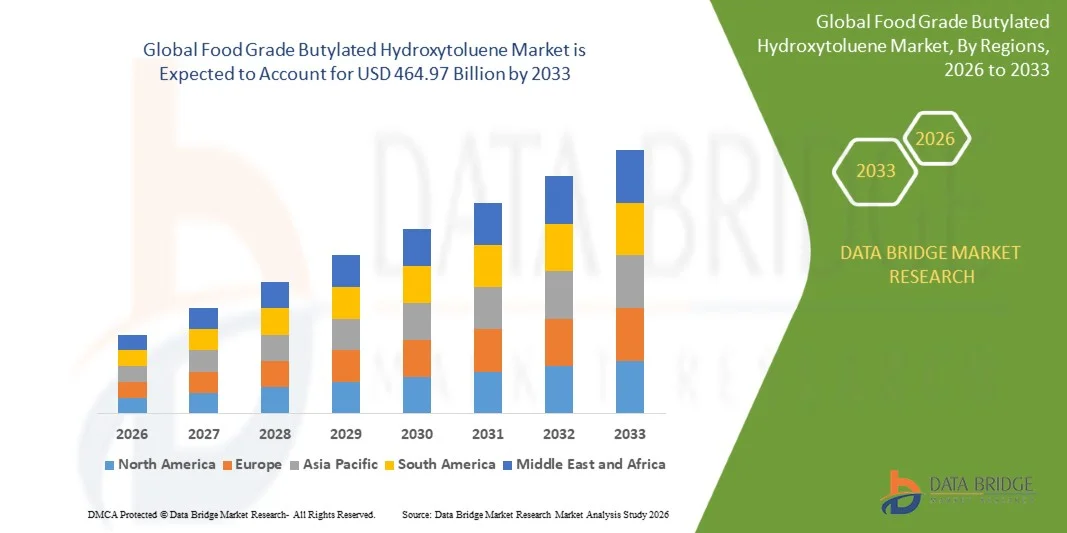
As per Data Bridge Market Research analysis the global food grade butylated hydroxytoluene market was valued at USD 291.73 billion in 2025 and is projected to reach USD 464.97 billion by 2033, growing at a CAGR of 6.00% from 2026 to 2033. The Food Grade Butylated Hydroxytoluene (BHT) market is experiencing steady growth driven by increasing demand for oxidation inhibitors in processed foods, edible oils, fats, bakery products, snack foods, cereals, and packaged food formulations. Rising consumption of convenience foods, longer shelf-life requirements, and growing demand for food preservation solutions are encouraging food manufacturers to incorporate food-grade BHT to maintain product freshness, prevent rancidity, and preserve flavor, color, and nutritional quality throughout storage and distribution.
The expansion of the packaged food industry, increasing global food trade, and stringent food safety and quality standards are further accelerating market demand. Food manufacturers are increasingly utilizing food-grade BHT within permissible regulatory limits to enhance oxidative stability in fat-containing products and reduce food waste caused by lipid oxidation. In addition, rising demand for processed and ready-to-eat foods across emerging economies, coupled with continuous improvements in food processing technologies and packaging solutions, is supporting the adoption of food-grade BHT across the global food industry.
Market Size & Forecast
- Market Value (2025): USD 291.73 Billion
- Expected Market Value (2033): USD 464.97 Billion
- Forecast CAGR (2026–2033): 6.00%
- Leading Region in 2025: Asia Pacific
- Fastest Growing Region: North America
Key Market Trends & Insights
- Asia-Pacific dominated the global food grade butylated hydroxytoluene market with an estimated revenue share of 39.12% in 2025, supported by the region's large food processing industry, expanding production of packaged and convenience foods, increasing consumption of edible oils and processed meat products, abundant manufacturing capacity, and the presence of major food additive manufacturers across China, India, Japan, and Southeast Asia.
- The food segment dominated the market with an estimated 69.28% revenue share in 2025, owing to the extensive use of food grade butylated hydroxytoluene as an antioxidant for preserving the quality, freshness, and shelf life of processed food products.
- North America is expected to be the fastest-growing region at an estimated CAGR of 6.4% from 2026 to 2033, fueled by increasing demand for shelf-life extension in processed foods, rising consumption of packaged convenience products, continuous innovation in food preservation technologies, stringent food quality standards, and growing investments in high-performance food additives across the United States and Canada.
- The consumer products segment is projected to register the fastest growth at a CAGR of 5.9% from 2026 to 2033, driven by rising demand for antioxidant ingredients in personal care products, household formulations, and consumer-oriented products requiring improved stability.
- The hydroquinone segment dominated the market with an estimated 61.84% revenue share in 2025, owing to its extensive use as a key intermediate in the commercial production of food grade butylated hydroxytoluene.
- The online segment is expected to witness the fastest growth at a CAGR of 6.4% from 2026 to 2033, driven by rapid digitalization of industrial procurement and the growing adoption of e-commerce platforms for specialty chemicals.
Report Scope and Food Grade Butylated Hydroxytoluene Market Segmentation
|
Attributes |
Food Grade Butylated Hydroxytoluene Key Market Insights |
|
Segments Covered |
|
|
Countries Covered |
North America
Europe
Asia-Pacific
Middle East and Africa
South America
|
|
Key Market Players |
|
|
Market Opportunities |
|
|
Value Added Data Infosets |
In addition to the insights on market scenarios such as market value, growth rate, segmentation, geographical coverage, and major players, the market reports curated by the Data Bridge Market Research also include in-depth expert analysis, geographically represented company-wise production and capacity, network layouts of distributors and partners, detailed and updated price trend analysis and deficit analysis of supply chain and demand. |
Food Grade Butylated Hydroxytoluene Market Trends
Trend: Increasing Demand for Clean-Label and Shelf-Life Extension Solutions in Processed Foods
Food manufacturers are increasingly focusing on extending product shelf life while maintaining quality, stability, and safety across processed food categories such as edible oils, snacks, cereals, bakery products, and packaged foods. Food grade butylated hydroxytoluene (BHT) continues to be used as an antioxidant to prevent oxidation, rancidity, and quality deterioration in fat-containing food products. Rising global consumption of packaged and convenience foods, expansion of food processing industries, and increasing demand for longer shelf-life products are supporting the adoption of effective antioxidant solutions. In addition, manufacturers are investing in improved food preservation technologies to reduce food waste and maintain product consistency throughout distribution networks. For instance, In December 2024, Corbion expanded its North American portfolio of consumer-friendly food preservation solutions with two new Verdad Opti Powder products for refrigerated foods. The growing demand for shelf-life extension, reduction of food waste, and stability of processed food products is driving continued adoption of food grade butylated hydroxytoluene as an effective antioxidant solution across global food manufacturing industries.
Food Grade Butylated Hydroxytoluene Market Dynamics
Key Market Driver: Expansion of Processed Food and Packaged Food Industries
The rapid growth of processed foods, packaged snacks, edible oils, bakery products, and convenience foods is significantly increasing demand for food grade butylated hydroxytoluene. Food manufacturers utilize BHT as an antioxidant to protect fats and oils from oxidative degradation, thereby improving product stability and extending shelf life. Increasing urbanization, changing consumer lifestyles, rising demand for ready-to-eat foods, and expansion of organized food retail channels are encouraging manufacturers to adopt effective preservation solutions. Emerging economies, particularly across Asia-Pacific, are witnessing strong growth in food processing activities, creating new opportunities for antioxidant suppliers. For instance, In August 2024, Corbion acquired the bread improver business from Novotech to strengthen its bakery ingredients portfolio and expand its presence in the Indian processed food market. Increasing processed food consumption, regulatory acceptance in approved applications, and rising demand for stable food products are expected to remain key factors supporting growth of the food grade butylated hydroxytoluene market.
Key Restraint/Challenge: Growing Preference for Natural Antioxidants and Regulatory Scrutiny
A major challenge for the food grade butylated hydroxytoluene market is the increasing consumer preference for natural and clean-label antioxidant alternatives. Food manufacturers are facing pressure to reduce synthetic additives due to changing consumer perceptions and increasing demand for naturally derived ingredients such as tocopherols, rosemary extract, and other plant-based antioxidants. In addition, regulatory differences across countries regarding permitted usage levels and labeling requirements create complexity for manufacturers operating in international markets. Companies must continuously invest in research, compliance, and formulation improvements to address evolving consumer and regulatory expectations. For instance, In October 2024, the Hong Kong Government gazetted the Preservatives in Food (Amendment) Regulation 2024, updating food safety standards for preservatives and antioxidants. Increasing demand for natural alternatives, evolving consumer preferences, and varying regulatory frameworks remain significant challenges that food grade butylated hydroxytoluene manufacturers must address through innovation and compliance strategies.
Key Market Opportunity: Growing Demand for Antioxidants in Emerging Food Processing Markets
The expansion of food processing industries in emerging economies presents significant opportunities for food grade butylated hydroxytoluene manufacturers. Countries across Asia-Pacific, Latin America, and the Middle East are experiencing increasing consumption of packaged foods, edible oils, snacks, and processed food products due to urbanization, rising disposable incomes, and changing dietary patterns. Growing investments in food manufacturing facilities and cold-chain infrastructure are increasing the need for effective preservation technologies that maintain product quality during storage and transportation. Manufacturers are also focusing on developing optimized antioxidant formulations to meet specific food application requirements. For instance, In September 2024, Corbion upgraded its Querétaro, Mexico facility, doubling production capacity for food ingredient solutions to better support customers across Latin America. Expanding food processing capacity, rising packaged food consumption, and increasing demand for effective preservation technologies create substantial long-term growth opportunities for suppliers operating in the food grade butylated hydroxytoluene market.
Food Grade Butylated Hydroxytoluene Market Scope
The food grade butylated hydroxytoluene market is segmented on the basis of raw material, application, and distribution channel and end-users.
- By Raw Material
On the basis of raw material, the global food grade butylated hydroxytoluene market is segmented into hydroquinone and chlorophenol. The hydroquinone segment dominated the market with an estimated 61.84% revenue share in 2025, owing to its extensive use as a key intermediate in the commercial production of food grade butylated hydroxytoluene. Hydroquinone offers high reaction efficiency, consistent product purity, and reliable antioxidant performance, making it the preferred raw material among manufacturers. The availability of well-established production technologies and large-scale manufacturing facilities further supports the dominance of this segment. Rising demand for food grade butylated hydroxytoluene from processed food manufacturers has increased the consumption of hydroquinone-based production routes due to their cost-effectiveness and scalability. In addition, manufacturers continue to optimize production processes to improve yield, reduce impurities, and comply with stringent food safety regulations. Growing investments in specialty chemical manufacturing and expanding production capacities across Asia-Pacific and North America are further supporting demand. The increasing emphasis on maintaining consistent quality standards for food additives is also driving the adoption of hydroquinone as the preferred feedstock. Its widespread commercial availability and stable supply chain continue to reinforce the leading position of the hydroquinone segment in the global food grade butylated hydroxytoluene market.
The chlorophenol segment is expected to witness the fastest growth at a CAGR of 5.6% from 2026 to 2033, driven by increasing investments in specialty chemical production and improvements in alternative manufacturing processes. Manufacturers are exploring chlorophenol-based synthesis routes to improve production flexibility and diversify raw material sourcing strategies. Rising demand for high-purity antioxidant ingredients in food and cosmetic formulations is encouraging continuous process innovations involving chlorophenol derivatives. Technological advancements in chemical processing are enhancing production efficiency while reducing waste generation and operational costs. The expansion of chemical manufacturing infrastructure in emerging economies is creating favorable opportunities for chlorophenol suppliers. Increasing focus on supply chain resilience and reducing dependence on single raw material sources is further supporting adoption. In addition, research aimed at improving process sustainability and product consistency is contributing to market expansion. The growing consumption of food grade butylated hydroxytoluene across multiple end-use industries is expected to generate additional demand for chlorophenol-based production, supporting the steady growth of this segment.
- By Application
On the basis of application, the global food grade butylated hydroxytoluene market is segmented into food, pharmaceuticals, and cosmetics. The food segment dominated the market with an estimated 69.28% revenue share in 2025, owing to the extensive use of food grade butylated hydroxytoluene as an antioxidant for preserving the quality, freshness, and shelf life of processed food products. It is widely incorporated into edible oils, fats, cereals, bakery products, snacks, confectionery, chewing gum, and packaged foods to prevent oxidative deterioration and rancidity. The increasing consumption of convenience foods and ready-to-eat meals worldwide has significantly boosted the demand for effective food preservatives. Food manufacturers continue to rely on food grade butylated hydroxytoluene to maintain flavor, color, and nutritional quality during storage and transportation. Rising globalization of food supply chains has further increased the need for antioxidants capable of ensuring long-term product stability. Regulatory approvals permitting controlled use of food grade butylated hydroxytoluene in numerous countries continue to support its commercial adoption. Growth in food processing industries, particularly across Asia-Pacific and Latin America, is also strengthening demand. Continuous innovations in packaged food manufacturing and increasing investments in shelf-life extension technologies are expected to maintain the dominance of the food segment throughout the forecast period.
The cosmetics segment is expected to witness the fastest growth at a CAGR of 5.9% from 2026 to 2033, driven by rising demand for stable and long-lasting personal care formulations. Food grade butylated hydroxytoluene is increasingly utilized in skincare products, lipsticks, lotions, creams, sunscreens, and hair care formulations to prevent oxidation of oils, fragrances, and active ingredients. Growing consumer awareness regarding product quality and formulation stability is encouraging cosmetic manufacturers to incorporate effective antioxidants into premium beauty products. Rapid expansion of the global beauty and personal care industry, particularly in Asia-Pacific and the Middle East, is further accelerating demand. Increasing product innovation, including multifunctional skincare and anti-aging formulations, is creating additional opportunities for antioxidant ingredients. Manufacturers are also focusing on extending product shelf life while maintaining formulation effectiveness during storage and transportation. Rising disposable income and growing expenditure on premium cosmetics continue to support market expansion. The increasing launch of advanced cosmetic formulations is expected to sustain strong growth of the cosmetics segment over the forecast period.
- By Distribution Channel
On the basis of distribution channel, the global food grade butylated hydroxytoluene market is segmented into offline and online. The offline segment dominated the market with an estimated 81.36% revenue share in 2025, owing to the strong presence of established chemical distributors, specialty ingredient suppliers, and direct business-to-business procurement channels. Food grade butylated hydroxytoluene is primarily purchased in bulk by food processors, pharmaceutical manufacturers, cosmetic companies, and industrial users through long-term supply agreements and authorized distributors. Offline procurement enables buyers to evaluate product certifications, regulatory compliance, technical specifications, and quality documentation before purchase. Strong supplier relationships, customized logistics support, and reliable after-sales services continue to make offline channels the preferred procurement method for industrial customers. Bulk purchasing through offline networks also allows companies to negotiate competitive pricing and maintain stable inventory levels. The presence of regional distribution networks and warehouse infrastructure further supports timely product availability across major manufacturing hubs. Increasing industrial production and expanding food processing activities are strengthening demand through traditional distribution channels. These factors continue to reinforce the leadership of the offline segment in the global food grade butylated hydroxytoluene market.
The online segment is expected to witness the fastest growth at a CAGR of 6.4% from 2026 to 2033, driven by rapid digitalization of industrial procurement and the growing adoption of e-commerce platforms for specialty chemicals. Manufacturers and distributors are increasingly offering food grade butylated hydroxytoluene through digital marketplaces and dedicated business procurement portals to improve accessibility and purchasing convenience. Online platforms enable buyers to compare product specifications, certifications, pricing, and supplier information efficiently before placing orders. Increasing digital transformation among small and medium-sized enterprises is further accelerating the adoption of online procurement channels. The expansion of secure digital payment systems, real-time inventory management, and faster logistics services is enhancing customer confidence in online purchasing. Manufacturers are also investing in digital sales platforms to expand their customer base across emerging markets. Growing internet penetration and improvements in cross-border e-commerce are creating new opportunities for ingredient suppliers. These developments are expected to support sustained growth of the online distribution channel throughout the forecast period.
- By End-users
On the basis of end-users, the global food grade butylated hydroxytoluene market is segmented into oil & gas, food & beverages, consumer products, aerospace, automotive, and others. The food & beverages segment dominated the market with an estimated 42.18% revenue share in 2025, supported by extensive application of food grade butylated hydroxytoluene as a preservative and antioxidant in processed food manufacturing. Food manufacturers utilize BHT to protect fats and oils from oxidative deterioration, maintain product freshness, and improve storage stability across various packaged food categories. The increasing consumption of ready-to-eat meals, frozen foods, snacks, bakery products, and processed edible oils is significantly contributing to demand growth. Furthermore, expansion of organized food processing industries, increasing international trade of packaged food products, and growing requirements for improved shelf-life performance are reinforcing the adoption of BHT-based antioxidant solutions. Continuous innovation in food preservation technologies and increasing focus on maintaining product quality throughout supply chains are further strengthening the leading position of the food & beverages segment.
The consumer products segment is projected to register the fastest growth at a CAGR of 5.9% from 2026 to 2033, driven by rising demand for antioxidant ingredients in personal care products, household formulations, and consumer-oriented products requiring improved stability. BHT is increasingly used in cosmetic formulations, fragrances, and personal care products to prevent oxidation of oils and maintain product consistency over extended storage periods. Growth in global beauty and personal care markets, increasing demand for premium skincare products, and rising consumer awareness regarding product quality and durability are supporting market expansion. In addition, manufacturers are investing in advanced formulations that require effective stabilization solutions to enhance performance and product lifespan. Increasing adoption of antioxidant additives in emerging economies, coupled with expanding consumer product manufacturing capabilities, is expected to create significant growth opportunities for the consumer products segment.
Food Grade Butylated Hydroxytoluene Market Regional Analysis
The Asia-Pacific food grade butylated hydroxytoluene market is expected to witness rapid growth, supported by the region’s expanding food processing industry, rising consumption of packaged foods, increasing urbanization, and growing demand for shelf-life extension solutions. Countries such as China, India, Japan, and Southeast Asian economies are experiencing increased production of processed foods, edible oils, snacks, bakery products, and convenience foods, driving the need for effective antioxidant additives. In addition, the presence of major food ingredient manufacturers, increasing investments in food manufacturing capacity, and rising consumer preference for packaged and ready-to-eat products are accelerating market growth across the region.
Japan Food Grade Butylated Hydroxytoluene Market Insight
The Japan food grade butylated hydroxytoluene market is witnessing steady growth due to the country’s advanced food processing industry, high demand for packaged foods, and strong emphasis on product quality and shelf-life management. Japanese food manufacturers increasingly utilize antioxidant additives to maintain freshness and stability in processed foods, edible oils, confectionery products, and snack items. Furthermore, Japan’s focus on food safety standards, technological advancements in food preservation, and the presence of established food and ingredient companies are supporting the adoption of food-grade butylated hydroxytoluene in various food applications.
China Food Grade Butylated Hydroxytoluene Market Insight
The China food grade butylated hydroxytoluene market is expanding rapidly, driven by the country’s large-scale food manufacturing sector, increasing packaged food consumption, and growing demand for processed food products. The rapid growth of the bakery, snack, edible oil, and convenience food industries is increasing the requirement for antioxidants that help prevent oxidation and extend product shelf life. In addition, China’s expanding food processing infrastructure, rising domestic consumption, and presence of major chemical and food ingredient manufacturers are positioning the country as a significant contributor to the global food grade butylated hydroxytoluene market.
U.K. Food Grade Butylated Hydroxytoluene Market Insight
The U.K. Food Grade Butylated Hydroxytoluene market is experiencing steady growth, supported by rising adoption of simulation technologies in professional driver training, automotive testing, and motorsport applications. Increasing investments in advanced simulator infrastructure and growing demand for cost-effective, risk-free training solutions are contributing to market growth. Furthermore, integration of AI, VR, and data analytics technologies is improving simulator performance and training efficiency, positioning the U.K. as a key innovation hub in the Food Grade Butylated Hydroxytoluene industry.
Germany Food Grade Butylated Hydroxytoluene Market Insight
The Germany Food Grade Butylated Hydroxytoluene market is expanding steadily due to the country’s strong automotive manufacturing base, advanced research capabilities, and increasing adoption of next-generation simulation technologies. Automotive companies, motorsport organizations, and training institutes are increasingly utilizing simulators for driver assessment, vehicle testing, and R&D activities. Continuous advancements in motion simulation, AI integration, and virtual reality technologies, along with strong government focus on road safety and innovation, are further driving market growth in Germany.
North America Food Grade Butylated Hydroxytoluene Market Insight
The North America food grade butylated hydroxytoluene market is expected to witness steady growth, supported by the region’s strong food processing industry, increasing demand for packaged and convenience foods, and rising adoption of antioxidant additives to improve product stability and shelf life. The presence of established food manufacturers, stringent food safety regulations, and continuous innovation in food preservation technologies are supporting market expansion. In addition, growing consumption of processed foods, edible oils, bakery products, and ready-to-eat meals across the United States and Canada is increasing the demand for food-grade antioxidants such as butylated hydroxytoluene.
U.S. Food Grade Butylated Hydroxytoluene Market Insight
The U.S. food grade butylated hydroxytoluene market is experiencing consistent growth due to the country’s large packaged food and processed food industry, increasing demand for longer shelf-life products, and widespread use of antioxidants in food manufacturing applications. Food producers are increasingly incorporating approved preservatives to maintain product quality, prevent oxidation, and improve storage stability across snacks, cereals, edible oils, and processed foods. Furthermore, the strong presence of major food and ingredient manufacturers, along with strict regulatory oversight by organizations such as the U.S. Food and Drug Administration (FDA), continues to support the adoption of food-grade butylated hydroxytoluene in the country.
Canada Food Grade Butylated Hydroxytoluene Market Insight
The Canada food grade butylated hydroxytoluene market is witnessing gradual growth, driven by increasing demand for processed foods, expanding packaged food consumption, and rising adoption of food preservation solutions among manufacturers. The country’s growing food processing sector, particularly in bakery products, edible oils, snacks, and ready-to-eat food categories, is creating demand for antioxidants that enhance product shelf life and maintain quality during storage and transportation. In addition, Canada’s strong food safety framework and increasing focus on maintaining product stability across the supply chain are encouraging food manufacturers to utilize approved antioxidant ingredients such as food-grade butylated hydroxytoluene.
Food Grade Butylated Hydroxytoluene Market Share
The food grade butylated hydroxytoluene industry is primarily led by well-established companies, including:
- BASF (Germany)
- Lanxess (Germany)
- Eastman Chemical Company (U.S.)
- Songwon Industrial Co., Ltd. (South Korea)
- ADEKA Corporation (Japan)
- Mayzo, Inc. (U.S.)
- Kemin Industries Inc. (U.S.)
- Spectrum Chemical (U.S.)
- Merck KGaA, Darmstadt, Germany and/or its affiliates (Germany)
- Tokyo Chemical Industry Pvt, Ltd. (Japan)
- Brenntag (Shanghai) Enterprise Management Co., Ltd. (Germany)
Latest Developments in Food Grade Butylated Hydroxytoluene Market
- In December 2021, the European Commission’s Scientific Committee on Consumer Safety (SCCS) published its final opinion on butylated hydroxytoluene (BHT), evaluating its safety profile and concentration limits for use in cosmetic products. The assessment influenced regulatory discussions around antioxidant applications of BHT and reinforced the importance of controlled usage levels across consumer product formulations. This regulatory review impacted manufacturers using BHT as an oxidation inhibitor in personal care and consumer formulations, encouraging compliance-focused product development and safety evaluations
- In November 2023, the Cosmetic, Toiletry and Perfumery Association (CTPA) reported that the U.K. Office for Product Safety and Standards (OPSS) notified amendments to the U.K. Cosmetics Regulation regarding butylated hydroxytoluene (BHT). The regulation introduced specific restrictions on BHT concentrations in different cosmetic applications, including oral care and leave-on/rinse-off products. The regulatory update highlighted the increasing focus on safety evaluation and controlled use of antioxidant ingredients such as BHT across consumer product industries. These changes encouraged manufacturers to optimize formulations while maintaining product stability and shelf-life performance
- In April 2024, Songwon Industrial Co., Ltd., a major global supplier of specialty chemicals and antioxidant solutions, presented its advanced additive portfolio at NPE 2024, highlighting antioxidant technologies designed to improve product stability and durability. The company showcased its range of antioxidant solutions, including products used for polymer stabilization, packaging materials, and applications requiring resistance against oxidation and degradation. The development reflects the broader industry trend toward high-performance antioxidant additives that support food-contact packaging, consumer products, and industrial applications where oxidation control is essential
- In April 2024, Songwon Industrial Co., Ltd., showcased its expanded range of antioxidant and stabilization solutions at the American Coatings Show 2024, focusing on technologies that improve durability and resistance against oxidation, heat, and environmental degradation. The company highlighted its SONGNOX antioxidant portfolio, which supports applications across coatings, plastics, automotive, and consumer product industries. These developments demonstrate continued investment by antioxidant manufacturers in advanced stabilization technologies, supporting demand for phenolic antioxidants such as BHT across multiple end-use industries
- In January 2025, Songwon Industrial Co., Ltd., announced the appointment of new distribution partners in Japan and India for its fuel and lubricant additives business, strengthening its regional supply network for antioxidant solutions. The expansion supports increasing demand for oxidation-control additives used in fuels, lubricants, and industrial applications. Improved distribution capabilities are expected to enhance accessibility of antioxidant technologies in high-growth Asian markets, where demand for fuel stability and industrial performance additives continues to increase

- Interactive Data Analysis Dashboard
- Company Analysis Dashboard for high growth potential opportunities
- Research Analyst Access for customization & queries
- Competitor Analysis with Interactive dashboard
- Latest News, Updates & Trend analysis
- Harness the Power of Benchmark Analysis for Comprehensive Competitor Tracking
Global Food Grade Butylated Hydroxytoluene Market, Supply Chain Analysis and Ecosystem Framework
To support market growth and help clients navigate the impact of geopolitical shifts, DBMR has integrated in-depth supply chain analysis into its Global Food Grade Butylated Hydroxytoluene Market research reports. This addition empowers clients to respond effectively to global changes affecting their industries. The supply chain analysis section includes detailed insights such as Global Food Grade Butylated Hydroxytoluene Market consumption and production by country, price trend analysis, the impact of tariffs and geopolitical developments, and import and export trends by country and HSN code. It also highlights major suppliers with data on production capacity and company profiles, as well as key importers and exporters. In addition to research, DBMR offers specialized supply chain consulting services backed by over a decade of experience, providing solutions like supplier discovery, supplier risk assessment, price trend analysis, impact evaluation of inflation and trade route changes, and comprehensive market trend analysis.
Data collection and base year analysis are done using data collection modules with large sample sizes. The stage includes obtaining market information or related data through various sources and strategies. It includes examining and planning all the data acquired from the past in advance. It likewise envelops the examination of information inconsistencies seen across different information sources. The market data is analysed and estimated using market statistical and coherent models. Also, market share analysis and key trend analysis are the major success factors in the market report. To know more, please request an analyst call or drop down your inquiry.
The key research methodology used by DBMR research team is data triangulation which involves data mining, analysis of the impact of data variables on the market and primary (industry expert) validation. Data models include Vendor Positioning Grid, Market Time Line Analysis, Market Overview and Guide, Company Positioning Grid, Patent Analysis, Pricing Analysis, Company Market Share Analysis, Standards of Measurement, Global versus Regional and Vendor Share Analysis. To know more about the research methodology, drop in an inquiry to speak to our industry experts.
Data Bridge Market Research is a leader in advanced formative research. We take pride in servicing our existing and new customers with data and analysis that match and suits their goal. The report can be customized to include price trend analysis of target brands understanding the market for additional countries (ask for the list of countries), clinical trial results data, literature review, refurbished market and product base analysis. Market analysis of target competitors can be analyzed from technology-based analysis to market portfolio strategies. We can add as many competitors that you require data about in the format and data style you are looking for. Our team of analysts can also provide you data in crude raw excel files pivot tables (Fact book) or can assist you in creating presentations from the data sets available in the report.













