


What is the Food Grade Maltodextrin Market Size and Growth Rate?
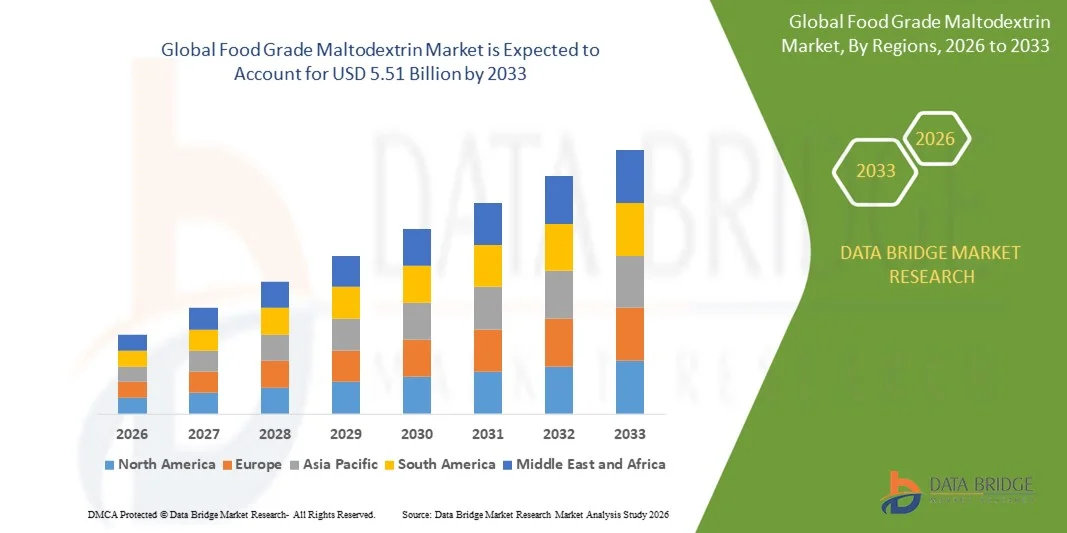
- The global food grade maltodextrin market size was valued at USD 3.38 billion in 2025 and is expected to reach USD 5.51 billion by 2033, at a CAGR of 6.30% during the forecast period
- The market growth is largely fueled by the rising demand for processed, functional, and convenience foods, driving increased adoption of food grade maltodextrin as a key ingredient for texture, sweetness, and stability across various formulations
- Furthermore, growing consumer preference for low-calorie, clean-label, and nutritionally enhanced products is encouraging food and beverage manufacturers to incorporate maltodextrin into bakery, confectionery, beverage, and dairy applications. These converging factors are accelerating the uptake of maltodextrin solutions, thereby significantly boosting the industry's growth
What are the Major Takeaways of Food Grade Maltodextrin Market?
- The market growth is largely fueled by the rising demand for processed, functional, and convenience foods, driving increased adoption of food grade maltodextrin as a key ingredient for texture, sweetness, and stability across various formulations
- Furthermore, growing consumer preference for low-calorie, clean-label, and nutritionally enhanced products is encouraging food and beverage manufacturers to incorporate maltodextrin into bakery, confectionery, beverage, and dairy applications. These converging factors are accelerating the uptake of maltodextrin solutions, thereby significantly boosting the industry's growth
- Asia-Pacific dominated the food grade maltodextrin market with a share of 34.5% in 2025, due to expanding food and beverage manufacturing, increasing demand for processed and convenience foods, and a strong presence of key ingredient suppliers
- North America is expected to be the fastest growing region in the food grade maltodextrin market during the forecast period due to strong demand for processed, functional, and convenience foods
- Powder segment dominated the market with a market share of 57.8% in 2025, due to its ease of handling, longer shelf life, and wide applicability across various food and beverage formulations. Manufacturers often prefer powder maltodextrin due to its uniform texture, stability under high-temperature processing, and compatibility with multiple dry mixes such as instant beverages and bakery products. The strong adoption of powdered maltodextrin is further supported by its cost-effectiveness and convenience in large-scale production, as well as its ability to provide consistent sweetness and texture enhancement in diverse applications
Report Scope and Food Grade Maltodextrin Market Segmentation
|
Attributes |
Food Grade Maltodextrin Key Market Insights |
|
Segments Covered |
|
|
Countries Covered |
North America
Europe
Asia-Pacific
Middle East and Africa
South America
|
|
Key Market Players |
|
|
Market Opportunities |
|
|
Value Added Data Infosets |
In addition to the insights on market scenarios such as market value, growth rate, segmentation, geographical coverage, and major players, the market reports curated by the Data Bridge Market Research also include in-depth expert analysis, pricing analysis, brand share analysis, consumer survey, demography analysis, supply chain analysis, value chain analysis, raw material/consumables overview, vendor selection criteria, PESTLE Analysis, Porter Analysis, and regulatory framework. |
What is the Key Trend in the Food Grade Maltodextrin Market?
Rising Demand for Clean-Label and Functional Food Ingredients
- A significant trend in the food grade maltodextrin market is the increasing adoption of clean-label and functional ingredients across bakery, beverage, dairy, and nutritional products, driven by growing consumer focus on health, nutrition, and transparency in food labeling. This trend is positioning maltodextrin as a key functional additive that enhances texture, sweetness, and stability without compromising clean-label requirements
- For instance, Ingredion and Roquette Frères supply specialty and clean-label maltodextrins that are widely used in low-calorie snacks, protein shakes, and ready-to-eat meal formulations. These ingredients enable manufacturers to meet consumer expectations for natural and functional products while maintaining product consistency and taste
- The demand for maltodextrin is growing in bakery and confectionery applications where it improves bulk, moisture retention, and texture, helping manufacturers produce high-quality, stable, and shelf-ready products. This is reinforcing its importance as a multifunctional ingredient in modern food processing
- Functional beverages and dairy alternatives are increasingly incorporating maltodextrin to enhance mouthfeel, improve solubility, and provide balanced sweetness. The versatility of maltodextrin in both liquid and powdered forms is accelerating its adoption across diverse product categories
- Rising consumer preference for low-sugar, low-calorie, and fortified foods is further boosting demand for maltodextrin as it allows manufacturers to reduce sugar content without compromising texture or stability. This is driving innovation in health-oriented and performance-focused food products
- The growing focus on processed and convenience foods, coupled with the shift toward nutrition-driven consumption, is supporting strong uptake of maltodextrin. This trend is contributing to overall market expansion, positioning maltodextrin as a critical functional ingredient for global food and beverage manufacturers
Food Grade Maltodextrin Market Dynamics
What are the Key Drivers of Food Grade Maltodextrin Market?
Growing Processed and Convenience Food Consumption
- The increasing consumption of processed, packaged, and ready-to-eat foods is driving demand for food grade maltodextrin, which is used as a bulking agent, stabilizer, and texturizer in a wide range of formulations. Its functional versatility makes it an essential ingredient for maintaining product quality, consistency, and shelf life
- For instance, companies such as Cargill and Tate & Lyle supply maltodextrin solutions for bakery mixes, confectionery, and nutritional products, enabling manufacturers to meet rising consumer demand efficiently. These solutions support scalable production while ensuring product performance and taste
- The expanding food service and convenience food sectors are incorporating maltodextrin to optimize texture, improve solubility, and enhance sweetness balance in ready-to-eat meals, beverages, and dairy products. This is reinforcing its role as a functional and cost-effective ingredient
- Rising urbanization, fast-paced lifestyles, and growing demand for on-the-go nutrition are accelerating the adoption of maltodextrin in functional and fortified food products. Manufacturers rely on maltodextrin to improve product stability and functionality while meeting consumer expectations for convenience and quality
- The overall increase in processed and convenience food consumption is shaping market growth by elevating the demand for versatile carbohydrate ingredients. Maltodextrin’s ability to provide consistent performance across multiple applications is further strengthening its position in the global food industry
Restraint/Challenge
Stringent Food Safety and Regulatory Compliance
- The food grade maltodextrin market faces challenges from strict regulatory standards, labeling requirements, and quality control protocols that vary across regions. Compliance with food safety regulations adds complexity and cost to production and distribution processes
- For instance, manufacturers such as Roquette Frères and ADM must adhere to certifications and quality audits for clean-label and functional maltodextrin products, ensuring safety, consistency, and compliance with international food standards. These requirements can increase operational complexity and affect time-to-market
- Stringent monitoring of raw materials, processing methods, and storage conditions is necessary to maintain the purity, solubility, and functional properties of maltodextrin. These precautions extend production cycles and increase compliance costs for manufacturers
- Regulatory variations across regions create challenges for global expansion, as companies must adapt production, labeling, and documentation to meet diverse standards. This can limit scalability and require additional investment in quality assurance systems
- Ensuring adherence to stringent food safety and regulatory frameworks continues to be a significant restraint, as manufacturers must balance compliance requirements with cost efficiency while meeting growing global demand
Food Grade Maltodextrin Market Scope
The market is segmented on the basis of form and product.
- By Form
On the basis of form, the food grade maltodextrin market is segmented into powder and liquid. The powder segment dominated the market with the largest revenue share of 57.8% in 2025, driven by its ease of handling, longer shelf life, and wide applicability across various food and beverage formulations. Manufacturers often prefer powder maltodextrin due to its uniform texture, stability under high-temperature processing, and compatibility with multiple dry mixes such as instant beverages and bakery products. The strong adoption of powdered maltodextrin is further supported by its cost-effectiveness and convenience in large-scale production, as well as its ability to provide consistent sweetness and texture enhancement in diverse applications.
The liquid segment is anticipated to witness the fastest growth rate of 19.5% from 2026 to 2033, fueled by rising demand in the beverage and dairy sectors. For instance, companies such as Cargill are increasingly supplying liquid maltodextrin for ready-to-drink beverages, nutritional shakes, and liquid sweeteners. Liquid maltodextrin provides advantages in formulations requiring rapid dissolution, smooth texture, and easy blending, making it attractive for food and beverage manufacturers seeking efficiency and product innovation. The segment growth is also driven by increasing adoption in industrial applications where liquid forms reduce processing time and enhance operational flexibility.
- By Product
On the basis of product, the food grade maltodextrin market is segmented into MD 30, MD 20, MD 15, and MD 10. The MD 20 segment dominated the market with the largest revenue share in 2025 due to its balanced sweetness, solubility, and functional properties suitable for a wide range of food and beverage applications. Manufacturers favor MD 20 for bakery products, confectioneries, and instant mixes, as it provides consistent texture, moisture retention, and stability during processing. Its versatility and broad compatibility with various formulations contribute to its sustained demand in both industrial and retail food sectors.
The MD 10 segment is expected to witness the fastest CAGR from 2026 to 2033, driven by increasing use in low-calorie and specialty formulations. For instance, Ingredion has developed MD 10-based solutions for low-calorie snacks and nutritional supplements, capitalizing on its lower sweetness and ability to enhance bulk and mouthfeel. The growth of MD 10 is also supported by rising consumer preference for functional foods, sugar-reduced products, and beverages where controlled sweetness and texture are critical. Its adoption is expanding in ready-to-drink products, dairy alternatives, and health-focused formulations, driving rapid market growth.
Which Region Holds the Largest Share of the Food Grade Maltodextrin Market?
- Asia-Pacific dominated the food grade maltodextrin market with the largest revenue share of 34.5% in 2025, driven by expanding food and beverage manufacturing, increasing demand for processed and convenience foods, and a strong presence of key ingredient suppliers
- The region’s cost-effective production facilities, rising investments in functional and nutritional ingredients, and growing exports of processed food products are accelerating market growth
- The availability of skilled workforce, supportive government policies, and rapid industrialization across developing economies are contributing to increased consumption of maltodextrin in both food and beverage sectors
China Food Grade Maltodextrin Market Insight
China held the largest share in the Asia-Pacific food grade maltodextrin market in 2025, owing to its strong food processing industry and extensive production capacity for starch-based ingredients. The country benefits from favorable government support for industrial growth, increasing exports of processed foods, and rising domestic demand for functional ingredients. Consumption is also bolstered by continuous innovation in convenience foods, bakery products, and beverages requiring maltodextrin for texture and sweetness enhancement.
India Food Grade Maltodextrin Market Insight
India is witnessing the fastest growth in the Asia-Pacific region, fueled by a rapidly expanding processed food and beverage sector, increasing demand for low-calorie and functional ingredients, and growing investments in manufacturing infrastructure. Government initiatives promoting food processing, along with rising urbanization and disposable income, are strengthening demand for maltodextrin. In addition, the surge in exports of ready-to-eat and health-focused food products is contributing to robust market expansion.
Europe Food Grade Maltodextrin Market Insight
The Europe food grade maltodextrin market is expanding steadily, supported by high demand for processed and functional foods, stringent food safety regulations, and growing investments in specialty ingredient production. The region emphasizes quality, environmental compliance, and advanced formulations in bakery, confectionery, and beverage applications. Increasing use of maltodextrin in dietary, low-sugar, and nutritional products is further enhancing market growth.
Germany Food Grade Maltodextrin Market Insight
Germany’s maltodextrin market is driven by its leadership in high-value food production, strong R&D capabilities, and advanced food processing infrastructure. The country has well-established networks between ingredient manufacturers and research institutions, fostering continuous innovation in functional and specialty maltodextrin products. Demand is particularly strong in bakery, confectionery, and nutritional formulations.
U.K. Food Grade Maltodextrin Market Insight
The U.K. market is supported by a mature food and beverage industry, growing focus on nutritional and low-calorie products, and increasing demand for specialty ingredients. Rising R&D activities, collaboration between academia and food manufacturers, and investments in functional ingredient production are enabling innovation in bakery, beverages, and confectionery applications. The U.K. continues to play a significant role in high-value ingredient markets.
North America Food Grade Maltodextrin Market Insight
North America is projected to grow at the fastest CAGR from 2026 to 2033, driven by strong demand for processed, functional, and convenience foods. A robust food manufacturing sector, rising health and wellness trends, and increasing adoption of low-calorie and specialty ingredients are boosting market expansion. In addition, growing collaborations between ingredient suppliers and food manufacturers are supporting market growth.
U.S. Food Grade Maltodextrin Market Insight
The U.S. accounted for the largest share in the North America market in 2025, underpinned by its expansive food and beverage industry, strong R&D infrastructure, and high consumption of processed foods. The country’s focus on product innovation, regulatory compliance, and nutritional labeling is encouraging the use of maltodextrin in bakery, beverages, and dairy applications. Presence of leading ingredient suppliers and well-established distribution networks further solidify the U.S.'s leading position in the region.
Which are the Top Companies in Food Grade Maltodextrin Market?
The food grade maltodextrin industry is primarily led by well-established companies, including:
- BASF SE (Germany)
- ADM (U.S.)
- Grain Processing Corporation (U.S.)
- Tate & Lyle (U.K.)
- Cargill, Incorporated (U.S.)
- Roquette Frères (France)
- Zhucheng Dongxiao Biotechnology Co., Ltd (China)
- NOWAMYL (Poland)
- Avebe (Netherlands)
- AGRANA Beteiligungs-AG (Austria)
- Matsutani Chemical Industry Co., Ltd (Japan)
What are Latest Developments in Global Food Grade Maltodextrin Market?
- In March 2023, Tate & Lyle expanded its production facility for specialty maltodextrins in North America, significantly increasing its output capacity to meet the rising demand from functional, low-calorie, and clean-label food segments. This expansion strengthens the company’s ability to supply ingredients for bakery, beverages, and nutritional products, enhances its competitive positioning, and supports faster delivery timelines, enabling food manufacturers to scale production efficiently in response to growing consumer health-conscious trends
- In September 2022, Roquette Frères introduced a sustainable maltodextrin production process, emphasizing energy efficiency and reduced environmental footprint throughout the manufacturing cycle. This development caters to the increasing demand for eco-friendly and clean-label ingredients among food and beverage producers, enabling companies to meet consumer expectations for sustainability while ensuring high-quality functional performance in applications such as snacks, beverages, and dairy alternatives
- In June 2021, Cargill invested in expanding its maltodextrin production capacity in Asia, targeting the rapidly growing processed food and beverage markets in emerging economies. The investment enhances the company’s regional footprint, reduces supply chain bottlenecks, and supports the rising demand for functional and convenience food products, particularly in bakery, confectionery, and ready-to-drink beverage segments, positioning Cargill to capture a larger share of the high-growth Asia-Pacific market
- In August 2020, Ingredion launched a new range of clean-label maltodextrins designed to meet the growing consumer preference for transparent, non-GMO, and label-friendly ingredients. This launch enables food manufacturers to formulate products that align with health-conscious and clean-label trends, strengthening Ingredion’s market presence and fostering adoption of maltodextrin in bakery mixes, beverages, nutritional supplements, and other functional food applications
- In November 2020, Roquette Frères partnered with leading beverage manufacturers to develop customized maltodextrin solutions tailored for nutritional drinks, protein shakes, and other fortified beverages. This collaboration allows Roquette to expand its application portfolio, enhance customer engagement, and provide value-added solutions that improve texture, solubility, and mouthfeel, driving market penetration in the fast-growing functional and sports nutrition beverage segment

- Interactive Data Analysis Dashboard
- Company Analysis Dashboard for high growth potential opportunities
- Research Analyst Access for customization & queries
- Competitor Analysis with Interactive dashboard
- Latest News, Updates & Trend analysis
- Harness the Power of Benchmark Analysis for Comprehensive Competitor Tracking
Global Food Grade Maltodextrin Market, Supply Chain Analysis and Ecosystem Framework
To support market growth and help clients navigate the impact of geopolitical shifts, DBMR has integrated in-depth supply chain analysis into its Global Food Grade Maltodextrin Market research reports. This addition empowers clients to respond effectively to global changes affecting their industries. The supply chain analysis section includes detailed insights such as Global Food Grade Maltodextrin Market consumption and production by country, price trend analysis, the impact of tariffs and geopolitical developments, and import and export trends by country and HSN code. It also highlights major suppliers with data on production capacity and company profiles, as well as key importers and exporters. In addition to research, DBMR offers specialized supply chain consulting services backed by over a decade of experience, providing solutions like supplier discovery, supplier risk assessment, price trend analysis, impact evaluation of inflation and trade route changes, and comprehensive market trend analysis.
Data collection and base year analysis are done using data collection modules with large sample sizes. The stage includes obtaining market information or related data through various sources and strategies. It includes examining and planning all the data acquired from the past in advance. It likewise envelops the examination of information inconsistencies seen across different information sources. The market data is analysed and estimated using market statistical and coherent models. Also, market share analysis and key trend analysis are the major success factors in the market report. To know more, please request an analyst call or drop down your inquiry.
The key research methodology used by DBMR research team is data triangulation which involves data mining, analysis of the impact of data variables on the market and primary (industry expert) validation. Data models include Vendor Positioning Grid, Market Time Line Analysis, Market Overview and Guide, Company Positioning Grid, Patent Analysis, Pricing Analysis, Company Market Share Analysis, Standards of Measurement, Global versus Regional and Vendor Share Analysis. To know more about the research methodology, drop in an inquiry to speak to our industry experts.
Data Bridge Market Research is a leader in advanced formative research. We take pride in servicing our existing and new customers with data and analysis that match and suits their goal. The report can be customized to include price trend analysis of target brands understanding the market for additional countries (ask for the list of countries), clinical trial results data, literature review, refurbished market and product base analysis. Market analysis of target competitors can be analyzed from technology-based analysis to market portfolio strategies. We can add as many competitors that you require data about in the format and data style you are looking for. Our team of analysts can also provide you data in crude raw excel files pivot tables (Fact book) or can assist you in creating presentations from the data sets available in the report.













