


Food Grade Salt Flour Market Size
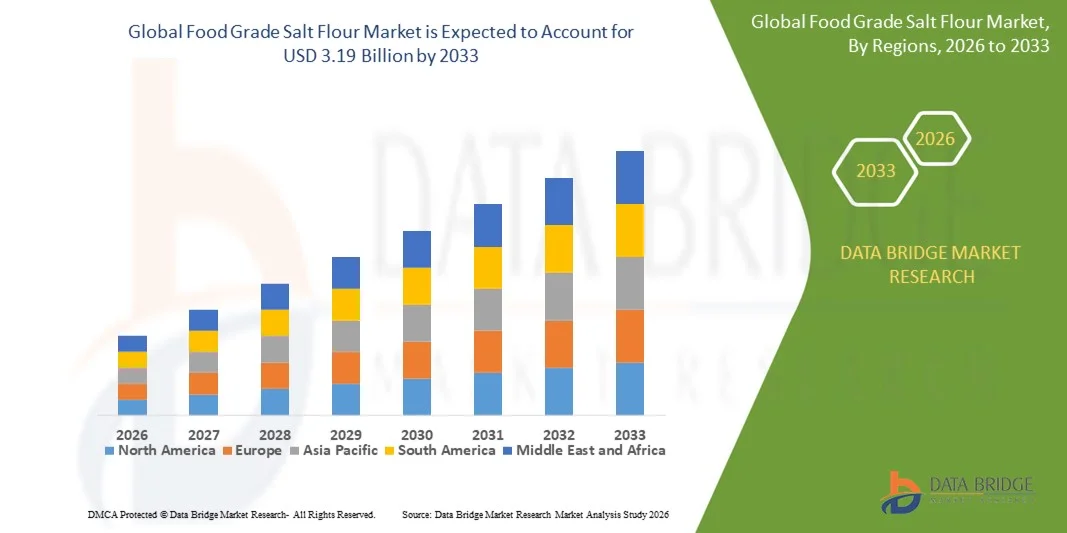
- The global food grade salt flour market size was valued at USD 1.89 billion in 2025 and is expected to reach USD 3.19 billion by 2033, at a CAGR of 6.7% during the forecast period
- The market growth is largely fueled by the increasing demand for processed, convenience, and ready-to-eat foods, which rely heavily on consistent quality food-grade salt and flour as essential ingredients
- Furthermore, rising consumer preference for fortified, clean-label, and specialty food products is encouraging manufacturers to adopt high-quality salts and flours, thereby boosting market expansion
Food Grade Salt Flour Market Analysis
- Food grade salt and flour are critical ingredients used across dairy products, soups, sauces, meat processing, baked goods, beverages, and ready-to-eat meals. These ingredients ensure flavor, preservation, texture, and nutritional quality in various food applications
- The escalating demand for food grade salt and flour is primarily driven by the growth of the processed and convenience food industries, increasing health-conscious consumer choices, and rising urbanization leading to higher consumption of packaged and fortified foods
- Asia-Pacific dominated the food grade salt flour market with a share of 41.5% in 2025, due to increasing demand from processed and convenience food industries, expanding dairy production, and a strong presence of salt and flour manufacturing hubs
- North America is expected to be the fastest growing region in the food grade salt flour market during the forecast period due to robust demand for processed, convenience, and ready-to-eat foods
- Iodized salt segment dominated the market with a market share of 48.8% in 2025, due to government fortification programs and health benefits such as preventing iodine deficiency. Its widespread use in households and food processing, combined with consumer trust and strong distribution networks, maintains its market leadership
Report Scope and Food Grade Salt Flour Market Segmentation
|
Attributes |
Food Grade Salt Flour Key Market Insights |
|
Segments Covered |
|
|
Countries Covered |
North America
Europe
Asia-Pacific
Middle East and Africa
South America
|
|
Key Market Players |
|
|
Market Opportunities |
|
|
Value Added Data Infosets |
In addition to the insights on market scenarios such as market value, growth rate, segmentation, geographical coverage, and major players, the market reports curated by the Data Bridge Market Research also include in-depth expert analysis, pricing analysis, brand share analysis, consumer survey, demography analysis, supply chain analysis, value chain analysis, raw material/consumables overview, vendor selection criteria, PESTLE Analysis, Porter Analysis, and regulatory framework. |
Food Grade Salt Flour Market Trends
Rising Demand for Fortified and Specialty Food Ingredients
- A prominent trend in the food grade salt flour market is the increasing incorporation of fortified and specialty ingredients in processed and packaged foods, driven by heightened consumer awareness regarding nutrition and functional benefits. Manufacturers are exploring mineral-enriched and specialty flours that enhance product value and cater to health-conscious populations
- For instance, Cargill produces fortified salt blends and enriched flours that are widely utilized in bakery and snack applications, supporting both nutritional enhancement and product diversification. Such offerings enable food companies to meet regulatory standards and evolving consumer expectations for healthier alternatives
- The rising popularity of plant-based and gluten-free diets is promoting demand for alternative flours and salt types that provide functional properties such as texture improvement, shelf-life extension, and flavor enhancement. This is positioning fortified and specialty ingredients as essential components for innovative food formulations
- Foodservice and industrial baking sectors are increasingly adopting specialty flours and fortified salts to improve product consistency, taste, and nutritional content. This adoption is driving greater R&D investment in ingredient development and quality assurance practices
- Retail and e-commerce channels are witnessing stronger consumer demand for fortified and functional food products, which is encouraging manufacturers to introduce customized salt and flour variants. These trends are reinforcing the strategic importance of differentiated ingredients in competitive markets
- The market is seeing steady growth in health-oriented and functional food segments where fortified salts and specialty flours contribute to nutritional value, product innovation, and brand differentiation. This rising preference is shaping product portfolios and strengthening market expansion globally
Food Grade Salt Flour Market Dynamics
Driver
Growth of Processed and Convenience Food Industries
- The expanding processed and convenience food industries are driving demand for food grade salt and flour, as these sectors rely on high-quality, consistent ingredients to maintain taste, texture, and shelf life. Increasing urbanization and changing lifestyles are supporting higher consumption of packaged and ready-to-eat products
- For instance, General Mills sources standardized flours and iodized salts for its bakery and snack product lines, ensuring uniform quality across global markets. Such practices enable manufacturers to meet production efficiency requirements and consumer expectations for reliable taste and nutrition
- Rising investment in industrial baking, snack production, and frozen food manufacturing is creating steady demand for large-scale, high-quality salt and flour supplies. These ingredients are critical to maintaining product consistency and meeting regulatory fortification standards
- The growing foodservice and quick-service restaurant sectors are increasing procurement of functional flours and fortified salts for menu innovations and nutritional compliance. This trend emphasizes the need for scalable, high-quality ingredient sourcing
- Global expansion of packaged food brands and the rising prevalence of convenience foods continue to boost demand for food grade salt and flour, reinforcing the sector’s growth trajectory and driving innovation in ingredient formulations
Restraint/Challenge
Fluctuating Raw Material Prices
- The food grade salt flour market faces challenges due to price volatility of raw materials such as wheat, corn, and sea salt, which affects production costs and profit margins. Weather conditions, supply disruptions, and global commodity price shifts contribute to instability across the supply chain
- For instance, Archer Daniels Midland Company has reported raw material cost fluctuations impacting the pricing of its flour and salt products. These variations influence procurement strategies and require careful cost management to sustain competitive pricing
- The dependence on agricultural output exposes manufacturers to risks from crop failures, transportation delays, and seasonal variations, further contributing to price uncertainty. Maintaining affordability without compromising quality remains a significant operational challenge
- Global trade policies, import-export restrictions, and logistical bottlenecks can amplify raw material cost volatility, impacting ingredient availability and manufacturing schedules. Manufacturers need robust sourcing strategies to navigate these uncertainties
- The market continues to encounter constraints related to balancing raw material costs with consumer demand for affordable fortified and specialty products. These challenges underscore the importance of strategic procurement, risk management, and cost optimization to sustain market growth
Food Grade Salt Flour Market Scope
The market is segmented on the basis of product type, processing type, and application.
- By Product Type
On the basis of product type, the food grade salt market is segmented into rock salt, vacuum salt, and sea salt. The rock salt segment dominated the largest market revenue share in 2025, driven by its long-standing use in food processing and household applications and its lower cost compared to refined salts. It is widely used in industrial food production for its consistent mineral content and preservation properties. Manufacturers prefer rock salt for large-scale production, and consumer trust in its traditional and natural profile sustains demand.
The sea salt segment is expected to witness the fastest growth from 2026 to 2033, driven by rising demand for natural, mineral-rich products. For instance, Cargill has expanded sea salt offerings for gourmet and health-conscious consumers. Its texture and flavor-enhancing properties make it popular in artisanal and premium food products, supporting rapid adoption across culinary and ready-to-eat applications.
- By Processing Type
On the basis of processing type, the market is segmented into iodized salt and non-iodized salt. The iodized salt segment dominated with the largest share of 48.8% in 2025, driven by government fortification programs and health benefits such as preventing iodine deficiency. Its widespread use in households and food processing, combined with consumer trust and strong distribution networks, maintains its market leadership.
The non-iodized salt segment is expected to grow fastest from 2026 to 2033, fueled by demand in gourmet cooking and specialized food processing. For instance, Tata Salt’s non-iodized products cater to additive-free and artisanal food preferences. Its neutral flavor and minimal processing appeal to premium culinary and ready-to-eat applications, supporting strong growth.
- By Application
On the basis of application, the market is segmented into dairy products, soups, sauces, fish & meat, beverages, convenience food, ready-to-eat food, animal feed, and others. The dairy products segment dominated in 2025, driven by extensive use in cheese, butter, yogurt, and milk-based products to enhance flavor, preserve freshness, and ensure quality. Its role as a natural preservative supports consistent demand across large-scale dairy manufacturing.
The convenience food segment is expected to grow fastest from 2026 to 2033, driven by urbanization and rising demand for ready-to-eat meals. For instance, Nestlé incorporates specialized salts in packaged foods to maintain flavor and shelf-life. Growing on-the-go consumption and demand for premium, low-sodium options support the segment’s rapid expansion.
Food Grade Salt Flour Market Regional Analysis
- Asia-Pacific dominated the food grade salt flour market with the largest revenue share of 41.5% in 2025, driven by increasing demand from processed and convenience food industries, expanding dairy production, and a strong presence of salt and flour manufacturing hubs
- The region’s cost-effective manufacturing landscape, rising investments in food processing infrastructure, and growing exports of processed food products are accelerating market expansion
- The availability of skilled labor, favorable government policies, and rapid urbanization across developing economies are contributing to increased consumption of food grade salt and flour in both industrial and retail sectors
China Food Grade Salt Flour Market Insight
China held the largest share in the Asia-Pacific food grade salt flour market in 2025, owing to its role as a global leader in processed food production and ingredient manufacturing. The country's strong industrial base, favorable policies supporting food sector expansion, and extensive export capabilities are major growth drivers. Demand is also bolstered by ongoing investments in high-quality salt and flour processing, serving both domestic consumption and international food exports.
India Food Grade Salt Flour Market Insight
India is witnessing the fastest growth in the Asia-Pacific region, fueled by rapidly growing convenience food production, increasing dairy output, and rising investments in food ingredient infrastructure. Initiatives promoting domestic manufacturing and self-reliance in food processing are strengthening the demand for food grade salt and flour. In addition, a surge in processed food consumption and expanding cold-chain logistics are contributing to robust market expansion.
Europe Food Grade Salt Flour Market Insight
The Europe food grade salt flour market is expanding steadily, supported by stringent quality standards, growing demand for processed and ready-to-eat foods, and investments in sustainable and fortified ingredients. The region emphasizes safety, environmental compliance, and nutritional quality, particularly in dairy, soups, sauces, and convenience foods. Increasing demand for fortified and specialty salts and flours in premium food segments is further enhancing market growth.
Germany Food Grade Salt Flour Market Insight
Germany’s market is driven by its leadership in high-quality food manufacturing, strong dairy and convenience food sectors, and export-oriented production model. The country has well-established R&D networks and partnerships between academic institutions and food ingredient manufacturers, fostering continuous product innovation. Demand is particularly strong for fortified salts, specialty flours, and ready-to-eat food ingredients.
U.K. Food Grade Salt Flour Market Insight
The U.K. market is supported by a mature processed food industry, increasing consumption of convenience foods, and focus on fortified and specialty ingredients. Rising investment in product innovation, health-oriented formulations, and collaborations between food tech companies and research institutions are boosting market adoption. The country continues to play a significant role in premium salt and flour ingredient consumption.
North America Food Grade Salt Flour Market Insight
North America is projected to grow at the fastest CAGR from 2026 to 2033, driven by robust demand for processed, convenience, and ready-to-eat foods. A strong focus on fortified and clean-label ingredients, innovations in food processing, and growing consumption of packaged meals are boosting demand. In addition, reshoring of food manufacturing and partnerships between ingredient suppliers and food producers are supporting market expansion.
U.S. Food Grade Salt Flour Market Insight
The U.S. accounted for the largest share in the North America market in 2025, underpinned by its expansive processed and convenience food industry, strong R&D infrastructure, and significant investment in fortified and specialty salt and flour production. The country’s focus on innovation, quality standards, and health-conscious formulations is encouraging the use of premium and fortified ingredients in domestic and export food products. Presence of key players and a mature distribution network further solidify the U.S.’s leading position in the region.
Food Grade Salt Flour Market Share
The food grade salt flour industry is primarily led by well-established companies, including:
- Cargill Incorporated (U.S.)
- United Salt Corp. (U.S.)
- SaltWorks (U.S.)
- Morton Salt Inc. (U.S.)
- The Cope Company Salt (U.S.)
- European Salt Company GmbH (Germany)
- ZOUTMAN NV (Belgium)
- San Francisco Salt Company (U.S.)
- Amagansett Sea Salt Company (U.S.)
- Alaska Pure Sea Salt Co. (U.S.)
- Tata Salt (India)
Latest Developments in Global Food Grade Salt Flour Market
- In October 2025, True Salt expanded its private label offerings to meet growing demand from grocery chains and foodservice distributors by scaling production capacity and adding larger pack formats for sea salt products. This expansion strengthens its ability to supply high-quality, store-brand salt options, supporting food manufacturers and retailers with consistent, cost-effective ingredient solutions that align with rising private-label growth and evolving consumer preferences
- In November 2025, True Salt released its 2026 catalog of salt grains for bulk ingredients and foodservice featuring six distinct grain sizes engineered for precise texture, solubility, and consistency. This catalog enhances formulators’ ability to integrate optimized salt variants into bakery, snack, and beverage products, improving production flexibility and meeting the technical needs of diverse food applications
- In May 2025, True Salt expanded its bulk sea salt grain catalog with two new grain sizes to better serve food producers seeking clean-label ingredients that integrate seamlessly into production lines. This product expansion directly enhances the company’s competitive position by broadening the functional applications of its salt portfolio across food manufacturing segments, including frozen entrees, cheeses, and cured meats
- In January 2025, SaltWorks launched a new portfolio of specialty salts for the food industry and private label markets with customizable packaging and premium artisanal varieties tailored for food manufacturers and spice distributors. This product launch reinforces SaltWorks’ innovation leadership and enables food businesses to differentiate their offerings with high-quality, clean-label salt ingredients that enhance flavor and culinary experience
- In 2025, True Salt opened a dedicated private label division to support its rapidly growing private label business, offering end-to-end solutions from branding and packaging to fulfillment. This strategic operational development strengthens partnerships with foodservice and grocery brands, accelerating product rollout timelines and meeting heightened demand for branded salt products in competitive retail environments

- Interactive Data Analysis Dashboard
- Company Analysis Dashboard for high growth potential opportunities
- Research Analyst Access for customization & queries
- Competitor Analysis with Interactive dashboard
- Latest News, Updates & Trend analysis
- Harness the Power of Benchmark Analysis for Comprehensive Competitor Tracking
Global Food Grade Salt Flour Market, Supply Chain Analysis and Ecosystem Framework
To support market growth and help clients navigate the impact of geopolitical shifts, DBMR has integrated in-depth supply chain analysis into its Global Food Grade Salt Flour Market research reports. This addition empowers clients to respond effectively to global changes affecting their industries. The supply chain analysis section includes detailed insights such as Global Food Grade Salt Flour Market consumption and production by country, price trend analysis, the impact of tariffs and geopolitical developments, and import and export trends by country and HSN code. It also highlights major suppliers with data on production capacity and company profiles, as well as key importers and exporters. In addition to research, DBMR offers specialized supply chain consulting services backed by over a decade of experience, providing solutions like supplier discovery, supplier risk assessment, price trend analysis, impact evaluation of inflation and trade route changes, and comprehensive market trend analysis.
Data collection and base year analysis are done using data collection modules with large sample sizes. The stage includes obtaining market information or related data through various sources and strategies. It includes examining and planning all the data acquired from the past in advance. It likewise envelops the examination of information inconsistencies seen across different information sources. The market data is analysed and estimated using market statistical and coherent models. Also, market share analysis and key trend analysis are the major success factors in the market report. To know more, please request an analyst call or drop down your inquiry.
The key research methodology used by DBMR research team is data triangulation which involves data mining, analysis of the impact of data variables on the market and primary (industry expert) validation. Data models include Vendor Positioning Grid, Market Time Line Analysis, Market Overview and Guide, Company Positioning Grid, Patent Analysis, Pricing Analysis, Company Market Share Analysis, Standards of Measurement, Global versus Regional and Vendor Share Analysis. To know more about the research methodology, drop in an inquiry to speak to our industry experts.
Data Bridge Market Research is a leader in advanced formative research. We take pride in servicing our existing and new customers with data and analysis that match and suits their goal. The report can be customized to include price trend analysis of target brands understanding the market for additional countries (ask for the list of countries), clinical trial results data, literature review, refurbished market and product base analysis. Market analysis of target competitors can be analyzed from technology-based analysis to market portfolio strategies. We can add as many competitors that you require data about in the format and data style you are looking for. Our team of analysts can also provide you data in crude raw excel files pivot tables (Fact book) or can assist you in creating presentations from the data sets available in the report.













