


What is the Food Grade Triacetin Market Size and Growth Rate?
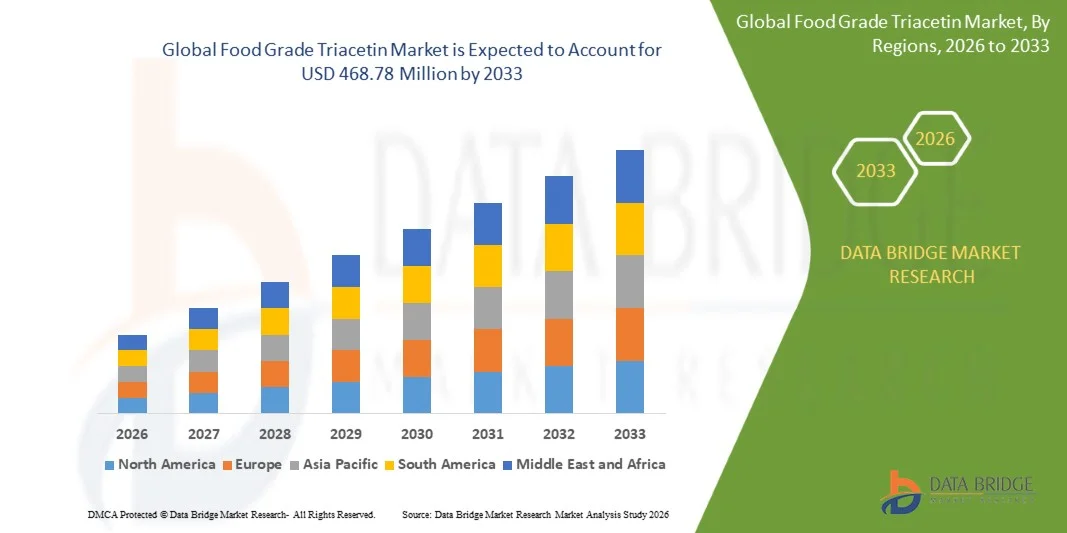
- As per Data Bridge Market Research analysis, the food grade triacetin market was valued at USD 312.50 million in 2025 and is projected to reach USD 468.78 million by 2033, growing at a CAGR of 5.20% from 2026 to 2033.
- The market is experiencing consistent growth driven by rising demand for clean-label flavor carriers, expanding global production of processed and packaged foods, and rapid advancements in high-purity esterification technologies. Triacetin (glycerol triacetate) is widely recognized as a versatile, Food Chemicals Codex (FCC) and Generally Recognized as Safe (GRAS) approved additive that plays a critical role as a flavor solvent, plasticizer, humectant, and antimicrobial stabilizer across diverse food and beverage formulations.
- The increasing consumer preference for convenience foods, shelf-stable bakery items, and novel flavor profiles globally, combined with stringent international food safety standards, is compelling food manufacturers and flavor houses to adopt standardized, high-purity triacetin solutions. Bio-based vegetable glycerin-derived triacetin is increasingly replacing synthetic solvents in many markets, offering eco-friendly, non-GMO, and natural-aligned alternatives for clean-label food applications and flexible food contact materials.
Market Size & Forecast
- Global Market Value (2025): USD 312.50 Million
- Expected Market Value (2033): USD 468.78 Million
- Forecast CAGR (2026–2033): 5.20%
- Leading Region in 2025: North America
- Fastest Growing Region: Asia-Pacific
What are the Major Takeaways of the Food Grade Triacetin Market?
- North America accounted for the largest share of the global food grade triacetin market, capturing 38.25% of revenue in 2025. The region's dominance is attributed to its well-established food processing industry, favorable regulatory framework with FDA GRAS approval, and the strong presence of leading flavor and fragrance manufacturers.
- Asia-Pacific is anticipated to witness the fastest growth, registering a CAGR of 7.10% during 2026–2033. Growth is supported by rapid urbanization, expanding food manufacturing capacity, and increasing consumption of packaged foods and beverages across China, India, and Southeast Asia.
- The solvent segment held the largest market share of 42.15% in 2025, driven by triacetin's excellent ability to dissolve hydrophobic flavor compounds, high thermal stability, and neutral taste, making it a preferred ingredient in food flavor formulations.
- The plasticizer segment is projected to grow at the fastest CAGR of 6.80% over the forecast period, supported by the increasing adoption of plant-based, non-GMO, and sustainable food additives across the food industry.
- The food & beverages segment dominated the market with a 36.50% revenue share in 2025, owing to the extensive use of triacetin by bakeries, confectionery manufacturers, and processed food producers as a humectant and plasticizer to enhance product freshness and texture.
- The pharmaceutical segment is expected to record the fastest CAGR of 6.50% during the forecast period, driven by rising demand for high-purity excipients, expanding pharmaceutical production, and increased utilization of triacetin in capsule formulations and controlled-release drug delivery systems.
Report Scope and Food Grade Triacetin Market Segmentation
|
Attributes |
Food Grade Triacetin Key Market Insights |
|
Segments Covered |
|
|
Countries Covered |
North America
Europe
Asia-Pacific
Middle East and Africa
South America
|
|
Key Market Players |
|
|
Market Opportunities |
|
|
Value Added Data Infosets |
In addition to the insights on market scenarios such as market value, growth rate, segmentation, geographical coverage, and major players, the market reports curated by the Data Bridge Market Research also include in-depth expert analysis, pricing analysis, brand share analysis, consumer survey, demography analysis, supply chain analysis, value chain analysis, raw material/consumables overview, vendor selection criteria, PESTLE Analysis, Porter Analysis, and regulatory framework. |
What is the Key Trend in the Food Grade Triacetin Market?
- Flavor manufacturers and food processing conglomerates are increasingly adopting bio-based, vegetable-derived triacetin as a sustainable, clean-label carrier to replace synthetic organic solvents and phthalate-based plasticizers in food formulations.
- For instance, in March 2025, Eastman Chemical Company expanded its global distribution of Triacetin Renew, an ISCC PLUS-certified food-grade triacetin produced utilizing mass-balance bio-glycerin feedstocks, allowing flavor houses and bakery producers to lower carbon footprints while maintaining full Food Chemicals Codex (FCC) purity compliance.
- High-resolution gas chromatography and real-time sensory profiling enable chemical engineers to verify flavor compound stability and volatility control with exceptional precision in triacetin matrices.
- Beverage developers and confectionery formulation laboratories are leveraging food grade triacetin to deliver clear, concentrated flavor emulsion systems in high-acid soft drinks, zero-sugar beverages, and thermal-processed baked products.
- For instance, in February 2025, Kerry Group's taste division integrated ultra-low odor food-grade triacetin into its citrus and botanical beverage concentrate lines, enhancing volatile flavor retention and preventing flavor degradation during extended ambient storage.
- As global food standards mandate lower synthetic chemical residue limits and transparent supply chains, the adoption of bio-glycerin food grade triacetin is expected to accelerate, reinforcing high-purity triacetin as a foundational ingredient in modern flavor chemistry and packaged food stability.
What are the Key Drivers of the Food Grade Triacetin Market?
- The rapid expansion of the global packaged food industry and growing consumer demand for complex, natural flavor profiles have significantly boosted demand for food grade triacetin as an efficient, low-volatility solvent for essential oils, oleoresins, and delicate aroma chemicals.
- For instance, in March 2025, Givaudan enhanced its global flavor creation centers with automated bio-triacetin dilution systems, enabling precise dosing and rapid compounding of liquid flavor formulations for bakery and dairy end markets.
- Food manufacturers, flavor ingredient suppliers, and beverage bottlers are integrating food grade triacetin into high-speed production lines to ensure uniform flavor dispersion, extend product shelf life, and prevent moisture loss in commercial baked goods.
- For instance, in November 2024, Lanxess AG expanded its production capacity for high-purity food grade triacetin at its European synthesis facility to meet rising global demand from commercial baking networks and chewing gum base manufacturers requiring consistent humectant properties.
- With the global food and beverage sector increasingly prioritizing product freshness, clean-label compliance, and extended distribution stability, food grade triacetin will remain an indispensable multi-functional additive across modern food processing.
Which Factors are Challenging the Growth of the Food Grade Triacetin Market?
- Food grade triacetin manufacturing requires rigorous multi-stage purification and esterification control to eliminate trace acetic acid, heavy metals, and residual mono- and diglycerides, resulting in significant capital and raw material expenditure.
- These price fluctuations in raw feedstocks particularly refined glycerol and acetic anhydride limit profit margins for small and medium-sized ingredient suppliers in price-sensitive developing markets.
- For instance, In February 2025, the European Commission adopted Commission Regulation (EU) 2025/351, introducing stricter quality control, manufacturing practices, and compliance requirements for plastic food-contact materials used across the food industry. Although not specific to triacetin manufacturers, the regulation requires ingredient and food additive suppliers involved in food-contact applications to strengthen quality assurance, documentation, and migration testing, driving additional compliance investments throughout the food ingredient value chain.
- The high raw material volatility and ongoing compliance costs associated with multi-jurisdictional food safety certifications (FDA GRAS, EFSA, Kosher, Halal) continue to restrict market penetration among regional ingredient blenders. This regulatory and cost barrier slows rapid adoption in emerging economies, limiting widespread market deployment despite escalating demand for packaged food.
How is the Food Grade Triacetin Market Segmented?
The food grade triacetin market is segmented on the basis of type, application.
- By Type
On the basis of type, the global food grade triacetin market is segmented into plasticizer, solvent, and humectant. The Solvent segment dominated the market with a 42.15% share in 2025, owing to triacetin's superior solubility for lipophilic flavor compounds, high boiling point, and thermal stability during pasteurization and baking. These characteristics deliver excellent flavor dispersion without altering final product taste, making it the top choice for international flavor houses and ingredient compounding facilities.
The Plasticizer segment is projected to register the fastest growth at a CAGR of 6.30% from 2026 to 2033, driven by rising demand for moisture retention in packaged baked goods, flexible food contact packaging films, and chewing gum bases.
- By Application
On the basis of application, the global food grade triacetin market is segmented into tobacco, food and beverages, pharmaceutical, cosmetic, and chemical. The food and beverages segment dominated the market, accounting for 36.50% of the global revenue share in 2025. The segment's leadership is attributed to the widespread use of food grade triacetin as a solvent, humectant, and plasticizer in bakery, confectionery, dairy, and beverage applications. It helps preserve product softness, extend shelf life, prevent staling, and enhance the stability and uniform dispersion of flavors and fragrances, making it an essential ingredient in processed and packaged food products.
The pharmaceutical segment is projected to register the fastest CAGR of 6.70% during 2026–2033. Growth is primarily driven by the increasing use of food grade triacetin as a pharmaceutical excipient, plasticizer, and solvent in capsule shells, film coatings, and controlled-release drug formulations. Rising demand for advanced oral drug delivery systems, nutraceutical products, and high-quality excipients is expected to further accelerate segment growth over the forecast period.
Which Region Holds the Largest Share of the Food Grade Triacetin Market?
- North America dominated the food grade triacetin market and accounted for the largest revenue share of 38.25% in 2025, supported by advanced food processing infrastructure, strong investments in flavor technology, and the presence of world-leading beverage and confectionery manufacturers.
- The region also benefits from established regulatory clarity under the U.S. FDA GRAS framework, high adoption of clean-label bio-glycerin derivatives, and widespread use of triacetin in bakery humectants and fruit essence concentrates. Increasing focus on organic food certifications and convenient packaged foods continues to strengthen North America's leadership position in the global market.
U.S. Food Grade Triacetin Market Insight
The U.S. food grade triacetin market is experiencing steady growth, supported by rising adoption of advanced flavor carrier technologies in commercial baking, ready-to-drink beverages, and dietary supplements. Increasing investments in bio-based triacetin refining and growing demand for high-purity, non-GMO food additives are contributing to market growth. Furthermore, continuous integration of automated liquid blending systems and strict quality assurance protocols in US flavor labs position the U.S. as a primary innovation hub in the food chemicals industry.
Germany Food Grade Triacetin Market Insight
The Germany food grade triacetin market is expanding steadily due to the country's robust chemical manufacturing base, stringent European food safety standards, and increasing adoption of plant-derived food additives. Flavor companies, confectionery manufacturers, and research centers are increasingly utilizing triacetin for moisture retention, aroma stabilization, and eco-friendly food packaging plasticization. Continuous advancements in esterification efficiency and green chemistry, along with strong EU regulatory support for food safety, are further driving market growth in Germany.
Asia-Pacific Food Grade Triacetin Market Insight
The Asia-Pacific food grade triacetin market is expected to witness rapid growth, driven by increasing urbanization, expanding food processing facilities, and rising investments in packaged food distribution across countries such as China, India, and Japan. Growing consumer awareness regarding food quality, rising adoption of functional beverages, and increasing demand for cost-effective shelf-life extension solutions are supporting regional market expansion. Additionally, the growing presence of major oleochemical production hubs in Southeast Asia is accelerating bio-triacetin availability across food sectors.
Japan Food Grade Triacetin Market Insight
The Japan food grade triacetin market is witnessing consistent growth due to rising investments in premium food formulations, functional confectionery, and advanced flavor preservation technologies. Food manufacturers, beverage bottlers, and chemical synthesis institutes are increasingly adopting high-purity triacetin for delicate taste masking, humectant control, and novel food packaging applications. Moreover, increasing integration of non-GMO bio-glycerin feedstocks and Japan's focus on high-quality food safety standards are further contributing to market growth.
China Food Grade Triacetin Market Insight
The China food grade triacetin market is growing rapidly, driven by rapid industrialization of food processing, expanding beverage production capacity, and rising government focus on food additive safety standardizations. Growing adoption of bio-based esterification platforms across commercial bakeries, flavor houses, and food contact packaging plants is significantly boosting market demand. In addition, rising investments in oleochemical processing, increasing domestic consumption of packaged snacks, and technological upgrades in continuous distillation are positioning China as one of the fastest-growing production and consumption markets for food grade triacetin globally.
Which are the Top Companies in Food Grade Triacetin Market?
The food grade triacetin industry is primarily led by well-established chemical and specialty ingredient companies, including:
- Eastman Chemical Company (U.S.)
- LANXESS (Germany
- Daicel Corporation (Japan)
- Jiangsu Ruijia Food Ingredient Co., Ltd. (China)
- MOSSELMAN (Belgium)
- KLK OLEO (Malaysia)
- BASF SE (Germany)
What are Latest Developments in Food Grade Triacetin Market?
- In September 2025, Eastman Chemical Company expanded its food-grade esterification output by introducing a high-purity continuous distillation process for Triacetin Renew, delivering superior clarity, ultra-low odor profile, and 100% compliance with FCC and USP standards for international flavor and beverage customers.
- In January 2025, Lanxess AG acquired a specialized European oleochemical processing facility to strengthen its bio-based triacetin production line, expanding its capacity to serve global organic baking, confectionery humectant, and eco-friendly food packaging packaging markets.
- In November 2025, KLK Oleo launched its certified Non-GMO Vegetable-Derived Triacetin series, catering specifically to clean-label food processors across Asia-Pacific and Western Europe seeking RSPO-certified palm and coconut-glycerin feedstocks.
- In November 2024, BASF SE upgraded its food additive quality testing capabilities across its Ludwigshafen complex, implementing advanced online mass spectrometry to ensure zero NIAS contamination in food contact plasticizer and flavor solvent triacetin batches.

- Interactive Data Analysis Dashboard
- Company Analysis Dashboard for high growth potential opportunities
- Research Analyst Access for customization & queries
- Competitor Analysis with Interactive dashboard
- Latest News, Updates & Trend analysis
- Harness the Power of Benchmark Analysis for Comprehensive Competitor Tracking
Global Food Grade Triacetin Market, Supply Chain Analysis and Ecosystem Framework
To support market growth and help clients navigate the impact of geopolitical shifts, DBMR has integrated in-depth supply chain analysis into its Global Food Grade Triacetin Market research reports. This addition empowers clients to respond effectively to global changes affecting their industries. The supply chain analysis section includes detailed insights such as Global Food Grade Triacetin Market consumption and production by country, price trend analysis, the impact of tariffs and geopolitical developments, and import and export trends by country and HSN code. It also highlights major suppliers with data on production capacity and company profiles, as well as key importers and exporters. In addition to research, DBMR offers specialized supply chain consulting services backed by over a decade of experience, providing solutions like supplier discovery, supplier risk assessment, price trend analysis, impact evaluation of inflation and trade route changes, and comprehensive market trend analysis.
Data collection and base year analysis are done using data collection modules with large sample sizes. The stage includes obtaining market information or related data through various sources and strategies. It includes examining and planning all the data acquired from the past in advance. It likewise envelops the examination of information inconsistencies seen across different information sources. The market data is analysed and estimated using market statistical and coherent models. Also, market share analysis and key trend analysis are the major success factors in the market report. To know more, please request an analyst call or drop down your inquiry.
The key research methodology used by DBMR research team is data triangulation which involves data mining, analysis of the impact of data variables on the market and primary (industry expert) validation. Data models include Vendor Positioning Grid, Market Time Line Analysis, Market Overview and Guide, Company Positioning Grid, Patent Analysis, Pricing Analysis, Company Market Share Analysis, Standards of Measurement, Global versus Regional and Vendor Share Analysis. To know more about the research methodology, drop in an inquiry to speak to our industry experts.
Data Bridge Market Research is a leader in advanced formative research. We take pride in servicing our existing and new customers with data and analysis that match and suits their goal. The report can be customized to include price trend analysis of target brands understanding the market for additional countries (ask for the list of countries), clinical trial results data, literature review, refurbished market and product base analysis. Market analysis of target competitors can be analyzed from technology-based analysis to market portfolio strategies. We can add as many competitors that you require data about in the format and data style you are looking for. Our team of analysts can also provide you data in crude raw excel files pivot tables (Fact book) or can assist you in creating presentations from the data sets available in the report.













