


Food Grade Vitamin A Market Overview
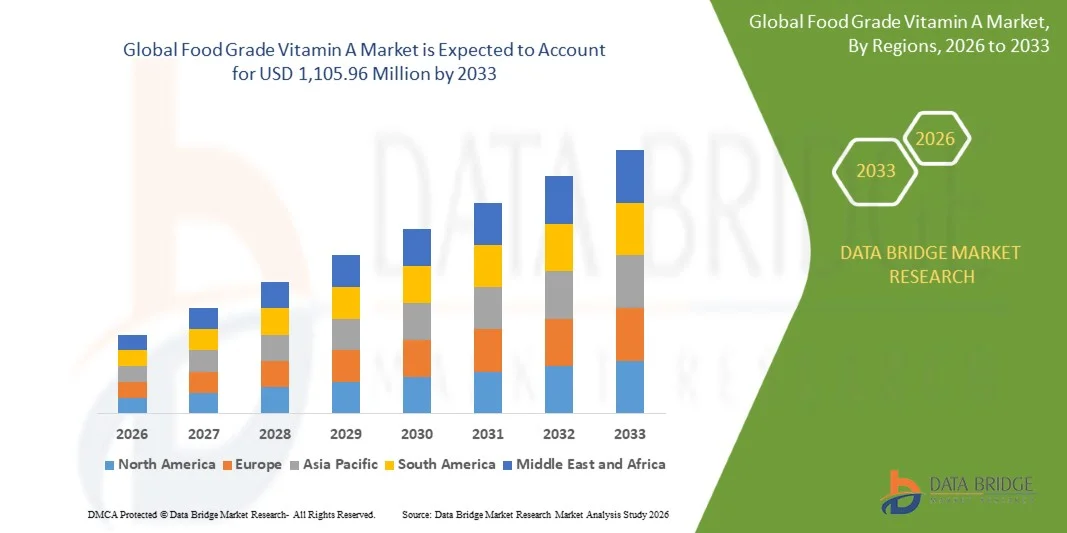
As per Data Bridge Market Research analysis The food grade vitamin A market was valued at USD 748.56 million in 2025 and is projected to reach USD 1,105.96 million by 2033, growing at a CAGR of 5.00% from 2026 to 2033. The market is experiencing steady growth driven by increasing demand for fortified food and beverage products, rising consumer awareness regarding nutritional health, and expanding applications of vitamin A in functional foods, dietary supplements, and infant nutrition formulations.
The growing prevalence of vitamin A deficiency in several developing regions, coupled with government-led food fortification initiatives and public health programs, is encouraging food manufacturers to incorporate food grade vitamin A into a wide range of products. Advances in microencapsulation and stabilization technologies are improving the shelf life and bioavailability of vitamin A ingredients, while the rising preference for preventive healthcare and nutrient-enriched foods continues to support market expansion across both developed and emerging economies.
Market Size & Forecast
- Global Market Value (2025): USD 748.56 Million
- Expected Market Value (2033): USD 1,105.96 Million
- Forecast CAGR (2026–2033): 5.00%
- Leading Region in 2025: North America
- Fastest Growing Region: Asia Pacific
Key Market Trends & Insights
- North America dominated the food grade vitamin A market with the largest revenue share of 35.12% in 2025, supported by high consumption of fortified foods, strong dietary supplement demand, and established food processing industries.
- The High Purity Feed Grade Vitamin A segment led the market with a 63.84% share in 2025, driven by its superior bioavailability, consistent quality, and extensive use in premium food fortification applications
- Asia-Pacific is expected to be the fastest-growing region at a CAGR of 7.4% from 2026 to 2033, fueled by rising nutritional awareness, government fortification programs, and increasing consumption of functional foods in China, India, and Southeast Asia
- Low Purity Feed Grade Vitamin A are the fastest-growing type, projected to register a CAGR of 6.8%, reflecting the surge in demand for cost-effective fortification solutions across emerging economies.
- The Powder segment dominated the form category with a 46.27% revenue share in 2025, led by its ease of handling, storage stability, and compatibility with a wide range of food manufacturing processes.
- Human Nutrition accounted for 78.65% of the market, preferred by widespread use of vitamin A in fortified foods, dietary supplements, infant formula, and functional nutrition products.
- The Cosmetics segment is the fastest-growing application category, with a CAGR of 6.5%, driven by increasing utilization of vitamin A-based ingredients in skincare, anti-aging, and personal care formulations.
Report Scope and Food Grade Vitamin A Market Segmentation
|
Attributes |
Food Grade Vitamin A Key Market Insights |
|
Segments Covered |
|
|
Countries Covered |
North America · U.S. · Canada · Mexico Europe · Germany · France · U.K. · Netherlands · Switzerland · Belgium · Russia · Italy · Spain · Turkey · Rest of Europe Asia-Pacific · China · Japan · India · South Korea · Singapore · Malaysia · Australia · Thailand · Indonesia · Philippines · Rest of Asia-Pacific Middle East and Africa · Saudi Arabia · U.A.E. · South Africa · Egypt · Israel · Rest of Middle East and Africa South America · Brazil · Argentina · Rest of South America |
|
Key Market Players |
· dsm-firmenich (Switzerland) · BASF SE (Germany) · Zhejiang NHU Co., Ltd. (China) · Zhejiang Medicine Co., Ltd. (China) · Adisseo (France) · Xiamen Kingdomway Group Company (China) · Archer Daniels Midland Company (U.S.) · Prinova Group LLC (U.S.) · SternVitamin GmbH & Co. KG (Germany) · Fermenta Biotech Limited (India) · Hexagon Nutrition Limited (India) · Sudeep Nutrition Pvt. Ltd. (India) · Jubilant Ingrevia Limited (India) · Foodchem International Corporation (China) · Fenchem Biotek Ltd. (China) · Divi's Laboratories Limited (India) · Nutrilo GmbH (Germany) · Glanbia Nutritionals, Inc. (U.S.) · Balchem Corporation (U.S.) · Farbest Brands (U.S.) |
|
Market Opportunities |
· Expansion of mandatory food fortification programs in emerging economies · Growing adoption of microencapsulated vitamin A technologies · Rising demand for clean-label and naturally sourced micronutrients |
|
Value Added Data Infosets |
In addition to the insights on market scenarios such as market value, growth rate, segmentation, geographical coverage, and major players, the market reports curated by the Data Bridge Market Research also include in-depth expert analysis, pricing analysis, brand share analysis, consumer survey, demography analysis, supply chain analysis, value chain analysis, raw material/consumables overview, vendor selection criteria, PESTLE Analysis, Porter Analysis, and regulatory framework. |
Food Grade Vitamin A Market Trends
Trend: Rising Demand for Fortified and Functional Food Products
Food manufacturers are increasingly incorporating food grade vitamin A into fortified foods and beverages to address nutritional deficiencies, support immune health, and meet growing consumer demand for functional nutrition. The integration of advanced encapsulation technologies enables improved stability, controlled release, and enhanced nutrient retention during processing and storage. Dairy producers, beverage companies, and packaged food brands are similarly utilizing vitamin A fortification to differentiate products through science-backed health benefits, while clean-label formulations create appealing offerings that align with evolving consumer preferences.
For instance, in March 2024, several global food manufacturers expanded fortified dairy and cereal product portfolios containing vitamin A to support nutrition-focused consumer demand and public health objectives.
Food Grade Vitamin A Market Dynamics
Key Market Driver: Growing Government Support for Food Fortification Programs
The increasing implementation of national food fortification initiatives and nutritional improvement programs has created substantial demand for food grade vitamin A that can enhance dietary intake and address micronutrient deficiencies across large populations. Food manufacturers, ingredient suppliers, and public health organizations are deploying vitamin A fortification as a core component of nutrition strategies, improving accessibility, supporting regulatory compliance, and strengthening consumer health outcomes through cost-effective intervention programs.
For instance, ongoing vitamin A fortification mandates for edible oils, flour, and staple foods across several developing economies continue to stimulate demand for food grade vitamin A ingredients.
Key Restraint/Challenge: Stability and Degradation Issues During Food Processing
A significant restraint in the food grade vitamin A market is the susceptibility of vitamin A compounds to degradation during processing, storage, and distribution. Modern food production environments expose vitamin A ingredients to heat, oxygen, moisture, and light, requiring specialized stabilization technologies and formulation expertise. The resulting manufacturing complexity extends to quality assurance, ingredient protection, and shelf-life management, making consistent nutrient retention difficult for food processors operating across diverse product categories and distribution networks.
For instance, manufacturers of fortified beverages and bakery products frequently invest in encapsulation and stabilization systems to minimize vitamin A losses during processing and storage.
Key Market Opportunity: Expansion of Natural and Clean-Label Vitamin A Ingredients
The increasing consumer preference for naturally sourced nutritional ingredients presents a significant market opportunity. Natural vitamin A solutions derived from carotenoids can support clean-label product development, enhance brand positioning, and satisfy growing demand for transparent ingredient sourcing. The development of advanced extraction technologies and sustainable production methods is further improving commercial viability, opening growth opportunities across premium food, beverage, and nutritional supplement markets in North America, Europe, and Asia-Pacific.
For instance, leading ingredient manufacturers are expanding investments in naturally derived carotenoid-based vitamin A solutions to address rising clean-label and plant-based nutrition trends.
Food Grade Vitamin A Market Scope
The food grade vitamin A market is segmented on the basis of type, form, and application
- By Type
On the basis of type, the food grade vitamin A market is segmented into high purity feed grade vitamin A and low purity feed grade vitamin A. The High Purity Feed Grade Vitamin A segment dominated the market with a 63.84% share in 2025, owing to its superior bioavailability, consistent quality, and extensive use in premium food fortification applications. Food manufacturers prefer high-purity formulations because they ensure accurate nutrient delivery and compliance with stringent food safety regulations. These products are widely utilized in fortified dairy products, infant nutrition, dietary supplements, and functional foods. Their enhanced stability and effectiveness make them suitable for applications requiring precise nutritional content. Increasing consumer demand for high-quality fortified food products is further supporting segment growth. Strong regulatory emphasis on micronutrient fortification continues to reinforce its market leadership.
The Low Purity Feed Grade Vitamin A segment is projected to register the fastest growth at a CAGR of 6.8% from 2026 to 2033, driven by increasing demand for cost-effective fortification solutions across emerging economies. Manufacturers are adopting lower-purity formulations in price-sensitive markets where affordability remains a key purchasing factor. Growing government-led nutrition programs are also encouraging broader usage in staple food fortification initiatives. These products offer a practical balance between nutritional enhancement and production cost management. Expanding food processing industries in developing regions are creating additional demand opportunities. Rising focus on improving nutritional accessibility among larger population groups is expected to accelerate segment expansion during the forecast period.
- By Form
On the basis of form, the food grade vitamin A market is segmented into powder, liquid, beadlets, and microencapsulated form. The Powder segment dominated the market with a 46.27% share in 2025, driven by its ease of handling, storage stability, and compatibility with a wide range of food manufacturing processes. Powdered vitamin A is extensively used in bakery products, dairy products, nutritional supplements, and fortified food blends. The format allows accurate dosing and efficient mixing during large-scale production. Manufacturers favor powder formulations because they provide longer shelf life and simplified transportation requirements. Their cost-effectiveness and operational flexibility contribute significantly to widespread adoption. Continuous growth in food fortification programs is further supporting segment dominance.
The Microencapsulated Form segment is expected to witness the fastest growth at a CAGR of 7.1% from 2026 to 2033, driven by increasing demand for enhanced nutrient stability and controlled release characteristics. Microencapsulation technologies protect vitamin A from degradation caused by heat, oxygen, moisture, and light exposure during processing and storage. These formulations improve bioavailability while maintaining nutritional integrity throughout product shelf life. Food manufacturers are increasingly adopting microencapsulated ingredients in premium functional foods and beverages. Technological advancements in encapsulation processes are making these solutions more commercially viable. Growing demand for high-performance fortified products is expected to sustain strong segment growth over the forecast period.
- By Application
On the basis of application, the food grade vitamin A market is segmented into human nutrition and cosmetics. The Human Nutrition segment led the market with a 78.65% share in 2025, driven by widespread use of vitamin A in fortified foods, dietary supplements, infant formula, and functional nutrition products. Rising awareness regarding immune health, vision support, and overall wellness has significantly increased consumer demand for vitamin A-enriched products. Governments and public health organizations continue to promote food fortification programs to address micronutrient deficiencies. Food and beverage manufacturers are expanding fortified product portfolios to meet evolving nutritional requirements. Growing preventive healthcare trends are further strengthening market demand. The segment also benefits from strong regulatory support for nutritional enhancement initiatives worldwide.
The Cosmetics segment is projected to register the fastest growth at a CAGR of 6.5% from 2026 to 2033, driven by increasing utilization of vitamin A-based ingredients in skincare, anti-aging, and personal care formulations. Vitamin A derivatives are widely recognized for supporting skin renewal, texture improvement, and appearance enhancement. Rising consumer spending on premium beauty and wellness products is encouraging greater adoption across cosmetic applications. Manufacturers are continuously developing innovative formulations incorporating vitamin A to improve product effectiveness and differentiation. Expanding beauty and personal care industries across emerging markets are creating additional growth opportunities. Growing preference for scientifically supported skincare ingredients is expected to accelerate demand throughout the forecast period.
Food Grade Vitamin A Market Regional Analysis
North America dominated the food grade vitamin A market with the largest revenue share of 35.12% in 2025, supported by high consumption of fortified foods, strong dietary supplement demand, and established food processing industries. The region also benefits from advanced food fortification programs, stringent food safety regulations, and widespread adoption of vitamin-enriched products across dairy, beverage, and functional food applications. Increasing consumer awareness regarding preventive healthcare and nutritional wellness continues to drive demand for vitamin A-fortified products. Growing investments in innovative nutrient delivery technologies and clean-label formulations further strengthen North America's leadership position in the global market..
U.S. Food Grade Vitamin A Market Insight
The U.S. food grade vitamin A market is witnessing strong growth due to rising demand for fortified food products, dietary supplements, and functional nutrition solutions. The country’s mature food processing and nutraceutical ecosystem, along with increasing adoption of preventive healthcare and wellness-focused consumption patterns, is driving demand across food, beverage, and supplement applications. In addition, growing emphasis on addressing micronutrient deficiencies and improving nutritional quality standards is accelerating vitamin A incorporation across food manufacturers and nutrition product developers.
Europe Food Grade Vitamin A Market Insight
The Europe food grade vitamin A market remains a major contributor to global revenue, driven by strong regulatory support, nutritional awareness, and high demand for fortified food solutions. The widespread use of vitamin A ingredients in dairy products, infant nutrition, and functional food formulations is supporting market expansion across the region. Increasing investments in advanced nutrient delivery technologies, coupled with strict food safety regulations and growing consumer preference for health-focused products, continue to enhance the adoption of food grade vitamin A throughout Europe.
U.K. Food Grade Vitamin A Market Insight
The U.K. food grade vitamin A market is experiencing steady growth, supported by rising consumption of fortified foods, dietary supplements, and nutrition-enhancing ingredients. Increasing investments in food innovation and growing demand for high-quality, health-oriented food products are contributing to market growth. Furthermore, integration of advanced fortification technologies and increasing consumer focus on immunity, vision health, and overall wellness are improving product demand, positioning the U.K. as a key innovation hub in the food grade vitamin A industry.
Germany Food Grade Vitamin A Market Insight
The Germany food grade vitamin A market is expanding steadily due to the country’s strong food manufacturing base, advanced nutritional research capabilities, and increasing adoption of fortified food products. Food companies, ingredient manufacturers, and nutrition brands are increasingly utilizing vitamin A for food enrichment, product differentiation, and health-focused formulations. Continuous advancements in encapsulation technologies, ingredient stability, and nutrient delivery systems, along with strong regulatory focus on food quality and innovation, are further driving market growth in Germany.
Asia-Pacific Food Grade Vitamin A Market Insight
The Asia-Pacific food grade vitamin A market is expected to witness rapid growth, driven by increasing nutritional awareness, expanding food processing industries, and rising investments in food fortification programs across countries such as China, India, and Japan. Growing awareness regarding micronutrient deficiencies, rising adoption of fortified food products, and increasing demand for affordable and accessible nutrition solutions are supporting regional market expansion. In addition, the growing presence of functional food manufacturers and government-led nutrition initiatives is accelerating vitamin A adoption across commercial and public health sectors.
Japan Food Grade Vitamin A Market Insight
The Japan food grade vitamin A market is witnessing consistent growth due to rising demand for functional foods, nutritional supplements, and health-oriented food products. Food manufacturers, nutraceutical companies, and research institutes are increasingly adopting advanced vitamin A formulations for product enhancement, nutritional improvement, and innovation purposes. Moreover, increasing integration of microencapsulation technologies and the country’s focus on healthy aging and preventive healthcare solutions are further contributing to market growth.
China Food Grade Vitamin A Market Insight
The China food grade vitamin A market is growing rapidly, driven by increasing health awareness, expanding food manufacturing infrastructure, and rising government focus on nutritional improvement and food fortification initiatives. Growing adoption of vitamin-enriched food products across dairy, beverage, and processed food sectors is significantly boosting market demand. In addition, rising investments in nutrition-focused product development, increasing awareness regarding balanced dietary intake, and rapid industrial advancements are positioning China as one of the fastest-growing markets for food grade vitamin A globally.
Food Grade Vitamin A Market Share
The food grade vitamin A industry is primarily led by well-established companies, including:
- dsm-firmenich (Switzerland)
- BASF SE (Germany)
- Zhejiang NHU Co., Ltd. (China)
- Zhejiang Medicine Co., Ltd. (China)
- Adisseo (France)
- Xiamen Kingdomway Group Company (China)
- Archer Daniels Midland Company (U.S.)
- Prinova Group LLC (U.S.)
- SternVitamin GmbH & Co. KG (Germany)
- Fermenta Biotech Limited (India)
- Hexagon Nutrition Limited (India)
- Sudeep Nutrition Pvt. Ltd. (India)
- Jubilant Ingrevia Limited (India)
- Foodchem International Corporation (China)
- Fenchem Biotek Ltd. (China)
- Divi's Laboratories Limited (India)
- Nutrilo GmbH (Germany)
- Glanbia Nutritionals, Inc. (U.S.)
- Balchem Corporation (U.S.)
- Farbest Brands (U.S.)
Latest Developments in Food Grade Vitamin A Market
- In March 2025, dsm-firmenich announced a partnership with MedAccess to secure affordable vitamin A pricing for edible oil fortification programs in low- and middle-income countries. The collaboration is designed to improve access to food-grade vitamin A for large-scale nutrition initiatives, strengthen supply chain resilience, and support governments in addressing vitamin A deficiency through staple food fortification. This development reinforces the company's commitment to global nutrition and food security
- In October 2024, dsm-firmenich launched Dry Vit A Palmitate for Early Life Nutrition, a breakthrough clean-label food-grade vitamin A ingredient specifically designed for infant formula applications. The innovation delivers improved stability compared to conventional vitamin A ingredients while helping manufacturers enhance the nutritional quality of early-life nutrition products. The launch highlights ongoing advancements in food-grade vitamin A formulation technology
- In September 2024, dsm-firmenich introduced Dry Vitamin A Palmitate NI, a new food-grade dry vitamin A solution developed for flour fortification programs. The ingredient provides enhanced stability during food processing and storage while helping manufacturers combat vitamin A deficiency through large-scale food fortification initiatives. The product supports clean-label formulation trends and improved nutrient retention
- In August 2024, BASF declared force majeure for selected vitamin A products following a fire at its Ludwigshafen production site in Germany. The incident temporarily disrupted the supply of vitamin A ingredients used across food, nutrition, and related industries, prompting the company to work closely with customers while restoring production capacity. The event highlighted the importance of supply chain resilience in the global vitamin A market
- In June 2024, dsm-firmenich stated that rising consumer interest in healthier lifestyles and preventive nutrition was supporting increased demand for nutrition ingredients, including vitamins used in fortified foods and dietary supplements. The company highlighted long-term opportunities driven by wellness trends and growing adoption of nutrient-enriched food products, reinforcing positive prospects for food-grade vitamin ingredients

- Interactive Data Analysis Dashboard
- Company Analysis Dashboard for high growth potential opportunities
- Research Analyst Access for customization & queries
- Competitor Analysis with Interactive dashboard
- Latest News, Updates & Trend analysis
- Harness the Power of Benchmark Analysis for Comprehensive Competitor Tracking
Global Food Grade Vitamin A Market, Supply Chain Analysis and Ecosystem Framework
To support market growth and help clients navigate the impact of geopolitical shifts, DBMR has integrated in-depth supply chain analysis into its Global Food Grade Vitamin A Market research reports. This addition empowers clients to respond effectively to global changes affecting their industries. The supply chain analysis section includes detailed insights such as Global Food Grade Vitamin A Market consumption and production by country, price trend analysis, the impact of tariffs and geopolitical developments, and import and export trends by country and HSN code. It also highlights major suppliers with data on production capacity and company profiles, as well as key importers and exporters. In addition to research, DBMR offers specialized supply chain consulting services backed by over a decade of experience, providing solutions like supplier discovery, supplier risk assessment, price trend analysis, impact evaluation of inflation and trade route changes, and comprehensive market trend analysis.
Data collection and base year analysis are done using data collection modules with large sample sizes. The stage includes obtaining market information or related data through various sources and strategies. It includes examining and planning all the data acquired from the past in advance. It likewise envelops the examination of information inconsistencies seen across different information sources. The market data is analysed and estimated using market statistical and coherent models. Also, market share analysis and key trend analysis are the major success factors in the market report. To know more, please request an analyst call or drop down your inquiry.
The key research methodology used by DBMR research team is data triangulation which involves data mining, analysis of the impact of data variables on the market and primary (industry expert) validation. Data models include Vendor Positioning Grid, Market Time Line Analysis, Market Overview and Guide, Company Positioning Grid, Patent Analysis, Pricing Analysis, Company Market Share Analysis, Standards of Measurement, Global versus Regional and Vendor Share Analysis. To know more about the research methodology, drop in an inquiry to speak to our industry experts.
Data Bridge Market Research is a leader in advanced formative research. We take pride in servicing our existing and new customers with data and analysis that match and suits their goal. The report can be customized to include price trend analysis of target brands understanding the market for additional countries (ask for the list of countries), clinical trial results data, literature review, refurbished market and product base analysis. Market analysis of target competitors can be analyzed from technology-based analysis to market portfolio strategies. We can add as many competitors that you require data about in the format and data style you are looking for. Our team of analysts can also provide you data in crude raw excel files pivot tables (Fact book) or can assist you in creating presentations from the data sets available in the report.













