


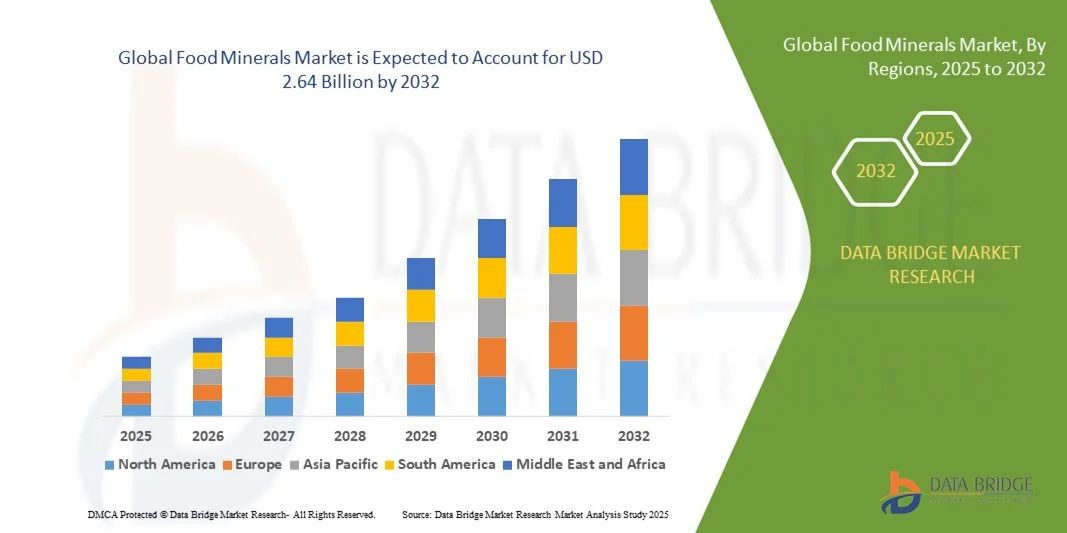
Global Food Minerals Market Size
- The global Food Minerals Market size was valued at USD 1.70 billion in 2024 and is projected to reach USD 2.64 billion by 2032, growing at a CAGR of 5.70% during the forecast period.
- Market expansion is primarily driven by increasing awareness of nutritional deficiencies and the essential role of dietary minerals in maintaining overall health, especially amid aging populations and rising health concerns.
- Additionally, the surge in demand for fortified and functional foods, coupled with innovations in nutraceutical formulations and clean-label trends, is propelling the adoption of food minerals across global markets, significantly fueling industry growth.
Global Food Minerals Market Analysis
- Food minerals, essential nutrients required for various bodily functions, are becoming increasingly crucial in modern diets due to growing awareness of micronutrient deficiencies and their impact on long-term health, especially among aging populations and individuals with specific dietary needs.
- The rising demand for food minerals is primarily driven by increasing health consciousness, expanding markets for fortified foods and beverages, and a growing preference for functional and clean-label products among consumers worldwide.
- North America led the global food minerals market with the largest revenue share of 33.3% in 2024, supported by strong demand for nutraceuticals, a well-established health and wellness culture, and high consumer spending on dietary supplements and fortified food products. The U.S. continues to drive innovation in this space through advancements in personalized nutrition and plant-based mineral sources.
- Asia-Pacific is anticipated to be the fastest-growing region in the food minerals market during the forecast period, fueled by rapid urbanization, a growing middle class, and increased awareness of preventive healthcare and nutrition.
The calcium segment dominated the market with the largest market revenue share of 28.7% in 2024, primarily due to its critical role in bone health, muscle function, and cardiovascular performance
Report Scope and Global Food Minerals Market Segmentation
|
Attributes |
Food Minerals Key Market Insights |
|
Segments Covered |
|
|
Countries Covered |
North America
Europe
Asia-Pacific
Middle East and Africa
South America
|
|
Key Market Players |
|
|
Market Opportunities |
|
|
Value Added Data Infosets |
In addition to the insights on market scenarios such as market value, growth rate, segmentation, geographical coverage, and major players, the market reports curated by the Data Bridge Market Research also include in-depth expert analysis, pricing analysis, brand share analysis, consumer survey, demography analysis, supply chain analysis, value chain analysis, raw material/consumables overview, vendor selection criteria, PESTLE Analysis, Porter Analysis, and regulatory framework. |
Global Food Minerals Market Trends
Rising Innovation in Personalized Nutrition and AI-Driven Supplementation
- A significant and accelerating trend in the global Food Minerals Market is the growing integration of artificial intelligence (AI) and personalized nutrition platforms, enabling tailored dietary mineral solutions based on individual health profiles, genetic data, and lifestyle factors. This shift is revolutionizing how consumers approach mineral intake and preventive health.
- For Instance, platforms such as Baze and Care/of use AI-driven health assessments and biomarker data to create customized supplement packs, including precise doses of essential minerals such as calcium, magnesium, zinc, and iron, based on individual nutritional gaps and goals.
- AI in the food minerals space is also powering predictive analytics and formulation optimization, helping manufacturers develop mineral-enriched functional foods targeted at specific demographics like athletes, seniors, or those with chronic health conditions. Companies are leveraging AI to simulate mineral bioavailability and absorption rates, ensuring more effective supplementation.
- Furthermore, AI-enabled apps and digital health tools allow users to track mineral intake, receive real-time dietary recommendations, and sync with wearables to monitor overall health metrics, making daily nutrition more responsive and data-driven.
- The integration of food minerals with broader digital health ecosystems is creating a seamless consumer experience where dietary planning, product selection, and wellness tracking occur within a unified platform. Brands are now aligning with health tech startups to embed trace mineral supplementation into broader preventive health programs.
- As consumers increasingly demand customized, science-backed, and tech-enabled nutrition solutions, this convergence of AI and food minerals is driving rapid innovation in the market. Leading players such as DSM, Glanbia, and BASF are actively investing in personalized nutrition technologies and digital platforms to capture this evolving consumer interest.
Global Food Minerals Market Dynamics
Driver
Growing Need Due to Increasing Health Awareness and Nutritional Deficiencies
-
The rising global awareness of micronutrient deficiencies and the increasing prevalence of diet-related health issues—such as osteoporosis, anemia, and immune disorders—are major factors fueling the demand for food minerals across both developed and developing markets.
- For instance, the World Health Organization (WHO) reports that over 2 billion people globally suffer from micronutrient deficiencies, with iron, iodine, and zinc being the most common. This growing public health concern is prompting governments and organizations to promote food fortification and encourage mineral-enriched diets, thereby boosting market demand.
- Food minerals offer vital health benefits including bone strength, immune support, cognitive function, and metabolism regulation, making them essential components of fortified foods, beverages, and dietary supplements. As consumers become more proactive about preventive health, the shift toward functional nutrition is becoming increasingly pronounced.
- Moreover, the expansion of the health and wellness industry, growing interest in plant-based and clean-label products, and increased investment in clinical nutrition are positioning food minerals as a cornerstone in both mainstream and specialized nutrition.
- In emerging markets, rising disposable incomes, expanding urban populations, and increased access to nutrition education are driving the adoption of fortified staple foods, especially among children and women of reproductive age. Governments are partnering with private companies to support public health supplementation programs, further contributing to market expansion.
Restraint/Challenge
Challenges in Bioavailability and Cost of Fortification
- One of the key challenges in the food minerals market is ensuring bioavailability, i.e., the body's ability to absorb and utilize the added minerals effectively. Certain minerals, such as iron and calcium, are known for poor absorption rates when not combined with the right enhancers or food matrices, limiting the efficacy of fortified products.
- For Instance, high doses of iron can cause gastrointestinal discomfort or compete with the absorption of other minerals, making formulation complex and often requiring multiple testing cycles. Manufacturers are increasingly turning to nanoencapsulation, chelated minerals, and liposomal delivery systems, but these advanced technologies come at a higher cost.
- Additionally, fortification costs—particularly in large-scale food production—can be a barrier for small and mid-sized food manufacturers, especially in price-sensitive or developing markets. While bulk minerals like calcium carbonate are relatively inexpensive, bioavailable alternatives or blends customized for specific demographic needs often carry a premium.
- Consumer perception also poses a challenge: skepticism around synthetic additives or fears of overconsumption of certain nutrients can affect the uptake of fortified products. Clean-label trends may conflict with fortification unless minerals are derived from natural or plant-based sources.
- Overcoming these obstacles will require further R&D investments, transparent labeling, consumer education, and the development of cost-effective, highly bioavailable mineral solutions to ensure continued growth and acceptance across all market segments.
Global Food Minerals Market Scope
The market is segmented on the basis of type, , source, application, end user
- By Type
On the basis of type, the food minerals market is segmented into zinc, magnesium, calcium, iron, copper, iodine, chromium, chloride, and others. The calcium segment dominated the market with the largest market revenue share of 28.7% in 2024, primarily due to its critical role in bone health, muscle function, and cardiovascular performance. Widely included in dairy products, fortified foods, and supplements, calcium is highly demanded across all age groups, especially in aging populations and health-conscious consumers. The broad application of calcium in both food and pharmaceutical formulations further supports its dominance.
The magnesium segment is anticipated to witness the fastest growth rate of 19.4% from 2025 to 2032, driven by rising awareness about its benefits for energy production, nerve function, and mental health. Increased inclusion in plant-based foods and functional beverages, alongside growing trends in wellness and stress management, contribute to its projected rapid growth.
- By Source
On the basis of source, the food minerals market is segmented into marine, fruits, vegetables, seaweed, nuts, and others. The vegetables segment held the largest market revenue share in 2024, owing to the widespread consumption of mineral-rich vegetables such as spinach, broccoli, kale, and legumes. These natural sources are preferred due to growing consumer demand for clean-label and organic products, supported by health and wellness trends that emphasize plant-based nutrition.
The seaweed segment is projected to witness the fastest CAGR of 21.1% from 2025 to 2032, attributed to its rich mineral content including iodine, calcium, and magnesium. As sustainable food sources gain momentum, seaweed’s high nutrient density and minimal environmental impact are driving its adoption in functional foods, supplements, and even as fortifying agents in snacks and beverages. Its use in vegan and alternative nutrition products is also accelerating its market growth.
- By Application
On the basis of application, the food minerals market is segmented into beverages, dairy, sweets, savory, and others. The beverages segment dominated the market in 2024, accounting for the largest market revenue share, largely driven by the surge in consumption of mineral-fortified drinks such as sports beverages, energy drinks, and functional waters. These products cater to a wide demographic including athletes, fitness enthusiasts, and health-conscious consumers seeking convenient mineral intake solutions.
The savory segment is expected to witness the fastest CAGR of 20.3% from 2025 to 2032, propelled by innovation in fortified snacks, soups, and ready meals. With the expansion of the health snack segment and increased demand for nutrient-dense processed foods, manufacturers are integrating essential minerals to enhance nutritional value. Consumers' preference for healthier indulgent options and increased label scrutiny are also key drivers behind this segment’s growth.
- By End User
On the basis of end user, the food minerals market is segmented into nutraceutical, pharmaceutical, food and beverages. The food and beverages segment held the largest market revenue share in 2024, driven by the rising demand for fortified foods to address nutritional deficiencies and promote general wellness. Consumer awareness around preventive health, coupled with regulatory support for fortification in staple foods, is fueling market dominance. Widespread application across categories—from bakery to dairy—also sustains this segment’s leadership.
The nutraceutical segment is anticipated to witness the fastest growth rate of 22.5% from 2025 to 2032, spurred by growing interest in functional nutrition and personalized dietary supplements. Consumers are increasingly turning to mineral-enriched nutraceuticals to support immunity, cognitive health, and overall vitality. As self-care and supplement use continue to rise post-pandemic, demand for trace minerals like zinc, magnesium, and iron in capsule, gummy, and powder forms is accelerating within this segment.
Global Food Minerals Market Regional Analysis
- North America dominated the global food minerals market with the largest revenue share of 33.3% in 2024, driven by rising health awareness, high consumption of dietary supplements, and a strong demand for functional and fortified food products.
- Consumers in the region prioritize nutritional transparency, personalized health solutions, and the inclusion of essential minerals like calcium, magnesium, and iron in their daily diets through both supplements and fortified foods.
- This widespread adoption is further supported by advanced healthcare infrastructure, high disposable incomes, and a well-established wellness industry, positioning food minerals as a key component of preventive healthcare and everyday nutrition across the region.
U.S. Food Minerals Market Insight
The U.S. food minerals market captured the largest revenue share of 79% in 2024 within North America, driven by a growing focus on preventive healthcare, aging population, and high demand for dietary supplements. Consumers increasingly seek personalized nutrition solutions, leading to a surge in fortified food and beverage consumption containing minerals such as calcium, magnesium, and zinc. The presence of major supplement manufacturers and health-conscious consumers, combined with well-established retail and e-commerce channels, continues to fuel market expansion.
Europe Food Minerals Market Insight
The Europe food minerals market is projected to expand at a substantial CAGR throughout the forecast period, supported by strict nutritional regulations, increasing awareness of micronutrient deficiencies, and demand for clean-label fortified products. The region’s focus on functional foods, especially in countries like Germany, France, and the Netherlands, is driving innovation in mineral fortification. Rising consumer preference for plant-based and sustainable nutrition is also contributing to the region’s dynamic market landscape, particularly in dairy alternatives, snacks, and beverages.
U.K. Food Minerals Market Insight
The U.K. food minerals market is anticipated to grow at a noteworthy CAGR during the forecast period, bolstered by a heightened focus on public health nutrition and government-backed initiatives aimed at reducing nutrient deficiencies. The market benefits from a growing demand for fortified cereals, dairy, and beverages, especially among young adults and elderly populations. The U.K.'s active engagement in promoting functional nutrition and innovations in personalized supplementation is expected to further stimulate market growth.
Germany Food Minerals Market Insight
The Germany food minerals market is expected to expand at a considerable CAGR, driven by consumer preference for natural and scientifically backed nutrition. Germany’s strong health and wellness culture, coupled with demand for organic and sustainable mineral sources, supports the growth of plant-based and clean-label fortified products. The country's well-developed food processing industry and high level of consumer health awareness make it a key hub for functional and fortified food innovation across Europe.
Asia-Pacific Food Minerals Market Insight
The Asia-Pacific food minerals market is poised to grow at the fastest CAGR of 23.5% from 2025 to 2032, propelled by rising urbanization, growing middle-class income, and increasing awareness of health and nutrition across emerging economies such as China, India, and Southeast Asia. Government initiatives supporting nutritional fortification, combined with changing dietary habits and expansion of the functional food industry, are significantly boosting the demand for food minerals across the region.
Japan Food Minerals Market Insight
The Japan food minerals market is gaining momentum due to the country’s aging population, demand for personalized and functional nutrition, and a preference for science-backed health products. Japanese consumers place a strong emphasis on disease prevention and longevity, which drives the consumption of mineral-enriched foods and supplements. Innovation in delivery formats, such as powdered drinks and gummy supplements, is also playing a role in market expansion.
China Food Minerals Market Insight
The China food minerals market accounted for the largest market revenue share in Asia-Pacific in 2024, owing to rapid urbanization, a growing middle class, and government support for micronutrient fortification programs. China's massive food manufacturing base, increasing adoption of health supplements, and the popularity of functional beverages are key growth drivers. Additionally, the rise of e-commerce and domestic health brands offering affordable mineral supplements is expanding consumer access across urban and rural markets.
Global Food Minerals Market Share
The Food Minerals industry is primarily led by well-established companies, including:
- Cargill, Incorporated (U.S.)
- Balchem Corporation (U.S.)
- SPI Pharma, Inc. (U.S.)
- ABF Ingredients Limited (U.K.)
- Waitaki Bio (New Zealand)
- Sigma Minerals Limited (India)
- Calspar India (India)
- Adani Pharmachem Private Limited (India)
- Koninklijke DSM N.V. (Netherlands)
- BASF SE (Germany)
- Glanbia Plc (Ireland)
- SternVitamin GmbH (Germany)
- Barentz International B.V. (Netherlands)
- Hexagon Nutrition Pvt. Ltd. (India)
- Farbest Tallman Foods Corporation (U.S.)
- Corbion NV (Netherlands)
What are the Recent Developments in Global Food Minerals Market?
- In May 2023, Koninklijke DSM N.V., a global science-based company in nutrition and health, launched a new AI-powered personalized nutrition platform to offer tailored mineral supplementation solutions based on individual health assessments. This initiative reflects DSM’s ongoing commitment to innovation in functional nutrition and preventive healthcare, positioning the company at the forefront of the evolving Global Food Minerals Market by integrating digital technology with scientifically backed nutritional products.
- In April 2023, Glanbia Plc introduced a new line of magnesium- and zinc-fortified performance nutrition products under its sports nutrition brand portfolio. Designed to support muscle function, recovery, and immune health, the launch addresses growing consumer demand for mineral-enriched functional foods, particularly among athletes and active individuals. This move reinforces Glanbia’s leadership in merging health science with consumer-focused product innovation.
- In March 2023, BASF SE announced the expansion of its human nutrition facility in Germany to increase the production capacity of key food minerals such as iron and calcium. The expansion supports BASF’s strategic objective to meet rising global demand for high-quality, bioavailable mineral ingredients for use in supplements, fortified foods, and beverages. This investment underscores the company’s long-term commitment to sustainability and nutritional health solutions.
- In February 2023, Hexagon Nutrition Pvt. Ltd. (India) entered a partnership with a leading Southeast Asian food manufacturer to develop fortified staple foods targeting malnutrition in rural populations. This initiative leverages Hexagon’s expertise in micronutrient premixes to provide cost-effective mineral solutions such as iron, iodine, and zinc. The partnership supports both companies’ social impact goals while expanding Hexagon’s presence in high-growth emerging markets.
- In January 2023, Cargill, Incorporated launched a new range of plant-based mineral solutions, sourced from algae and other sustainable materials, aimed at the clean-label nutrition segment. This launch reflects growing consumer preference for natural and environmentally friendly mineral sources, as well as Cargill’s strategic focus on combining innovation and sustainability to address evolving dietary trends within the global food minerals market.

- Interactive Data Analysis Dashboard
- Company Analysis Dashboard for high growth potential opportunities
- Research Analyst Access for customization & queries
- Competitor Analysis with Interactive dashboard
- Latest News, Updates & Trend analysis
- Harness the Power of Benchmark Analysis for Comprehensive Competitor Tracking
Global Food Minerals Market, Supply Chain Analysis and Ecosystem Framework
To support market growth and help clients navigate the impact of geopolitical shifts, DBMR has integrated in-depth supply chain analysis into its Global Food Minerals Market research reports. This addition empowers clients to respond effectively to global changes affecting their industries. The supply chain analysis section includes detailed insights such as Global Food Minerals Market consumption and production by country, price trend analysis, the impact of tariffs and geopolitical developments, and import and export trends by country and HSN code. It also highlights major suppliers with data on production capacity and company profiles, as well as key importers and exporters. In addition to research, DBMR offers specialized supply chain consulting services backed by over a decade of experience, providing solutions like supplier discovery, supplier risk assessment, price trend analysis, impact evaluation of inflation and trade route changes, and comprehensive market trend analysis.
Data collection and base year analysis are done using data collection modules with large sample sizes. The stage includes obtaining market information or related data through various sources and strategies. It includes examining and planning all the data acquired from the past in advance. It likewise envelops the examination of information inconsistencies seen across different information sources. The market data is analysed and estimated using market statistical and coherent models. Also, market share analysis and key trend analysis are the major success factors in the market report. To know more, please request an analyst call or drop down your inquiry.
The key research methodology used by DBMR research team is data triangulation which involves data mining, analysis of the impact of data variables on the market and primary (industry expert) validation. Data models include Vendor Positioning Grid, Market Time Line Analysis, Market Overview and Guide, Company Positioning Grid, Patent Analysis, Pricing Analysis, Company Market Share Analysis, Standards of Measurement, Global versus Regional and Vendor Share Analysis. To know more about the research methodology, drop in an inquiry to speak to our industry experts.
Data Bridge Market Research is a leader in advanced formative research. We take pride in servicing our existing and new customers with data and analysis that match and suits their goal. The report can be customized to include price trend analysis of target brands understanding the market for additional countries (ask for the list of countries), clinical trial results data, literature review, refurbished market and product base analysis. Market analysis of target competitors can be analyzed from technology-based analysis to market portfolio strategies. We can add as many competitors that you require data about in the format and data style you are looking for. Our team of analysts can also provide you data in crude raw excel files pivot tables (Fact book) or can assist you in creating presentations from the data sets available in the report.













