


What is the Food Texturants Market Size and Growth Rate?
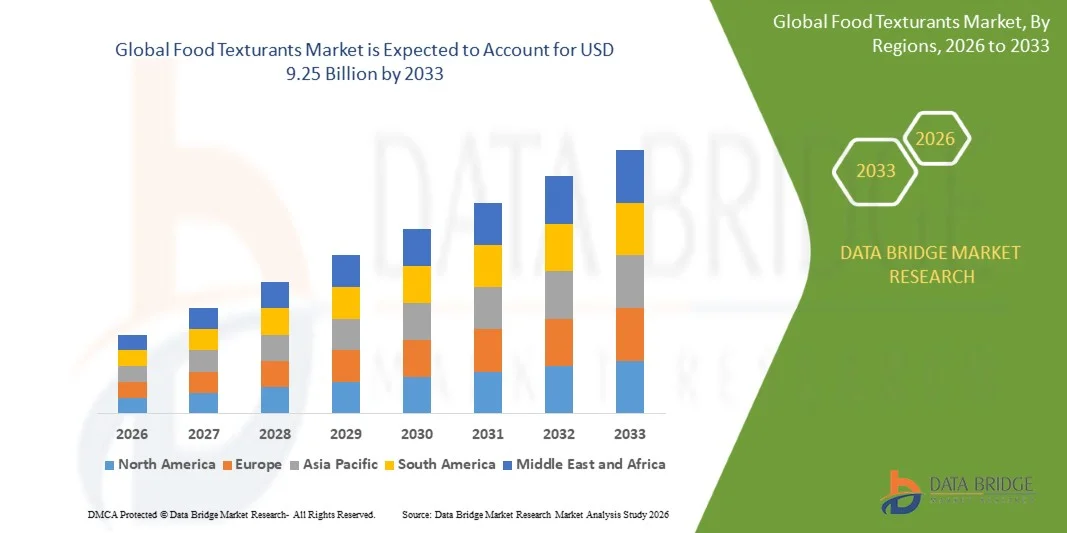
- As per Data Bridge Market Research analysis the food texturants market was valued at USD 5.81 billion in 2025 and is projected to reach USD 9.25 billion by 2033, growing at a CAGR of 6.00% from 2026 to 2033.
- The market is experiencing steady growth driven by increasing demand for processed and convenience foods, rising consumer preference for clean-label and natural ingredients, and continuous innovation in food formulation to improve texture, stability, and sensory appeal.
- The growing consumption of bakery, dairy, confectionery, and plant-based food products, coupled with the expanding food processing industry and evolving consumer expectations for enhanced mouthfeel and product quality, is accelerating the adoption of food texturants across global food and beverage applications.
Market Size & Forecast
- Market Value (2025): USD 5.81 Billion
- Expected Market Value (2033): USD 9.25 Billion
- Forecast CAGR (2026–2033): 6.00%
- Leading Region in 2025: North America
- Fastest Growing Region: Asia-Pacific
What are the Major Takeaways of the Food Texturants Market?
- North America dominated the food texturants market in 2025, supported by the strong presence of leading food ingredient manufacturers, a highly developed processed food industry, and growing consumer demand for clean-label and functional food products.
- Asia-Pacific food texturants market is expected to witness the fastest growth rate from 2026 to 2033, supported by rapid urbanization, changing dietary habits, rising disposable incomes, and expanding food processing industries across China, India, Japan, and Southeast Asia.
- The conventional segment dominated the market in 2025 driven by its widespread use in processed foods, bakery products, dairy products, and beverages due to its consistent functionality, cost-effectiveness, and broad commercial availability. Conventional texturants remain the preferred choice among large-scale food manufacturers for maintaining product texture, stability, and shelf life.
- The clean label segment is projected to register the fastest growth at a CAGR from 2026 to 2033 driven by rising consumer demand for natural ingredients, transparent labeling, and minimally processed food products. Increasing product reformulation by food manufacturers and growing preference for plant-based ingredients are accelerating segment expansion.
- The hydrocolloids segment dominated the market in 2025 driven by their extensive use in improving viscosity, stabilization, gelling, and moisture retention across bakery, dairy, beverage, and processed food applications. Their multifunctional properties and compatibility with clean-label formulations continue to support widespread adoption.
- The bioactive ingredients segment is projected to register the fastest growth at a CAGR from 2026 to 2033 driven by increasing demand for functional foods, fortified products, and health-focused formulations. Growing consumer awareness regarding nutritional benefits and wellness-oriented food products is accelerating segment growth.
Report Scope and Food Texturants Market Segmentation
|
Attributes |
Food Texturants Key Market Insights |
|
Segments Covered |
|
|
Countries Covered |
North America
Europe
Asia-Pacific
Middle East and Africa
South America
|
|
Key Market Players |
|
|
Market Opportunities |
|
|
Value Added Data Infosets |
In addition to the insights on market scenarios such as market value, growth rate, segmentation, geographical coverage, and major players, the market reports curated by the Data Bridge Market Research also include in-depth expert analysis, pricing analysis, brand share analysis, consumer survey, demography analysis, supply chain analysis, value chain analysis, raw material/consumables overview, vendor selection criteria, PESTLE Analysis, Porter Analysis, and regulatory framework. |
What is the Key Trend in the Food Texturants Market?
- Clean-label and plant-based food innovation is driving the adoption of natural food texturants such as pectin, citrus fiber, starches, and hydrocolloids that improve texture, stability, and mouthfeel while meeting consumer demand for recognizable ingredients.
- For instance, in October 2024, CP Kelco announced the expansion of its citrus fiber portfolio designed to help food manufacturers replace synthetic additives while maintaining texture and stability in dairy, beverage, bakery, and plant-based applications.
- Food manufacturers are increasingly reformulating products with multifunctional texturants that deliver viscosity, emulsification, moisture retention, and improved sensory performance across a wide range of processed foods.
- For instance, in May 2024, Ingredion Incorporated introduced new clean-label texturizing starch solutions to support texture optimization and formulation flexibility in plant-based foods and prepared meals.
- As consumer demand for healthier, minimally processed, and clean-label food products continues to rise, the adoption of advanced natural food texturants is expected to accelerate, reinforcing texture innovation as a key focus across the global food and beverage industry.
What are the Key Drivers of the Food Texturants Market?
- The growing consumption of convenience foods, bakery products, dairy products, beverages, and plant-based alternatives is significantly increasing demand for food texturants that enhance consistency, stability, and overall eating experience.
- For instance, in June 2024, Cargill expanded its label-friendly ingredient portfolio with new texturizing solutions aimed at improving texture and functionality in confectionery, dairy, sauces, and plant-based food applications.
- Food manufacturers are increasingly investing in innovative hydrocolloids, starches, proteins, and fibers to improve product quality, extend shelf life, and meet evolving regulatory and consumer expectations for clean-label formulations.
- For instance, in 2024, International Food Information Council (IFIC) reported that consumers continue to prioritize ingredients they recognize and perceive as natural, encouraging manufacturers to adopt cleaner-label formulation strategies supported by natural texturants.
- With food companies increasingly focusing on product reformulation, premium quality, and clean-label innovation, food texturants will remain essential ingredients for improving functionality, consumer acceptance, and product differentiation across the global food industry.
Which Factors are Challenging the Growth of the Food Texturants Market?
- Natural food texturants often experience supply volatility and higher production costs because they depend on agricultural raw materials that are affected by climate conditions, seasonal availability, and fluctuating commodity prices.
- These cost pressures make formulation more expensive for food manufacturers, particularly in price-sensitive markets where maintaining competitive pricing remains a major challenge.
- For instance, the Food and Agriculture Organization (FAO) has highlighted that volatility in agricultural commodity markets continues to influence ingredient availability and pricing, affecting food ingredient supply chains, including hydrocolloids, starches, and plant-derived texturants.
- The combination of raw material price fluctuations, supply chain disruptions, and increasing regulatory requirements for ingredient sourcing and labeling continues to challenge food texturant manufacturers. These factors raise production costs, complicate procurement strategies, and slow the adoption of premium natural texturants despite growing global demand for clean-label food products.
How is the Food Texturants Market Segmented?
The market is segmented on the basis of nature, type, application, and form.
- By Nature
On the basis of nature, the food texturants market is segmented into conventional, clean label, and others. The conventional segment dominated the market in 2025 driven by its widespread use in processed foods, bakery products, dairy products, and beverages due to its consistent functionality, cost-effectiveness, and broad commercial availability. Conventional texturants remain the preferred choice among large-scale food manufacturers for maintaining product texture, stability, and shelf life.
The clean label segment is projected to register the fastest growth at a CAGR from 2026 to 2033 driven by rising consumer demand for natural ingredients, transparent labeling, and minimally processed food products. Increasing product reformulation by food manufacturers and growing preference for plant-based ingredients are accelerating segment expansion.
- By Type
On the basis of type, the food texturants market is segmented into hydrocolloids, fats, sugar, food cultures, lecithin, bioactive ingredients, and others. The hydrocolloids segment dominated the market in 2025 driven by their extensive use in improving viscosity, stabilization, gelling, and moisture retention across bakery, dairy, beverage, and processed food applications. Their multifunctional properties and compatibility with clean-label formulations continue to support widespread adoption.
The bioactive ingredients segment is projected to register the fastest growth at a CAGR from 2026 to 2033 driven by increasing demand for functional foods, fortified products, and health-focused formulations. Growing consumer awareness regarding nutritional benefits and wellness-oriented food products is accelerating segment growth.
- By Application
On the basis of application, the food texturants market is segmented into bakery, confectionary, sauces and dressings, dairy, beverage, infant foods, breakfast solutions, frozen foods, fortified foods, snacks, and others. The bakery segment dominated the market in 2025 driven by the extensive use of texturants to improve dough consistency, softness, moisture retention, and product freshness in bread, cakes, pastries, and other baked goods. Rising global consumption of bakery products continues to strengthen segment demand.
The fortified foods segment is projected to register the fastest growth at a CAGR from 2026 to 2033 driven by increasing consumer preference for nutrient-enriched foods and functional nutrition. Expanding product innovation and growing health awareness are accelerating the adoption of advanced texturant solutions in fortified food formulations.
- By Form
On the basis of form, the food texturants market is segmented into powder, liquid, and semi-solids. The powder segment dominated the market in 2025 driven by its longer shelf life, ease of transportation, convenient storage, and superior compatibility with dry food processing applications. Powder-based texturants are widely used across bakery, confectionery, dairy, and beverage manufacturing due to their processing efficiency.
The liquid segment is projected to register the fastest growth at a CAGR from 2026 to 2033 driven by increasing demand for ready-to-use formulations and improved dispersion characteristics in beverages, sauces, dairy products, and liquid food processing. Rising adoption in large-scale food manufacturing is supporting continued segment expansion.
Which Region Holds the Largest Share of the Food Texturants Market?
- North America dominated the food texturants market in 2025, supported by the strong presence of leading food ingredient manufacturers, a highly developed processed food industry, and growing consumer demand for clean-label and functional food products.
- Food manufacturers across the region are increasingly incorporating advanced texturants to improve texture, stability, shelf life, and sensory appeal. Rising innovation in bakery, dairy, beverages, and plant-based foods continues to strengthen market growth.
U.S. Food Texturants Market Insight
The U.S. food texturants market captured the largest share within North America in 2025, fueled by increasing demand for convenience foods, premium bakery products, and clean-label formulations. Food manufacturers are investing in natural hydrocolloids, starches, proteins, and fibers to meet evolving consumer preferences for healthier products without compromising texture or product quality. Continuous product innovation and a strong food processing sector further support market expansion.
Europe Food Texturants Market Insight
Europe food texturants market is expected to witness the fastest growth rate from 2026 to 2033, primarily driven by increasing demand for natural ingredients, stringent food regulations, and rising consumption of plant-based and organic food products. Manufacturers are actively reformulating products to eliminate artificial additives while maintaining desirable texture and stability. Growing investments in sustainable food innovation are further supporting regional growth.
U.K. Food Texturants Market Insight
U.K. food texturants market is expected to witness the fastest growth rate from 2026 to 2033, driven by rising consumer preference for clean-label foods, functional nutrition, and premium bakery and dairy products. Increasing demand for vegan and plant-based alternatives is encouraging food manufacturers to adopt innovative natural texturants. Strong retail distribution and continuous product reformulation are expected to further stimulate market growth.
Germany Food Texturants Market Insight
Germany food texturants market is expected to witness the fastest growth rate from 2026 to 2033, fueled by the country's advanced food processing industry and growing demand for high-quality, clean-label food products. Manufacturers are increasingly utilizing multifunctional texturants to improve product consistency, stability, and sensory performance. Germany's focus on food innovation and sustainable ingredient development continues to support market expansion.
Asia-Pacific Food Texturants Market Insight
The Asia-Pacific food texturants market is expected to witness the fastest growth rate from 2026 to 2033, supported by rapid urbanization, changing dietary habits, rising disposable incomes, and expanding food processing industries across China, India, Japan, and Southeast Asia. Growing demand for packaged foods, dairy products, beverages, and convenience foods is driving the adoption of food texturants. Increasing investments in food manufacturing capacity are further accelerating regional growth.
Japan Food Texturants Market Insight
Japan food texturants market is expected to witness the fastest growth rate from 2026 to 2033 due to strong consumer demand for premium-quality processed foods, functional foods, and convenience products. The country's emphasis on food quality, texture, and product consistency encourages manufacturers to adopt advanced texturizing ingredients. Growing innovation in bakery, dairy, confectionery, and health-focused food products continues to support market growth.
China Food Texturants Market Insight
The China food texturants market accounted for the largest market share in Asia-Pacific in 2025, attributed to the country's large food manufacturing industry, expanding middle-class population, and increasing consumption of processed and packaged foods. Rising demand for bakery products, dairy products, beverages, and plant-based foods is driving the use of food texturants across multiple applications. Continuous investment in food processing technologies and rapid product innovation are further propelling market growth.
Which are the Top Companies in Food Texturants Market?
The food texturants industry is primarily led by well-established companies, including:
- Cargill, Incorporated (U.S.)
- ADM (U.S.)
- Ingredion Incorporated (U.S.)
- International Flavors & Fragrances Inc. (U.S.)
- Kerry Group plc (Ireland)
- Tate & Lyle plc (U.K.)
- dsm-firmenich AG (Switzerland)
- BASF SE (Germany)
- CP Kelco (U.S.)
- Roquette Frères (France)
- Ashland Inc. (U.S.)
- Corbion N.V. (Netherlands)
- Jungbunzlauer Suisse AG (Switzerland)
- Palsgaard A/S (Denmark)
- Givaudan SA (Switzerland)
What are Latest Developments in Food Texturants Market?
- In May 2025, Sarda Bio Polymers, product showcase, introduced a portfolio of clean-label, plant-based hydrocolloid solutions at IFFA 2025 for meat and alternative protein applications. The new range includes guar gum, konjac, xanthan gum, carrageenan, cassia tora gum, tamarind xyloglucan, and CMC to improve texture, stability, and processing performance. This development strengthens the adoption of sustainable and natural food texturants while supporting innovation in clean-label food formulations.
- In March 2025, Cargill, facility expansion, inaugurated a new corn milling plant in Gwalior, Madhya Pradesh, through its partnership with Saatvik Agro Processors to increase the production of starch derivatives for confectionery, dairy, and infant nutrition applications. The investment enhances regional manufacturing capacity, strengthens supply chain efficiency, and supports the growing demand for food texturants across India.
- In March 2025, Ingredion Incorporated, strategic partnership, collaborated with AGRANA Beteiligungs-AG to expand specialty starch production capacity in Romania. The partnership is intended to improve ingredient availability across Eastern Europe, strengthen regional manufacturing capabilities, and meet the increasing demand for specialty starches used in food applications. This development reinforces the growth of the food texturants market in Europe.
- In February 2025, China Starch Holding Company Limited, capacity expansion, expanded the operations of its subsidiary Linqing Deneng Golden Corn Bio Limited by adding new starch processing facilities to increase production capacity. The expansion enhances the company's ability to supply starch-based ingredients for food manufacturers while supporting the rising global demand for food texturants used in processed and convenience foods.

- Interactive Data Analysis Dashboard
- Company Analysis Dashboard for high growth potential opportunities
- Research Analyst Access for customization & queries
- Competitor Analysis with Interactive dashboard
- Latest News, Updates & Trend analysis
- Harness the Power of Benchmark Analysis for Comprehensive Competitor Tracking
Global Food Texturants Market, Supply Chain Analysis and Ecosystem Framework
To support market growth and help clients navigate the impact of geopolitical shifts, DBMR has integrated in-depth supply chain analysis into its Global Food Texturants Market research reports. This addition empowers clients to respond effectively to global changes affecting their industries. The supply chain analysis section includes detailed insights such as Global Food Texturants Market consumption and production by country, price trend analysis, the impact of tariffs and geopolitical developments, and import and export trends by country and HSN code. It also highlights major suppliers with data on production capacity and company profiles, as well as key importers and exporters. In addition to research, DBMR offers specialized supply chain consulting services backed by over a decade of experience, providing solutions like supplier discovery, supplier risk assessment, price trend analysis, impact evaluation of inflation and trade route changes, and comprehensive market trend analysis.
Data collection and base year analysis are done using data collection modules with large sample sizes. The stage includes obtaining market information or related data through various sources and strategies. It includes examining and planning all the data acquired from the past in advance. It likewise envelops the examination of information inconsistencies seen across different information sources. The market data is analysed and estimated using market statistical and coherent models. Also, market share analysis and key trend analysis are the major success factors in the market report. To know more, please request an analyst call or drop down your inquiry.
The key research methodology used by DBMR research team is data triangulation which involves data mining, analysis of the impact of data variables on the market and primary (industry expert) validation. Data models include Vendor Positioning Grid, Market Time Line Analysis, Market Overview and Guide, Company Positioning Grid, Patent Analysis, Pricing Analysis, Company Market Share Analysis, Standards of Measurement, Global versus Regional and Vendor Share Analysis. To know more about the research methodology, drop in an inquiry to speak to our industry experts.
Data Bridge Market Research is a leader in advanced formative research. We take pride in servicing our existing and new customers with data and analysis that match and suits their goal. The report can be customized to include price trend analysis of target brands understanding the market for additional countries (ask for the list of countries), clinical trial results data, literature review, refurbished market and product base analysis. Market analysis of target competitors can be analyzed from technology-based analysis to market portfolio strategies. We can add as many competitors that you require data about in the format and data style you are looking for. Our team of analysts can also provide you data in crude raw excel files pivot tables (Fact book) or can assist you in creating presentations from the data sets available in the report.













