


Food Thermometer Market Overview
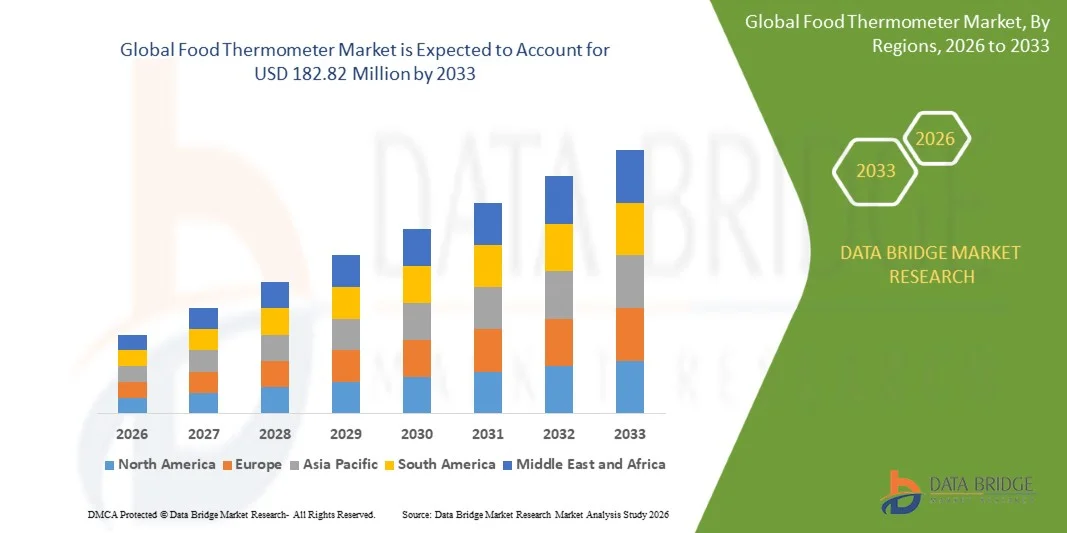
As per Data Bridge Market Research analysis the global food thermometer market was valued at USD 83.45 million in 2025 and is projected to reach USD 182.82 million by 2033, growing at a CAGR of 10.30% from 2026 to 2033. The market is witnessing robust growth driven by increasing emphasis on food safety and hygiene, rising consumer awareness regarding proper cooking temperatures, and growing adoption of digital kitchen appliances across residential and commercial foodservice sectors.
Stringent food safety regulations implemented by government authorities, coupled with the expansion of the global foodservice industry and increasing demand for precision cooking, are accelerating the adoption of food thermometers worldwide. The growing popularity of smart digital and infrared food thermometers, integration of Bluetooth and wireless connectivity for real-time temperature monitoring, and rising use in restaurants, catering services, food processing facilities, and home kitchens are further supporting market expansion. In addition, increasing consumer preference for convenience, accurate temperature measurement, and prevention of foodborne illnesses continues to create significant growth opportunities for manufacturers throughout the forecast period.
Market Size & Forecast
- Global Market Value (2025): USD 83.45 Million
- Expected Market Value (2033): USD 182.82 Million
- Forecast CAGR (2026–2033): 10.30%
- Leading Region in 2025: North America
- Fastest Growing Region: Asia-Pacific
Key Market Trends & Insights
- North America dominated the food thermometer market with the largest revenue share in 2025, supported by stringent food safety regulations, high consumer awareness regarding safe food handling practices, and widespread adoption of digital kitchen appliances.
- Asia-Pacific food thermometer market is expected to witness the fastest growth rate from 2026 to 2033, supported by rapid urbanization, rising disposable incomes, expanding foodservice industries, and increasing consumer awareness regarding food safety.
- The meat thermometers segment held the largest market revenue share in 2025, driven by increasing consumer awareness regarding safe cooking temperatures for meat and poultry, growing popularity of grilling and barbecue cooking, and widespread adoption across commercial kitchens and households. Food safety organizations such as the USDA and FDA continue to recommend the use of meat thermometers to ensure food reaches safe internal temperatures, supporting sustained demand for the segment.
- The food probe thermometers segment is projected to register the fastest growth during the forecast period of 2026 to 2033, driven by increasing demand for instant-read digital thermometers in restaurants, food processing facilities, and home kitchens. Their high accuracy, rapid response time, ease of calibration, and compatibility with HACCP food safety practices are expected to continue driving market expansion.
- The medium segment accounted for the largest market share in 2025, owing to its balance between affordability, durability, and digital functionality. Medium-priced food thermometers are extensively used by households, restaurants, bakeries, and catering businesses because they provide accurate temperature measurement without the higher investment required for premium smart devices.
- The high segment is anticipated to witness the fastest growth during the forecast period of 2026 to 2033, driven by rising adoption of Bluetooth- and Wi-Fi-enabled food thermometers, growing popularity of smart kitchens, and increasing demand for connected cooking devices capable of remote temperature monitoring and data logging.
Report Scope and Food Thermometer Market Segmentation
|
Attributes |
Food Thermometer Key Market Insights |
|
Segments Covered |
|
|
Countries Covered |
North America
Europe
Asia-Pacific
Middle East and Africa
South America
|
|
Key Market Players |
|
|
Market Opportunities |
|
|
Value Added Data Infosets |
In addition to the insights on market scenarios such as market value, growth rate, segmentation, geographical coverage, and major players, the market reports curated by the Data Bridge Market Research also include in-depth expert analysis, pricing analysis, brand share analysis, consumer survey, demography analysis, supply chain analysis, value chain analysis, raw material/consumables overview, vendor selection criteria, PESTLE Analysis, Porter Analysis, and regulatory framework. |
Food Thermometer Market Trends
Trend: Rising Adoption Of Smart Wireless And HACCP-Compliant Food Thermometers
Growing emphasis on food safety, digital kitchen management, and regulatory compliance is accelerating the adoption of advanced food thermometers across commercial foodservice, food processing, and residential kitchens. Conventional analog thermometers require manual reading and calibration, whereas digital probe, infrared, and Bluetooth-enabled food thermometers provide faster response times, greater measurement accuracy, and real-time temperature monitoring. These technologies help reduce foodborne illness risks while improving operational efficiency and regulatory compliance across the food industry.
In commercial kitchens and food manufacturing facilities, businesses are increasingly integrating digital food thermometers into HACCP-based food safety systems to automate temperature verification and documentation. For instance, the U.S. Food and Drug Administration (FDA) Food Code 2022 recommends the use of calibrated food temperature measuring devices to verify cooking, cooling, reheating, and hot holding temperatures as part of food safety management practices, driving wider adoption of digital thermometers among restaurants, institutional kitchens, and food processors.
The growing popularity of smart kitchens, precision cooking, barbecue grilling, and connected cooking appliances is further increasing demand for wireless food thermometers capable of delivering real-time alerts through mobile applications. Continuous innovation in Bluetooth connectivity, cloud-based monitoring, and multi-probe technology is expected to strengthen product adoption across residential and commercial sectors throughout the forecast period.
Food Thermometer Market Dynamics
Key Market Driver: Increasing Focus On Food Safety Regulations And HACCP Compliance
Governments and food safety authorities worldwide are implementing stricter food hygiene regulations to minimize foodborne illnesses and improve consumer protection. Restaurants, catering companies, food manufacturers, supermarkets, and institutional kitchens are increasingly investing in accurate food temperature monitoring equipment to comply with Hazard Analysis and Critical Control Point (HACCP) requirements and national food safety regulations. Growing awareness regarding safe food handling is further supporting the adoption of digital food thermometers across both commercial and residential applications.
Food businesses are deploying digital probe and infrared thermometers to monitor cooking, storage, transportation, and serving temperatures throughout the food supply chain. For instance, the U.S. Department of Agriculture (USDA) Food Safety and Inspection Service states that a food thermometer is the only reliable way to ensure foods have reached a safe minimum internal temperature capable of destroying harmful bacteria, reinforcing its use across commercial kitchens and households.
As regulatory compliance becomes increasingly important and consumer awareness regarding food safety continues to grow, demand for accurate, reliable, and easy-to-use food thermometers is expected to accelerate steadily across global foodservice and food processing industries.
Key Restraint/Challenge: Price Sensitivity And Limited Adoption In Cost-Conscious Markets
Despite continuous technological advancements, the adoption of smart wireless food thermometers remains limited across several developing economies where affordability remains a major purchasing factor. Small restaurants, street food vendors, independent catering businesses, and household consumers often continue using conventional analog or low-cost digital thermometers due to lower upfront costs. Limited awareness regarding advanced temperature monitoring technologies and inconsistent enforcement of food safety regulations further restrict market penetration.
Premium Bluetooth- and Wi-Fi-enabled food thermometers also involve higher acquisition costs because of advanced sensors, wireless communication modules, rechargeable batteries, and mobile application integration. For instance, ThermoWorks' RFX Wireless Meat Thermometer offers long-range wireless monitoring, multiple probe connectivity, and smartphone integration for precision cooking, but its premium pricing makes adoption comparatively lower among budget-conscious foodservice operators and consumers.
Although product innovation continues to improve performance and convenience, affordability challenges and uneven regulatory implementation are expected to remain key barriers to widespread adoption in price-sensitive markets during the forecast period.
Key Market Opportunity: Expansion Of Smart Kitchens And Connected Food Monitoring Solutions
Rapid growth in smart homes, connected kitchen appliances, and digital foodservice operations is creating substantial opportunities for manufacturers of advanced food thermometers. Consumers increasingly seek smartphone-connected temperature monitoring solutions that provide remote access, real-time notifications, and precision cooking assistance. Commercial kitchens are also adopting connected monitoring systems to improve operational efficiency, maintain food quality, and simplify regulatory compliance.
Manufacturers are continuously introducing Bluetooth- and Wi-Fi-enabled thermometers capable of integrating with mobile applications for remote monitoring and automated temperature recording. For instance, ThermoWorks launched the RFX Wireless Meat Thermometer, featuring completely wireless probes, smartphone connectivity, and continuous temperature monitoring designed for grilling, smoking, roasting, and commercial food preparation, reflecting the industry's shift toward smart cooking technologies.
Continuous innovation in IoT-enabled food monitoring, cloud-based compliance platforms, and precision cooking technologies is expected to create significant growth opportunities for market participants while accelerating the adoption of smart food thermometers across residential and commercial foodservice sectors over the forecast period.
Food Thermometer Market Scope
The market is segmented on the basis of type, price range, application, and distribution channel.
- By Type
On the basis of type, the food thermometer market is segmented into meat thermometers, oven thermometers, food probe thermometers, fridge/freezer thermometers, cooking thermometers, and others. The meat thermometers segment held the largest market revenue share in 2025, driven by increasing consumer awareness regarding safe cooking temperatures for meat and poultry, growing popularity of grilling and barbecue cooking, and widespread adoption across commercial kitchens and households. Food safety organizations such as the USDA and FDA continue to recommend the use of meat thermometers to ensure food reaches safe internal temperatures, supporting sustained demand for the segment.
The food probe thermometers segment is projected to register the fastest growth during the forecast period of 2026 to 2033, driven by increasing demand for instant-read digital thermometers in restaurants, food processing facilities, and home kitchens. Their high accuracy, rapid response time, ease of calibration, and compatibility with HACCP food safety practices are expected to continue driving market expansion.
- By Price Range
On the basis of price range, the food thermometer market is segmented into high, medium, and low. The medium segment accounted for the largest market share in 2025, owing to its balance between affordability, durability, and digital functionality. Medium-priced food thermometers are extensively used by households, restaurants, bakeries, and catering businesses because they provide accurate temperature measurement without the higher investment required for premium smart devices.
The high segment is anticipated to witness the fastest growth during the forecast period of 2026 to 2033, driven by rising adoption of Bluetooth- and Wi-Fi-enabled food thermometers, growing popularity of smart kitchens, and increasing demand for connected cooking devices capable of remote temperature monitoring and data logging.
- By Application
On the basis of application, the food thermometer market is segmented into roasts, casseroles, soups, thin and thick foods, chicken and burgers, and others. The roasts segment held the largest market share of 31% in 2025, driven by increasing consumption of roasted meat products across households, restaurants, and foodservice establishments, where precise internal temperature measurement is essential to ensure food safety and maintain product quality. Growing consumer preference for premium roasting, holiday meal preparation, and slow-cooking techniques, along with food safety recommendations from organizations such as the USDA and FDA advocating the use of food thermometers for large cuts of meat, continues to support the segment's market leadership.
The thin and thick foods segment is expected to register the fastest growth during the forecast period, supported by increasing adoption of instant-read digital thermometers for seafood, bakery products, confectionery, dairy products, sauces, and ready-to-eat meals. Rising consumer preference for precision cooking and consistent food quality is further contributing to segment growth.
- By Distribution Channel
On the basis of distribution channel, the food thermometer market is segmented into online store and offline store. The offline store segment accounted for the largest market share in 2025, supported by strong product availability through supermarkets, hypermarkets, specialty kitchenware retailers, restaurant equipment suppliers, and electronics stores. Many commercial buyers continue to prefer offline purchases for product demonstrations, technical guidance, and immediate product availability.
The online store segment is projected to witness the fastest growth during the forecast period of 2026 to 2033, driven by expanding e-commerce platforms, increasing availability of smart kitchen appliances, competitive pricing, and growing consumer preference for convenient online purchasing. Rising direct-to-consumer sales and wider access to international brands are expected to further accelerate segment growth.
Food Thermometer Market Regional Analysis
North America Food Thermometer Market Insight
North America dominated the food thermometer market with the largest revenue share in 2025, supported by stringent food safety regulations, high consumer awareness regarding safe food handling practices, and widespread adoption of digital kitchen appliances. Strong demand from commercial foodservice establishments, food processing companies, and households continues to drive the market across the region. The presence of leading manufacturers, increasing popularity of grilling and barbecue cooking, and recommendations from organizations such as the U.S. Food and Drug Administration (FDA) and the U.S. Department of Agriculture (USDA) regarding the use of food thermometers further strengthen market growth.
U.S. Food Thermometer Market Insight
The U.S. food thermometer market captured the largest revenue share in 2025 within North America, fueled by strict food safety standards and growing consumer awareness of preventing foodborne illnesses. Restaurants, institutional kitchens, food manufacturers, and households increasingly utilize digital and instant-read thermometers to ensure compliance with USDA and FDA safe cooking temperature guidelines. In addition, the rising popularity of smart kitchens, outdoor grilling, barbecue culture, and connected cooking appliances continues to support sustained market expansion.
Canada Food Thermometer Market Insight
The Canada food thermometer market is expected to witness significant growth during the forecast period of 2026 to 2033, driven by increasing consumer awareness regarding food safety, rising adoption of digital kitchen appliances, and stringent food handling regulations. Growing demand from restaurants, food processing facilities, healthcare institutions, and households for accurate temperature monitoring is supporting market expansion. In addition, the increasing popularity of home cooking, outdoor grilling, and barbecue culture, coupled with guidance from the Government of Canada's food safety authorities on maintaining safe cooking temperatures, continues to encourage the adoption of digital and instant-read food thermometers across residential and commercial applications.
Europe Food Thermometer Market Insight
The Europe food thermometer market is expected to witness the fastest growth rate from 2026 to 2033, primarily driven by increasingly stringent food safety regulations, rising adoption of digital food monitoring equipment, and growing consumer demand for precision cooking. Expansion of the hospitality sector, increasing implementation of Hazard Analysis and Critical Control Point (HACCP) practices, and rising demand for premium kitchen appliances are encouraging wider adoption of food thermometers across residential and commercial applications throughout the region.
U.K. Food Thermometer Market Insight
The U.K. food thermometer market is expected to witness the fastest growth rate from 2026 to 2033, driven by increasing consumer awareness regarding food hygiene, expanding home cooking trends, and strong adoption of digital kitchen technologies. Growing demand from restaurants, catering services, and food retailers for accurate temperature monitoring equipment, coupled with guidance from the UK Food Standards Agency on safe cooking practices, is expected to continue supporting market growth.
Germany Food Thermometer Market Insight
The Germany food thermometer market is expected to witness the fastest growth rate from 2026 to 2033, fueled by the country's well-established food processing industry, high-quality manufacturing standards, and increasing adoption of digital food safety equipment. Growing investment in automated food production, rising demand for precision cooking appliances, and increasing implementation of HACCP compliance across foodservice operations continue to promote the adoption of advanced food thermometers throughout the country.
Asia-Pacific Food Thermometer Market Insight
The Asia-Pacific food thermometer market is expected to witness the fastest growth rate from 2026 to 2033, supported by rapid urbanization, rising disposable incomes, expanding foodservice industries, and increasing consumer awareness regarding food safety. Growing demand for smart kitchen appliances, rapid growth of quick-service restaurants, and expanding food processing industries in countries such as China, Japan, and India are significantly contributing to regional market expansion. Increasing e-commerce penetration is also improving product accessibility across emerging economies.
Japan Food Thermometer Market Insight
The Japan food thermometer market is expected to witness the fastest growth rate from 2026 to 2033 due to the country's advanced consumer electronics industry, strong emphasis on food quality, and growing demand for precision cooking solutions. Increasing adoption of smart kitchen appliances, expanding use of digital thermometers in restaurants and convenience food manufacturing, and rising consumer preference for high-accuracy cooking tools continue to drive market growth. Japan's aging population is also contributing to demand for user-friendly and reliable digital kitchen devices.
China Food Thermometer Market Insight
The China food thermometer market accounted for the largest market revenue share in Asia-Pacific in 2025, attributed to the country's rapidly expanding food processing industry, increasing household adoption of smart kitchen appliances, and growing awareness of food safety standards. Rising urbanization, continuous expansion of restaurant chains, strong domestic electronics manufacturing capabilities, and increasing online retail sales of digital kitchen devices are key factors supporting the growth of the food thermometer market in China.
Food Thermometer Market Share
The Food Thermometer industry is primarily led by well-established companies, including:
- B + B Thermo-Technik GmbH (Germany)
- Rototherm Group (U.K.)
- CHINO Corporation (Japan)
- Digitron Italia S.r.l. (Italy)
- Fluke Corporation (U.S.)
- Hanna Instruments, Inc. (U.S.)
- Tecpel Co., Ltd. (Taiwan)
- Tel-Tru Manufacturing Company (U.S.)
- Testo SE & Co. KGaA (Germany)
- ThermoWorks, Inc. (U.S.)
Latest Developments in Food Thermometer Market
- In July 2024, FireBoard Labs Product Launch, FireBoard Labs announced the launch of the FireBoard Pulse, a dual-band wireless food temperature probe designed for precision cooking and food temperature monitoring. The product combines Bluetooth 5.3 and Sub-1 GHz (S1G) wireless connectivity with dual internal and ambient temperature sensors, enabling long-range, real-time monitoring through the FireBoard mobile app and cloud platform. The launch enhances accuracy, connectivity, and convenience for grilling, smoking, and commercial food preparation while strengthening the adoption of smart food thermometers and connected kitchen technologies, supporting innovation in the global food thermometer market.

- Interactive Data Analysis Dashboard
- Company Analysis Dashboard for high growth potential opportunities
- Research Analyst Access for customization & queries
- Competitor Analysis with Interactive dashboard
- Latest News, Updates & Trend analysis
- Harness the Power of Benchmark Analysis for Comprehensive Competitor Tracking
Global Food Thermometer Market, Supply Chain Analysis and Ecosystem Framework
To support market growth and help clients navigate the impact of geopolitical shifts, DBMR has integrated in-depth supply chain analysis into its Global Food Thermometer Market research reports. This addition empowers clients to respond effectively to global changes affecting their industries. The supply chain analysis section includes detailed insights such as Global Food Thermometer Market consumption and production by country, price trend analysis, the impact of tariffs and geopolitical developments, and import and export trends by country and HSN code. It also highlights major suppliers with data on production capacity and company profiles, as well as key importers and exporters. In addition to research, DBMR offers specialized supply chain consulting services backed by over a decade of experience, providing solutions like supplier discovery, supplier risk assessment, price trend analysis, impact evaluation of inflation and trade route changes, and comprehensive market trend analysis.
Data collection and base year analysis are done using data collection modules with large sample sizes. The stage includes obtaining market information or related data through various sources and strategies. It includes examining and planning all the data acquired from the past in advance. It likewise envelops the examination of information inconsistencies seen across different information sources. The market data is analysed and estimated using market statistical and coherent models. Also, market share analysis and key trend analysis are the major success factors in the market report. To know more, please request an analyst call or drop down your inquiry.
The key research methodology used by DBMR research team is data triangulation which involves data mining, analysis of the impact of data variables on the market and primary (industry expert) validation. Data models include Vendor Positioning Grid, Market Time Line Analysis, Market Overview and Guide, Company Positioning Grid, Patent Analysis, Pricing Analysis, Company Market Share Analysis, Standards of Measurement, Global versus Regional and Vendor Share Analysis. To know more about the research methodology, drop in an inquiry to speak to our industry experts.
Data Bridge Market Research is a leader in advanced formative research. We take pride in servicing our existing and new customers with data and analysis that match and suits their goal. The report can be customized to include price trend analysis of target brands understanding the market for additional countries (ask for the list of countries), clinical trial results data, literature review, refurbished market and product base analysis. Market analysis of target competitors can be analyzed from technology-based analysis to market portfolio strategies. We can add as many competitors that you require data about in the format and data style you are looking for. Our team of analysts can also provide you data in crude raw excel files pivot tables (Fact book) or can assist you in creating presentations from the data sets available in the report.













