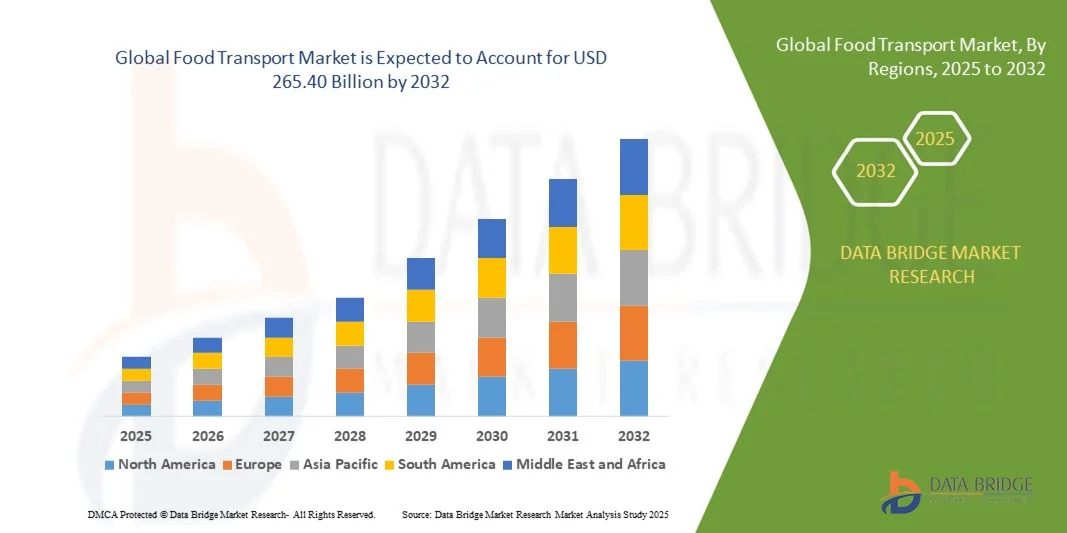
Food Transport Market Size
- The global food transport market size was valued at USD 190.97 billion in 2024 and is expected to reach USD 265.40 billion by 2032, at a CAGR of 4.20% during the forecast period
- The market growth is largely fueled by increasing demand for the efficient and timely transportation of perishable and non-perishable food products across urban and rural areas, driven by the expansion of retail, e-commerce, and foodservice sectors
- Furthermore, rising consumer expectations for fresh, high-quality, and safely delivered food, coupled with the adoption of advanced cold chain logistics, automated tracking systems, and temperature-controlled vehicles, are accelerating the uptake of modern food transport solutions, thereby significantly boosting industry growth
Food Transport Market Analysis
- Food transport services, encompassing road, rail, air, and sea logistics, are becoming increasingly critical for ensuring the safe, rapid, and efficient movement of diverse food products, including fruits, vegetables, meat, seafood, dairy, and packaged goods
- The escalating demand for food transport is primarily fueled by urbanization, rising disposable incomes, expansion of retail and quick-commerce platforms, and growing regulatory emphasis on food safety and quality standards, driving investment in cold chain infrastructure, route optimization, and real-time monitoring technologies
- Europe dominated the food transport market in 2024, due to well-developed logistics infrastructure, high demand for fresh and perishable food products, and advanced cold chain capabilities
- Asia-Pacific is expected to be the fastest growing region in the food transport market during the forecast period due to rapid urbanization, rising disposable incomes, and expanding retail and e-commerce channels in countries such as China, Japan, and India
- Roadways segment dominated the market with a market share of 52.5% in 2024, due to its extensive last-mile delivery network, flexibility in routing, and ability to reach remote and urban locations efficiently. Road transport is widely preferred for perishable goods due to its shorter transit times compared with rail or sea and its adaptability to varying shipment volumes. The segment benefits from continuous improvements in refrigerated trucks, GPS tracking, and real-time monitoring systems that enhance safety and reduce spoilage. Its integration with e-commerce logistics and regional distribution hubs further strengthens demand
Report Scope and Food Transport Market Segmentation
|
Attributes |
Food Transport Key Market Insights |
|
Segments Covered |
|
|
Countries Covered |
North America
Europe
Asia-Pacific
Middle East and Africa
South America
|
|
Key Market Players |
|
|
Market Opportunities |
|
|
Value Added Data Infosets |
In addition to the insights on market scenarios such as market value, growth rate, segmentation, geographical coverage, and major players, the market reports curated by the Data Bridge Market Research also include in-depth expert analysis, pricing analysis, brand share analysis, consumer survey, demography analysis, supply chain analysis, value chain analysis, raw material/consumables overview, vendor selection criteria, PESTLE Analysis, Porter Analysis, and regulatory framework. |
Food Transport Market Trends
Growth of Quick-Commerce and E-Commerce
- The food transport market is expanding rapidly due to the significant growth of quick-commerce and e-commerce platforms, which are transforming the logistics landscape for food and perishable goods. Consumers are increasingly prioritizing convenience, freshness, and rapid delivery, prompting retailers and logistics providers to upgrade transportation networks with specialized cold-chain and real-time tracking technologies
- For instance, companies such as DHL Supply Chain and Maersk have invested heavily in temperature-controlled logistics solutions integrated with cloud-based monitoring to support e-grocery and meal delivery enterprises. Similarly, Swiggy Instamart and Amazon Fresh have advanced hyperlocal distribution models powered by predictive route planning and smart warehousing systems
- Quick-commerce platforms have redefined delivery expectations to within minutes, creating demand for compact, agile, and efficient transport fleets capable of maintaining product integrity throughout short-distance supply chains. This trend is pushing innovation in electric refrigerated vehicles, insulated container designs, and IoT-enabled temperature sensors for real-time quality assurance
- The convergence of digital platforms, automation, and data analytics is optimizing transport operations through predictive demand forecasting and load optimization. E-commerce growth is also driving the integration of multi-modal transport systems — combining trucks, microhubs, and drones — to enhance agility and sustainability in food delivery operations
- The rise of quick-commerce and e-commerce is thus reshaping food transport infrastructure, emphasizing the need for flexible, reliable, and technology-driven distribution systems that ensure freshness while meeting consumer expectations for speed and convenience
Food Transport Market Dynamics
Driver
Rising Demand for Fresh and Safe Food Delivery
- The growing consumer demand for fresh, high-quality, and safe food delivery is a major driver for the food transport market. Urbanization, expanded online retail, and awareness of food hygiene have increased the need for end-to-end cold-chain solutions capable of preserving temperature-sensitive goods from origin to destination
- For instance, Lineage Logistics and Americold Logistics have expanded refrigerated warehousing and transportation fleets to meet rising demand from supermarkets, restaurants, and online platforms requiring precise temperature controls for produce, dairy, and meat distribution. These solutions ensure minimal spoilage and compliance with health regulations during transit
- Food safety and quality assurance in perishable transport have become strategic priorities for logistics providers. Real-time monitoring technologies using IoT and RFID enable constant visibility of temperature, humidity, and delivery conditions, reducing risks of product degradation and contamination
- The global shift toward premium, organic, and minimally processed food categories further amplifies the need for robust cold-chain transport systems capable of guaranteeing product freshness and extending shelf life. Technological advancements in vehicle refrigeration, energy efficiency, and automated quality control are facilitating this transformation
- With consumers demanding fresh food delivered quickly and safely, the food transport industry is increasingly investing in smarter infrastructure, sophisticated sensors, and compliance-driven logistics models. This evolution underlines the growing alignment between consumer trust, brand reputation, and advanced transport reliability
Restraint/Challenge
High Costs of Cold Chain and Last-Mile Logistics
- High operational and infrastructure costs associated with maintaining cold-chain integrity and last-mile delivery efficiency represent significant challenges for the food transport market. The need for continuous refrigeration, specialized vehicles, and energy-intensive handling equipment drives substantial capital and operating expenditures
- For instance, maintaining temperature-controlled delivery fleets such as refrigerated vans and trailers from companies such as Thermo King and Carrier Transicold requires significant investments in energy, maintenance, and calibration. These costs often limit scalability, particularly for small and medium-sized distributors in cost-sensitive markets
- Last-mile delivery adds further cost pressures due to fragmented routes, variable order volumes, and the need for ultra-fast service in urban environments. Advanced delivery models involving micro-fulfillment centers or smaller refrigerated hubs can reduce transit times but also require higher infrastructure and technology investments
- In addition, energy costs and sustainability mandates are prompting companies to balance affordability with eco-efficiency by adopting electric and hybrid refrigerated vehicles. However, upfront costs for such fleets remain a barrier to widespread deployment
- To overcome these challenges, logistics operators are focusing on optimizing network planning, utilizing route analytics, and adopting shared-fleet and consolidated delivery models. Achieving cost efficiency while maintaining temperature precision and delivery speed will be essential to ensuring sustainable growth in the global food transport landscape
Food Transport Market Scope
The market is segmented on the basis of transportation type, product type, and service type.
- By Transportation Type
On the basis of transportation type, the food transport market is segmented into roadways, railways, seaways, and airways. The roadways segment dominated the market with the largest revenue share of 52.5% in 2024, driven by its extensive last-mile delivery network, flexibility in routing, and ability to reach remote and urban locations efficiently. Road transport is widely preferred for perishable goods due to its shorter transit times compared with rail or sea and its adaptability to varying shipment volumes. The segment benefits from continuous improvements in refrigerated trucks, GPS tracking, and real-time monitoring systems that enhance safety and reduce spoilage. Its integration with e-commerce logistics and regional distribution hubs further strengthens demand.
The airways segment is expected to witness the fastest growth rate from 2025 to 2032, fueled by increasing demand for rapid delivery of high-value and highly perishable food products such as seafood, fresh fruits, and specialty dairy. Air transport ensures minimal transit time and reduces the risk of quality degradation, making it ideal for international trade and premium food segments. Growing investment in cold chain facilities at airports and enhanced air cargo logistics also support this rapid growth.
- By Product Type
On the basis of product type, the food transport market is segmented into fish, shellfish, and meat; vegetables, fruit, and nuts; cereals, bakery, and dairy products; coffee, tea, and vegetable oil. The vegetables, fruit, and nuts segment dominated the market with the largest revenue share in 2024, owing to the high global demand for fresh produce and the need for efficient cold chain logistics to maintain product quality. Seasonal variations, short shelf life, and strict regulatory standards for freshness drive specialized transportation solutions in this segment. The segment also benefits from increasing health-conscious consumption patterns and growing export-import activities across regions.
The fish, shellfish, and meat segment is anticipated to witness the fastest growth rate from 2025 to 2032, driven by rising global seafood and protein consumption, expanding aquaculture operations, and increasing demand for premium meat products. Temperature-controlled transport and advanced packaging technologies ensure compliance with hygiene and safety standards, supporting rapid expansion. The growth is further fueled by rising awareness of nutritional benefits and the need for quick delivery to preserve freshness.
- By Service Type
On the basis of service type, the food transport market is segmented into cold chain and non-cold chain services. The cold chain segment dominated the market with the largest revenue share in 2024, owing to its ability to maintain the quality, safety, and shelf life of perishable food products during transit. Growing consumer demand for fresh and frozen products, along with stringent food safety regulations, has made cold chain logistics essential for both domestic and international food transport. The segment benefits from technological advancements such as IoT-enabled temperature monitoring, refrigerated storage units, and automated tracking systems that enhance efficiency and reduce spoilage.
The non-cold chain segment is expected to witness the fastest growth rate from 2025 to 2032, driven by increasing demand for bulk food transport of non-perishable goods such as cereals, coffee, and vegetable oil. Lower operational costs, simpler infrastructure requirements, and ease of integration with road and rail networks support this growth. Expanding retail distribution networks and rising trade in packaged food products also contribute to the accelerating adoption of non-cold chain services.
Food Transport Market Regional Analysis
- Europe dominated the food transport market with the largest revenue share in 2024, driven by well-developed logistics infrastructure, high demand for fresh and perishable food products, and advanced cold chain capabilities
- European transport providers are investing in refrigerated fleets, real-time tracking, and temperature-controlled storage to ensure food quality and safety during transit
- The region’s mature retail and foodservice sectors, coupled with strong regulatory standards, support widespread adoption of both cold chain and non-cold chain transport solutions
France Food Transport Market Insight
The France market captured the largest share in Europe in 2024, fueled by strong domestic consumption of fresh produce, seafood, and dairy products. Logistics companies are upgrading transport fleets with advanced cold chain technologies to maintain product freshness and reduce spoilage. French providers are also focusing on efficiency and sustainability to meet evolving regulatory and consumer expectations, driving growth across road, rail, and air transport services.
Germany Food Transport Market Insight
The Germany market is projected to grow at a notable CAGR during the forecast period, supported by increasing demand for perishable and high-value food products in retail and hospitality channels. Investments in temperature-controlled vehicles, automated tracking systems, and efficient distribution networks enable consistent, high-quality deliveries. Strong emphasis on food safety compliance and integration with e-commerce platforms further accelerates market expansion.
U.K. Food Transport Market Insight
The U.K. market is expected to expand steadily due to growing consumption of fresh, frozen, and packaged food items across households and foodservice sectors. Transport providers are enhancing cold chain capabilities and adopting advanced monitoring solutions to preserve quality during transit. The market benefits from innovations in route optimization, last-mile delivery efficiency, and increased adoption of refrigerated road transport.
North America Food Transport Market Insight
The North America market is witnessing moderate growth, driven by high demand for fresh produce, seafood, meat, and dairy products in the U.S. and Canada. Transport operators are emphasizing refrigerated fleets, IoT-based monitoring, and data-driven logistics for safe and timely deliveries. Rising adoption of cold chain services and integration with online grocery platforms support market expansion, while non-cold chain solutions continue to cater to bulk and dry food transport.
Asia-Pacific Food Transport Market Insight
The Asia-Pacific market is poised to grow at the fastest CAGR during 2025–2032, driven by rapid urbanization, rising disposable incomes, and expanding retail and e-commerce channels in countries such as China, Japan, and India. Increasing consumption of perishable and frozen food products is fueling demand for efficient transport solutions. Companies are focusing on both cold chain and non-cold chain services to ensure timely deliveries and maintain product quality across diverse regions.
China Food Transport Market Insight
The China market accounted for the largest revenue share in Asia-Pacific in 2024, attributed to growing urban populations, rising middle-class demand, and expanding domestic and international food trade. Transport providers are investing heavily in refrigerated trucks, rail, and air cargo solutions to maintain freshness of seafood, meat, fruits, and vegetables, supporting growth across both domestic and export markets.
Japan Food Transport Market Insight
The Japan market is gaining momentum due to high consumer demand for premium, fresh, and frozen food products. Advanced logistics infrastructure, efficient cold chain networks, and focus on product quality are driving adoption of innovative transport solutions. Japanese providers are integrating IoT-enabled monitoring and automated tracking systems to ensure safety, freshness, and compliance with strict food standards.
Food Transport Market Share
The food transport industry is primarily led by well-established companies, including:
- Allen Lund Company (U.S.)
- A.N. Deringer, Inc. (U.S.)
- APL Logistics Ltd (Singapore)
- CaseStack (U.S.)
- CT LOGISTICS (U.S.)
- Distribution Technology (U.S.)
- CJ Logistics America (U.S.)
- DSC Logistics, Inc. (U.S.)
- Echo Global Logistics (U.S.)
- Evans Distribution Systems (U.S.)
- H&M BAY INC. (U.S.)
- Hellmann Worldwide Logistics SE & Co. KG (Germany)
- LINEAGE LOGISTICS HOLDING, LLC (U.S.)
- ODW Logistics (U.S.)
- Johanson Transportation Service (U.S.)
- KENCO (U.S.)
- LeSaint Logistics (U.S.)
- Lynden Incorporated (U.S.)
- Alexander International Logistics Inc. (U.S.)
- MATSON (U.S.)
Latest Developments in Global Food Transport Market
- In September 2025, Aran Group unveiled the second-generation Bag-In-Box Premium Flex, an advanced and sustainable packaging solution for liquid foods. This next-generation design improves durability for long-distance transportation, ensuring juices, sauces, and dairy products remain intact during transit. By emphasizing recyclability and reducing environmental impact, the innovation strengthens supply chain sustainability while enhancing product quality, allowing manufacturers and distributors to meet growing consumer demand for eco-friendly solutions
- In July 2025, Kiko Live launched Tabe, a food-only buyer app on ONDC, designed to replicate the convenience and usability of mainstream food delivery platforms. By leveraging ONDC’s digital infrastructure, Tabe enables restaurants to reduce commissions, which can translate into lower prices for consumers. The platform improves transparency in food ordering and expands accessibility for kirana stores and smaller eateries, positioning it as a key enabler in India’s affordable and inclusive food delivery ecosystem
- In June 2025, BigBasket announced plans to roll out nationwide 10-minute food delivery services by the end of fiscal 2026, intensifying competition in India’s $7.1 billion quick-commerce space. The service will leverage a network of dark stores in urban areas to fulfill rapid deliveries, catering to both existing food delivery users and new customers seeking ultra-fast service. This move underscores the rising demand for speed and convenience in grocery and prepared food logistics, reshaping last-mile food transport standards
- In May 2025, Estonian mobility company Bolt expanded into Bulgaria with the launch of Bolt Food in Sofia. This entry allows Bolt to capture the growing demand for food delivery in Eastern Europe, providing users with faster, more reliable, and technology-enabled food transport services. By integrating real-time tracking and efficient routing, the service enhances delivery efficiency and sets a competitive benchmark for local and regional players in the food transport sector
- In April 2025, Zepto, an Indian quick-commerce platform, announced the expansion of its cloud kitchen and hyperlocal distribution network to cover 15 new cities. This expansion enables Zepto to ensure faster deliveries of fresh and prepared foods while maintaining quality through optimized cold chain management. By scaling its logistics infrastructure, Zepto addresses rising consumer expectations for speed, convenience, and variety in food delivery, reinforcing the transformation of urban food transport systems

- Interactive Data Analysis Dashboard
- Company Analysis Dashboard for high growth potential opportunities
- Research Analyst Access for customization & queries
- Competitor Analysis with Interactive dashboard
- Latest News, Updates & Trend analysis
- Harness the Power of Benchmark Analysis for Comprehensive Competitor Tracking
Global Food Transport Market, Supply Chain Analysis and Ecosystem Framework
To support market growth and help clients navigate the impact of geopolitical shifts, DBMR has integrated in-depth supply chain analysis into its Global Food Transport Market research reports. This addition empowers clients to respond effectively to global changes affecting their industries. The supply chain analysis section includes detailed insights such as Global Food Transport Market consumption and production by country, price trend analysis, the impact of tariffs and geopolitical developments, and import and export trends by country and HSN code. It also highlights major suppliers with data on production capacity and company profiles, as well as key importers and exporters. In addition to research, DBMR offers specialized supply chain consulting services backed by over a decade of experience, providing solutions like supplier discovery, supplier risk assessment, price trend analysis, impact evaluation of inflation and trade route changes, and comprehensive market trend analysis.
Data collection and base year analysis are done using data collection modules with large sample sizes. The stage includes obtaining market information or related data through various sources and strategies. It includes examining and planning all the data acquired from the past in advance. It likewise envelops the examination of information inconsistencies seen across different information sources. The market data is analysed and estimated using market statistical and coherent models. Also, market share analysis and key trend analysis are the major success factors in the market report. To know more, please request an analyst call or drop down your inquiry.
The key research methodology used by DBMR research team is data triangulation which involves data mining, analysis of the impact of data variables on the market and primary (industry expert) validation. Data models include Vendor Positioning Grid, Market Time Line Analysis, Market Overview and Guide, Company Positioning Grid, Patent Analysis, Pricing Analysis, Company Market Share Analysis, Standards of Measurement, Global versus Regional and Vendor Share Analysis. To know more about the research methodology, drop in an inquiry to speak to our industry experts.
Data Bridge Market Research is a leader in advanced formative research. We take pride in servicing our existing and new customers with data and analysis that match and suits their goal. The report can be customized to include price trend analysis of target brands understanding the market for additional countries (ask for the list of countries), clinical trial results data, literature review, refurbished market and product base analysis. Market analysis of target competitors can be analyzed from technology-based analysis to market portfolio strategies. We can add as many competitors that you require data about in the format and data style you are looking for. Our team of analysts can also provide you data in crude raw excel files pivot tables (Fact book) or can assist you in creating presentations from the data sets available in the report.