


What is the Food Vacuum Machine Market Size and Growth Rate?
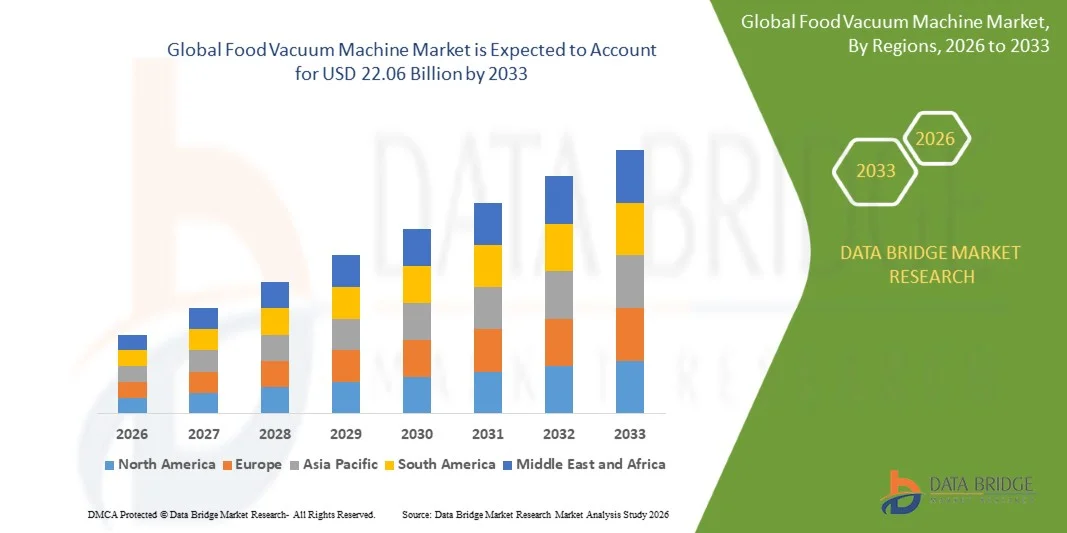
- As per Data Bridge Market Research analysis, the food vacuum machine market was valued at USD 14.93 billion in 2025 and is projected to reach USD 22.06 billion by 2033, growing at a CAGR of 5.00% from 2026 to 2033.
- The market is experiencing steady growth driven by rising demand for extended shelf life and food safety, growing consumption of ready-to-eat and convenience foods, and increasing automation across meat, seafood, dairy, and bakery processing operations.
- The rising incidence of food wastage, combined with stricter food safety and hygiene regulations, is compelling food processors, retailers, and foodservice operators to adopt advanced vacuum packaging technologies. Chamber and thermoforming vacuum machines are replacing manual sealing methods in many markets, offering longer shelf life, reduced spoilage, and improved supply-chain efficiency.
Market Size & Forecast
- Global Market Value (2025): USD 14.93 Billion
- Expected Market Value (2033): USD 22.06 Billion
- Forecast CAGR (2026–2033): 5.00%
- Leading Region in 2025: Asia-Pacific
- Fastest Growing Region: North America
What are the Major Takeaways of the Food Vacuum Machine Market?
- Asia-Pacific dominated the global food vacuum machine market with the largest revenue share of 38.60% in 2025, supported by expanding food processing infrastructure and rising packaged food consumption.
- North America is expected to be the fastest-growing region at a CAGR of 6.10% from 2026 to 2033, fueled by increasing automation in meat and dairy processing and growing e-commerce grocery delivery.
- The fixed chamber vacuum machines segment led the market with a 44.20% share in 2025, driven by high sealing efficiency, reliability, and widespread use across industrial food processing facilities.
- External/nozzle vacuum sealers are the fastest-growing machinery type, projected to register a CAGR of 6.40%, reflecting rising demand from small and medium-sized commercial kitchens and retail outlets.
- The flexible packaging segment dominated the packaging type category with a 52.30% revenue share in 2025, led by its lightweight, cost-effective, and space-saving characteristics.
- The industrial end-use sector accounted for 46.80% of the market share in 2025, preferred by meat, seafood, and dairy processors requiring high-throughput sealing capacity.
- The household/domestic segment is the fastest-growing end-use category, with a CAGR of 6.90%, driven by rising consumer adoption of compact vacuum sealers for home food storage.
- The meat, poultry & seafood application segment led the market with a 29.40% share in 2025, owing to the critical need for shelf-life extension and freshness preservation in protein packaging.
Report Scope and Food Vacuum Machine Market Segmentation
|
Attributes |
Food Vacuum Machine Key Market Insights |
|
Segments Covered |
|
|
Countries Covered |
North America
Europe
Asia-Pacific
Middle East and Africa
South America
|
|
Key Market Players |
|
|
Market Opportunities |
|
|
Value Added Data Infosets |
In addition to the insights on market scenarios such as market value, growth rate, segmentation, geographical coverage, and major players, the market reports curated by the Data Bridge Market Research also include in-depth expert analysis, geographically represented company-wise production and capacity, network layouts of distributors and partners, detailed and updated price trend analysis and deficit analysis of supply chain and demand. |
What is the Key Trend in the Food Vacuum Machine Market?
- Food processors and retailers are increasingly adopting smart, IoT-connected vacuum packaging machines that provide real-time monitoring, predictive maintenance alerts, and remote diagnostics, reducing downtime and improving overall equipment efficiency.
- For instance, in September 2025, Sealed Air Corporation's CRYOVAC brand food packaging installed its 4,000th rotary vacuum chamber system for longtime customer Cargill at its Dodge City, Kansas facility, underscoring continued industrial investment in high-throughput vacuum packaging equipment.
- Compact, tabletop, and small-format vacuum machines are gaining traction among artisan food producers, delis, and specialty retailers seeking in-store packaging flexibility.
- For instance, in March 2025, MULTIVAC UK showcased its C 200 tabletop vacuum chamber machine and R 085 compact thermoforming packaging machine at Foodex 2025, targeting small-scale manufacturers entering vacuum skin packaging.
- As demand for freshness, traceability, and sustainable packaging grows, manufacturers continue to prioritize compact, energy-efficient, and digitally connected vacuum packaging equipment, reinforcing automation as a core component of modern food processing operations.
What are the Key Drivers of the Food Vacuum Machine Market?
- Rising global demand for extended shelf life, food safety, and reduced spoilage has significantly increased adoption of vacuum packaging systems capable of preserving product quality across meat, seafood, dairy, and bakery categories.
- For instance, in September 2025, Sealed Air introduced the CRYOVAC brand SVS45 soft vacuum sealing system for cheese packaging, which uses up to 50% less energy than comparable systems while better preserving product texture, structure, and appearance.
- Automotive-grade automation is being replaced here by growing automation across meat, poultry, seafood, and dairy processing facilities, as processors integrate vacuum packaging into their production lines to reduce labor costs, improve consistency, and enhance food safety compliance.
- For instance, in January 2025, MULTIVAC's Cooling@Packing system, which cools and vacuum-packs bakery products directly within the thermoforming packaging machine, received the Sustainable Packaging News Award, reflecting the industry's growing focus on energy-efficient, integrated processing solutions.
- With rising global protein consumption and tightening food-safety regulation, vacuum packaging technology will remain indispensable for food processors, retailers, and foodservice operators seeking to minimize waste and extend product freshness.
Which Factors are Challenging the Growth of the Food Vacuum Machine Market?
- Advanced food vacuum machines, particularly industrial chamber and rotary systems, require significant upfront investment due to the integration of high-precision sealing mechanisms, automation, and food-grade construction materials.
- These high costs limit adoption among small and medium-sized food processors, independent retailers, and organizations in emerging economies.
- Reliance on specialized films, bags, and consumables adds recurring operational costs, further restraining adoption among cost-sensitive food businesses.
- The combined burden of high capital investment, recurring consumable costs, and maintenance requirements continues to restrict market penetration in price-sensitive and emerging regions, despite growing demand for food preservation solutions.
How is the Food Vacuum Machine Market Segmented?
The food vacuum machine market is segmented on the basis of machinery type, packaging type, end-use sector, application, automation level, and distribution channel.
- By Machinery Type
On the basis of machinery type, the global food vacuum machine market is segmented into chamber vacuum machines, external/nozzle vacuum sealers, tray sealing machines, vacuum skin packaging machines, and thermoforming vacuum packaging machines. The chamber vacuum machines segment dominated the market with a 44.20% share in 2025, owing to its high sealing efficiency, reliability across varied pack sizes, and extensive use in industrial meat, seafood, and dairy processing facilities. These systems deliver consistent vacuum levels and hygienic sealing, making them the preferred choice for large-scale processors and food service distributors.
The external/nozzle vacuum sealers segment is projected to register the fastest growth at a CAGR of 6.40% from 2026 to 2033, driven by rising demand from small commercial kitchens, delis, and home users seeking compact, affordable sealing solutions. Declining equipment costs and growing awareness of food preservation benefits are accelerating segment expansion.
- By Packaging Type
On the basis of packaging type, the global food vacuum machine market is segmented into rigid packaging, semi-rigid packaging, and flexible packaging. The flexible packaging segment led the market with a 52.30% share in 2025, supported by its lightweight design, lower material costs, and space-saving storage and transportation benefits across retail and industrial applications.
The semi-rigid packaging segment is expected to experience the fastest growth at a CAGR of 6.20% from 2026 to 2033, driven by rising demand for tamper-evident, visually appealing packaging formats in ready-to-eat and premium food categories.
- By End-Use Sector
On the basis of end-use sector, the global food vacuum machine market is segmented into industrial, commercial, and household/domestic. The industrial segment dominated the market with a share of 46.80% in 2025 due to its widespread adoption by meat, seafood, poultry, and dairy processors requiring high-throughput, continuous-operation sealing equipment, along with increasing integration of automation and traceability systems.
The household/domestic segment is anticipated to witness the fastest CAGR of 6.90% from 2026 to 2033, driven by growing consumer interest in home food preservation, bulk buying, and meal prepping, supported by the wide availability of affordable, compact vacuum sealers through online retail channels.
- By Application
On the basis of application, the global food vacuum machine market is segmented into meat, poultry & seafood, bakery & confectionery, dairy & cheese products, fruits & vegetables, ready-to-eat & convenience foods, and others. The meat, poultry & seafood segment dominated the market with a share of 29.40% in 2025 due to the critical role of vacuum packaging in extending shelf life, preventing freezer burn, and preserving freshness in protein products.
The ready-to-eat & convenience foods segment is expected to witness the fastest CAGR of 6.70% from 2026 to 2033, driven by changing consumer lifestyles, increasing urbanization, and rising demand for shelf-stable, portion-controlled meal solutions.
- By Automation Level
On the basis of automation level, the global food vacuum machine market is segmented into manual, semi-automatic, and fully automatic. The semi-automatic segment dominated the market with a share of 41.10% in 2025, offering a balance between operational flexibility and cost-effectiveness for mid-sized food processing operations.
The fully automatic segment is expected to witness the fastest CAGR of 6.80% from 2026 to 2033, driven by increasing labor costs, rising throughput requirements, and growing integration of robotics and AI-driven quality inspection in large-scale processing facilities.
- By Distribution Channel
On the basis of distribution channel, the global food vacuum machine market is segmented into direct sales, distributors & dealers, and online retail. The distributors & dealers segment dominated the market with a share of 47.60% in 2025, owing to established regional networks that provide installation, training, and after-sales service support to food processors.
The online retail segment is expected to witness the fastest CAGR of 7.10% from 2026 to 2033, driven by rising e-commerce penetration and growing consumer preference for purchasing compact household vacuum sealers directly through digital platforms.
Which Region Holds the Largest Share of the Food Vacuum Machine Market?
- Asia-Pacific dominated the food vacuum machine market and accounted for the largest revenue share of 38.60% in 2025, supported by expanding food processing infrastructure, rising urbanization, and growing consumption of packaged and convenience foods across China, India, and Japan.
- The region also benefits from a strong base of local vacuum machine manufacturers, competitive production costs, and increasing government focus on reducing food wastage. Growing investment in cold-chain and food processing infrastructure continues to strengthen Asia-Pacific's leadership position in the global market.
China Food Vacuum Machine Market Insight
The China food vacuum machine market is growing rapidly, driven by expanding food processing capacity, rising urbanization, increasing consumption of packaged foods, and greater emphasis on food safety and waste reduction. The country’s large meat, seafood, dairy, and ready-to-eat food industries are increasingly adopting vacuum packaging equipment to extend product shelf life, preserve freshness, and improve packaging efficiency. In addition, the growing modernization of food processing facilities is encouraging manufacturers to invest in automated and AI-enabled vacuum packaging systems that offer higher throughput, precision, and operational efficiency. Government initiatives focused on food safety, cold-chain development, and reducing food losses are further supporting market growth. China’s strong domestic manufacturing ecosystem, availability of packaging equipment suppliers, and expanding export-oriented food processing sector are also positioning the country as a major production and consumption hub for food vacuum machines.
India Food Vacuum Machine Market Insight
The India food vacuum machine market is expanding steadily, supported by increasing investments in food processing infrastructure, rapid urbanization, growth of organized retail, and rising consumer demand for packaged, processed, and shelf-stable foods. Meat, seafood, dairy, bakery, and ready-to-eat food manufacturers are increasingly adopting vacuum packaging technologies to improve product preservation, minimize spoilage, and meet evolving food safety requirements. Government initiatives aimed at strengthening the food processing industry, developing cold-chain infrastructure, and reducing post-harvest losses are further encouraging the adoption of modern packaging equipment. Additionally, the expansion of food delivery services, e-commerce grocery platforms, and organized retail is creating greater demand for packaging solutions that maintain product quality during storage and transportation. Growing exports of processed food products are also prompting manufacturers to adopt advanced vacuum packaging systems that comply with quality and shelf-life requirements in international markets.
North America Food Vacuum Machine Market Insight
The North America food vacuum machine market is experiencing steady growth, driven by increasing automation across meat, dairy, seafood, and processed food manufacturing facilities, along with rising demand for efficient food preservation solutions. Food manufacturers are increasingly deploying automated vacuum packaging machines to improve production efficiency, reduce packaging waste, extend product shelf life, and maintain consistent packaging quality. The growing popularity of ready-to-eat meals, processed meats, frozen foods, and meal-preparation products is further supporting demand for vacuum packaging technologies. In the residential segment, increasing consumer interest in bulk purchasing, meal prepping, home food preservation, and reducing household food waste is driving the adoption of compact and easy-to-use vacuum sealers. Furthermore, the rapid expansion of e-commerce grocery delivery is increasing the need for packaging solutions that protect food products from moisture, oxidation, and contamination during transportation and storage, supporting continued market development across the region.
U.S. Food Vacuum Machine Market Insight
The U.S. food vacuum machine market is experiencing steady growth, supported by strong demand from meat, dairy, seafood, and processed food manufacturers, increasing automation in food production facilities, and growing consumer interest in home food preservation. Large-scale food processors are adopting advanced vacuum packaging systems to extend shelf life, improve operational efficiency, minimize product losses, and maintain food quality throughout distribution. The growing consumption of packaged meats, frozen foods, ready-to-eat meals, and convenience foods is further contributing to demand for high-performance vacuum packaging equipment. At the household level, rising interest in bulk purchasing, meal prepping, portion control, and reducing food waste is encouraging consumers to use compact vacuum sealers for storing meat, vegetables, prepared meals, and other perishable products. In addition, the expansion of online grocery shopping and home delivery is increasing the importance of packaging solutions that preserve freshness and product integrity during transportation, creating further opportunities for vacuum machine manufacturers in the U.S. market.
Which are the Top Companies in Food Vacuum Machine Market?
The food vacuum machine industry is primarily led by well-established companies, including:
- Multivac Group (Germany)
- Sealed Air Corporation (U.S.)
- ULMA Packaging, S. Coop. (Spain)
- Proseal UK Limited (U.K.)
- GEA Group Aktiengesellschaft (Germany)
- Henkelman B.V. (Netherlands)
- Webomatic Maschinenfabrik GmbH (Germany)
- Audion Elektro B.V. (Netherlands)
- Minipack-Torre S.p.A. (Italy)
- Sipromac Inc. (Canada)
- Dadaux SAS (France)
- Boss Vakuum-Verpackungsmaschinen GmbH (Germany)
- Ilpra S.p.A. (Italy)
- Reepack A/S (Denmark)
- Henkovac International B.V. (Netherlands)
- Promarks Vacuum Packing Machines (Turkey)
- Technopack Corporation (India)
- ISG Pack Industries (India)
- ARY VacMaster (U.S.)
- Accu-Seal Corporation (U.S.)
What are Latest Developments in Food Vacuum Machine Market?
- In September 2025, Sealed Air Corporation's CRYOVAC brand food packaging installed its 4,000th rotary vacuum chamber system, delivered to longtime customer Cargill at its Dodge City, Kansas facility. The installation replaced a unit that had reliably operated for 40 years, reflecting the durability and continued industrial demand for CRYOVAC's rotary vacuum packaging technology.
- In September 2025, Sealed Air introduced the CRYOVAC brand SVS45 soft vacuum sealing system, designed for cheese packaging. The system combines differential pressure vacuum with controlled pressure hot sealing, using up to 50% less energy and roughly ten times less compressed air than traditional vacuum systems, while better preserving product texture and appearance.
- In March 2025, MULTIVAC UK exhibited its C 200 tabletop vacuum chamber machine and R 085 compact thermoforming packaging machine at Foodex 2025, targeting small-scale food manufacturers entering vacuum skin packaging with reduced operating costs and a compact equipment footprint.
- In January 2025, MULTIVAC's Cooling@Packing system, which integrates cooling and vacuum packing of bakery products directly within the thermoforming packaging machine, received the Sustainable Packaging News Award, reinforcing the company's focus on energy-efficient, integrated food packaging solutions.
- In September 2025, MULTIVAC exhibited its R3 thermoforming packaging machine under its newly branded MULTIVAC Health Packaging segment at Compamed, demonstrating a modular design approach that is also informing the development of its food-grade packaging platforms.

- Interactive Data Analysis Dashboard
- Company Analysis Dashboard for high growth potential opportunities
- Research Analyst Access for customization & queries
- Competitor Analysis with Interactive dashboard
- Latest News, Updates & Trend analysis
- Harness the Power of Benchmark Analysis for Comprehensive Competitor Tracking
Global Food Vacuum Machine Market, Supply Chain Analysis and Ecosystem Framework
To support market growth and help clients navigate the impact of geopolitical shifts, DBMR has integrated in-depth supply chain analysis into its Global Food Vacuum Machine Market research reports. This addition empowers clients to respond effectively to global changes affecting their industries. The supply chain analysis section includes detailed insights such as Global Food Vacuum Machine Market consumption and production by country, price trend analysis, the impact of tariffs and geopolitical developments, and import and export trends by country and HSN code. It also highlights major suppliers with data on production capacity and company profiles, as well as key importers and exporters. In addition to research, DBMR offers specialized supply chain consulting services backed by over a decade of experience, providing solutions like supplier discovery, supplier risk assessment, price trend analysis, impact evaluation of inflation and trade route changes, and comprehensive market trend analysis.
Data collection and base year analysis are done using data collection modules with large sample sizes. The stage includes obtaining market information or related data through various sources and strategies. It includes examining and planning all the data acquired from the past in advance. It likewise envelops the examination of information inconsistencies seen across different information sources. The market data is analysed and estimated using market statistical and coherent models. Also, market share analysis and key trend analysis are the major success factors in the market report. To know more, please request an analyst call or drop down your inquiry.
The key research methodology used by DBMR research team is data triangulation which involves data mining, analysis of the impact of data variables on the market and primary (industry expert) validation. Data models include Vendor Positioning Grid, Market Time Line Analysis, Market Overview and Guide, Company Positioning Grid, Patent Analysis, Pricing Analysis, Company Market Share Analysis, Standards of Measurement, Global versus Regional and Vendor Share Analysis. To know more about the research methodology, drop in an inquiry to speak to our industry experts.
Data Bridge Market Research is a leader in advanced formative research. We take pride in servicing our existing and new customers with data and analysis that match and suits their goal. The report can be customized to include price trend analysis of target brands understanding the market for additional countries (ask for the list of countries), clinical trial results data, literature review, refurbished market and product base analysis. Market analysis of target competitors can be analyzed from technology-based analysis to market portfolio strategies. We can add as many competitors that you require data about in the format and data style you are looking for. Our team of analysts can also provide you data in crude raw excel files pivot tables (Fact book) or can assist you in creating presentations from the data sets available in the report.













