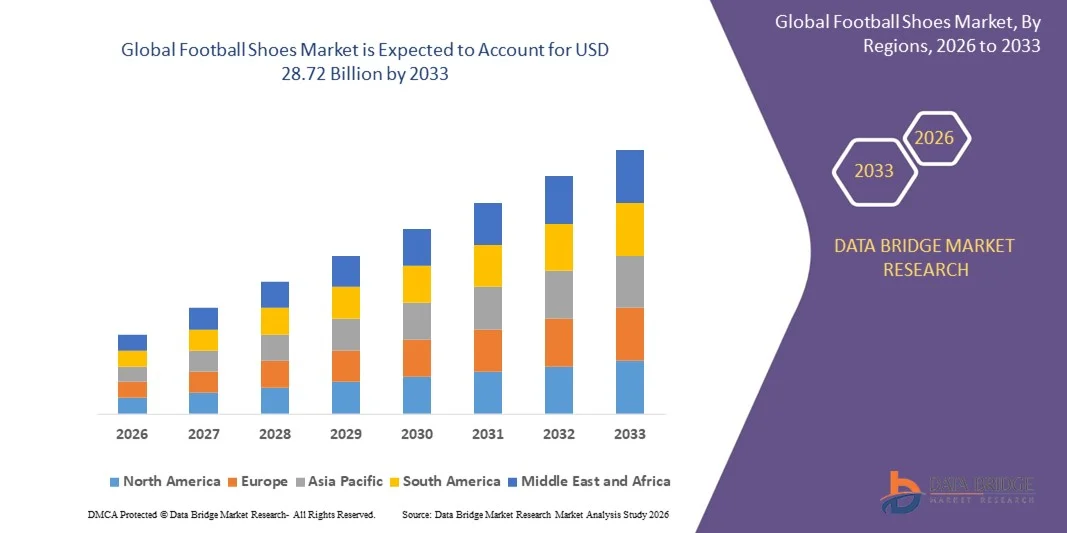
Football Shoes Market Size
- The global football shoes market size was valued at USD 20.83 billion in 2025 and is expected to reach USD 28.72 billion by 2033, at a CAGR of 4.1% during the forecast period
- The market growth is largely driven by the rising popularity of football across professional, amateur, and recreational levels, coupled with increasing participation in organized leagues, school programs, and grassroots initiatives. Growing consumer interest in performance-enhancing sports gear and advanced footwear technologies is further accelerating demand for football shoes
- Furthermore, technological innovations such as AI-powered customization, advanced cushioning systems, lightweight materials, and sustainable components are enabling players to optimize performance, comfort, and durability. These converging factors are boosting the adoption of high-performance and specialty football shoes, thereby significantly contributing to market expansion
Football Shoes Market Analysis
- Football shoes, designed to enhance performance, traction, comfort, and agility on various playing surfaces, are becoming essential equipment for professional athletes, club players, and enthusiasts alike. Features such as stud configuration, breathable materials, and ergonomic design are increasingly influencing purchase decisions among consumers
- The escalating demand for football shoes is primarily fueled by the growing football fan base, increased participation in competitive leagues, and rising awareness of sports science and injury prevention. In addition, the expansion of e-commerce channels and global availability of international and local brands is further facilitating access to technologically advanced football footwear, driving overall market growth
- Europe dominated football shoes market with a share of over 30% in 2025, due to a strong football culture, professional leagues, and the presence of major football footwear brands such as Adidas and Puma
- Asia-Pacific is expected to be the fastest growing region in the football shoes market during the forecast period due to rising football popularity in countries such as China, India, and Japan
- Adult segment dominated the market with a market share of 68.1% in 2025, due to widespread participation in professional, amateur, and recreational football among adults. Adults typically demand high-performance football shoes that offer durability, traction, and comfort during competitive play. Endorsements by professional athletes and availability of technologically advanced models further strengthen this segment’s market position. Adult consumers often invest in premium or mid-range shoes that balance performance with style, reinforcing its market dominance
Report Scope and Football Shoes Market Segmentation
|
Attributes |
Football Shoes Key Market Insights |
|
Segments Covered |
|
|
Countries Covered |
North America
Europe
Asia-Pacific
Middle East and Africa
South America
|
|
Key Market Players |
|
|
Market Opportunities |
|
|
Value Added Data Infosets |
In addition to the insights on market scenarios such as market value, growth rate, segmentation, geographical coverage, and major players, the market reports curated by the Data Bridge Market Research also include in-depth expert analysis, pricing analysis, brand share analysis, consumer survey, demography analysis, supply chain analysis, value chain analysis, raw material/consumables overview, vendor selection criteria, PESTLE Analysis, Porter Analysis, and regulatory framework. |
Football Shoes Market Trends
Rising Adoption of Customized Football Shoes
- A notable trend in the global football shoes market is the increasing adoption of customized and personalized footwear, driven by consumer demand for performance optimization, comfort, and unique designs tailored to individual playing styles and preferences
- For instance, in November 2023, Adidas launched an AI-powered customization platform allowing players to design football shoes based on biomechanics, foot shape, and performance metrics, enabling athletes to select stud configuration, cushioning level, and aesthetic elements, which is significantly enhancing user engagement and brand loyalty
- The growing integration of advanced technologies in football shoes, such as 3D printing, AI-driven design tools, and performance tracking sensors, allows brands to offer highly tailored products that improve traction, agility, and injury prevention, thereby driving consumer interest in personalized options
- In addition, the rise of digital platforms and e-commerce channels facilitates easy access to customized football shoes, allowing consumers to engage with brands online and receive products designed to meet specific functional and stylistic requirements, thereby boosting overall market adoption
- This trend is reinforced by sports enthusiasts and professional players seeking footwear that provides measurable performance benefits and unique design elements, prompting companies to invest in R&D for innovative materials, sustainable components, and interactive customization tools
- The cumulative effect of technological innovation, increasing consumer demand for personalization, and enhanced engagement through digital platforms is reshaping the football shoes market, establishing customized footwear as a key growth segment and creating long-term opportunities for global sports brands
Football Shoes Market Dynamics
Driver
Growing Popularity of Football and Sports Participation
- The expanding popularity of football across professional leagues, amateur clubs, and school programs is a primary driver of football shoes market growth, as increasing participation leads to higher demand for performance-enhancing footwear
- For instance, Nike has experienced significant growth in its football shoe segment through sponsorship of major leagues and football academies, which encourages youth participation and increases brand visibility among aspiring athletes, directly driving demand for its high-performance products
- Rising consumer interest in sports and physical fitness is contributing to greater adoption of football shoes among recreational players, with an emphasis on footwear that enhances comfort, agility, and durability during prolonged play
- Urbanization and the growth of organized sports infrastructure in emerging markets are supporting increased accessibility and participation in football, which in turn stimulates demand for both professional-grade and casual football footwear
- The combination of professional league popularity, grassroots initiatives, youth engagement, and growing health consciousness is sustaining a robust demand for football shoes, reinforcing the market’s expansion and establishing strong growth prospects across global regions
Restraint/Challenge
High Cost of Advanced and Premium Football Shoes
- The relatively high price point of advanced and premium football shoes presents a significant challenge to market growth, particularly for price-sensitive consumers in developing regions who may find cutting-edge footwear financially inaccessible
- For instance, specialized AI-customized football shoes or limited-edition high-performance boots from Adidas and Nike often command premium prices that limit adoption among amateur players and casual consumers, restricting market penetration
- Manufacturers must balance the integration of advanced materials, innovative design, and performance-enhancing features with production costs, which can result in higher retail prices and create barriers to widespread consumer acceptance
- While entry-level models are available at more affordable price points, the perceived value and benefits of premium football shoes often deter purchase decisions among budget-conscious buyers, impacting overall sales volume in certain markets
- Addressing the cost challenge through strategic pricing, targeted promotions, and offering tiered product lines that provide performance benefits at varying price points is essential for expanding consumer reach and sustaining long-term growth in the football shoes market
Football Shoes Market Scope
The market is segmented on the basis of product type, material type, gender, age group, distribution channel, price range, end user, technology, and specialty.
- By Product Type
On the basis of product type, the football shoes market is segmented into cleats, turf shoes, indoor shoes, sandals/slides, and training shoes. The cleats segment dominated the market with the largest market revenue share of 41.8% in 2025, driven by their essential role in providing traction and stability on natural grass fields. Football players, from amateurs to professionals, often prefer cleats for their ability to enhance grip and reduce the risk of slipping during high-intensity gameplay. The strong adoption of cleats is further fueled by innovations in stud configurations and lightweight materials, which enhance player performance and comfort. Cleats also benefit from widespread endorsements by professional athletes, contributing to higher consumer trust and brand loyalty. Manufacturers continue to introduce technologically advanced cleats with improved ergonomics, reinforcing their position as the leading product type.
The turf shoes segment is anticipated to witness the fastest growth rate of 19.6% from 2026 to 2033, fueled by increasing play on artificial turf surfaces and urban sports facilities. For instance, brands such as Nike and Adidas have launched specialized turf shoes designed for enhanced traction and durability on synthetic surfaces, appealing to both youth and amateur players. Turf shoes offer a balance of comfort and stability, making them ideal for recreational players and schools investing in artificial pitches. Growing interest in multi-surface play and training programs also drives the adoption of turf shoes. In addition, their versatility for different football formats contributes to their rising popularity in emerging markets.
- By Material Type
On the basis of material type, the football shoes market is segmented into leather, synthetic, and hybrid. The synthetic segment held the largest market revenue share in 2025, driven by its affordability, lightweight properties, and adaptability to different playing conditions. Synthetic football shoes are favored for their consistent performance, low maintenance requirements, and water-resistant features, making them suitable for varied climates and terrains. Manufacturers continuously innovate synthetic materials to enhance flexibility, breathability, and durability, thereby meeting the needs of both professional and amateur players. The widespread availability of synthetic options across price ranges also makes them highly accessible to a broad consumer base.
The leather segment is expected to witness the fastest CAGR from 2026 to 2033, fueled by rising demand for premium football shoes that provide a superior fit, touch, and ball control. For instance, Puma and Adidas have reintroduced high-quality kangaroo leather models that appeal to professional players seeking comfort and performance. Leather football shoes offer natural stretch and adaptability to foot contours, improving long-term comfort. Rising disposable income and the aspiration for high-end footwear in emerging football markets further drive leather adoption.
- By Gender
On the basis of gender, the football shoes market is segmented into men, women, and unisex. The men’s segment dominated the market with the largest revenue share of 62.4% in 2025, driven by higher participation rates in football across professional and amateur leagues. Male players demand specialized football shoes for optimal performance, stability, and injury prevention during competitive play. Marketing campaigns and sponsorships targeting male athletes further reinforce this segment’s market leadership. The availability of a wide range of styles, brands, and technologies for men contributes to its dominance in revenue.
The women’s segment is anticipated to witness the fastest growth rate of 22.3% from 2026 to 2033, fueled by increasing female participation in football at professional, amateur, and grassroots levels. For instance, Adidas and Nike have launched women-specific lines designed with narrower fits and enhanced comfort features tailored to female athletes. Rising support for women’s football leagues and youth programs encourages demand for performance-oriented football shoes. The growing influence of female football stars in media campaigns also accelerates adoption.
- By Age Group
On the basis of age group, the football shoes market is segmented into youth and adult. The adult segment dominated the market with the largest revenue share of 68.1% in 2025, driven by widespread participation in professional, amateur, and recreational football among adults. Adults typically demand high-performance football shoes that offer durability, traction, and comfort during competitive play. Endorsements by professional athletes and availability of technologically advanced models further strengthen this segment’s market position. Adult consumers often invest in premium or mid-range shoes that balance performance with style, reinforcing its market dominance.
The youth segment is expected to witness the fastest CAGR from 2026 to 2033, fueled by rising interest in football among children and teenagers and growing school and academy football programs. For instance, Puma and Nike youth football shoes feature lightweight designs and flexible uppers for improved agility and comfort. Youth-focused marketing campaigns and initiatives to introduce football at the grassroots level encourage adoption. Parents increasingly invest in high-quality football shoes for skill development and injury prevention, driving segment growth.
- By Distribution Channel
On the basis of distribution channel, the football shoes market is segmented into online retail, offline retail, and direct sales. The offline retail segment dominated the market with the largest revenue share of 55.7% in 2025, driven by the opportunity for consumers to physically try shoes for fit, comfort, and style. Physical stores also provide personalized assistance and immediate purchase, catering to consumers who prefer traditional shopping experiences. Strong presence of leading sports retailers and brand outlets in urban and semi-urban areas contributes to offline retail dominance. Exclusive in-store releases and promotions enhance customer engagement and brand loyalty.
The online retail segment is anticipated to witness the fastest growth rate of 23.1% from 2026 to 2033, fueled by increasing e-commerce penetration and consumer preference for convenient shopping experiences. For instance, platforms such as Amazon and Nike.com provide a wide range of football shoes with detailed specifications and customer reviews to guide purchasing decisions. Online sales also enable access to limited editions and custom designs not always available offline. Rising digital marketing initiatives and home delivery services further drive online retail adoption.
- By Price Range
On the basis of price range, the football shoes market is segmented into premium, mid-range, and economy. The mid-range segment dominated the market with the largest revenue share of 48.5% in 2025, driven by its balance between affordability and performance features. Mid-range football shoes attract a wide audience, including amateur players and football enthusiasts seeking quality without premium pricing. Brands continually enhance mid-range offerings with improved comfort, durability, and design options, ensuring strong consumer preference. The segment benefits from broad availability across offline and online channels, increasing reach.
The premium segment is expected to witness the fastest CAGR from 2026 to 2033, fueled by rising demand for high-end football shoes with advanced technologies for professional players. For instance, Adidas Predator and Nike Mercurial lines offer lightweight materials, specialized stud configurations, and performance-enhancing features. Growing brand consciousness, endorsements by professional athletes, and aspirational buying behavior drive premium segment growth. Rising disposable incomes in emerging markets also contribute to adoption.
- By End User
On the basis of end user, the football shoes market is segmented into professional players, amateur players, and kids. The amateur players segment dominated the market with the largest revenue share of 57.3% in 2025, driven by the larger population of recreational players and local league participants. Amateur players seek football shoes that provide comfort, durability, and reasonable pricing for regular play. The growth of community leagues and grassroots football initiatives further boosts this segment. Amateur players also adopt mid-range and performance-oriented shoes, creating steady demand across brands and models.
The professional players segment is anticipated to witness the fastest growth rate of 20.8% from 2026 to 2033, fueled by demand for high-performance football shoes with innovative materials and technologies. For instance, Nike and Puma develop professional-grade shoes with lightweight uppers and advanced stud patterns to enhance traction and ball control. Professional endorsements and media visibility drive consumer aspiration to use the same shoes as elite athletes. Increasing professional league participation in emerging markets also stimulates growth.
- By Technology
On the basis of technology, the football shoes market is segmented into traditional stud patterns, knit uppers, customizable options, and performance-enhancing features. The traditional stud patterns segment dominated the market with the largest revenue share of 49.6% in 2025, driven by proven traction, stability, and comfort across various field types. Traditional stud shoes are widely used by players of all levels due to reliability and compatibility with multiple playing surfaces. Sports brands continue to innovate stud designs for better grip and reduced fatigue, reinforcing their popularity. The familiarity and widespread acceptance of traditional stud patterns maintain consumer trust and strong sales.
The customizable options segment is expected to witness the fastest CAGR from 2026 to 2033, fueled by rising demand for personalized designs, fit adjustments, and unique colorways. For instance, Nike By You allows football enthusiasts to create custom shoes tailored to their size, style, and preferred features. Personalized products cater to aspirational players seeking individuality and brand exclusivity. Increased awareness through digital channels and social media campaigns accelerates adoption.
- By Specialty
On the basis of specialty, the football shoes market is segmented into custom-made shoes, limited edition releases, and collaborations. The limited edition releases segment dominated the market with the largest revenue share of 52.1% in 2025, driven by collector appeal and exclusivity offered by renowned brands. Limited editions often feature unique designs, enhanced materials, and branding tie-ups that attract enthusiasts and professional players. Strong marketing campaigns and high-profile endorsements amplify consumer desire, sustaining market dominance. The exclusivity factor also encourages faster purchase decisions and repeat engagement among loyal brand followers.
The collaborations segment is anticipated to witness the fastest growth rate of 24.4% from 2026 to 2033, fueled by partnerships between sports brands and celebrities, designers, or football clubs. For instance, Adidas collaborations with Manchester United and Lionel Messi create high demand for co-branded football shoes with innovative designs. Collaborations generate media buzz, social media engagement, and a sense of prestige, appealing to youth and professional players alike. Rising interest in collectible football shoes drives market expansion in this segment.
Football Shoes Market Regional Analysis
- Europe dominated the football shoes market with the largest revenue share of over 30% in 2025, driven by a strong football culture, professional leagues, and the presence of major football footwear brands such as Adidas and Puma
- Consumers in the region highly value performance, durability, and technological innovations in football shoes, including lightweight materials, advanced traction systems, and enhanced comfort
- This widespread adoption is further supported by high consumer spending power, strong retail and e-commerce networks, and the growing trend of football as a recreational and professional sport, establishing Europe as a key market for football footwear
Germany Football Shoes Market Insight
The Germany football shoes market captured the largest revenue share in 2025 within Europe, fueled by strong participation in professional and amateur football leagues and the popularity of football among youth. Consumers increasingly seek innovative footwear with cutting-edge technology, such as Boost cushioning by Adidas or Puma’s evoPOWER design. The country’s robust sporting goods retail infrastructure, coupled with increasing awareness of sports performance enhancement, further drives market growth. Moreover, the growing trend of fitness and health-conscious lifestyles encourages the adoption of high-performance football shoes.
U.K. Football Shoes Market Insight
The U.K. football shoes market is expected to grow at a substantial CAGR during the forecast period, driven by the popularity of the Premier League and grassroots football programs. For instance, Nike’s Mercurial and Tiempo series have seen rising demand among professional and amateur players. The emphasis on brand loyalty, innovative shoe designs, and strong online retail channels supports continuous growth in the U.K. football footwear segment. In addition, social media marketing and influencer endorsements further increase consumer engagement and adoption.
France Football Shoes Market Insight
The France football shoes market is projected to expand steadily due to increasing participation in professional leagues and local football clubs. Consumers are drawn to advanced football shoe technologies that enhance performance, agility, and ball control. French players and teams increasingly prefer high-quality footwear from established brands such as Nike, Adidas, and Puma. The integration of e-commerce platforms with offline retail channels allows easy access to premium football shoes. Moreover, France’s investment in sports infrastructure and football academies continues to boost the market.
Asia-Pacific Football Shoes Market Insight
The Asia-Pacific football shoes market is poised to grow at the fastest CAGR during the forecast period of 2026 to 2033, driven by rising football popularity in countries such as China, India, and Japan. For instance, China has witnessed growing adoption of football shoes due to government initiatives promoting football in schools and urban areas. Increasing disposable incomes, a burgeoning youth population, and rising awareness of professional football leagues are further driving adoption. In addition, the expansion of local and international sports brands into APAC is making technologically advanced football shoes more accessible.
Japan Football Shoes Market Insight
The Japan football shoes market is gaining momentum owing to the country’s emphasis on sports education, urban football culture, and professional league popularity. Consumers increasingly prefer shoes offering comfort, performance, and injury prevention technologies. Integration of innovative materials and design, such as lightweight soles and improved traction, is fueling growth. Moreover, Japan’s aging but active population encourages demand for easy-to-wear, high-performance football shoes suitable for all age groups.
China Football Shoes Market Insight
The China football shoes market accounted for the largest market revenue share in Asia-Pacific in 2025, attributed to rapid urbanization, a growing middle class, and increasing interest in football. China has become a key market for both professional and recreational football shoes. For instance, domestic brands such as Li-Ning and international brands such as Adidas are expanding retail presence and marketing campaigns to target youth and sports enthusiasts. Government-led football promotion programs, increasing participation in local leagues, and the rise of football academies are significant factors driving market growth.
Football Shoes Market Share
The football shoes industry is primarily led by well-established companies, including:
- Nike, Inc. (U.S.)
- Adidas (Germany)
- Puma (Germany)
- New Balance (U.S.)
- Under Armour (U.S.)
- Mizuno (Japan)
- Asics (Japan)
- Umbro (U.K.)
- Diadora (Italy)
- Lotto (Italy)
- Warrior Sports (U.K)
- Kelme (Spain)
- Concave (U.K.)
- Joma (Spain)
- Kipsta (Decathlon) (France)
- Hummel (Denmark)
- Uhlsport (Germany)
- Lelli Kelly (U.K.)
- Voit (Mexico)
- Penalty (Brazil)
Latest Developments in Global Football Shoes Market
- In June 2025, Adidas launched the Predator 25 ‘Goal Hunter’, which combines iconic design elements from the Predator legacy with advanced performance technologies. This launch has significantly boosted consumer interest in high-performance football shoes, strengthened brand loyalty among both professional and amateur players, and reinforced Adidas’s leadership in performance-driven footwear by creating a strong differentiation in the competitive European and global markets
- In April 2025, major brands including Adidas, Nike, and Puma accelerated the release of limited-edition and special colorway boots, moving from seasonal drops to near-weekly launches. This strategy has heightened consumer engagement, created excitement among collectors and trend-conscious players, and driven incremental sales while maintaining sustained visibility in an increasingly competitive football footwear market
- In November 2023, Adidas unveiled an AI-powered customization platform, enabling players to design football shoes based on their foot shape, biomechanics, and playing style. This innovation provides highly personalized performance optimization, strengthens customer loyalty, and positions Adidas as a technological pioneer in smart, tailored sports footwear solutions
- In March 2023, Nike introduced a football shoe line using sustainable materials, including recycled polyester, plant-based components, and water-based adhesives. The eco-friendly innovation addresses the rising consumer demand for environmentally conscious products, enhances brand image, and differentiates Nike in a competitive market by combining performance with sustainability
- In March 2023, Puma replaced kangaroo leather in its KING football boots with K-BETTER, a high-performance synthetic material containing recycled content. This development reinforces Puma’s commitment to sustainability and ethical practices while maintaining comfort, durability, and ball control, appealing to environmentally and socially conscious consumers, and strengthening the brand’s market position in Europe and globally

- Interactive Data Analysis Dashboard
- Company Analysis Dashboard for high growth potential opportunities
- Research Analyst Access for customization & queries
- Competitor Analysis with Interactive dashboard
- Latest News, Updates & Trend analysis
- Harness the Power of Benchmark Analysis for Comprehensive Competitor Tracking
Data collection and base year analysis are done using data collection modules with large sample sizes. The stage includes obtaining market information or related data through various sources and strategies. It includes examining and planning all the data acquired from the past in advance. It likewise envelops the examination of information inconsistencies seen across different information sources. The market data is analysed and estimated using market statistical and coherent models. Also, market share analysis and key trend analysis are the major success factors in the market report. To know more, please request an analyst call or drop down your inquiry.
The key research methodology used by DBMR research team is data triangulation which involves data mining, analysis of the impact of data variables on the market and primary (industry expert) validation. Data models include Vendor Positioning Grid, Market Time Line Analysis, Market Overview and Guide, Company Positioning Grid, Patent Analysis, Pricing Analysis, Company Market Share Analysis, Standards of Measurement, Global versus Regional and Vendor Share Analysis. To know more about the research methodology, drop in an inquiry to speak to our industry experts.
Data Bridge Market Research is a leader in advanced formative research. We take pride in servicing our existing and new customers with data and analysis that match and suits their goal. The report can be customized to include price trend analysis of target brands understanding the market for additional countries (ask for the list of countries), clinical trial results data, literature review, refurbished market and product base analysis. Market analysis of target competitors can be analyzed from technology-based analysis to market portfolio strategies. We can add as many competitors that you require data about in the format and data style you are looking for. Our team of analysts can also provide you data in crude raw excel files pivot tables (Fact book) or can assist you in creating presentations from the data sets available in the report.