What is the Foramsulfuron Herbicide Market Size and Growth Rate?
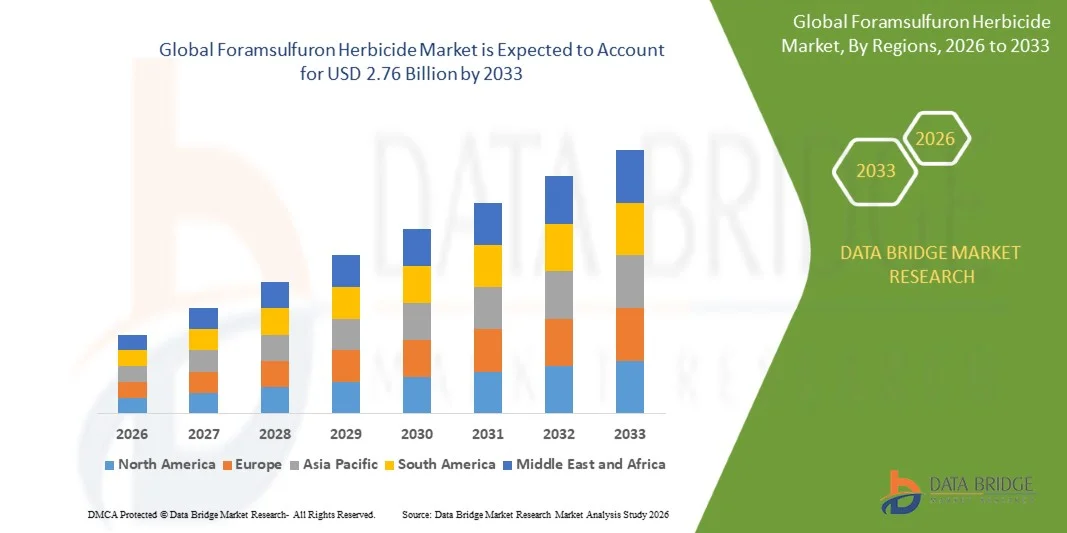
- As per Data Bridge Market Research analysis, the foramsulfuron herbicide market was valued at USD 1.72 billion in 2025 and is projected to reach USD 2.76 billion by 2033, growing at a CAGR of 6.10% from 2026 to 2033.
- The market is experiencing consistent growth driven by increasing demand for food security, expanding agricultural land under cultivation, and rising adoption of advanced weed management practices, with the market report highlighting continued innovation in herbicide development and the need to optimize crop protection strategies.
- The growing need for effective weed control in maize, combined with the adoption of post-emergence herbicide applications, is supporting demand for foramsulfuron. Research has demonstrated its efficacy against several important maize weeds, including redroot pigweed, green foxtail, wild mustard, black nightshade, velvetleaf, common lambsquarters, and barnyardgrass, while also reporting good crop selectivity and no negative effect on maize yield.
Market Size & Forecast
- Global Market Value (2025): USD 1.72 Billion
- Expected Market Value (2033): USD 2.76 Billion
- Forecast CAGR (2026–2033): 6.10%
- Leading Region in 2025: North America
- Fastest Growing Region: Asia Pacific
What are the Major Takeaways of the Foramsulfuron Herbicide Market?
- North America dominated the foramsulfuron herbicide market with the largest revenue share of 34.2% in 2025, supported by advanced agricultural practices, extensive crop cultivation, and high adoption of precision agriculture and advanced weed-management solutions.
- Asia-Pacific is expected to be the fastest-growing region at a CAGR of 7.9% from 2026 to 2033, fueled by its vast agricultural landscape, rapid adoption of modern farming technologies, supportive government initiatives, and increasing demand for cereals and grains
- The liquid segment led the market with a 58% share in 2025, driven by its uniform active-ingredient distribution and easier application through conventional agricultural spraying equipment.
- Granular are the fastest-growing product type, projected to register a CAGR of 6.5%, reflecting the surge in interest in controlled and convenient herbicide application technologies.
- The cereals & grains segment dominated the application category with a 72% revenue share in 2025, led by its importance for post-emergence weed control in maize and other cereal-based production systems
- Selective accounted for 90% of the market share in 2025, preferred by farmers and commercial growers for targeted post-emergence weed control, particularly in maize and other cereal crops.
- The combination segment is the fastest-growing formulation category, with a CAGR of 6.2%, driven by increasing demand for broader-spectrum weed control, rising herbicide-resistance concerns, and the need to control diverse grass
Report Scope and Foramsulfuron Herbicide Market Segmentation
|
Attributes |
Foramsulfuron Herbicide Key Market Insights |
|
Segments Covered |
|
|
Countries Covered |
North America
Europe
Asia-Pacific
Middle East and Africa
South America
|
|
Key Market Players |
|
|
Market Opportunities |
|
|
Value Added Data Infosets |
In addition to the insights on market scenarios such as market value, growth rate, segmentation, geographical coverage, and major players, the market reports curated by the Data Bridge Market Research also include import export analysis, production capacity overview, production consumption analysis, price trend analysis, climate change scenario, supply chain analysis, value chain analysis, raw material/consumables overview, vendor selection criteria, PESTLE Analysis, Porter Analysis, and regulatory framework. |
What is the Key Trend in the Foramsulfuron Herbicide Market?
- Farmers are increasingly focusing on optimized foramsulfuron application rates and integrated weed-management practices to achieve effective weed control while reducing unnecessary herbicide use and improving environmental sustainability.
- For instance, in January 2024, a study published eight post-emergence herbicides for weedy sunflower control in maize and found satisfactory weed control, with most estimated effective doses (ED90) below the recommended field rate, supporting the trend toward reduced and optimized herbicide application.
- Dose-response testing is enabling growers to match herbicide rates with weed species and growth stages for more precise post-emergence weed management.
- Research is also evaluating foramsulfuron within integrated and sequential weed-control programs, particularly where multiple weed species occur simultaneously in corn production systems.
- For instance, in June 2024, a study published foramsulfuron + iodosulfuron at five application rates (0–186 g a.i./ha) with biostimulants and potassium chloride, demonstrating continued research into optimizing foramsulfuron-based tank mixtures and improving crop tolerance.
- As growers increasingly prioritize effective weed control, optimized application rates, and integrated management, demand for targeted foramsulfuron-based solutions is expected to remain supported across maize production systems.
What are the Key Drivers of the Foramsulfuron Herbicide Market?
- The growing need for effective post-emergence weed control in maize is increasing demand for foramsulfuron, particularly because the herbicide provides selective control of grasses and some broadleaf weeds.
- For instance, in April 2022, research published in Weed Technology documented ALS-inhibitor resistance in johnsongrass from Greek cornfields, reinforcing the need for effective herbicide-management strategies and alternative weed-control approaches in maize production.
- Foramsulfuron provides broad-spectrum weed-control capabilities, supporting its use against diverse weed populations that compete with maize for nutrients, water, and growing space.
- suppression is particularly important because volunteer cereal interference can substantially reduce maize productivity, increasing the importance of timely post-emergence herbicide applications.
- For instance, in April 2024, a field study published in the Indian Journal of Weed Science evaluated sole, tank-mix, sequential, and integrated herbicide applications for managing complex weed flora in Kharif maize, demonstrating the increasing emphasis on integrated approaches to improve weed control and maize productivity.
- With maize producers increasingly seeking selective, effective, and timely weed-management solutions, the demonstrated efficacy of foramsulfuron against diverse weed species will continue to support market demand.
Which Factors are Challenging the Growth of the Foramsulfuron Herbicide Market?
- The development of ALS-inhibitor resistance among weeds represents a significant challenge because foramsulfuron acts by inhibiting acetolactate synthase (ALS), potentially reducing effectiveness against resistant weed populations.
- For instance, in August 2024, a study published that inappropriate herbicide use can cause phytotoxic effects in maize, while studying herbicide resistance mechanisms and identifying 20 susceptible maize inbred lines among 42 tested lines, demonstrating the crop-safety challenges associated with repeated herbicide use
- Resistant weed populations can substantially reduce the effectiveness of foramsulfuron, requiring alternative herbicide modes of action and more integrated weed-management strategies.
- Herbicide efficacy also varies according to weed species, growth stage, and application rate, making appropriate timing and dose selection important for achieving consistent control.
- For instance, in December 2024, researchers reported that inappropriate use of sulfonylurea herbicides can cause significant phytotoxic effects in maize, with herbicide resistance potentially reducing treatment effectiveness, highlighting crop-safety and resistance-management challenges for ALS-inhibiting herbicides such as foramsulfuron.
- The emergence of ALS-resistant weeds and variability in treatment effectiveness can limit the long-term reliability of foramsulfuron, increasing the need for integrated weed-management practices and alternative herbicide modes of action.
How is the Foramsulfuron Herbicide Market Segmented?
The foramsulfuron herbicide market is segmented on the basis of product type, application, mode of action, formulation, and distribution channel.
- By Product Type
On the basis of product type, the foramsulfuron herbicide market is segmented into liquid, granular, and powder. The liquid segment dominated the market with an estimated share of 58% in 2025, primarily because liquid formulations provide uniform active-ingredient distribution and easier application through conventional agricultural spraying equipment. Foramsulfuron is commonly supplied in concentrated liquid formulations that can be diluted before field application. These formulations facilitate rapid and consistent coverage of weeds in large-scale maize and cereal fields. Liquid products are also compatible with mechanized spraying systems and precision agriculture equipment. Their comparatively easier handling, mixing, and application further support their widespread adoption among commercial growers.
The granular segment is projected to register the fastest growth at an estimated CAGR of 6.5% from 2026 to 2033, supported by growing interest in controlled and convenient herbicide application technologies. Granular formulations can offer easier storage and handling while reducing issues associated with liquid spills and spray drift. Their application can also be integrated with mechanized agricultural equipment, particularly in large-scale farming operations. Increasing adoption of precision application technologies is creating opportunities for more accurately distributed granular herbicides. Farmers are also seeking formulations that simplify field operations and reduce unnecessary chemical exposure during handling.
- By Application
On the basis of application, the foramsulfuron herbicide market is segmented into cereals & grains, fruits & vegetables, turf & ornamentals, and others. The cereals & grains segment dominated the market with an estimated share of 72% in 2025, primarily because foramsulfuron is particularly important for post-emergence weed control in maize and other cereal-based production systems. The herbicide provides selective control of several economically important grass and broadleaf weeds that compete with crops for nutrients, water, and sunlight. Large-scale maize cultivation across North America, Europe, and other agricultural regions supports substantial demand for selective herbicide solutions. Farmers increasingly rely on post-emergence herbicides to improve crop establishment and protect yield potential. Consequently, cereals and grains are expected to remain the principal application area throughout the forecast period.
The turf & ornamentals segment is projected to experience relatively faster growth at an estimated CAGR of 5.8% from 2026 to 2033, supported by increasing investment in professional turf management and landscaped environments. Professional turf managers increasingly require selective herbicides that can control unwanted vegetation while minimizing damage to desirable plants. Improvements in application precision are also supporting more targeted weed management in managed landscapes. Rising urbanization and expenditure on green spaces are creating additional opportunities for specialized herbicide applications. Nevertheless, regulatory requirements and crop-specific tolerance considerations limit the broader use of foramsulfuron outside its principal agricultural applications.
- By Mode of Action
On the basis of mode of action, the foramsulfuron herbicide market is segmented into selective and non-selective. The selective segment dominated the market with an estimated share of 90% in 2025, reflecting the fundamental use of foramsulfuron as a selective post-emergence herbicide. Selective weed control enables farmers to target unwanted weeds while preserving the cultivated crop when the product is applied according to recommended use patterns. This characteristic makes the herbicide particularly valuable in maize production, where competition from grasses and broadleaf weeds can substantially reduce crop productivity. Increasing demand for crop-specific weed-management solutions is strengthening this segment. The segment is expected to retain its overwhelming market position because selectivity is one of the principal performance advantages associated with foramsulfuron.
The non-selective segment is projected to register the fastest growth at an estimated CAGR of 6.5% from 2026 to 2033, supported by increasing demand for broad-spectrum vegetation management. Non-selective herbicides can provide wider weed and vegetation control across areas where preservation of specific plant species is not the primary objective. Growing adoption in non-crop areas, land preparation, industrial vegetation management, and certain specialized applications is creating additional opportunities for this segment. Increasing weed resistance and the need for broader-spectrum vegetation control are also encouraging interest in non-selective solutions. Advances in formulation technologies can improve application efficiency and effectiveness across different weed populations.
- By Formulation
On the basis of formulation, the foramsulfuron herbicide market is segmented into single and combination. The combination formulation segment dominated the market with an estimated share of 55% in 2025, driven by the increasing need to control diverse weed populations with different susceptibility profiles. Combination products can incorporate foramsulfuron with complementary herbicide active ingredients to broaden the spectrum of grass and broadleaf weed control. This approach can improve overall field performance and reduce the need for multiple separate herbicide applications. Farmers benefit from simplified application schedules and broader weed-control coverage. Their ability to provide broader and more flexible weed-management programs is expected to support continued market dominance.
The combination formulation segment is projected to remain the fastest-growing formulation category, expanding at an estimated CAGR of 6.2% from 2026 to 2033, as growers increasingly seek broader-spectrum weed management. Combining different herbicidal mechanisms can help address complex weed populations and improve the consistency of field-level control. Combination formulations can also contribute to resistance-management strategies when active ingredients with complementary mechanisms are appropriately selected. Farmers are also interested in reducing the number of separate products required during a crop-protection program. Continued product development and formulation innovation are therefore expected to accelerate adoption of combination products.
- By Distribution Channel
On the basis of distribution channel, the foramsulfuron herbicide market is segmented into direct sales, agrochemical stores, online retail, and others. The agrochemical stores segment dominated the market with an estimated share of 48% in 2025, owing to the importance of local agricultural dealers and crop-protection distributors in herbicide purchasing decisions. Farmers frequently depend on agrochemical retailers for product availability, application guidance, dosage recommendations, and information about weed-control programs. Physical agricultural stores also provide access to multiple crop-protection products required during the growing season. Retailers can In addition provide recommendations based on crop type, weed pressure, and local farming conditions. These factors make agrochemical stores the leading distribution channel globally.
The online retail segment is projected to register the fastest growth at an estimated CAGR of 8.0% from 2026 to 2033, supported by increasing digitalization of agricultural input procurement. Online platforms provide farmers with greater access to product information, formulation specifications, prices, and availability across multiple suppliers. The expansion of e-commerce infrastructure in agricultural regions is making digital purchasing increasingly convenient for commercial growers. Integration of digital agriculture platforms with farm-management systems can further facilitate product selection and procurement. However, regulatory requirements governing the online sale and distribution of agricultural chemicals may moderate the pace of adoption in certain countries.
Which Region Holds the Largest Share of the Foramsulfuron Herbicide Market?
- North America dominated the foramsulfuron herbicide market with the largest revenue share of 34.2% in 2025, supported by advanced agricultural practices, extensive crop cultivation, and high adoption of precision agriculture and advanced weed-management solutions.
- The region also benefits from advanced mechanized farming, established herbicide application infrastructure, and continued research into integrated weed-management systems. Studies in Illinois and Georgia have demonstrated foramsulfuron's effectiveness against several important corn weeds, including giant foxtail, fall panicum, redroot pigweed, and Texas panicum. Research further indicates that tank mixtures and sequential herbicide programs can improve broad-spectrum weed control, supporting demand for foramsulfuron-based solutions in North American corn production
U.S. Foramsulfuron Herbicide Market Insight
The U.S. foramsulfuron herbicide market is supported by extensive corn cultivation, established crop-protection practices, and demand for effective post-emergence weed management. Foramsulfuron is particularly relevant for controlling grass and broadleaf weeds in corn, helping growers reduce weed competition and protect crop yields. Research conducted at four Illinois locations found that foramsulfuron alone provided 88% control of giant foxtail and 99% control of both fall panicum and redroot pigweed 28 days after treatment. The same research found that sequential programs incorporating foramsulfuron achieved more than 85% control of several important weeds, demonstrating its value in U.S. corn weed-management systems. University of Illinois field trials at Brownstown, DeKalb, Perry, and Urbana evaluated post-emergence foramsulfuron programs in corn and documented high control of several economically important weeds.
Asia-Pacific Foramsulfuron Herbicide Market Insight
The Asia-Pacific foramsulfuron herbicide market is expected to witness growth due to expanding agricultural production, increasing emphasis on crop productivity, and the need for effective weed-management solutions. Growing adoption of modern agricultural practices is encouraging the use of selective herbicides for managing weeds in cereal and grain production. Foramsulfuron can provide post-emergence control of important grass and broadleaf weeds, creating opportunities in maize-producing markets. Increasing mechanization and improved access to agricultural inputs are also supporting the transition toward more efficient weed-control practices. However, product availability and permitted uses remain dependent on national pesticide-registration requirements. A field study conducted at four locations in Iran found that foramsulfuron applied at the highest tested rate provided satisfactory control of broadleaf and grass weeds in maize, demonstrating its effectiveness under a West Asian maize-production environment.
Japan Foramsulfuron Herbicide Market Insight
The Japan foramsulfuron herbicide market is supported by the country’s focus on crop protection, efficient agricultural production, and regulatory monitoring of pesticide residues. The use of herbicides is particularly important for maintaining crop productivity where weed competition can affect agricultural output. Japan’s Ministry of Agriculture, Forestry and Fisheries (MAFF) continues to monitor pesticide residues through its official agricultural-product testing program, including foramsulfuron. Such regulatory monitoring supports the controlled and compliant use of crop-protection products. Continued emphasis on food safety and appropriate pesticide management is therefore an important factor shaping the Japanese market. In its February 2025 pesticide-residue monitoring data, Japan's MAFF specifically listed foramsulfuron as a herbicide and reported testing results for the active ingredient, demonstrating its inclusion within Japan's official agricultural chemical monitoring framework.
China Foramsulfuron Herbicide Market Insight
The China foramsulfuron herbicide market is supported by the country’s large agricultural sector, increasing demand for efficient weed management, and continuing modernization of crop-production practices. Maize production represents an important application area for post-emergence herbicides because grass and broadleaf weeds can compete strongly with crops for nutrients, water, and sunlight. Foramsulfuron’s selective activity provides an option for controlling several important weed species in maize. Research has also demonstrated the potential benefits of combining foramsulfuron with complementary broadleaf herbicides to improve overall weed control. These characteristics support the potential adoption of foramsulfuron within integrated weed-management programs. Research on Echinochloa species found that foramsulfuron applied at 45 g active ingredient/ha provided average control of 82% for E. oryzoides and 76% for E. phyllopogon when applied at the three- to four-leaf stage of maize
U.K. Foramsulfuron Herbicide Market Insight
The U.K. foramsulfuron herbicide market is supported by established maize production, regulated crop-protection practices, and demand for effective selective weed control. Foramsulfuron is used in approved maize herbicide products, providing growers with a post-emergence option for managing unwanted vegetation. The U.K. regulatory framework places strong emphasis on the authorization and safe use of plant-protection products. This creates demand for products with clearly defined crop, weed, application, and safety requirements. Continued emphasis on integrated weed management and efficient agricultural input use is also influencing herbicide selection in the U.K. maize sector. The U.K. government's pesticide database lists Maister WG, containing 300 g/kg foramsulfuron and 10 g/kg iodosulfuron-methyl-sodium, as an authorized herbicide for forage maize and grain maize
Germany Foramsulfuron Herbicide Market Insight
The Germany foramsulfuron herbicide market is supported by the country’s established maize-production sector, advanced agricultural practices, and emphasis on integrated weed management. Weed control is an important component of maize production across Western Europe, where growers increasingly seek effective and economically efficient crop-protection strategies. Foramsulfuron can contribute to post-emergence weed-management programs by targeting grass and selected broadleaf weeds. Research also indicates that combining herbicide mechanisms or using integrated programs can improve weed-control performance. Germany’s position within European maize production therefore provides a relevant agricultural base for demand for advanced selective herbicide solutions. : European research reported that maize cultivation in the EU-27 exceeded 13 million hectares in 2007, with Germany among the eight countries accounting for more than 80% of that area.
Which are the Top Companies in Foramsulfuron Herbicide Market?
The foramsulfuron herbicide industry is primarily led by well-established companies, including:
- Bayer AG (Germany)
- BASF SE (Germany)
- Syngenta AG (Switzerland)
- Corteva Agriscience (U.S.)
- ADAMA (Israel)
- Nufarm Limited (Australia)
- UPL Limited (India)
- FMC Corporation (U.S.)
- Sumitomo Chemical Co., Ltd. (Japan)
- Albaugh, LLC (U.S.)
- Shandong Weifang Rainbow Chemical Co., Ltd. (China)
- Zhejiang Xin'an Chemical Group Co., Ltd. (China)
- Shandong Sino-Agri United Biotechnology Co., Ltd. (China)
- HELM AG (Germany)
- Sipcam Oxon S.p.A. (Italy)
- Tagros Chemicals India Pvt. Ltd. (India)
- Jiangsu Agrochem Laboratory Co., Ltd. (China)
- Zhejiang Rayfull Chemicals Co., Ltd. (China)
What are Latest Developments in Foramsulfuron Herbicide Market?
- In August 2025, BASF advanced AI-based weed and herbicide-trial assessment through collaborative research, using drone imagery and computer-vision technology to automate crop and weed monitoring. Research using data from Germany, Spain, and the U.S. reported substantially improved species identification and herbicide-damage classification, and the resulting technology was deployed in BASF’s phenotyping pipeline. This development is relevant to the foramsulfuron market because automated weed identification can support more precise herbicide testing, evaluation, and application
- In February 2025, Health Canada completed the re-evaluation of foramsulfuron-containing products, confirming the continued registration of products containing the active ingredient for post-emergence weed control in field corn and lowbush blueberry, subject to revised conditions of registration. Health Canada identified foramsulfuron as a selective sulfonylurea herbicide and confirmed that registered products can be applied once per season, with tank-mixing permitted to enhance weed-control efficacy. This regulatory decision supports the continued availability and use of existing foramsulfuron products in the Canadian agricultural market
- In October 2024, research examined the environmental behavior of foramsulfuron under sustainable agricultural practices, investigating its degradation alongside S-metolachlor and thiencarbazone-methyl in soils treated with wheat straw. The research found that foramsulfuron exhibited different degradation behavior depending on soil amendment conditions, providing additional evidence relevant to the development and management of herbicide application practices.
- In January 2024, researchers demonstrated the potential of computer-vision and deep-learning technology for precision herbicide application, with field trials covering 25 hectares showing that robotic spot spraying achieved 97% of the weed-control effectiveness of conventional broadcast spraying while reducing herbicide use by an average of 35%. In lower weed-pressure areas, herbicide use was reduced by as much as 65%. Such developments support the broader shift toward precision weed management, which could improve the efficiency of selective herbicides such as foramsulfuron.
- In July 2023, research published in Science of the Total Environment investigated how mulching and organic soil amendments influence the adsorption and retention of foramsulfuron. The researchers compared herbicide behavior in soils receiving mulching and organic amendments and found that organic-amended soils generally showed higher herbicide retention than mulches. The study reported that mulch decomposition enhanced the adsorption of foramsulfuron, while milling of mulch increased adsorption of foramsulfuron and thiencarbazone-methyl.

- Interactive Data Analysis Dashboard
- Company Analysis Dashboard for high growth potential opportunities
- Research Analyst Access for customization & queries
- Competitor Analysis with Interactive dashboard
- Latest News, Updates & Trend analysis
- Harness the Power of Benchmark Analysis for Comprehensive Competitor Tracking
Data collection and base year analysis are done using data collection modules with large sample sizes. The stage includes obtaining market information or related data through various sources and strategies. It includes examining and planning all the data acquired from the past in advance. It likewise envelops the examination of information inconsistencies seen across different information sources. The market data is analysed and estimated using market statistical and coherent models. Also, market share analysis and key trend analysis are the major success factors in the market report. To know more, please request an analyst call or drop down your inquiry.
The key research methodology used by DBMR research team is data triangulation which involves data mining, analysis of the impact of data variables on the market and primary (industry expert) validation. Data models include Vendor Positioning Grid, Market Time Line Analysis, Market Overview and Guide, Company Positioning Grid, Patent Analysis, Pricing Analysis, Company Market Share Analysis, Standards of Measurement, Global versus Regional and Vendor Share Analysis. To know more about the research methodology, drop in an inquiry to speak to our industry experts.
Data Bridge Market Research is a leader in advanced formative research. We take pride in servicing our existing and new customers with data and analysis that match and suits their goal. The report can be customized to include price trend analysis of target brands understanding the market for additional countries (ask for the list of countries), clinical trial results data, literature review, refurbished market and product base analysis. Market analysis of target competitors can be analyzed from technology-based analysis to market portfolio strategies. We can add as many competitors that you require data about in the format and data style you are looking for. Our team of analysts can also provide you data in crude raw excel files pivot tables (Fact book) or can assist you in creating presentations from the data sets available in the report.