


Form-Fill-Seal (FFS) Films Market Overview
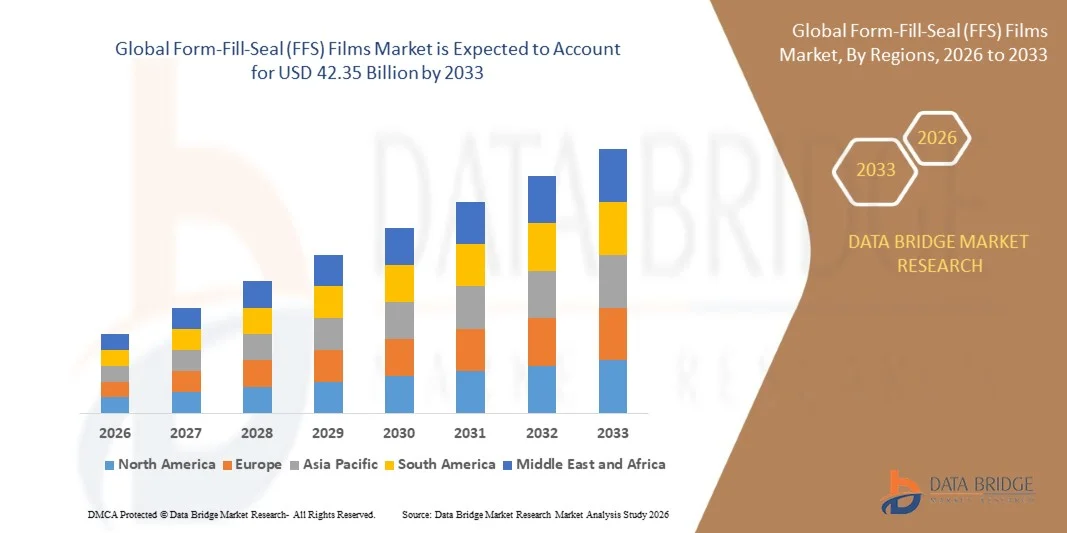
As per Data Bridge Market Research Analysis the form-fill-seal (FFS) Films market was valued at USD 29.56 billion in 2025 and is projected to reach USD 42.35 billion by 2033, growing at a CAGR of 4.60% from 2026 to 2033. Market growth is supported by rising consumption of packaged food, automated filling operations, pharmaceutical and personal-care packaging, agricultural inputs, and industrial products. Manufacturers use FFS films to form, fill, and seal packages on the same production line, helping improve throughput, reduce manual handling, and maintain consistent package quality.
FFS films are supplied as rollstock and converted directly into bags, pouches, sachets, stick packs, flow wraps, and thermoformed packs. Polyethylene remains the most widely used material because it offers flexible processing, strong sealing, moisture resistance, and cost efficiency. At the same time, mono-material recyclable structures, post-consumer recycled content, downgauged films, and multilayer barrier systems are gaining attention. Film design must balance seal strength, puncture resistance, print quality, barrier performance, machine speed, food-contact requirements, and recyclability, which makes technical collaboration between resin suppliers, converters, equipment manufacturers, and end users increasingly important.
Market Size & Forecast
- Market Value (2025): USD 29.56 Billion
- Expected Market Value (2035): USD 42.35 Billion
- Forecast CAGR (2026-2035): 4.60%
- Leading Region: North America
- Fastest-Growing Region: Asia-Pacific
Key Market Trends & Insights
- North America dominated the form-fill-seal (FFS) films market with the largest revenue share in 2025, supported by strong demand for packaged food, pharmaceutical products, and advanced flexible packaging solutions. Manufacturers in the region highly value the operational efficiency, product protection, and sustainability benefits offered by FFS films across automated packaging lines.
- Asia-Pacific form-fill-seal (FFS) films market is expected to witness the fastest growth rate from 2026 to 2033, supported by increasing urbanization, rising disposable incomes, and rapid growth in packaged food consumption across countries such as China, India, and Japan.
- The polyethylene films segment held the largest market revenue share in 2025, driven by its excellent sealability, flexibility, moisture resistance, and widespread use across food, pharmaceutical, and consumer goods packaging applications. Polyethylene films are preferred due to their cost-effectiveness, compatibility with high-speed FFS equipment, and ability to support both mono-material and recyclable packaging formats.
- The polypropylene films segment is projected to register the fastest growth at a CAGR from 2026 to 2033, driven by increasing demand for recyclable mono-material packaging, superior heat resistance, and enhanced barrier properties. Rising adoption in snack foods, personal care products, and premium flexible packaging applications is accelerating segment expansion.
- The vertical form-fill-seal segment held the largest market revenue share in 2025, driven by its extensive deployment in packaged food, pet food, and agricultural applications. Vertical FFS technology is widely utilized due to its high throughput, operational efficiency, and suitability for pouches, sachets, and bag packaging formats.
- The thermoforming segment is projected to register the fastest growth at a CAGR from 2026 to 2033, driven by growing demand for premium food packaging, medical packaging, and high-barrier applications requiring customized pack designs. Increasing investments in automated packaging systems are supporting segment growth.
Report Scope and Form-Fill-Seal (FFS) Films Market Segmentation
|
Attributes |
Form-Fill-Seal (FFS) Films Key Market Insights |
|
Segments Covered |
|
|
Countries Covered |
North America
Europe
Asia-Pacific
Middle East and Africa
South America
|
|
Key Market Players |
|
|
Market Opportunities |
|
|
Value Added Data Infosets |
In addition to the insights on market scenarios such as market value, growth rate, segmentation, geographical coverage, and major players, the market reports curated by the Data Bridge Market Research also include import export analysis, production capacity overview, production consumption analysis, price trend analysis, climate change scenario, supply chain analysis, value chain analysis, raw material/consumables overview, vendor selection criteria, PESTLE Analysis, Porter Analysis, and regulatory framework. |
Form-Fill-Seal (FFS) Films Market Trends
Trend: Rising Adoption Of Recyclable Mono-Material And High-Barrier FFS Films
Growing regulatory pressure and sustainability commitments are accelerating the transition from conventional multi-material laminates to recyclable mono-material form-fill-seal (FFS) films across the global packaging industry. Brand owners are increasingly seeking flexible packaging solutions that maintain product protection, machinability, and shelf life while improving recyclability and supporting circular economy objectives. Mono-polyethylene (PE) and mono-polypropylene (PP) structures are gaining traction due to their compatibility with existing recycling streams and their ability to meet evolving packaging regulations.
The expansion of packaged food, pharmaceuticals, personal care, and consumer goods applications is creating sustained demand for FFS films that offer high barrier performance, puncture resistance, seal integrity, and compatibility with high-speed packaging lines. For instance, in June 2026, Mondi introduced re/loop FlowWrap, a mono-polypropylene FFS solution for wet wipes containing 35% post-consumer recycled content. The product was designed for polypropylene mechanical recycling while maintaining barrier and sealing performance comparable to virgin-material alternatives and demonstrated successful operation on existing IMA Ilapak equipment. This development reflects increasing industry investment in recyclable flexible packaging solutions that directly support demand for advanced FFS films.
The growing shift toward recyclable mono-material packaging and continued investments in high-performance film technologies are expected to reinforce long-term demand for FFS films, positioning manufacturers to benefit from increasing automation, sustainability initiatives, and global packaged-product consumption.
Form-Fill-Seal (FFS) Films Market Dynamics
Key Market Driver: Expansion Of Automated Food, Pharmaceutical, And Consumer Product Packaging
The global packaging industry continues to experience rising demand for automated packaging solutions due to their ability to improve productivity, maintain hygiene standards, reduce material waste, and deliver consistent package quality. Manufacturers are increasingly adopting form-fill-seal systems to support high-volume production across food, pharmaceuticals, personal care, pet food, and industrial applications. These systems require films with reliable sealing performance, excellent barrier properties, and compatibility with high-speed machinery.
Major packaging manufacturers continue investing in production capabilities to meet growing demand. For instance, in August 2025, Coveris completed a EUR 9.5 million expansion at its Halle facility in Germany to increase flexible packaging production capacity and enhance operational efficiency. The investment highlights continued industry focus on strengthening packaging infrastructure to support rising demand across food, healthcare, and consumer goods applications.
As packaged-product consumption and factory automation continue to expand globally, manufacturers of FFS films are expected to benefit from sustained demand driven by automated packaging trends, increasing requirements for product protection, and ongoing investments in flexible packaging technologies.
Key Restraint/Challenge: Recycling Complexity And Raw Material Price Volatility
FFS film manufacturers remain heavily dependent on polymer resins, adhesives, coatings, and specialty materials, exposing production costs to fluctuations in raw-material prices, energy costs, and supply chain disruptions. In addition, many high-performance film structures utilize multiple material layers to achieve barrier and mechanical requirements, creating challenges for collection, sorting, and recycling within existing waste-management systems.
Manufacturers must also manage increasing regulatory requirements related to recyclability, food-contact compliance, and recycled-content mandates while maintaining packaging performance and cost competitiveness. For instance, Amcor stated in its fiscal year 2025 filings that a hypothetical 1% increase in average input costs, if not recovered through pricing mechanisms, could adversely impact pretax earnings by approximately USD 97 million. These market conditions continue to create cost pressures across the flexible packaging industry.
Despite robust market demand, recycling complexities and ongoing raw-material price volatility are expected to remain significant restraints, increasing production costs, pressuring profit margins, and limiting long-term market stability throughout the forecast period.
Key Market Opportunity: Expansion Of Drop-In Recyclable Solutions For Existing Packaging Lines
Governments, packaging companies, and consumer brands are accelerating investments in recyclable packaging systems to improve material recovery rates and reduce environmental impact. This transition is creating significant opportunities for FFS film manufacturers capable of delivering recyclable mono-material solutions that operate efficiently on existing vertical and horizontal packaging equipment without requiring major capital investments.
Leading manufacturers are strengthening their recyclable packaging portfolios through innovations that combine sustainability with high-speed performance. For instance, ProAmpac's ProActive Recyclable R-2300 film platform is designed for food, pet-care, and home-care applications and is compatible with form-fill-seal equipment while offering multiple oxygen-barrier options. The company also offers PE-based R-2000 films engineered to support low seal-initiation temperatures and maintain packaging speeds across dry and frozen food applications.
As sustainability regulations become more stringent and brand owners accelerate circular packaging initiatives, increasing adoption of recyclable mono-material FFS films is expected to create substantial long-term growth opportunities for the global form-fill-seal films market.
Form-Fill-Seal (FFS) Films Market Scope
The FFS films market is segmented on the basis of material type, technology, thickness, and end-use application.
- By Material Type
On the basis of material type, the form-fill-seal (FFS) films market is segmented into polyethylene films, polypropylene films, polyester films, nylon films, and other materials. The polyethylene films segment held the largest market revenue share in 2025, driven by its excellent sealability, flexibility, moisture resistance, and widespread use across food, pharmaceutical, and consumer goods packaging applications. Polyethylene films are preferred due to their cost-effectiveness, compatibility with high-speed FFS equipment, and ability to support both mono-material and recyclable packaging formats.
The polypropylene films segment is projected to register the fastest growth at a CAGR from 2026 to 2033, driven by increasing demand for recyclable mono-material packaging, superior heat resistance, and enhanced barrier properties. Rising adoption in snack foods, personal care products, and premium flexible packaging applications is accelerating segment expansion.
- By Technology
On the basis of technology, the form-fill-seal (FFS) films market is segmented into vertical form-fill-seal, horizontal form-fill-seal, and thermoforming. The vertical form-fill-seal segment held the largest market revenue share in 2025, driven by its extensive deployment in packaged food, pet food, and agricultural applications. Vertical FFS technology is widely utilized due to its high throughput, operational efficiency, and suitability for pouches, sachets, and bag packaging formats.
The thermoforming segment is projected to register the fastest growth at a CAGR from 2026 to 2033, driven by growing demand for premium food packaging, medical packaging, and high-barrier applications requiring customized pack designs. Increasing investments in automated packaging systems are supporting segment growth.
- By End-Use Application
On the basis of end-use application, the form-fill-seal (FFS) films market is segmented into food packaging, pharmaceutical packaging, industrial packaging, agricultural packaging, and other applications. The food packaging segment held the largest market revenue share in 2025, driven by rising consumption of packaged foods, frozen products, snacks, dairy products, and ready-to-eat meals. FFS films remain the preferred choice due to their ability to provide moisture protection, extended shelf life, and compatibility with high-speed packaging lines.
The pharmaceutical packaging segment is projected to register the fastest growth at a CAGR from 2026 to 2033, driven by increasing demand for sterile, tamper-evident, and high-barrier packaging solutions. Growing pharmaceutical production and stricter product safety requirements are contributing to segment expansion.
- By Layer Structure
On the basis of layer structure, the form-fill-seal (FFS) films market is segmented into monolayer and multilayer. The multilayer segment held the largest market revenue share in 2025, driven by its superior oxygen and moisture barrier properties, improved puncture resistance, and extensive use in food, pharmaceutical, and industrial packaging applications. Multilayer films are preferred for products requiring extended shelf life and enhanced product protection.
The monolayer segment is projected to register the fastest growth at a CAGR from 2026 to 2033, driven by increasing regulatory support for recyclable packaging and growing adoption of mono-material polyethylene and polypropylene structures. Rising sustainability initiatives and circular economy objectives are accelerating segment growth across the packaging industry.
Form-Fill-Seal (FFS) Films Market Regional Analysis
North America Form-Fill-Seal (FFS) Films Market Insight
North America dominated the form-fill-seal (FFS) films market with the largest revenue share in 2025, supported by strong demand for packaged food, pharmaceutical products, and advanced flexible packaging solutions. Manufacturers in the region highly value the operational efficiency, product protection, and sustainability benefits offered by FFS films across automated packaging lines. This widespread adoption is further supported by high investments in packaging automation, established food processing industries, and increasing demand for recyclable flexible packaging, establishing FFS films as a preferred packaging solution across multiple end-use sectors.
U.S. Form-Fill-Seal (FFS) Films Market Insight
The U.S. form-fill-seal (FFS) films market captured the largest revenue share in 2025 within North America, fueled by the rapid expansion of packaged food consumption and increasing adoption of automated packaging systems. Manufacturers are increasingly prioritizing high-barrier and sustainable film structures to improve shelf life and reduce packaging waste. Moreover, growing investments in food, pharmaceutical, and pet food packaging infrastructure are significantly contributing to market expansion.
Europe Form-Fill-Seal (FFS) Films Market Insight
The Europe form-fill-seal (FFS) films market is expected to witness the fastest growth rate from 2026 to 2033, primarily driven by stringent sustainability regulations and the increasing transition toward recyclable mono-material packaging. The implementation of the Packaging and Packaging Waste Regulation (PPWR), coupled with rising demand for circular packaging solutions, is fostering the adoption of advanced FFS films. The region is experiencing significant growth across food, healthcare, and personal care applications, with recyclable film solutions being incorporated into both new and existing packaging lines.
U.K. Form-Fill-Seal (FFS) Films Market Insight
The U.K. form-fill-seal (FFS) films market is expected to witness the fastest growth rate from 2026 to 2033, driven by growing demand for sustainable packaging and increased investments in flexible packaging technologies. In addition, expanding e-commerce activities and rising consumption of packaged goods are encouraging manufacturers to adopt high-performance FFS films. The U.K.'s emphasis on reducing plastic waste, alongside its advanced retail and food processing industries, is expected to continue stimulating market growth.
Germany Form-Fill-Seal (FFS) Films Market Insight
The Germany form-fill-seal (FFS) films market is expected to witness the fastest growth rate from 2026 to 2033, fueled by the country's strong manufacturing base and leadership in packaging machinery innovation. Germany's well-developed industrial infrastructure, combined with its focus on sustainability and automation, promotes the adoption of advanced FFS films across food, pharmaceutical, and industrial applications. The integration of recyclable packaging materials with high-speed packaging equipment is also becoming increasingly prevalent, aligning with local regulatory and consumer expectations.
Asia-Pacific Form-Fill-Seal (FFS) Films Market Insight
The Asia-Pacific form-fill-seal (FFS) films market is expected to witness the fastest growth rate from 2026 to 2033, supported by increasing urbanization, rising disposable incomes, and rapid growth in packaged food consumption across countries such as China, India, and Japan. The region's growing manufacturing capabilities, supported by investments in packaging automation and flexible packaging production, are driving market expansion. Furthermore, as APAC emerges as a major hub for food processing and consumer goods manufacturing, the affordability and accessibility of FFS films are expanding to a wider customer base.
Japan Form-Fill-Seal (FFS) Films Market Insight
The Japan form-fill-seal (FFS) films market is expected to witness the fastest growth rate from 2026 to 2033 due to the country's advanced packaging technologies, aging population, and demand for convenient packaged products. The Japanese market places significant emphasis on product quality and shelf-life extension, driving the adoption of high-barrier FFS films. Moreover, the integration of sustainable materials and automated packaging systems is fueling growth across food, healthcare, and consumer goods sectors.
China Form-Fill-Seal (FFS) Films Market Insight
The China form-fill-seal (FFS) films market accounted for the largest market revenue share in Asia-Pacific in 2025, attributed to the country's expanding packaged food industry, rapid industrialization, and high rates of manufacturing activity. China remains one of the largest markets for flexible packaging materials, and FFS films are becoming increasingly popular across food, pharmaceutical, agricultural, and industrial applications. The country's strong domestic production capabilities, alongside government support for advanced manufacturing and sustainable packaging initiatives, are key factors propelling market growth in China.
Form-Fill-Seal (FFS) Films Market Share
The form-fill-seal (FFS) Films market is established by well known companies:
- Amcor plc (Switzerland)
- Mondi plc (United Kingdom)
- Sealed Air Corporation (U.S.)
- Coveris Group (Austria)
- ProAmpac Holdings Inc. (U.S.)
- Constantia Flexibles Group GmbH (Austria)
- Winpak Ltd. (Canada)
- Huhtamaki Oyj (Finland)
- Sonoco Products Company (U.S.)
- TC Transcontinental Inc. (Canada)
- Glenroy, Inc. (U.S.)
- UFlex Limited (India)
- Jindal Poly Films Limited (India)
Latest Developments in Form-Fill-Seal (FFS) Films Market
- In June 2026, Mondi introduced re/loop FlowWrap, a mono-polypropylene form-fill-and-seal solution for wet wipes containing 35% post-consumer recycled material. The film is designed to replace non-recyclable laminates while maintaining barrier protection, sealing reliability, and compatibility with existing packaging lines. The launch reflects the market's shift toward recycled-content mono-material FFS films.
- In August 2025, Coveris completed a EUR 9.5 million upgrade at its Halle facility in Germany. The investment expanded machine capacity and infrastructure for flexible packaging and strengthened the site's ability to develop and manufacture high-performance and more sustainable film solutions for medical and other applications.
- In December 2024, ProAmpac introduced the ProActive Recyclable R-2300 series for food, pet-care, and home-care applications. The recyclable film is designed to run on form-fill-seal equipment and is available with different oxygen-barrier levels, supporting the replacement of conventional multi-material flexible packaging.

- Interactive Data Analysis Dashboard
- Company Analysis Dashboard for high growth potential opportunities
- Research Analyst Access for customization & queries
- Competitor Analysis with Interactive dashboard
- Latest News, Updates & Trend analysis
- Harness the Power of Benchmark Analysis for Comprehensive Competitor Tracking
Global Form Fill Seal Ffs Films Market, Supply Chain Analysis and Ecosystem Framework
To support market growth and help clients navigate the impact of geopolitical shifts, DBMR has integrated in-depth supply chain analysis into its Global Form Fill Seal Ffs Films Market research reports. This addition empowers clients to respond effectively to global changes affecting their industries. The supply chain analysis section includes detailed insights such as Global Form Fill Seal Ffs Films Market consumption and production by country, price trend analysis, the impact of tariffs and geopolitical developments, and import and export trends by country and HSN code. It also highlights major suppliers with data on production capacity and company profiles, as well as key importers and exporters. In addition to research, DBMR offers specialized supply chain consulting services backed by over a decade of experience, providing solutions like supplier discovery, supplier risk assessment, price trend analysis, impact evaluation of inflation and trade route changes, and comprehensive market trend analysis.
Data collection and base year analysis are done using data collection modules with large sample sizes. The stage includes obtaining market information or related data through various sources and strategies. It includes examining and planning all the data acquired from the past in advance. It likewise envelops the examination of information inconsistencies seen across different information sources. The market data is analysed and estimated using market statistical and coherent models. Also, market share analysis and key trend analysis are the major success factors in the market report. To know more, please request an analyst call or drop down your inquiry.
The key research methodology used by DBMR research team is data triangulation which involves data mining, analysis of the impact of data variables on the market and primary (industry expert) validation. Data models include Vendor Positioning Grid, Market Time Line Analysis, Market Overview and Guide, Company Positioning Grid, Patent Analysis, Pricing Analysis, Company Market Share Analysis, Standards of Measurement, Global versus Regional and Vendor Share Analysis. To know more about the research methodology, drop in an inquiry to speak to our industry experts.
Data Bridge Market Research is a leader in advanced formative research. We take pride in servicing our existing and new customers with data and analysis that match and suits their goal. The report can be customized to include price trend analysis of target brands understanding the market for additional countries (ask for the list of countries), clinical trial results data, literature review, refurbished market and product base analysis. Market analysis of target competitors can be analyzed from technology-based analysis to market portfolio strategies. We can add as many competitors that you require data about in the format and data style you are looking for. Our team of analysts can also provide you data in crude raw excel files pivot tables (Fact book) or can assist you in creating presentations from the data sets available in the report.













