


What is the Fortified Rice Market Size and Growth Rate?
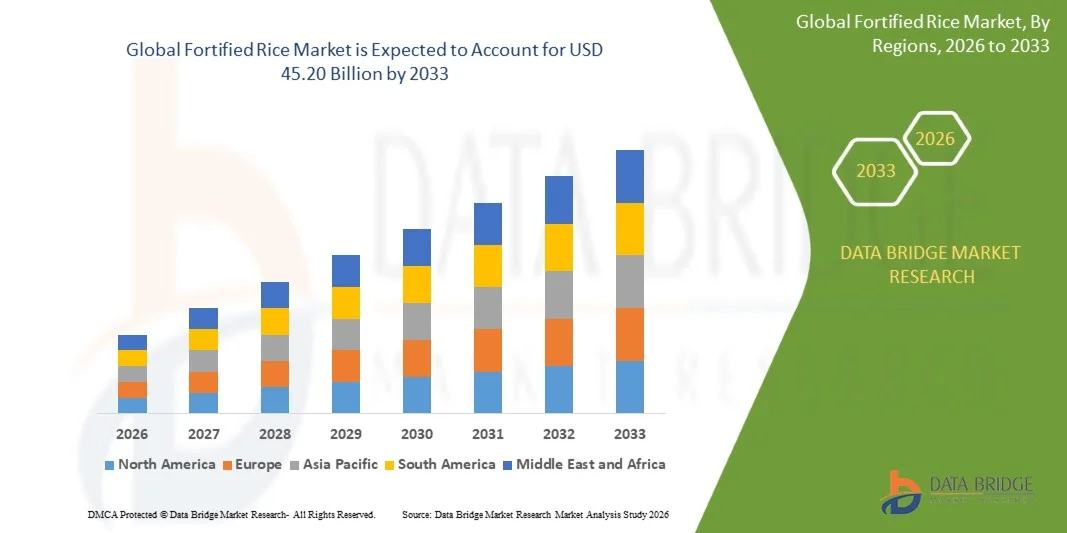
- As per Data Bridge Market Research Analysis the fortified rice market was valued at USD 28.15 billion in 2025 and is projected to reach USD 45.20 billion by 2033, growing at a CAGR of 6.10% from 2026 to 2033.
- The market is experiencing robust growth driven by increasing awareness about the benefits of fortified rice in combating malnutrition and addressing micronutrient deficiencies, especially in developing countries. Fortified rice is enriched with essential micronutrients such as iron, folic acid, and vitamins, addressing nutritional deficiencies prevalent in populations, particularly in developing countries. This market's expansion is propelled by government initiatives and partnerships with international organizations aimed at combating malnutrition and enhancing food security.
- The Asia-Pacific region dominates the fortified rice market, accounting for a significant revenue share due to its high population density and prevalence of malnutrition issues. The India market dominated the Asia Pacific Fortified Rice Market in 2025 and is expected to continue to be a dominant market till 2033, reaching a market value of USD 3.55 billion by 2033.
Market Size & Forecast
- Global Market Value (2025): USD 28.15 Billion
- Expected Market Value (2033): USD 45.20 Billion
- Forecast CAGR (2026–2033): 6.10%
What are the Major Takeaways of the Fortified Rice Market?
- Asia-Pacific dominated the fortified rice market in 2025, accounting for a significant revenue share of 58.90% due to its high population density, role of rice as a staple food, and prevalence of malnutrition issues. Government-led programs and partnerships with international organizations have spurred the adoption of fortified rice as a cost-effective solution to combat malnutrition and improve public health outcomes.
- North America is expected to witness significant growth from 2026 to 2033, supported by increasing consumer awareness of nutritional deficiencies, growing demand for functional and fortified food products, and rising emphasis on preventive healthcare.
- The Iron-Fortified Rice segment dominated the market in 2025, driven by the high global prevalence of iron deficiency anemia and the widespread implementation of government-led nutrition programs targeting women and children. Its extensive adoption across public food distribution systems and school feeding initiatives has further strengthened its market leadership.
- The multiple micronutrient fortified rice segment is projected to register the fastest growth at a CAGR from 2026 to 2033, supported by increasing demand for comprehensive nutritional interventions that simultaneously address deficiencies of iron, zinc, folic acid, vitamin B12, and other essential micronutrients. Growing government initiatives and international nutrition programs are expected to accelerate the adoption of multiple micronutrient fortified rice.
- The hot or warm extrusion segment dominated the market in 2025, owing to its superior nutrient retention, uniform micronutrient distribution, and high stability during cooking and storage. The technology is widely adopted by manufacturers as it produces fortified rice kernels that closely resemble natural rice while meeting stringent food fortification standards.
- The coating segment is projected to register the fastest growth at a CAGR from 2026 to 2033, driven by continuous advancements in coating technologies that improve nutrient retention, enhance product appearance, and reduce production costs. Increasing adoption among manufacturers seeking flexible and scalable fortification solutions is further supporting segment growth.
Report Scope and Fortified Rice Market Segmentation
|
Attributes |
Fortified Rice Market Key Market Insights |
|
Segments Covered |
|
|
Countries Covered |
North America
Europe
Asia-Pacific
Middle East and Africa
South America
|
|
Key Market Players |
|
|
Market Opportunities |
|
|
Value Added Data Infosets |
In addition to the insights on market scenarios such as market value, growth rate, segmentation, geographical coverage, and major players, the market reports curated by the Data Bridge Market Research also include in-depth expert analysis, pricing analysis, brand share analysis, consumer survey, demography analysis, supply chain analysis, value chain analysis, raw material/consumables overview, vendor selection criteria, PESTLE Analysis, Porter Analysis, and regulatory framework. |
What is the Key Trend in the Fortified Rice Market?
- Governments and international organizations are increasingly expanding large-scale fortified rice programs to address micronutrient deficiencies, improve public health, and strengthen food security through national welfare and school feeding initiatives.
- For instance, in October 2024, the Government of India approved the continuation of its nationwide fortified rice initiative under the Pradhan Mantri Garib Kalyan Anna Yojana (PMGKAY) and other welfare schemes through December 2028, reinforcing fortified rice distribution across the Public Distribution System (PDS), ICDS, and PM-POSHAN programs.
- Public-private collaborations are accelerating investments in rice fortification technologies, micronutrient premixes, and quality assurance systems to support large-scale production and distribution.
- For instance, in August 2025, the United Nations World Food Programme (WFP) and the Government of India signed an agreement enabling India to supply fortified rice for humanitarian assistance, expanding the global reach of fortified staple foods to vulnerable populations.
- As governments continue prioritizing nutrition security and international agencies expand food fortification initiatives, the adoption of fortified rice is expected to accelerate, establishing it as a key strategy for combating hidden hunger and micronutrient deficiencies worldwide.
What are the Key Drivers of the Fortified Rice Market?
- The increasing prevalence of iron deficiency anemia and other micronutrient deficiencies is driving governments to integrate fortified rice into national nutrition and food security programs, particularly in countries where rice is a dietary staple.
- For instance, India's Department of Food and Public Distribution reported that the country's fortified rice initiative has been extended nationwide, with fortified rice being distributed through TPDS, ICDS, and PM-POSHAN, supported by a fully government-funded program through 2028.
- International organizations and nutrition partners are supporting governments with technical expertise, fortification technologies, and implementation frameworks to improve access to nutrient-enriched staple foods.
- For instance, dsm-firmenich and the World Food Programme (WFP) reported that their long-standing partnership supports fortified rice programs in more than 20 countries, indirectly reaching over 730 million people annually through social protection and nutrition initiatives.
- With governments and global health organizations intensifying efforts to reduce malnutrition and improve dietary quality, fortified rice will remain a critical component of national nutrition strategies and food assistance programs.
Which Factors are Challenging the Growth of the Fortified Rice Market?
- Fortified rice programs require stringent quality control, specialized blending infrastructure, and efficient storage and distribution systems to preserve nutrient stability throughout the supply chain.
- Operational complexities related to fortified rice kernel (FRK) production, storage, and logistics increase implementation costs and create challenges for large-scale deployment, particularly in developing markets.
- For instance, in February 2026, the Government of India temporarily reviewed and paused the universal rollout of fortified rice under certain welfare schemes due to concerns regarding shelf-life, storage stability, and implementation efficiency, highlighting the operational challenges associated with nationwide fortification programs.
- The need for robust quality assurance, stable supply chains, and standardized fortification processes continues to pose challenges for governments and manufacturers, slowing market expansion despite growing demand for nutrient-fortified staple foods.
How is the Fortified Rice Market Segmented?
The fortified rice market is segmented on the basis of type of rice kernels, processing method, category
end user, and distribution channel.
- By Type of Rice Kernels
On the basis of type of rice kernels, the fortified rice market is segmented into iron-fortified rice, zinc-fortified rice, vitamin A-fortified rice, and multiple micronutrient fortified rice. The Iron-Fortified Rice segment dominated the market in 2025, driven by the high global prevalence of iron deficiency anemia and the widespread implementation of government-led nutrition programs targeting women and children. Its extensive adoption across public food distribution systems and school feeding initiatives has further strengthened its market leadership.
The multiple micronutrient fortified rice segment is projected to register the fastest growth at a CAGR from 2026 to 2033, supported by increasing demand for comprehensive nutritional interventions that simultaneously address deficiencies of iron, zinc, folic acid, vitamin B12, and other essential micronutrients. Growing government initiatives and international nutrition programs are expected to accelerate the adoption of multiple micronutrient fortified rice.
- By Processing Method
On the basis of processing method, the fortified rice market is segmented into hot or warm extrusion, dusting, and coating. The hot or warm extrusion segment dominated the market in 2025, owing to its superior nutrient retention, uniform micronutrient distribution, and high stability during cooking and storage. The technology is widely adopted by manufacturers as it produces fortified rice kernels that closely resemble natural rice while meeting stringent food fortification standards.
The coating segment is projected to register the fastest growth at a CAGR from 2026 to 2033, driven by continuous advancements in coating technologies that improve nutrient retention, enhance product appearance, and reduce production costs. Increasing adoption among manufacturers seeking flexible and scalable fortification solutions is further supporting segment growth.
- By Category
On the basis of category, the fortified rice market is segmented into organic and conventional. The conventional segment held the largest market revenue share in 2025, driven by large-scale government fortification programs, public distribution systems, school feeding initiatives, and welfare schemes across major rice-consuming countries such as India, Bangladesh, and Indonesia. Conventional fortified rice remains the preferred choice due to its lower production cost, established supply chains, and widespread availability through public nutrition programs aimed at addressing micronutrient deficiencies.
The organic segment is projected to register the fastest growth at a CAGR from 2026 to 2033, driven by rising consumer preference for clean-label and organically sourced food products. Growing awareness regarding sustainable agriculture, increasing demand for premium fortified food products, and expansion of organic food retail channels are supporting the growth of organically fortified rice across developed and emerging markets.
- By End User
On the basis of end user, the fortified rice market is segmented into on-trade and off-trade. The off-trade segment held the largest market revenue share in 2025, driven by strong sales through supermarkets, hypermarkets, convenience stores, public distribution channels, government nutrition programs, and e-commerce platforms. The increasing availability of fortified rice through retail networks and welfare distribution systems has significantly strengthened segment growth globally.
The on-trade segment is projected to register the fastest growth at a CAGR from 2026 to 2033, driven by rising incorporation of fortified rice in institutional catering, restaurants, hotels, hospitals, school meal programs, and foodservice establishments. Growing emphasis on nutritional food offerings and health-focused menu development is expected to support demand across the on-trade sector during the forecast period.
- By Distribution Channel
On the basis of distribution channel, the fortified rice market is segmented into B2B and B2C. The B2B segment accounted for the largest market share in 2025, supported by large-scale procurement by government agencies, humanitarian organizations, institutional buyers, food aid programs, and food service providers. Bulk purchasing for national nutrition initiatives and public distribution programs continues to drive strong demand through the B2B channel.
The B2C segment is projected to register the fastest growth at a CAGR from 2026 to 2033, driven by increasing consumer awareness regarding nutritional health, rising demand for fortified staple foods, and the expanding availability of fortified rice through supermarkets, hypermarkets, convenience stores, and online retail platforms. Growing health-conscious consumer preferences are expected to further accelerate retail sales.
Which Region Holds the Largest Share of the Fortified Rice Market?
- Asia-Pacific dominated the fortified rice market in 2025, accounting for a significant revenue share of 58.90% due to its high population density, role of rice as a staple food, and prevalence of malnutrition issues. Government-led programs and partnerships with international organizations have spurred the adoption of fortified rice as a cost-effective solution to combat malnutrition and improve public health outcomes.
- The market in Asia-Pacific benefits from large populations in countries such as China, India, and Bangladesh, where rice constitutes a significant portion of daily caloric intake. Initiatives of governments in the region towards fortifying rice to improve the nutritional status of their populations and combat malnutrition are further encouraging the adoption of fortified rice
Japan Fortified Rice Market Insight
The Japan fortified rice market is expected to witness significant growth from 2026 to 2033 due to increasing consumer focus on preventive healthcare, healthy aging, and nutritional well-being. The country's aging population and growing demand for functional food products are encouraging the adoption of vitamin- and mineral-enriched staple foods, including fortified rice. In addition, rising awareness regarding balanced nutrition, coupled with continuous innovation in food processing and fortification technologies, is supporting market growth. The increasing availability of fortified rice through retail and institutional channels is further contributing to the expansion of the market.
China Fortified Rice Market Insight
The China fortified rice market accounted for the largest market revenue share in Asia-Pacific in 2025, driven by its vast population, high rice consumption levels, and increasing government focus on improving nutrition and food security. Growing awareness regarding micronutrient deficiencies, particularly among children and rural populations, has encouraged the adoption of fortified staple foods. In addition, the expansion of food fortification initiatives, rising disposable incomes, and increasing demand for health-focused food products are supporting market growth. China's strong food manufacturing capabilities and extensive distribution networks further strengthen its position as one of the leading fortified rice markets globally.
North America Fortified Rice Market Insight
North America is expected to witness significant growth from 2026 to 2033, supported by increasing consumer awareness of nutritional deficiencies, growing demand for functional and fortified food products, and rising emphasis on preventive healthcare. Consumers across the region are increasingly seeking nutrient-enriched staple foods that support overall health and wellness, driving demand for fortified rice products. The market is further supported by a well-established food processing industry, strong retail distribution networks, and growing adoption of fortified foods among health-conscious consumers. In addition, government nutrition initiatives and the presence of leading food manufacturers continue to contribute to the expansion of the fortified rice market across North America.
U.S. Fortified Rice Market Insight
The U.S. is expected to witness significant growth from 2026 to 2033, driven by increasing consumer awareness of nutritional health, growing demand for fortified and functional food products, and rising efforts to address micronutrient deficiencies among specific population groups. The growing popularity of enriched staple foods, coupled with strong retail distribution networks and increasing adoption of health-focused dietary habits, continues to support market growth. In addition, the presence of leading food manufacturers, advancements in food fortification technologies, and increasing demand for value-added rice products are further contributing to the expansion of the fortified rice market across the U.S.
Europe Fortified Rice Market Insight
The Europe fortified rice market is expected to witness substantial growth from 2026 to 2033, driven by increasing consumer awareness regarding nutritional deficiencies, growing demand for functional food products, and rising preference for fortified staple foods. The region's focus on preventive healthcare and nutrition improvement programs is encouraging manufacturers to introduce value-added rice products enriched with essential vitamins and minerals. In addition, increasing demand for clean-label and organic fortified food products is supporting market growth across several European countries.
U.K. Fortified Rice Market Insight
The U.K. fortified rice market is expected to witness significant growth from 2026 to 2033, supported by increasing health consciousness and growing demand for nutrient-enriched food products. Consumers are increasingly seeking foods that help address nutritional gaps while supporting overall wellness. The expansion of modern retail channels, rising adoption of functional foods, and growing awareness regarding micronutrient deficiencies are expected to contribute to market growth in the country.
Germany Fortified Rice Market Insight
The Germany fortified rice market is expected to witness notable growth from 2026 to 2033, driven by increasing demand for fortified and functional food products, coupled with strong consumer preference for health-oriented dietary choices. Growing awareness regarding vitamin and mineral deficiencies, alongside the popularity of sustainable and organic food products, is supporting the adoption of fortified rice. The country's well-established food processing industry and advanced retail infrastructure further contribute to market expansion.
Which are the Top Companies in Fortified Rice Market?
The fortified rice market industry is primarily led by well-established companies, including:
- Amoli International (India)
- BASF SE (Germany)
- Bühler AG (Switzerland)
- Bunge Limited (U.S.)
- Cargill, Incorporated (U.S.)
- Daawat (India)
- DSM-Firmenich (Netherlands)
- General Mills Inc. (U.S.)
- Hexagon Nutrition Ltd. (India)
- KRBL Limited (India)
- LT Foods Limited (India)
- Mars, Incorporated (U.S.)
- Olam International Limited (Singapore)
- Oliria (India)
- Radiance Global (India)
- Relishum Foods (India)
- Tilda Rice (UK)
- VSR Foods (India)
- Wilmar International Limited (Singapore)
What are Latest Developments in Fortified Rice Market?
- In January 2026, Cargill announced an investment of more than RMB 45 million (approximately USD 6.2 million) to expand its Beijing facility in Changping District. The expansion includes two dedicated production lines for flavored powdered beverages and flavored frozen coatings, along with a high-bay warehouse equipped with advanced vision-guided robotics and end-to-end traceability systems. Commercial operations are scheduled to begin in the first half of 2027.
- In April 2025, Shyamatara Rice Mills launched Bengal Crown Fortified Rice, a premium fortified rice enriched with essential micronutrients. The new product aims to address malnutrition while supporting improved nutritional outcomes and public health across West Bengal.
- In March 2025, Laos introduced a USD 1 million India–United Nations partnership to integrate fortified rice into school feeding programs. The initiative highlights South-South collaboration by leveraging India's fortified rice production capabilities to strengthen regional nutrition and food security programs.

- Interactive Data Analysis Dashboard
- Company Analysis Dashboard for high growth potential opportunities
- Research Analyst Access for customization & queries
- Competitor Analysis with Interactive dashboard
- Latest News, Updates & Trend analysis
- Harness the Power of Benchmark Analysis for Comprehensive Competitor Tracking
Global Fortified Rice Market, Supply Chain Analysis and Ecosystem Framework
To support market growth and help clients navigate the impact of geopolitical shifts, DBMR has integrated in-depth supply chain analysis into its Global Fortified Rice Market research reports. This addition empowers clients to respond effectively to global changes affecting their industries. The supply chain analysis section includes detailed insights such as Global Fortified Rice Market consumption and production by country, price trend analysis, the impact of tariffs and geopolitical developments, and import and export trends by country and HSN code. It also highlights major suppliers with data on production capacity and company profiles, as well as key importers and exporters. In addition to research, DBMR offers specialized supply chain consulting services backed by over a decade of experience, providing solutions like supplier discovery, supplier risk assessment, price trend analysis, impact evaluation of inflation and trade route changes, and comprehensive market trend analysis.
Data collection and base year analysis are done using data collection modules with large sample sizes. The stage includes obtaining market information or related data through various sources and strategies. It includes examining and planning all the data acquired from the past in advance. It likewise envelops the examination of information inconsistencies seen across different information sources. The market data is analysed and estimated using market statistical and coherent models. Also, market share analysis and key trend analysis are the major success factors in the market report. To know more, please request an analyst call or drop down your inquiry.
The key research methodology used by DBMR research team is data triangulation which involves data mining, analysis of the impact of data variables on the market and primary (industry expert) validation. Data models include Vendor Positioning Grid, Market Time Line Analysis, Market Overview and Guide, Company Positioning Grid, Patent Analysis, Pricing Analysis, Company Market Share Analysis, Standards of Measurement, Global versus Regional and Vendor Share Analysis. To know more about the research methodology, drop in an inquiry to speak to our industry experts.
Data Bridge Market Research is a leader in advanced formative research. We take pride in servicing our existing and new customers with data and analysis that match and suits their goal. The report can be customized to include price trend analysis of target brands understanding the market for additional countries (ask for the list of countries), clinical trial results data, literature review, refurbished market and product base analysis. Market analysis of target competitors can be analyzed from technology-based analysis to market portfolio strategies. We can add as many competitors that you require data about in the format and data style you are looking for. Our team of analysts can also provide you data in crude raw excel files pivot tables (Fact book) or can assist you in creating presentations from the data sets available in the report.













