


What is the Fractional Flow Reserve Market Size and Growth Rate?
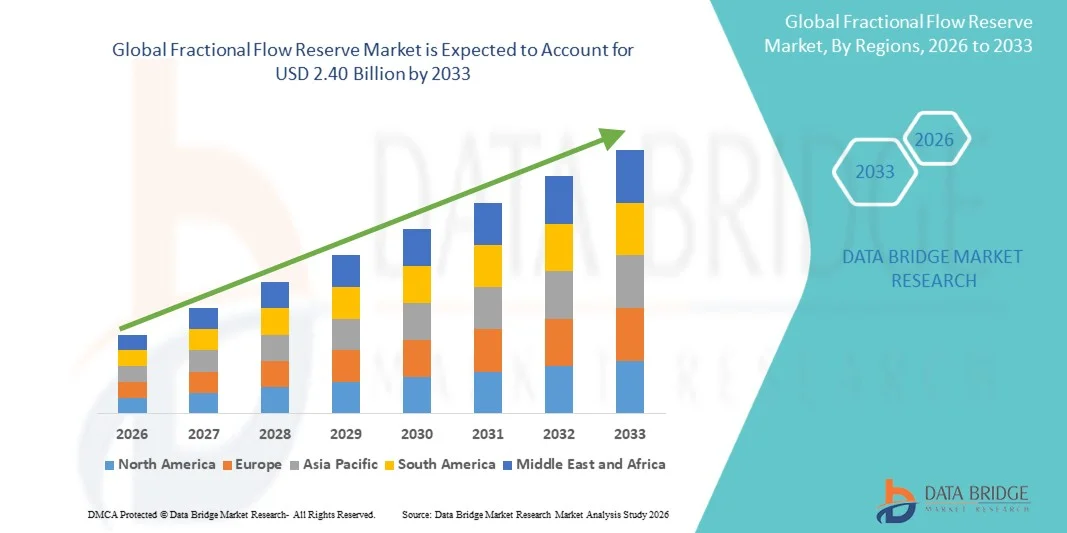
- As per Data Bridge Market Research analysis, the fractional flow reserve market was valued at USD 1.25 billion in 2025 and is projected to reach USD 2.40 billion by 2033, growing at a CAGR of 8.55% from 2026 to 2033.
- The market is experiencing consistent growth driven by the rising prevalence of coronary artery disease, increasing adoption of physiology-guided percutaneous coronary intervention, growing demand for minimally invasive cardiovascular diagnostics, and technological advancements in pressure-wire and non-invasive FFR systems.
- The increasing burden of cardiovascular diseases globally, combined with growing clinical evidence supporting FFR-guided treatment decisions, is encouraging hospitals and cardiac catheterization laboratories to adopt advanced physiological assessment technologies. Invasive pressure-wire systems and emerging non-invasive FFR-CT solutions are improving lesion assessment, reducing unnecessary interventions, and supporting more precise coronary revascularization decisions.
Market Size & Forecast
- Global Market Value (2025): USD 1.25 Billion
- Expected Market Value (2033): USD 2.40 Billion
- Forecast CAGR (2026–2033): 8.55%
- Leading Region in 2025: North America
- Fastest Growing Region: Asia Pacific
What are the Major Takeaways of the Fractional Flow Reserve Market?
- North America dominated the fractional flow reserve market with the largest revenue share of 39.73% in 2025, supported by advanced cardiovascular healthcare infrastructure, favorable reimbursement policies, and high adoption of coronary physiological assessment technologies.
- Asia-Pacific is expected to be the fastest-growing region at a CAGR of 13.34% from 2026 to 2033, fueled by expanding catheterization infrastructure, rising cardiovascular disease prevalence, increasing PCI volumes, and growing adoption in China, India, and Japan
- The FFR guidewires segment led the market with a 55.22% share in 2025, driven by their established role in invasive coronary physiological assessment.
- Non-invasive FFR systems are the fastest-growing product type, projected to register a CAGR of 15.24%, reflecting the surge in demand for rapid expansion of FFR-CT software platforms.
- The invasive FFR segment dominated the technology category with a 59.73% revenue share in 2025, led by its established position in coronary physiological assessment.
- Interventional procedures accounted for 64.25% of the market share in 2025, preferred by interventional cardiologists and cardiac catheterization laboratories for physiology-guided PCI and precise assessment of coronary lesions before revascularization.
- The acute coronary syndrome segment is the fastest-growing application category, with a CAGR of 9.5%, driven by increasing clinical interest in physiological assessment of coronary lesions in selected ACS patients.
Report Scope and Fractional Flow Reserve Market Segmentation
|
Attributes |
Fractional Flow Reserve Key Market Insights |
|
Segments Covered |
|
|
Countries Covered |
North America
Europe
Asia-Pacific
Middle East and Africa
South America
|
|
Key Market Players |
|
|
Market Opportunities |
|
|
Value Added Data Infosets |
In addition to the insights on market scenarios such as market value, growth rate, segmentation, geographical coverage, and major players, the market reports curated by the Data Bridge Market Research also include in-depth expert analysis, patient epidemiology, pipeline analysis, pricing analysis, and regulatory framework. |
What is the Key Trend in the Fractional Flow Reserve Market?
- AI-powered and non-invasive FFR technologies are increasingly transforming coronary physiological assessment by enabling clinicians to derive functional information from routine coronary CT angiography without invasive pressure wires.
- For instance, in January 2024, HeartFlow announced that more than 250,000 patients had been assessed using its AI-enabled FFRCT Analysis, demonstrating the growing clinical adoption of non-invasive, AI-based physiological assessment for coronary artery disease.
- AI-based FFR platforms can combine coronary anatomy, plaque characteristics, and physiological information to support more comprehensive and personalized coronary artery disease assessment.
- Hospitals and cardiac imaging centers are increasingly adopting CT-derived FFR to reduce unnecessary invasive testing and improve the selection of patients requiring coronary intervention.
- For instance, in May 2025, a Nature Medicine analysis found that combining coronary CT angiography with FFRCT reduced the need for invasive coronary angiography by 7% and inappropriate invasive procedures by 16%, highlighting the growing role of non-invasive FFR in clinical decision-making.
- As AI, computational fluid dynamics, and coronary CT imaging continue to converge, non-invasive FFR is expected to become increasingly integrated into routine cardiovascular diagnostic pathways, accelerating the shift toward personalized and data-driven coronary care.
What are the Key Drivers of the Fractional Flow Reserve Market?
- The rising global burden of coronary artery disease and increasing demand for accurate assessment of intermediate coronary lesions are significantly increasing the adoption of FFR technologies for physiology-guided revascularization decisions.
- For instance, in March 2025, the FLAVOUR II randomized trial evaluated 1,839 patients across 22 centers in China and found that angiography-derived FFR-guided PCI was non-inferior to IVUS-guided PCI, supporting the growing use of physiological assessment to guide coronary revascularization decisions.
- Interventional cardiologists, hospitals, and cardiac catheterization laboratories are increasingly integrating physiological assessment into PCI workflows to improve lesion selection, optimize treatment, and reduce reliance on angiography alone.
- For instance, in August 2025, an extended follow-up of the FLAVOUR trial published in the Journal of the American College of Cardiology evaluated 1,682 patients and found that FFR-guided treatment produced a significantly lower overall target-vessel PCI rate of 38.8% versus 60.5% with IVUS-guided treatment, supporting the use of physiological assessment to avoid unnecessary interventions.
- With clinical guidelines supporting physiological assessment and continued advances in pressure-wire, microcatheter, angiography-derived, and CT-derived technologies, FFR is becoming increasingly important for evidence-based coronary intervention and personalized cardiovascular treatment.
Which Factors are Challenging the Growth of the Fractional Flow Reserve Market?
- The relatively high cost of FFR technologies, specialized equipment, disposable pressure wires, advanced imaging infrastructure, and trained personnel can limit adoption, particularly in cost-sensitive healthcare systems.
- For instance, in December 2023, India’s Central Government Health Scheme (CGHS) set the package rate for FFR, including the cost of the pressure wire, at ₹30,000, illustrating the relatively high procedural cost that can constrain adoption in cost-sensitive healthcare settings
- The financial and infrastructure requirements are particularly challenging for emerging markets where reimbursement coverage, cardiac imaging capacity, and access to specialized cardiovascular technologies remain uneven.
- For instance, the 2025 Asian Society of Cardiovascular Imaging review reported that Hong Kong, Singapore, Taiwan, Thailand, and Vietnam remained in early or exploratory stages of CT-FFR adoption partly because of cost, reimbursement, and infrastructure barriers.
- Invasive FFR also requires catheterization-laboratory infrastructure and specialized procedural expertise, while non-invasive FFR depends on high-quality coronary CT angiography and sophisticated computational analysis.
- For instance, in August 2022, the RIPCORD 2 trial published in Circulation found that systematic FFR assessment increased median procedure time to 69.0 minutes versus 42.2 minutes with angiography alone, while also increasing contrast use, highlighting additional procedural-resource requirements.
- These cost, reimbursement, infrastructure, data-quality, and workflow barriers continue to slow penetration of advanced FFR technologies, particularly across developing healthcare markets, despite growing clinical demand for physiological coronary assessment.
How is the Fractional Flow Reserve Market Segmented?
The fractional flow reserve market is segmented on the basis of product type, technology, procedure type, application, and end user.
- By Product Type
On the basis of product type, the fractional flow reserve market is segmented into FFR guidewires, FFR monitoring systems, non-invasive FFR systems, FFR software, microcatheter-based FFR systems, and accessories & consumables. The FFR guidewires segment dominated the market with 55.22% share in 2025, driven by their established role in invasive coronary physiological assessment. These guidewires enable real-time measurement of pressure differences across coronary lesions during catheterization. Their extensive clinical validation and established physician familiarity continue to support widespread adoption. FFR guidewires are particularly important during PCI because they help determine whether an angiographically identified stenosis is functionally significant. Improvements in sensor accuracy, wire flexibility, and procedural compatibility are further supporting their use
The non-invasive FFR systems segment is projected to register the fastest growth at a CAGR of 15.24% through 2033, primarily because of the rapid expansion of FFR-CT software platforms. These systems provide physiological information without requiring placement of an invasive pressure wire. FFR-CT combines coronary CT angiography with computational analysis to estimate the functional significance of coronary lesions. Increasing integration of artificial intelligence and computational fluid dynamics is improving the speed and scalability of these solutions. The technology can also help clinicians identify patients who may require invasive coronary angiography.
- By Technology
On the basis of technology, the fractional flow reserve market is segmented into invasive FFR, non-invasive FFR, FFR-CT, angiography-derived FFR, CFD, and AI/ML-based FFR. The invasive FFR segment dominated the market with 59.73% share in 2025, reflecting its established position in coronary physiological assessment. Invasive FFR uses a pressure-sensitive guidewire to directly measure the pressure gradient across a coronary lesion. The technique has extensive clinical evidence supporting its use in determining the physiological significance of intermediate stenoses. Interventional cardiologists can obtain lesion-specific information during the same catheterization procedure used for coronary angiography or PCI. Its established clinical workflow and physician familiarity continue to support high utilization.
The non-invasive FFR-CT segment is projected to be the fastest-growing technology at a CAGR of 15.64% through 2033, supported by increasing adoption of computational coronary assessment. FFR-CT provides physiological information using coronary CT angiography data rather than invasive pressure measurements. Advances in AI and computational fluid dynamics are improving automated coronary segmentation and physiological modeling. The technology can provide anatomical and functional information within a non-invasive diagnostic pathway. This approach is particularly attractive for patients with stable chest pain who may not immediately require invasive angiography. Increasing clinical acceptance, reimbursement development, and expansion of advanced cardiac imaging infrastructure are expected to further accelerate adoption.
- By Procedure Type
On the basis of procedure type, the fractional flow reserve market is segmented into diagnostic procedures and interventional procedures. The interventional procedures segment dominated the market with 64.25% share in 2025, supported by extensive use of FFR during PCI. FFR provides physiological information that helps physicians determine whether coronary lesions require revascularization. During interventional procedures, FFR can be used to guide decisions regarding stent placement and lesion treatment. The technology is particularly valuable when angiography alone cannot clearly establish the significance of a coronary stenosis. Increasing emphasis on physiology-guided PCI is supporting continued utilization. High PCI volumes in hospitals and cardiac catheterization laboratories further reinforce the leading position of interventional procedures.
The diagnostic procedures segment is projected to be the fastest-growing procedure category at a CAGR of 12.52% through 2033, driven by the expansion of diagnostic angiography and image-derived FFR technologies. Angiography-derived FFR allows physiological information to be estimated from coronary angiographic images in appropriate clinical workflows. This can reduce dependence on conventional pressure-wire measurements for selected assessments. AI-based image processing is improving the ability to automatically identify coronary vessels and estimate lesion-specific physiological significance. The increasing focus on avoiding unnecessary invasive procedures is also supporting demand for advanced diagnostic assessment.
- By Application
On the basis of application, the fractional flow reserve market is segmented into coronary artery disease, acute coronary syndrome, stable angina, neurovascular applications, peripheral vascular disease, and others. The coronary artery disease segment dominated the market with 58.3% share in 2025, reflecting the central role of FFR in evaluating coronary stenosis and guiding revascularization decisions. FFR is widely used to determine whether an anatomical coronary narrowing produces clinically significant ischemia. The technology helps distinguish lesions requiring intervention from those that can potentially be managed conservatively. Increasing prevalence of coronary artery disease is expanding the potential patient population requiring physiological assessment. Growing use of FFR-guided PCI is further supporting the segment. The established clinical evidence and guideline support surrounding coronary FFR applications continue to make CAD the principal application area.
The acute coronary syndrome segment is projected to be the fastest-growing application at a CAGR of 9.5% during the forecast period, supported by increasing clinical interest in physiological assessment of coronary lesions in selected ACS patients. FFR can help physicians evaluate the functional significance of lesions that may appear ambiguous through angiography alone. Growing PCI volumes associated with acute coronary conditions are creating additional opportunities for physiological assessment. Advances in rapid measurement technologies are improving the practicality of incorporating FFR into cardiovascular intervention workflows. Increasing clinical research into physiology-guided management of non-culprit lesions is also supporting broader application.
- By End User
On the basis of end user, the fractional flow reserve market is segmented into hospitals, cardiac catheterization laboratories, cardiac centers, diagnostic centers, ambulatory surgical centers, and research institutes. The hospitals segment dominated the market with 66.26% share in 2025, driven by high cardiovascular procedure volumes and the availability of specialized cardiac infrastructure. Hospitals commonly operate catheterization laboratories where invasive FFR measurements can be performed alongside coronary angiography and PCI. They also have access to trained interventional cardiologists and advanced cardiovascular imaging systems. Integration of FFR with intravascular imaging and digital diagnostic platforms is strengthening utilization in hospital settings. Higher procedural volumes and established procurement systems further support hospital adoption.
The diagnostic imaging centers segment is projected to be the fastest-growing end-user category at a CAGR of 13.77% through 2033, supported by expanding use of non-invasive FFR-CT. Diagnostic centers can perform coronary CT angiography and utilize cloud-based computational platforms to obtain physiological information without invasive catheterization. The expansion of outpatient cardiovascular diagnostics is creating additional demand for these facilities. FFR-CT can also allow imaging centers to provide more comprehensive anatomical and functional assessment from a single diagnostic pathway. Increasing reimbursement availability and growing demand for lower-risk diagnostic options are supporting this transition. As advanced cardiac imaging becomes more accessible outside major hospitals, diagnostic centers are expected to capture a growing share of FFR-related activity.
Which Region Holds the Largest Share of the Fractional Flow Reserve Market?
- North America dominated the fractional flow reserve market with the largest revenue share of 39.73% in 2025, supported by advanced cardiovascular healthcare infrastructure, favorable reimbursement policies, and high adoption of coronary physiological assessment technologies.
- The region also benefits from high coronary artery disease prevalence, extensive cardiac catheterization laboratory networks, strong clinical adoption of FFR-guided interventions, and continued investment in advanced cardiovascular diagnostics. The U.S. represents the major contributor within North America, supported by high procedural volumes and established reimbursement mechanisms. Growing adoption of non-invasive FFR-CT and angiography-derived FFR is further strengthening regional demand.
U.S. Fractional Flow Reserve Market Insight
The U.S. fractional flow reserve market is witnessing strong growth due to the high prevalence of coronary artery disease, advanced cardiovascular healthcare infrastructure, and widespread adoption of physiology-guided percutaneous coronary intervention. The country’s mature cardiac catheterization network, favorable reimbursement environment, and strong presence of cardiovascular technology companies are driving demand for invasive and non-invasive FFR solutions. In addition, increasing adoption of FFR-CT, angiography-derived FFR, and AI-enabled coronary assessment technologies is accelerating utilization across hospitals and cardiac centers.
Asia-Pacific Fractional Flow Reserve Market Insight
The Asia-Pacific fractional flow reserve market is expected to witness rapid growth, driven by rising cardiovascular disease prevalence, expanding healthcare infrastructure, and increasing investments in cardiac catheterization facilities across countries such as China, India, and Japan. Growing awareness of physiology-guided PCI, increasing coronary intervention volumes, and improving access to advanced cardiovascular diagnostics are supporting regional market expansion. In addition, increasing adoption of angiography-derived FFR, FFR-CT, and AI-based technologies is creating new opportunities for market growth across emerging healthcare systems.
Japan Fractional Flow Reserve Market Insight
The Japan fractional flow reserve market is witnessing consistent growth due to the country’s advanced cardiovascular healthcare infrastructure, established reimbursement framework, and increasing adoption of physiological assessment during coronary interventions. Hospitals and cardiac centers are increasingly utilizing FFR technologies to evaluate intermediate coronary lesions and guide PCI treatment decisions. Moreover, growing adoption of non-invasive FFR-CT, angiography-derived FFR, and advanced cardiovascular imaging technologies is further contributing to market development.
China Fractional Flow Reserve Market Insight
The China fractional flow reserve market is growing rapidly, driven by the rising burden of coronary artery disease, increasing PCI volumes, and expansion of cardiovascular healthcare infrastructure. Growing adoption of physiology-guided coronary intervention and increasing investments in advanced catheterization laboratories are significantly boosting market demand. In addition, the development of angiography-derived FFR and AI-enabled cardiovascular assessment technologies, combined with increasing clinical research and awareness of precision coronary treatment, is positioning China as one of the fastest-growing markets for fractional flow reserve technologies globally.
U.K. Fractional Flow Reserve Market Insight
The U.K. fractional flow reserve market is experiencing steady growth, supported by established cardiovascular services, increasing adoption of physiology-guided coronary intervention, and growing utilization of non-invasive cardiovascular diagnostic technologies. Increasing integration of FFR-CT into clinical pathways and the expansion of advanced cardiac imaging are contributing to market growth. Furthermore, the country's strong clinical research environment, established healthcare infrastructure, and emphasis on cost-effective coronary disease management are supporting the adoption of invasive and non-invasive FFR technologies.
Germany Fractional Flow Reserve Market Insight
The Germany fractional flow reserve market is expanding steadily due to the country’s advanced healthcare infrastructure, strong cardiology sector, and increasing adoption of evidence-based coronary intervention technologies. Hospitals and cardiac centers are increasingly utilizing FFR for physiological assessment of coronary lesions and treatment optimization during PCI procedures. Continuous advances in non-invasive FFR-CT, angiography-derived FFR, and AI-supported cardiovascular imaging, along with Germany’s strong medical technology ecosystem and emphasis on efficient cardiovascular care, are further driving market growth.
Which are the Top Companies in Fractional Flow Reserve Market?
The fractional flow reserve industry is primarily led by well-established companies, including:
- Abbott. (U.S.)
- Boston Scientific Corporation (U.S.)
- Medtronic (U.S.)
- Koninklijke Philips N.V. (Netherlands)
- GE HealthCare (U.S.)
- Siemens Healthineers AG (Germany)
- Heartflow, Inc. (U.S.)
- Bracco (Italy)
- Terumo Corporation (Japan)
- Merit Medical Systems (U.S.)
- Edwards Lifesciences Corporation (U.S.)
- ASAHI INTECC CO., LTD. (Japan)
- MicroPort Scientific Corporation (China)
- CANON INC. (Japan)
- FUJIFILM Corporation (Japan)
- Integer Holdings Corporation (U.S.)
- Surmodics, Inc. (U.S.)
- Esaote SPA (Italy)
- Shimadzu Corporation (Japan)
What are Latest Developments in Fractional Flow Reserve Market?
- In March 2025, the American College of Cardiology reported results from the FLAVOUR II trial, in which an AI-powered angiography-derived FFR technology, AngioFFR, was found to be noninferior to intravascular ultrasound for guiding PCI. The multicenter trial included 1,839 patients across 22 centers in China and demonstrated the growing role of AI-based, wire-free physiological assessment in coronary intervention.
- In January 2024, HeartFlow announced that FFRCT transitioned to a Category I CPT code in the U.S., effective January 1, 2024. The new reimbursement code was designed to broaden access to AI-powered FFRCT assessment, while CMS increased hospital payment for the FFRCT service by approximately 7%, supporting wider clinical adoption of non-invasive coronary physiological assessment.
- In November 2022, HeartFlow announced results from the PRECISE randomized controlled trial, which enrolled 2,103 patients at 65 sites and evaluated a CCTA plus FFRCT-based diagnostic pathway for suspected coronary artery disease. The study found that the non-invasive pathway improved diagnostic accuracy, reduced unnecessary invasive catheterization by fourfold, and increased confidence in identifying patients requiring intervention.
- In October 2022, HeartFlow received FDA 510(k) clearance for its Plaque Analysis and RoadMap Analysis, expanding its coronary assessment platform beyond FFRCT. The technologies combine anatomical information with physiological assessment to provide physicians with additional insights into coronary plaque, vessel narrowing, and blood-flow impairment.
- In April 2021, HeartFlow announced that three additional Medicare Administrative Contractors had published final Local Coverage Determinations for HeartFlow Analysis, bringing formal Medicare coverage for the AI-powered FFRCT technology to patients with coronary artery disease in 38 U.S. states. The development strengthened reimbursement support and expanded access to non-invasive FFR assessment.

- Interactive Data Analysis Dashboard
- Company Analysis Dashboard for high growth potential opportunities
- Research Analyst Access for customization & queries
- Competitor Analysis with Interactive dashboard
- Latest News, Updates & Trend analysis
- Harness the Power of Benchmark Analysis for Comprehensive Competitor Tracking
Data collection and base year analysis are done using data collection modules with large sample sizes. The stage includes obtaining market information or related data through various sources and strategies. It includes examining and planning all the data acquired from the past in advance. It likewise envelops the examination of information inconsistencies seen across different information sources. The market data is analysed and estimated using market statistical and coherent models. Also, market share analysis and key trend analysis are the major success factors in the market report. To know more, please request an analyst call or drop down your inquiry.
The key research methodology used by DBMR research team is data triangulation which involves data mining, analysis of the impact of data variables on the market and primary (industry expert) validation. Data models include Vendor Positioning Grid, Market Time Line Analysis, Market Overview and Guide, Company Positioning Grid, Patent Analysis, Pricing Analysis, Company Market Share Analysis, Standards of Measurement, Global versus Regional and Vendor Share Analysis. To know more about the research methodology, drop in an inquiry to speak to our industry experts.
Data Bridge Market Research is a leader in advanced formative research. We take pride in servicing our existing and new customers with data and analysis that match and suits their goal. The report can be customized to include price trend analysis of target brands understanding the market for additional countries (ask for the list of countries), clinical trial results data, literature review, refurbished market and product base analysis. Market analysis of target competitors can be analyzed from technology-based analysis to market portfolio strategies. We can add as many competitors that you require data about in the format and data style you are looking for. Our team of analysts can also provide you data in crude raw excel files pivot tables (Fact book) or can assist you in creating presentations from the data sets available in the report.













