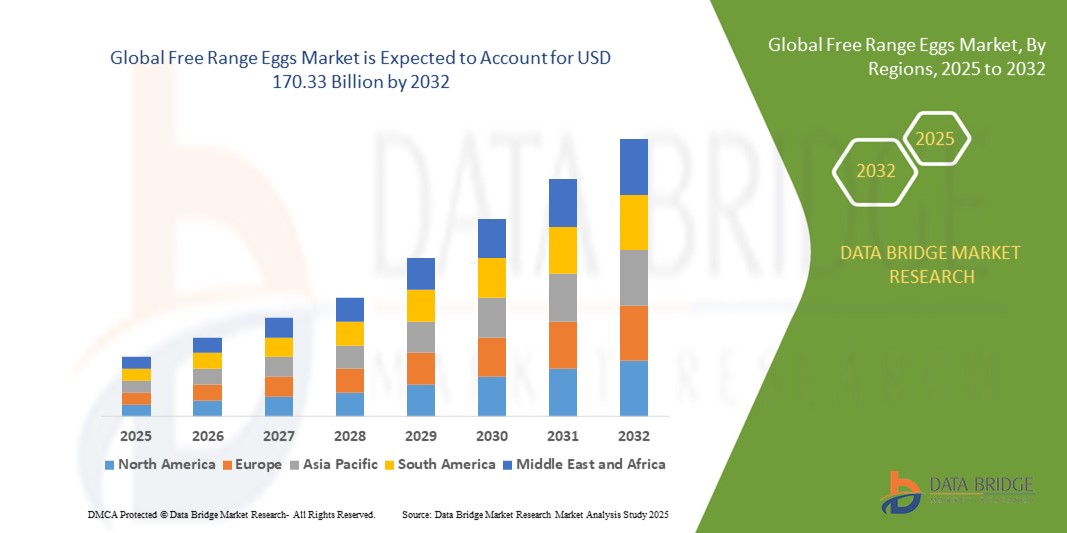
What is the Global Free Range Eggs Market Size and Growth Rate?
- The global free range eggs market size was valued at USD 110.99 billion in 2024 and is expected to reach USD 170.33 billion by 2032, at a CAGR of5.5% during the forecast period
- The increased cost of production, maintenance of free-range eggs and the presence of substitutes are expected to hamper the expansion of the free-range eggs market
- In addition, the aggregate endeavors from the public authority and administrative experts on the poultry business to supply cage free eggs and various health benefits from the eggs will create ample opportunities for free range eggs market
What are the Major Takeaways of Free-Range Eggs Market?
- The rise in the interest of the customer for eggs with relatively greater size and higher nutritive worth is a major factor expected to the boost the growth of the free-range eggs market in the forecast period of 2025 to 2032
- Furthermore, the rise in mindfulness is regarded as the medical advantage of free-range eggs over ordinary eggs, increase in the popularity of free-range eggs from the poultry business, and increasing significant advantage of free-range eggs are also expected to fuel the expansion of free-range eggs market in the above-mentioned forecast period
- Europe dominated the global free range eggs market with the largest revenue share of 38.5% in 2024, driven by strong regulatory support for sustainable sourcing, high consumer awareness of ethical consumption, and well-established retail infrastructure promoting Fairtrade-certified products
- Asia-Pacific free range eggs market is poised to grow at the fastest CAGR of 9.5% during the forecast period 2025–2032, driven by rising urbanization, growing disposable incomes, and increasing consumer awareness of ethical and sustainable products
- The coffee segment dominated the market with the largest revenue share of 38.5% in 2024, driven by the global preference for ethically sourced coffee and increasing awareness of Fairtrade-certified products among consumers
Report Scope and Free-Range Eggs Market Segmentation
|
Attributes |
Free Range Eggs Key Market Insights |
|
Segments Covered |
|
|
Countries Covered |
North America
Europe
Asia-Pacific
Middle East and Africa
South America
|
|
Key Market Players |
|
|
Market Opportunities |
|
|
Value Added Data Infosets |
In addition to the insights on market scenarios such as market value, growth rate, segmentation, geographical coverage, and major players, the market reports curated by the Data Bridge Market Research also include in-depth expert analysis, pricing analysis, brand share analysis, consumer survey, demography analysis, supply chain analysis, value chain analysis, raw material/consumables overview, vendor selection criteria, PESTLE Analysis, Porter Analysis, and regulatory framework. |
What is the Key Trend in the Free Range Eggs Market?
Rising Demand for Ethical and Sustainable Consumption
- A major and accelerating trend in the global free range eggs market is the growing consumer preference for ethically produced, sustainable, and socially responsible products. Certifications such as Fairtrade and organic labeling ensure that farmers and workers receive fair wages and operate under ethical conditions, which resonates strongly with socially conscious buyers
- For instance, companies such as Eggland’s Best and The Lakes Free Range Egg Company are increasingly highlighting ethical sourcing and sustainable farming practices in their product lines, attracting environmentally aware consumers
- Increasing awareness of climate change, animal welfare, and labor practices has made sustainability a key purchasing factor. Free Range and certified eggs provide transparency in sourcing, ensuring environmental and social accountability
- Retailers and online platforms are emphasizing ethically sourced eggs to meet consumer demand, with dedicated sections in supermarkets across Europe, North America, and Australia
- This trend is reshaping consumer expectations, encouraging companies to align operations with ESG (Environmental, Social, and Governance) principles, enhancing both market share and brand loyalty
What are the Key Drivers of Free Range Eggs Market?
- The rising consumer preference for ethically produced and sustainable food products is a primary driver of market growth. Awareness of fair wages, animal welfare, and environmentally responsible practices is shaping purchasing decisions globally
- For instance, in March 2023, Nestlé U.K. & Ireland expanded Fairtrade-certified coffee and cocoa sourcing, reinforcing its commitment to responsible supply chains and strengthening its brand positioning, reflecting wider trends in ethical food sourcing
- Growing demand for organic and natural food products, particularly in developed regions, supports Free Range and ethically certified egg consumption. Consumers perceive these certifications as a mark of authenticity and sustainability, enabling premium pricing
- Expansion of retail and e-commerce channels focusing on ethical consumption, alongside advocacy from NGOs and sustainability organizations, is accelerating market penetration
- Younger demographics, especially millennials and Gen Z, are emerging as key consumers, prioritizing transparency and sustainability, ensuring long-term market momentum for free range eggs
Which Factor is Challenging the Growth of the Free Range Eggs Market?
- A major challenge in the free range eggs market is the higher price point of certified eggs compared to conventional alternatives. Compliance with certification standards and ethical practices often increases production costs, limiting affordability for price-sensitive consumers.
- For instance, Fairtrade-certified eggs and related products often retail at a premium, restricting adoption in markets with lower disposable incomes
- Limited consumer awareness in emerging economies hampers growth, as many buyers are unfamiliar with certifications such as Fairtrade and their long-term benefits, reducing willingness to pay extra
- Supply chain complexities and certification costs may also discourage smaller producers from entering the system, limiting product availability and diversity
- Overcoming these challenges will require consumer education campaigns, government support for sustainable sourcing, and initiatives to make certifications more accessible and affordable. Addressing these barriers can expand market reach and strengthen the impact of ethical consumption globally
How is the Free-Range Eggs Market Segmented?
The market is segmented on the basis of color, size, and distribution channel.
- By Color
On the basis of color, the free range eggs market is segmented into white and brown eggs. The brown eggs segment dominated the market with the largest revenue share of 62% in 2024, driven by consumer perception that brown eggs are more natural, wholesome, and nutritious. In regions such as Europe, North America, and parts of Asia, brown eggs are often preferred for their association with traditional, free-range farming practices and ethical production methods. Brown eggs are commonly highlighted in Fairtrade and organic certifications, further enhancing consumer trust and willingness to pay a premium.
The white eggs segment is expected to witness the fastest CAGR of 20% from 2025 to 2032, fueled by growing awareness of their nutritional equivalence to brown eggs and increasing adoption in commercial baking, food processing, and hospitality industries. White eggs’ affordability and availability across retail and online channels are expanding their consumption globally.
- By Size
On the basis of size, the free range eggs market is segmented into small, medium, extra-large, jumbo, and others. The medium-sized eggs segment accounted for the largest market revenue share of 45% in 2024, driven by widespread consumer preference for standard-sized eggs suitable for daily household consumption and convenient packaging. Medium eggs are popular in supermarkets and online platforms, balancing affordability with nutritional value, and are frequently promoted under ethical and sustainable certifications.
The jumbo-sized eggs segment is projected to witness the fastest CAGR of 22% from 2025 to 2032, as consumers increasingly seek larger eggs for premium culinary applications, bakeries, and specialty products. The growing interest in protein-rich diets, meal prep, and gourmet cooking is contributing to higher adoption of jumbo eggs in both developed and emerging markets.
- By Distribution Channel
On the basis of distribution channel, the free range eggs market is segmented into store-based and non-store-based channels. The store-based segment dominated the market with the largest revenue share of 68% in 2024, driven by the prevalence of supermarkets, hypermarkets, and retail chains with dedicated Fairtrade and ethically sourced product sections. Store-based channels allow consumers to inspect packaging, verify certifications, and assess freshness, which strongly influences purchase decisions.
The non-store-based segment is expected to witness the fastest CAGR of 24% from 2025 to 2032, fueled by the rapid growth of e-commerce, direct-to-consumer subscriptions, and online marketplaces. Increasing digital literacy, convenience, targeted social media marketing, and partnerships between online retailers and Fairtrade-certified brands are accelerating adoption in emerging markets and urban centers, expanding the reach of Free Range Eggs globally.
Which Region Holds the Largest Share of the Free-Range Eggs Market?
- Europe dominated the global free range eggs market with the largest revenue share of 38.5% in 2024, driven by strong regulatory support for sustainable sourcing, high consumer awareness of ethical consumption, and well-established retail infrastructure promoting Fairtrade-certified products
- Consumers in the region highly value product traceability, ethical sourcing, and the environmental and social benefits associated with Fairtrade and organic certifications
- This widespread adoption is further supported by high disposable incomes, strong urbanization, and extensive advocacy campaigns, establishing Fairtrade eggs as a preferred choice for residential, commercial, and hospitality sectors
U.K. Free Range Eggs Market Insight
In the U.K., the free range eggs market captured the largest revenue share within Europe in 2024. Growth is fueled by rising consumer awareness of sustainability, ethical sourcing, and animal welfare. Retailers, supermarkets, specialty stores, and online platforms are actively promoting certified Fairtrade products. Government initiatives and NGO campaigns educating consumers on ethical food production further boost adoption. Urban populations, cafés, and premium retail outlets increasingly offer Fairtrade-certified eggs. The focus on premium, traceable, and environmentally responsible products aligns with consumer demand for transparency. Overall, the U.K. market demonstrates strong potential for sustained growth driven by ethical consumption trends.
Germany Free Range Eggs Market Insight
In Germany, the free range eggs market is witnessing notable growth due to heightened consumer emphasis on ethical sourcing, fair trade, and sustainability. Retail chains, cafés, and online platforms are expanding certified product offerings, while government policies support sustainable agriculture and social responsibility. Awareness campaigns highlighting environmental and social benefits are boosting adoption in urban and semi-urban areas. Consumers are increasingly willing to pay a premium for traceable, high-quality eggs, strengthening Germany’s position as a key growth hub for Free Range Eggs in Europe.
Which Region is the Fastest Growing Region in the Free Range Eggs Market?
Asia-Pacific free range eggs market is poised to grow at the fastest CAGR of 9.5% during the forecast period 2025–2032, driven by rising urbanization, growing disposable incomes, and increasing consumer awareness of ethical and sustainable products. Government initiatives promoting fair trade certification and sustainable agriculture are supporting market adoption.
Japan Free Range Eggs Market Insight
In Japan, the free range eggs market is gaining momentum due to growing health consciousness, urban lifestyles, and a preference for ethically sourced food. Supermarkets, specialty stores, and online platforms are expanding Fairtrade product availability. Consumers increasingly value transparency, environmental responsibility, and social impact. Government programs promoting sustainable agriculture and corporate social responsibility further enhance adoption. E-commerce platforms and subscription services improve accessibility, particularly in urban areas. The growing presence of cafés and retail outlets offering Fairtrade-certified eggs positions Japan as a fast-growing market in Asia-Pacific, driven by rising consumer demand for high-quality, ethically produced products.
China Free Range Eggs Market Insight
In China, the free range eggs market accounted for the largest revenue share in Asia-Pacific in 2024. Growth is fueled by rapid urbanization, an expanding middle class, and increasing awareness of ethical consumption. Online marketplaces and e-commerce platforms are key drivers of accessibility, enabling consumers in urban and semi-urban areas to purchase Fairtrade-certified eggs. Retail chains, cafés, and specialty stores are actively adopting ethically sourced products. Government policies supporting sustainable agriculture and ethical food production further promote market expansion. Rising disposable incomes and growing interest in socially responsible products are expected to sustain rapid growth across the region.
Which are the Top Companies in Free Range Eggs Market?
The free range eggs industry is primarily led by well-established companies, including:
- Cal-Maine Foods, Inc. (U.S.)
- Weaver Bros., Inc. (U.S.)
- Herbruck's Poultry Ranch, Inc. (U.S.)
- The Lakes Free Range Egg Company (U.K.)
- Eggland’s Best, LLC (U.S.)
- Rembrandt Enterprises (U.S.)
- Rose Acre Farms (U.S.)
- Sunny Queen Farms Pty Ltd. (Australia)
- Hillandale Farms (U.S.)
- Trillium Farms (U.S.)
- Farm Pride (Australia)
- Avril Group (France)
- Granja Agas S.A. (Brazil)
What are the Recent Developments in Global Free Range Eggs Market?
- In June 2022, ISE Food Inc., one of Japan’s leading egg producers, announced its expansion into the Indian market by launching products across several retail channels, aiming to cater to the growing demand for eggs in India, marking a strategic move to strengthen its international presence
- In March 2022, Cal-Maine Foods, Inc., a major global egg producer, announced a USD 82 million investment to expand its cage-free egg production capacity, which includes four new cage-free houses and two pullet houses capable of supporting approximately 810,000 hens, highlighting its commitment to meeting the rising consumer preference for organic and cage-free products
- In November 2021, New Barn Organics, in collaboration with NestFresh Eggs, launched Regenerative Organic Certified Pasture Raised Eggs, emphasizing the companies’ dedication to sustainability and environmentally responsible farming practices, further strengthening their position in the premium egg segment
- In February 2021, Good Eggs, a grocery delivery startup, secured USD 100 million in funding to expand operations in Southern California, aiming to enhance market reach and online egg distribution, supporting the growing demand for convenient and fresh grocery delivery services

- Interactive Data Analysis Dashboard
- Company Analysis Dashboard for high growth potential opportunities
- Research Analyst Access for customization & queries
- Competitor Analysis with Interactive dashboard
- Latest News, Updates & Trend analysis
- Harness the Power of Benchmark Analysis for Comprehensive Competitor Tracking
Global Free Range Eggs Market, Supply Chain Analysis and Ecosystem Framework
To support market growth and help clients navigate the impact of geopolitical shifts, DBMR has integrated in-depth supply chain analysis into its Global Free Range Eggs Market research reports. This addition empowers clients to respond effectively to global changes affecting their industries. The supply chain analysis section includes detailed insights such as Global Free Range Eggs Market consumption and production by country, price trend analysis, the impact of tariffs and geopolitical developments, and import and export trends by country and HSN code. It also highlights major suppliers with data on production capacity and company profiles, as well as key importers and exporters. In addition to research, DBMR offers specialized supply chain consulting services backed by over a decade of experience, providing solutions like supplier discovery, supplier risk assessment, price trend analysis, impact evaluation of inflation and trade route changes, and comprehensive market trend analysis.
Data collection and base year analysis are done using data collection modules with large sample sizes. The stage includes obtaining market information or related data through various sources and strategies. It includes examining and planning all the data acquired from the past in advance. It likewise envelops the examination of information inconsistencies seen across different information sources. The market data is analysed and estimated using market statistical and coherent models. Also, market share analysis and key trend analysis are the major success factors in the market report. To know more, please request an analyst call or drop down your inquiry.
The key research methodology used by DBMR research team is data triangulation which involves data mining, analysis of the impact of data variables on the market and primary (industry expert) validation. Data models include Vendor Positioning Grid, Market Time Line Analysis, Market Overview and Guide, Company Positioning Grid, Patent Analysis, Pricing Analysis, Company Market Share Analysis, Standards of Measurement, Global versus Regional and Vendor Share Analysis. To know more about the research methodology, drop in an inquiry to speak to our industry experts.
Data Bridge Market Research is a leader in advanced formative research. We take pride in servicing our existing and new customers with data and analysis that match and suits their goal. The report can be customized to include price trend analysis of target brands understanding the market for additional countries (ask for the list of countries), clinical trial results data, literature review, refurbished market and product base analysis. Market analysis of target competitors can be analyzed from technology-based analysis to market portfolio strategies. We can add as many competitors that you require data about in the format and data style you are looking for. Our team of analysts can also provide you data in crude raw excel files pivot tables (Fact book) or can assist you in creating presentations from the data sets available in the report.